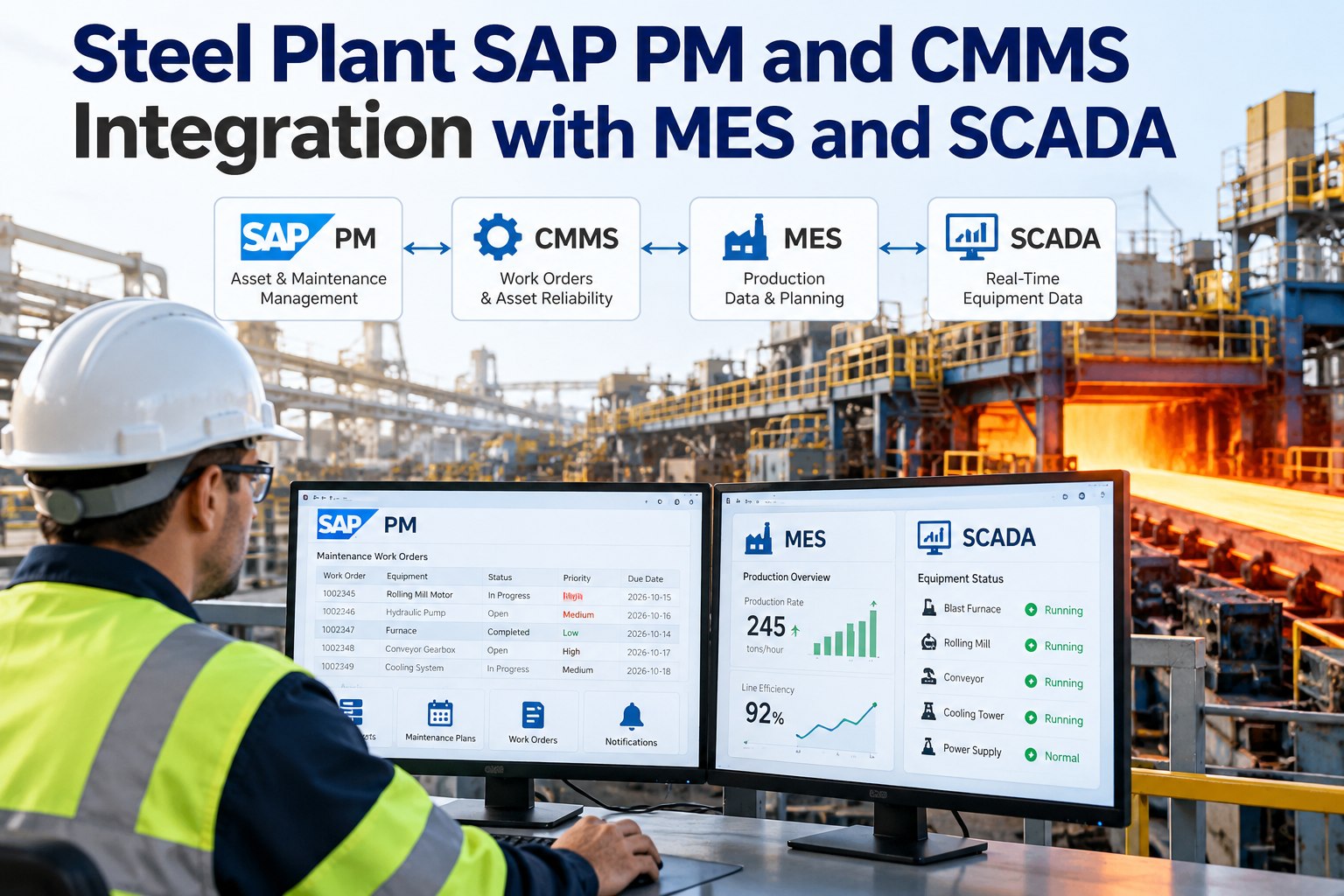
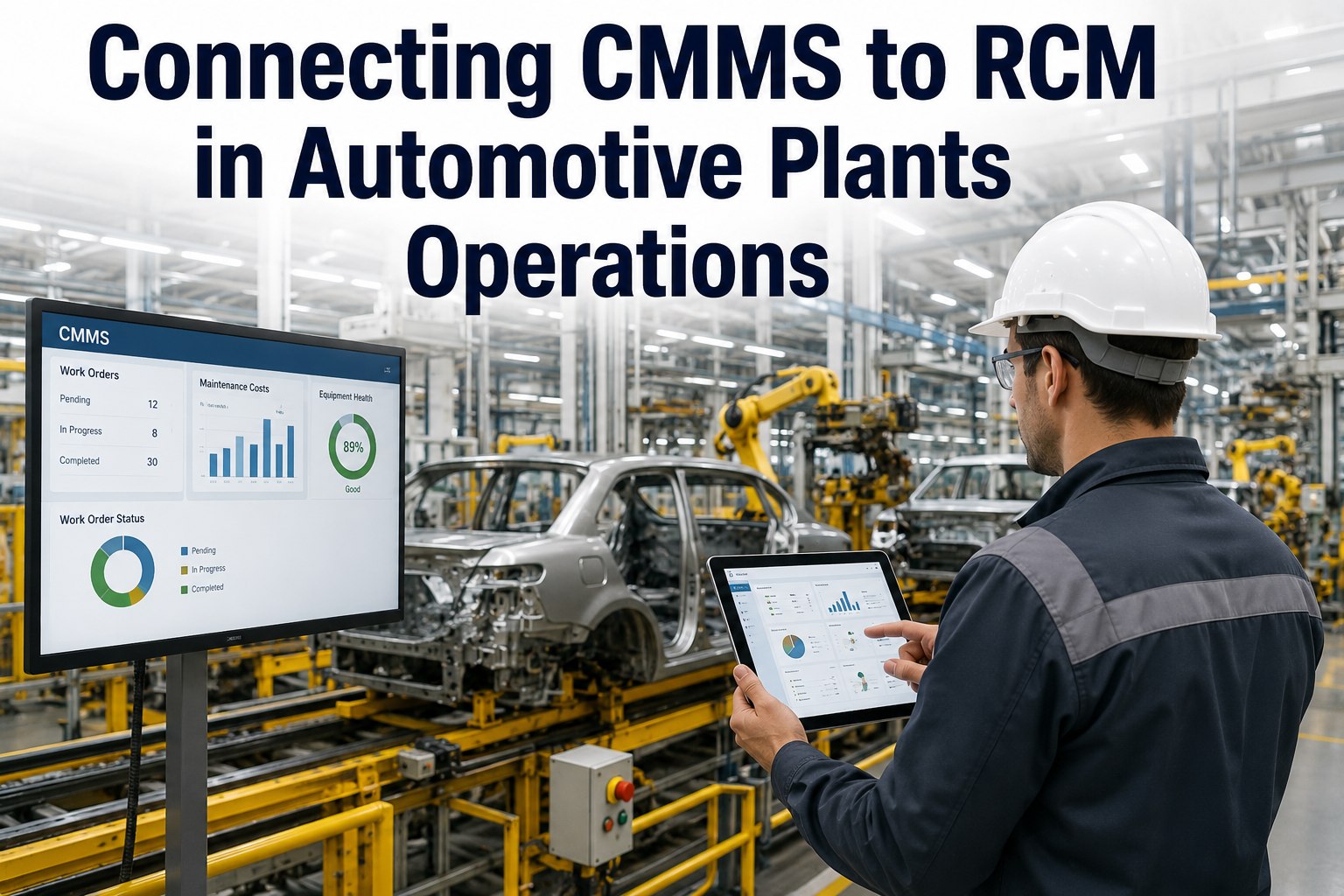
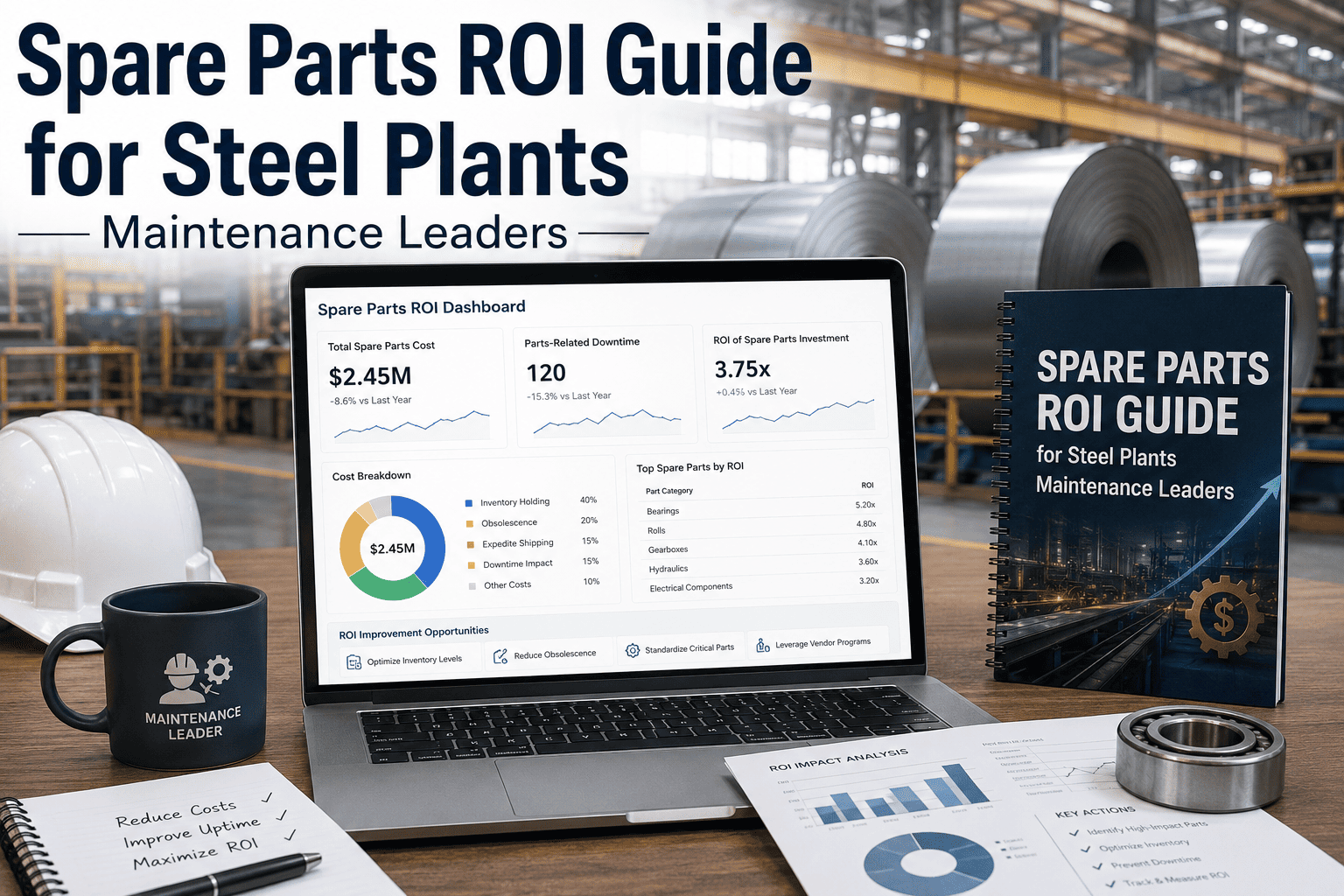
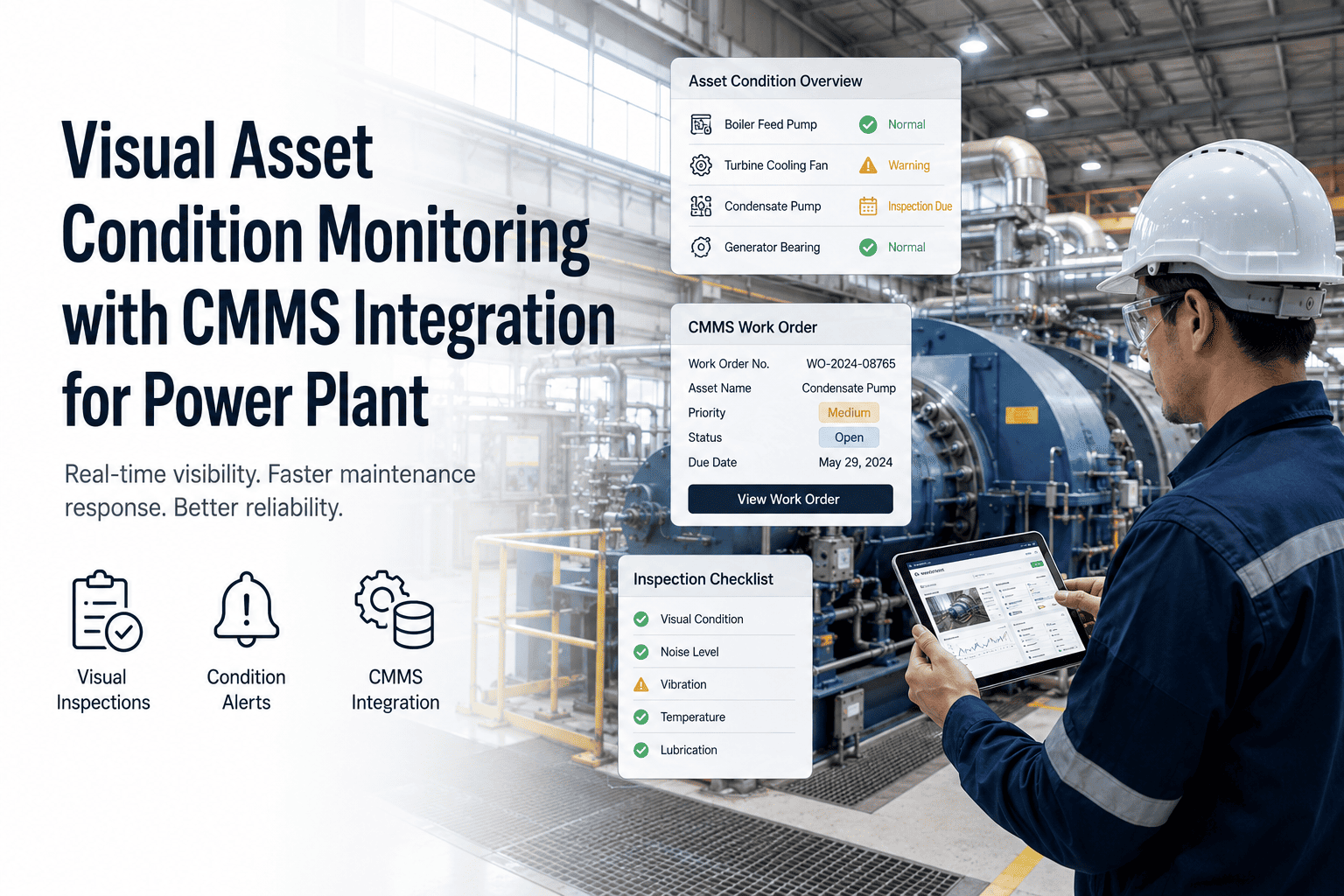
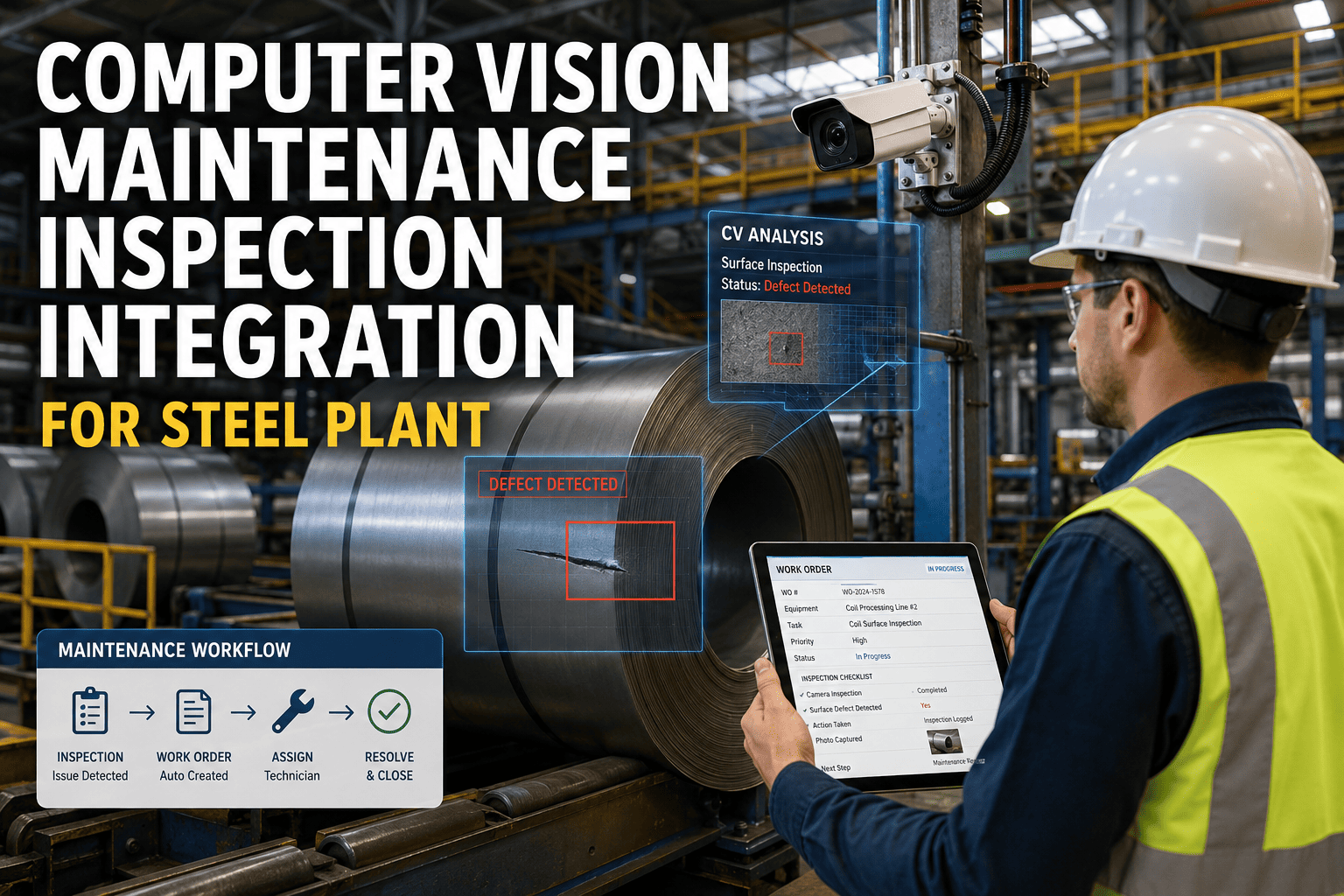
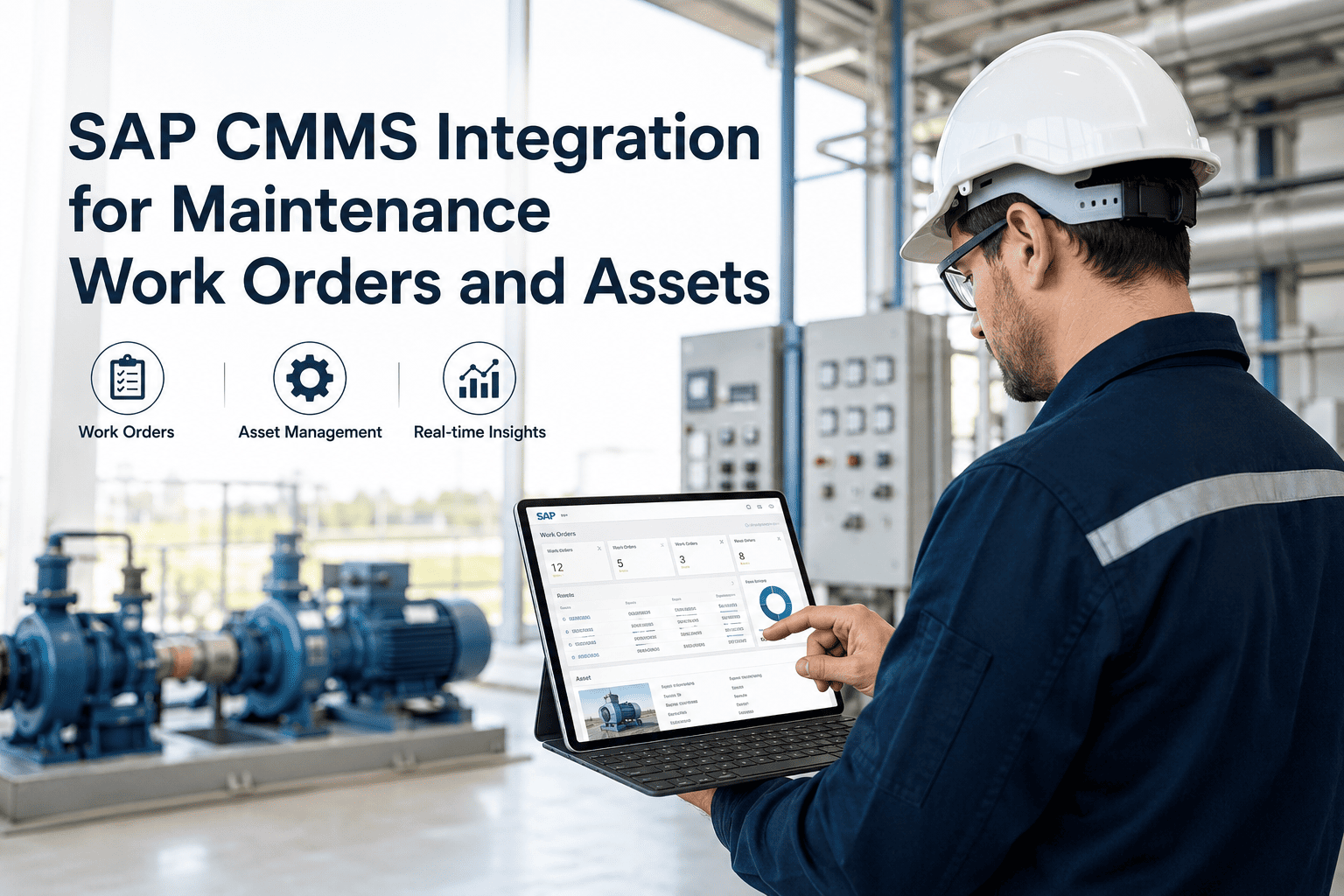
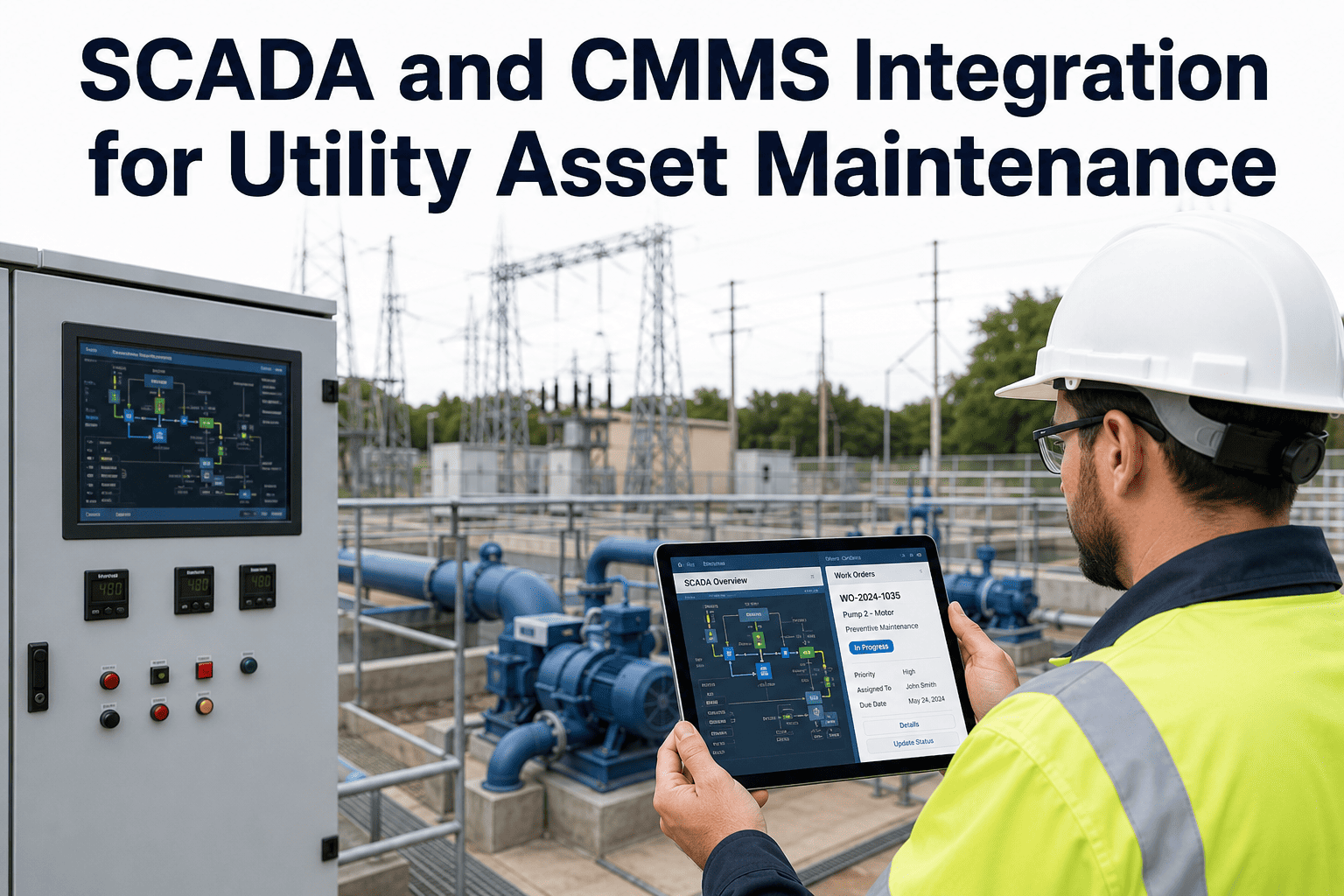
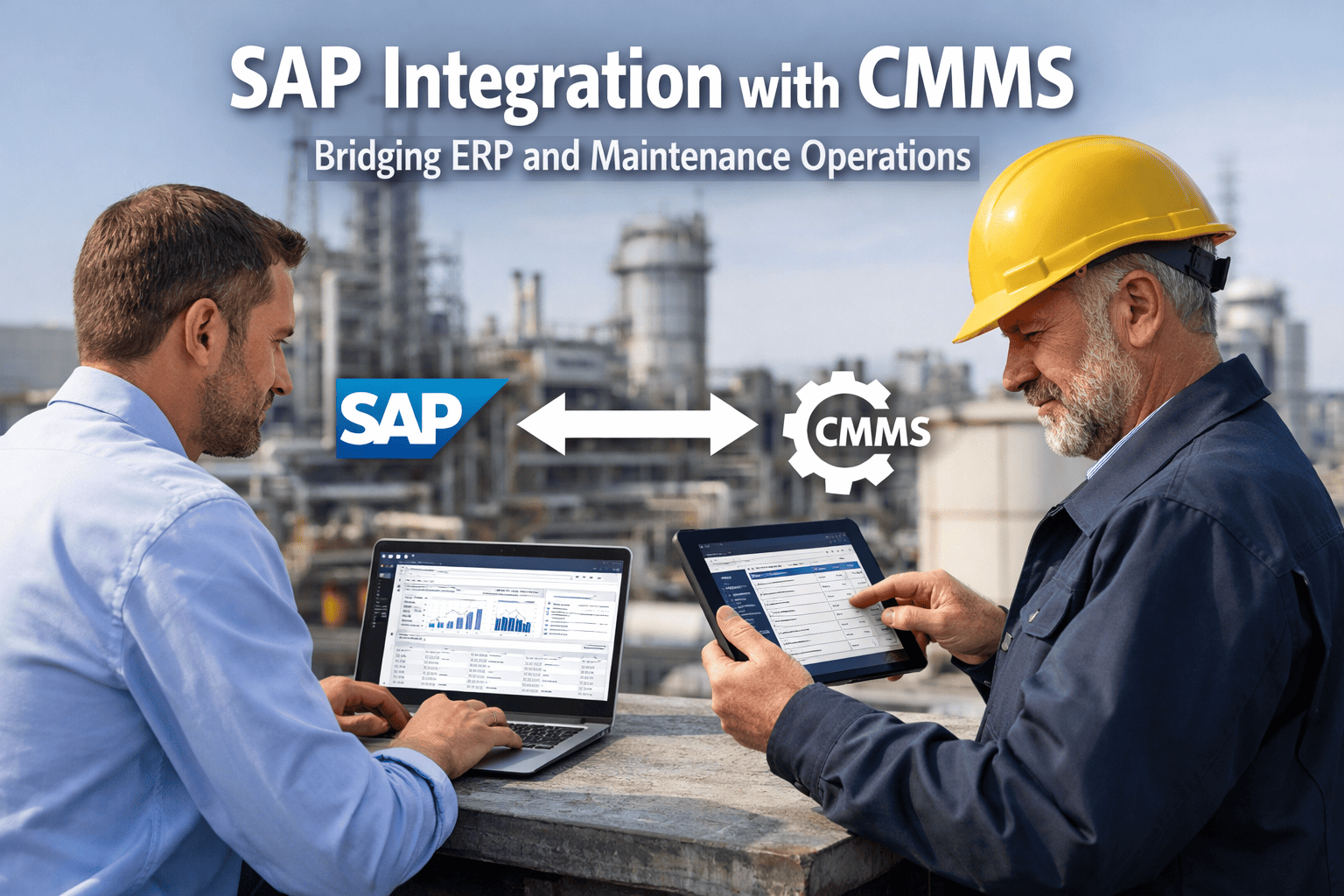
A modern steel plant runs on four systems that were never designed to talk to each other SCADA on the floor, MES above it, SAP PM for the formal maintenance record, and a CMMS layer the technicians actually use. When they don't share one thread, an EAF heat anomaly caught by SCADA at 02:14 becomes a maintenance notification somebody files at 11:00 the next morning. OXMAINT AI is the AI-powered CMMS and maintenance management software built to run as the execution layer between the plant floor and SAP PM — so the signal from SCADA, the context from MES and the notification in SAP are the same event, not three.
STEEL PLANT · SAP PM + CMMS + MES + SCADA INTEGRATION · GUIDE 2026
Steel Plant SAP PM and CMMS Integration with MES and SCADA
Four systems. Four owners. Four inboxes. The result is a maintenance workflow where a tapped-out furnace, a stuck mould oscillator or a hot-saw drive fault takes hours to become a work order, days to become a notification, and weeks to become a reliability lesson. The OXMAINT AI software sits as the integration-aware execution layer: it reads the signal, inherits the production context, raises the work order the team actually acts on, and posts the formal notification back to SAP PM — one event, one chain.
SSCADA
↔
MMES
↔
CCMMS
↔
ESAP PM
4
systems on every modern steel plant stack — SCADA, MES, CMMS, SAP PM — and only one audit trail should survive
ISA-95
reference model for OT/IT integration (L0 field → L4 business) is the architectural map steel plants work against
M1/M2/M3
SAP PM notification types — malfunction, activity, request — are what the CMMS layer must post back cleanly
1
heat ID, cast ID or coil ID is the common key that stitches a maintenance event back to the production that caused it
The Four-Layer Architecture Map
The ISA-95 reference model gives steel plants the only serious architectural language for OT/IT integration — and every well-run integration project draws itself against it. OXMAINT AI is designed to sit at Level 3 as the maintenance-execution system that bridges the Level 2 control layer and the Level 4 SAP PM record of truth — schedule a walkthrough of the Level 2/3/4 map in OXMAINT AI.
L4
Business Planning — SAP ERP + SAP PM
Formal maintenance notifications (M1 malfunction, M2 activity, M3 request), work orders, spares procurement, cost accounting, equipment master record.
SAP ECC / S/4HANASAP PMMM (spares)
↑ notifications, cost postings ↓ equipment master, orders
L3
Operations Management — MES + CMMS Execution
Production execution, heat/cast/coil genealogy, OEE, batch tracking, shop-floor work order dispatch, mobile technician execution, condition-based triggers.
MES (Level 3)OXMAINT AI (CMMS)Mobile execution
↑ events, condition triggers, heat IDs ↓ recipes, work-order dispatch
L2
Supervisory Control — SCADA / DCS / Historian
Real-time control loops, HMIs, alarm management, process historian (tag data), PLC supervision, interlocks.
SCADADCSProcess Historian
↑ alarms, process variables ↓ setpoints, control signals
L0–L1
Field & Sensing — PLCs, Instruments, Drives
Transmitters, actuators, drives, thermocouples, load cells, vibration sensors, VFD fault codes — the physics of the plant.
PLCVFDsInstruments
SAP PM vs CMMS: Who Owns What
The most common integration failure is unclear ownership. SAP PM holds the formal record, the spares and the cost; the CMMS layer runs the mobile execution and the condition-based triggers. When both try to do everything, techs enter data twice and nothing reconciles. OXMAINT AI holds the division-of-responsibility explicit, so each system does what it is best at.
Function
SAP PM
OXMAINT AI (CMMS)
Equipment master record
System of record
Read-only mirror; synced nightly
Condition-based trigger
—
Reads SCADA tags & raises defect
Notification (M1/M2/M3)
Receives from CMMS; formal record
Raises on event; posts to SAP PM
Work order dispatch
High-level order shell & cost
Mobile dispatch, step-by-step execution
Spares & MRO
MM / inventory system of record
Reservation requests & consumption posting
Technician execution
Confirmation posting
Mobile checklists, photos, measurements
Cost & financial posting
System of record (CO / FI)
Labor hours & part consumption sent for posting
The Data Payloads That Have to Flow
An integration isn't done when systems can see each other; it's done when the right payload lands at each hop. SCADA pushes alarms and tag values; MES hands over production context (heat ID, operator, cast number); OXMAINT AI stitches them to the equipment and raises the maintenance event; SAP PM receives the formal notification and returns the order number. One event, four systems informed — start free and set up the integration payload map in OXMAINT AI.
SCADA
→
MES / CMMS
Payload: alarm tag, equipment ID, timestamp, severity, measured value, acknowledgement state
MES
→
OXMAINT AI
Payload: heat ID / cast ID / coil ID, operator, product grade, running recipe, downtime reason code
OXMAINT AI
→
SAP PM
Payload: M1/M2/M3 notification, equipment number, functional location, long text, defect code, priority
SAP PM
→
OXMAINT AI
Payload: work order number, order type, cost centre, planner, scheduled start, status
OXMAINT AI
→
SAP PM + MES
Payload: confirmation posting (labor hrs, parts consumed, measurement readings, return-to-service time)
Three Systems Can See the Event. Only One Should Own It.
Clear ownership is what separates a working integration from a round-robin of duplicate tickets. The OXMAINT AI maintenance management software is designed as the Level 3 execution owner — SCADA remains the eyes, MES the production brain, SAP PM the financial record, and OXMAINT AI the single hand that turns the event into a closed work order.
Four Steel-Plant Use Cases That Depend On This Chain
The integration pattern isn't academic. Every major steel-plant work front has a specific chain that collapses when the four systems aren't speaking. Below are four of the highest-value flows OXMAINT AI runs end-to-end.
EAF / BOF
Heat-anomaly to work order
SCADA flags an electrode or oxygen-lance anomaly during a heat. MES tags the heat ID; OXMAINT AI raises the defect against the electrode arm with heat context attached; SAP PM gets the M1 notification with cost center.
CONTINUOUS CASTER
Mould oscillator fault
Oscillator vibration climbs mid-cast. SCADA alarms; MES correlates to the cast ID and strand; OXMAINT AI opens a condition-based work order tied to the mould assembly; SAP PM holds the cost history for the next refurb cycle.
HOT & COLD ROLLING
Mill drive fault code
A rolling-mill VFD throws a fault code. The historian captures it; MES ties it to the coil in process; OXMAINT AI raises a dispatch to the on-shift electrical crew with the drive's prior fault history; SAP PM accrues the labor and parts.
OVERHEAD CRANES
Duty-cycle PM trigger
Hoist cycle counts from the crane PLC accumulate. OXMAINT AI triggers wire-rope inspection PMs at ISO 4309 thresholds, raises them against the crane in SAP PM, and holds the inspection evidence against the equipment master.
Three Integration Patterns — Pick One, Stick With It
Steel plants typically choose from three integration patterns. Each has trade-offs in build cost, flexibility and ongoing ownership. OXMAINT AI supports all three; the right one depends on how heterogeneous the OT estate is and how disciplined the enterprise architecture team is.
01 · ISA-95 Vertical B2MML
Formal, standardized B2MML messages between L2, L3 and L4. Highest discipline, slowest to build, best long-term maintainability. Right for greenfield or regulated plants.
Best fit: new builds, regulated grades, multi-site rollouts
02 · Unified Namespace (MQTT/OPC UA)
A central broker where every system publishes/subscribes against a shared tag tree. Flexible, modern, scales well with new sensors. Right for plants adding IIoT in waves.
Best fit: brownfield modernization, phased IIoT rollout
03 · Point-to-Point APIs
Direct SCADA↔CMMS, CMMS↔SAP PM, MES↔CMMS APIs. Fastest to launch, hardest to maintain as endpoints grow. Right for narrow pilots or a short list of flows.
Best fit: pilot projects, 1-2 priority use cases
The Integration Readiness Checklist
Before the first interface is written, these items need to be true. Each one looks procedural; collectively they decide whether the integration delivers on its promise or becomes another layer of IT debt.
How the OXMAINT AI Software Runs the Integration
The four-layer map, the SAP PM division-of-responsibility, the SCADA tag read, the heat-ID context stitching and the SAP notification post-back are all features the OXMAINT AI maintenance management software was built to run on steel plants — spin up a free account and connect your first SCADA feed to OXMAINT AI.
Historian / SCADA Tag Read
OXMAINT AI reads alarms and process variables from the historian, OPC UA or MQTT — never writes back into the control layer, so OT security is preserved.
MES Context Stitching
Heat ID, cast ID, coil ID and operator pulled from MES and attached to every defect raised — so the root cause has production context, not just equipment context.
SAP PM Notification Loop
M1 malfunction, M2 activity and M3 request notifications posted to SAP PM with equipment number, functional location and defect code already populated.
Equipment Master Sync
SAP PM functional-location hierarchy mirrored into the CMMS asset register nightly — one source of truth, no duplicate entry.
Mobile Execution Layer
Technicians dispatch, execute and confirm from a phone against the SAP work order number — closeout postings flow back automatically.
Daily Reconciliation
OXMAINT AI runs a reconciliation report between CMMS and SAP PM every night — mismatches surface before they become an audit finding.
Frequently Asked Questions
Do we replace SAP PM when we add a CMMS layer?
No — SAP PM stays as the system of record for equipment master, formal notifications, spares (MM) and cost. OXMAINT AI runs the Level 3 execution layer that triggers condition-based events, dispatches techs, and posts the formal notification back to SAP PM.
Start free and set up the SAP PM integration in OXMAINT AI.
Where does the OXMAINT AI software sit in the ISA-95 model?
Level 3 — operations management, alongside the MES. It reads up from the Level 2 historian/SCADA, exchanges context with the MES, and interfaces to Level 4 SAP PM for the formal maintenance record.
Which integration pattern should we pick for a brownfield steel plant?
A unified namespace on MQTT or OPC UA is usually the right pattern for brownfield modernization — a central broker scales as new sensors arrive without rebuilding every point-to-point link. OXMAINT AI subscribes on the same broker, so no custom integration per source.
Does the CMMS write back into SCADA?
No, and it shouldn't. OT security requires a one-way boundary: the CMMS reads from the historian and the SCADA alarm stream but never issues setpoints or commands downward. OXMAINT AI respects that boundary by design.
How quickly can a steel plant have this running?
A first-wave rollout covering one work front — EAF, caster, rolling mill or cranes — typically takes 8-12 weeks from kickoff to live SAP PM notifications. Multi-front rollout follows in waves. Book a walkthrough and the OXMAINT AI team will scope your window.
One Event. One Chain. Four Systems Informed.
Run the integration between SCADA, MES, OXMAINT AI and SAP PM on one execution layer — condition triggers caught at Level 2, production context stitched at Level 3, notifications posted to Level 4, and the technician closing from a phone on the mill floor. The OXMAINT AI maintenance management software is built to be that layer.