Distribution centers are 24/7 engines of commerce — and when their equipment fails, the entire supply chain feels it within hours. The warehouse automation market grew from $21.42 billion in 2024 to $24.09 billion in 2025 at 12.4% annual growth, and is on track to surpass $42 billion by 2029. Yet behind every automated sortation line, every forklift fleet, and every miles-long conveyor network sits a maintenance operation that determines whether those assets deliver their promised ROI or become sources of costly unplanned downtime. Unplanned equipment downtime costs Fortune 500 companies an average of $2.8 billion annually — roughly 11% of revenue — and the mean time to repair has increased from 49 minutes to 81 minutes driven by skills gaps and parts supply delays. In warehousing specifically, 89% of distribution centers rely on racking and shelving systems, 85% depend on forklifts, and labor costs consume 50–70% of the total warehousing budget, meaning any equipment failure that idles workers multiplies costs instantly. Predictive maintenance can reduce maintenance costs by up to 25% and increase uptime by 10–20%, yet adoption actually decreased slightly from 30% in 2024 to 27% in 2025, leaving the majority of warehouses exposed to preventable failures. Sign up for Oxmaint to bring every warehouse asset — from dock levelers to automated sortation — into a single digital maintenance platform with scheduled inspections, automated work orders, and real-time equipment health visibility.
Article
Warehouse Maintenance Management: Keeping Distribution Centers Running
Equipment strategies, zone-by-zone maintenance plans, and CMMS implementation for warehouse and distribution center operations
$24B
Warehouse automation market in 2025, projected to reach $42B+ by 2029
$2.8B
Average annual cost of unplanned downtime for Fortune 500 companies
65%
Of companies now using a CMMS to manage maintenance and optimize costs
81 min
Average mean time to repair in 2025 — up from 49 min due to skills and parts gaps
Why Warehouse Maintenance Demands a Different Approach
Warehouses are not factories. They operate on razor-thin margins with extreme throughput pressure, seasonal demand spikes that double or triple volume overnight, a workforce that ranges from highly skilled equipment operators to temporary seasonal staff, and a facility footprint measured in hundreds of thousands of square feet with assets spread across receiving docks, storage aisles, pick zones, packing stations, and shipping bays. A maintenance strategy designed for a single production line does not translate to this environment. Warehouse maintenance must be zone-aware, equipment-diverse, and responsive enough to handle a forklift breakdown during peak shipping hours without halting order fulfillment. Book a demo to see how Oxmaint organizes maintenance by warehouse zone, equipment type, and priority level — so your team always knows what matters most right now.
Zone-by-Zone Maintenance Blueprint
Every distribution center has distinct operational zones with different equipment, environmental conditions, and failure consequences. Effective warehouse maintenance plans each zone independently while coordinating across the facility through a centralized CMMS. The following blueprint covers the five critical zones present in virtually every distribution center.
Critical Equipment
Dock levelers and dock locks
Overhead dock doors and seals
Pallet jacks and receiving forklifts
Floor scales and barcode scanners
Top Failure Risks
Dock leveler hydraulic seal failure from weather exposure and heavy truck impact
Door track misalignment from repeated forklift contact
Scale calibration drift causing inventory accuracy issues
Maintenance Schedule
Daily: Dock door operation check, leveler visual inspection, forklift pre-shift walkaround
Weekly: Leveler hydraulic fluid level, door seal condition, dock light function
Monthly: Leveler lip and hinge pin inspection, door balance test, scale calibration verification
Quarterly: Full hydraulic system service, door spring tension check, dock bumper condition
Critical Equipment
Pallet racking systems (selective, drive-in, push-back)
Reach trucks and order pickers
HVAC and ventilation systems
Fire suppression sprinklers and detection
Top Failure Risks
Racking damage from forklift impact — structural collapse is a catastrophic safety risk
HVAC failure causing temperature excursion in climate-controlled storage
Lighting failure creating safety hazards in narrow aisle zones
Maintenance Schedule
Daily: Visual scan for rack damage on high-traffic aisles, forklift pre-shift check
Weekly: HVAC filter and temperature verification, emergency lighting test
Monthly: Full rack inspection per OSHA/SEMA guidelines, reach truck hydraulic check
Annually: Professional rack safety audit, fire suppression system inspection, HVAC deep service
Critical Equipment
Conveyor systems (belt, roller, spiral)
Automated sortation equipment
Pick-to-light and voice-pick systems
Autonomous mobile robots (AMRs)
Top Failure Risks
Conveyor belt mistracking and jam sensors creating throughput bottlenecks
Sortation diverter failures misdirecting packages — quality and cost impact
AMR navigation sensor failure or charging station malfunction
Maintenance Schedule
Per Shift: Conveyor belt tracking check, jam sensor test, sortation diverter cycle test
Weekly: Conveyor roller rotation check, belt tension, photo-eye sensor cleaning
Monthly: Drive motor current measurement, gearbox oil check, AMR sensor calibration
Quarterly: Full conveyor system alignment, sortation accuracy audit, AMR fleet diagnostics
Critical Equipment
Case erectors and tape machines
Stretch wrap machines and shrink tunnels
Label printers and apply systems
Weigh-in-motion scales
Top Failure Risks
Tape machine head jamming during peak volume — halts entire packing line
Label applicator misalignment causing incorrect shipping labels — costly returns
Stretch wrap film break sensor failure leading to unstable pallet loads
Maintenance Schedule
Daily: Tape head cleaning, label applicator alignment check, scale zero verification
Weekly: Stretch wrap pre-stretch roller inspection, printer head cleaning, film tension check
Monthly: Full case erector mechanical inspection, shrink tunnel element check, scale calibration
Quarterly: Complete packing line lubrication service, electrical connection inspection
Critical Equipment
Outbound dock levelers and doors
Shipping conveyor and accumulation lines
Truck loading forklifts and powered jacks
Trailer restraint and dock lock systems
Top Failure Risks
Dock lock failure allowing premature trailer departure — severe safety hazard
Accumulation conveyor jam during peak shipping window — missed carrier cutoffs
Loading forklift breakdown during carrier pickup window — shipment delays
Maintenance Schedule
Daily: Dock lock engagement test, leveler operation check, shipping conveyor run test
Weekly: Trailer restraint hook condition, accumulation line sensor verification
Monthly: Full dock leveler hydraulic service, shipping conveyor drive inspection
Quarterly: Dock safety audit including dock locks, levelers, doors, bumpers, and lighting
Organize Maintenance by Zone, Not by Crisis
Oxmaint lets you structure your entire maintenance program by warehouse zone — with zone-specific asset registers, inspection templates, and performance dashboards. Every technician sees exactly what needs attention in their area, every shift.
Warehouse Equipment Maintenance Priorities
Not all warehouse equipment carries the same failure consequence. A broken label printer slows one packing station. A failed dock leveler blocks an entire receiving bay. A conveyor system failure can halt the pick-pack-ship pipeline for the entire facility. Maintenance resources should be allocated by criticality — not by convenience or habit. Sign up for Oxmaint to assign criticality ratings to every asset and automatically prioritize work orders based on production impact.
Conveyor & Sortation Systems
Entire pick-pack-ship pipeline halts — throughput drops to zero on affected lines
Condition monitoring (vibration, thermal) + daily operational checks + predictive analytics
Critical
Dock Levelers & Doors
Receiving or shipping bay blocked — inbound or outbound operations disrupted at that dock position
Preventive maintenance on hydraulics, hinges, and seals + seasonal weatherization
Critical
Forklift & MHE Fleet
Operator idle, product movement stops in affected zone — cascading delays to upstream and downstream
Fleet PM program with daily pre-shift checks + manufacturer-interval service + battery management
Critical
HVAC & Climate Control
Temperature excursion in cold storage or climate-controlled zones — product quality risk and regulatory exposure
Continuous temperature monitoring + filter changes + refrigerant checks + seasonal service
High
Fire Suppression & Safety Systems
Regulatory non-compliance, insurance invalidation, life safety risk — operational shutdown if failed during inspection
Code-mandated inspection schedule (NFPA) + annual professional testing + monthly visual checks
High
Packing Line Equipment
Individual packing station or line slowed — can often reroute to adjacent station temporarily
Preventive maintenance on scheduled intervals + spare consumables stocked on-site
Medium
Lighting & Electrical
Safety hazard in affected zone — potential OSHA citation if below minimum lux levels
Group relamping schedule + emergency lighting monthly test + panel thermography annually
Medium
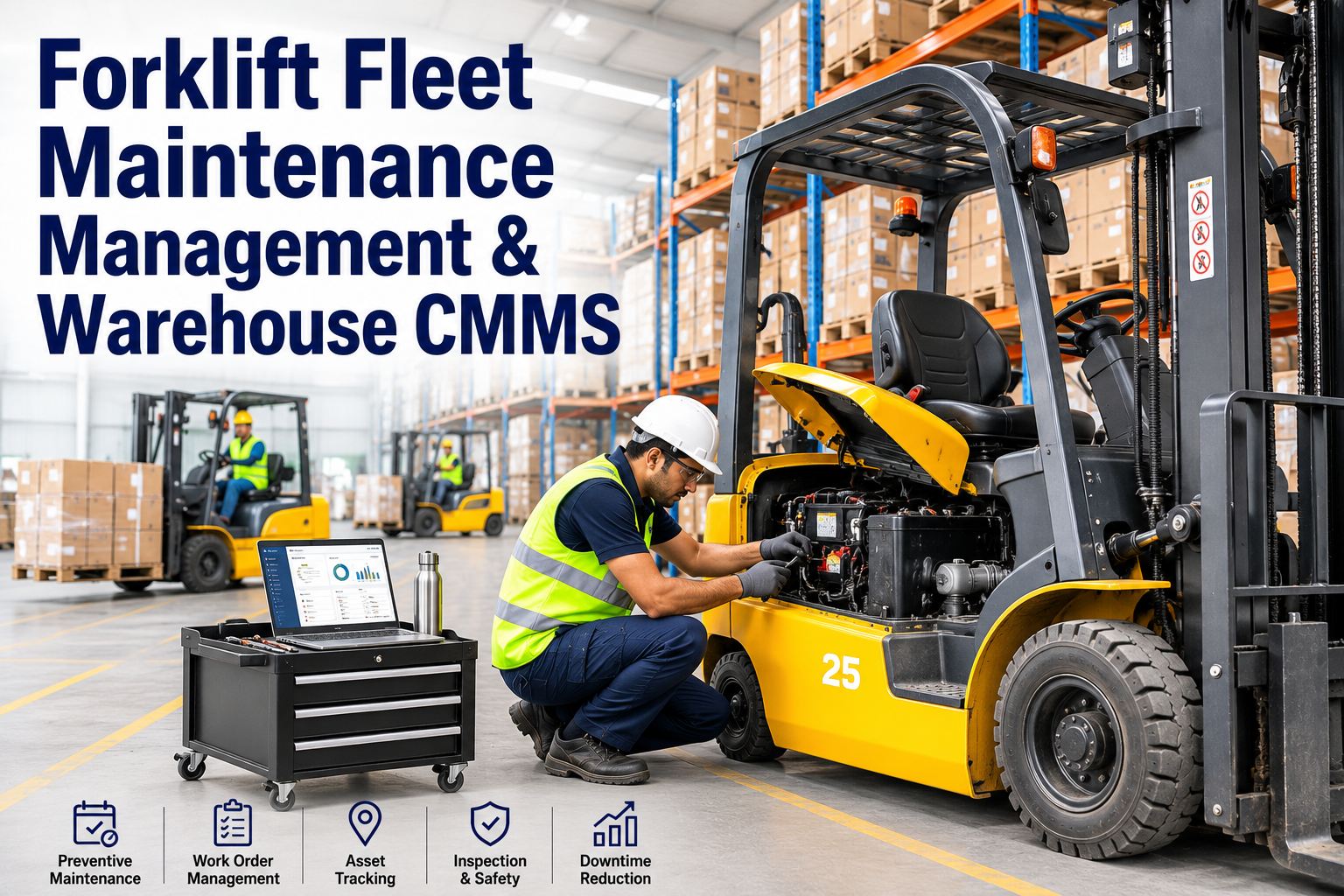
Forklift Fleet Maintenance Program
Forklifts are the single most maintenance-intensive asset category in most warehouses — and the most dangerous. With 85% of distribution centers relying on forklifts, a structured fleet maintenance program is not optional. OSHA requires daily pre-shift inspections, and the frequency of mechanical service depends on operating hours, environment, and power source (electric, LPG, diesel). Book a demo to see how Oxmaint manages forklift fleet maintenance with operator pre-shift checklists, automated service scheduling, and fleet-wide cost tracking.
Pre-Shift Operator Check (OSHA Required)
Fluid levels — hydraulic oil, engine oil/coolant (IC), battery water level (electric)
Tire condition — wear, damage, proper inflation (pneumatic) or chunking (cushion)
Fork and carriage — cracks, bending, wear on heel, locking pin condition
Mast and chains — chain tension and lubrication, mast roller condition, cylinder leaks
Brakes — service brake and parking brake function test
Horn, lights, backup alarm — all safety devices operational
Seatbelt, overhead guard — structural integrity and functionality
Scheduled Service Intervals
Every 250 hrs: Oil and filter change (IC), hydraulic filter, grease all fittings, chain lubrication
Every 500 hrs: Transmission fluid check, brake adjustment, mast chain adjustment and inspection
Every 1,000 hrs: Hydraulic system service, coolant flush (IC), full electrical system inspection
Every 2,000 hrs: Major service — mast overhaul inspection, cylinder reseal assessment, full brake service
Annually: OSHA-compliant thorough examination of all structural and safety-critical components
Battery (Electric): Weekly water levels, monthly terminal cleaning, quarterly equalization charge, annual capacity test
CMMS Implementation for Warehouse Operations
A CMMS transforms warehouse maintenance from reactive firefighting into a structured, data-driven program. In 2024, 65% of companies were using a CMMS — meaning 35% are still managing maintenance through spreadsheets, paper, or memory. For warehouses, where equipment is spread across massive footprints and maintenance teams move between zones constantly, mobile CMMS access is not a nice-to-have — it is a requirement.
Work Order Automation
Automatically generate PM work orders based on calendar dates, operating hours, or condition triggers. Assign to technicians by zone and skill level. Track completion time, parts used, and labor cost for every job.
Mobile Inspections
Equip technicians and forklift operators with mobile inspection checklists. Capture photos, log readings, and flag issues from the warehouse floor — no trips back to the office to file paperwork.
Asset Tracking by Zone
Organize every asset by warehouse zone with complete maintenance history, cost records, warranty information, and manufacturer documentation. Know the health status of every asset at a glance.
Spare Parts Management
Track parts consumption, set min/max reorder levels, and link parts to specific equipment. Eliminate stockouts on critical spares and reduce overstock on slow-moving inventory.
Compliance Documentation
Maintain audit-ready records for OSHA forklift inspections, fire suppression system tests, racking safety audits, and all regulatory-mandated maintenance activities.
KPI Dashboards
Real-time visibility into MTBF, MTTR, planned vs. reactive work ratio, PM completion rate, equipment uptime, and maintenance cost per square foot — the metrics that matter for warehouse operations.
Run Your Warehouse Maintenance Like a Top-Tier DC
Oxmaint gives your maintenance team mobile access, automated scheduling, zone-based asset management, and the analytics to prove that your maintenance program is protecting throughput and controlling costs.
Frequently Asked Questions
What equipment needs the most maintenance in a warehouse?
Forklifts and material handling equipment (MHE) typically require the most maintenance attention due to their constant use, mechanical complexity, and OSHA inspection requirements. Conveyor and sortation systems are the second most maintenance-intensive category because they operate continuously and any failure halts throughput for the entire affected line. Dock levelers and doors rank third due to their exposure to weather, heavy truck impact, and hydraulic system wear. A well-structured warehouse maintenance program allocates resources proportional to these categories based on criticality — not equal time to all equipment.
How often should warehouse racking be inspected?
OSHA and SEMA (Storage Equipment Manufacturers' Association) guidelines recommend daily visual scans of high-traffic aisles for obvious forklift impact damage, monthly documented inspections of all racking components including uprights, beams, beam connectors, base plates, and floor anchors, and annual professional racking safety audits conducted by qualified structural engineers. Any damage that affects the structural integrity of a rack component — dents, bends, or displaced connectors — requires immediate load removal from the affected bay and engineering assessment before returning to service. Racking collapse is one of the most catastrophic warehouse safety events.
What is the best maintenance strategy for warehouse conveyors?
A combination of daily operational checks (belt tracking, jam sensor function, drive motor temperature) and condition-based monitoring on critical drives (vibration analysis, motor current signature) delivers the best results. Per-shift walk-around inspections catch acute issues like mistracking or debris buildup, while monthly vibration readings on drive motors and gearboxes detect developing bearing or gear failures weeks before breakdown. Conveyor systems should be classified as critical assets in the CMMS because any conveyor failure immediately impacts throughput for the pick-pack-ship pipeline.
How does a CMMS help with warehouse maintenance?
A CMMS like Oxmaint helps warehouse maintenance teams by automating PM scheduling so inspections and service tasks are never missed, providing mobile access so technicians complete inspections and work orders from the warehouse floor without returning to an office, organizing assets by warehouse zone with complete maintenance history and cost data, managing spare parts inventory with automated reorder points, maintaining compliance documentation for OSHA forklift inspections and fire system tests, and generating KPI dashboards showing equipment uptime, MTTR, planned work percentage, and cost per zone. In 2024, 65% of companies had adopted CMMS — those that have not are operating at a significant disadvantage in maintenance efficiency and data visibility.
What are the most common causes of warehouse equipment downtime?
The five most common causes are forklift mechanical failure from deferred maintenance or harsh operating conditions, conveyor belt and roller issues caused by debris, mistracking, or bearing seizure, dock leveler hydraulic failures from weather exposure and repeated heavy loading, HVAC system breakdowns in climate-controlled storage zones, and electrical system failures including lighting, control panels, and sensor networks. Across all categories, the underlying cause is almost always the same — reactive maintenance that waits for equipment to fail rather than proactively preventing failures through structured inspection programs and condition monitoring.
How do you reduce forklift maintenance costs?
Three strategies deliver the greatest forklift cost reduction. First, enforce daily pre-shift operator inspections — catching a hydraulic leak or low tire pressure before it causes a breakdown avoids 80% of forklift emergency repairs. Second, follow manufacturer-recommended service intervals strictly (typically every 250, 500, 1,000, and 2,000 operating hours) — deferred maintenance on forklifts compounds rapidly into major component failures. Third, track maintenance cost per unit in your CMMS and establish a replacement threshold — when annual repair costs exceed 50% of the unit's depreciated value, replacement is more economical than continued repair.
What KPIs should warehouse maintenance teams track?
The six essential warehouse maintenance KPIs are equipment uptime percentage (target: 95%+ for critical systems), planned-to-reactive work ratio (target: 80%+ planned), mean time between failures by equipment category (tracking reliability trends), mean time to repair (tracking response and resolution speed), PM completion rate (target: 95%+ on-time completion), and maintenance cost per square foot or per order shipped (benchmarking operational efficiency). These should be tracked monthly and reviewed with operations leadership to ensure maintenance investment is delivering measurable throughput and cost results.