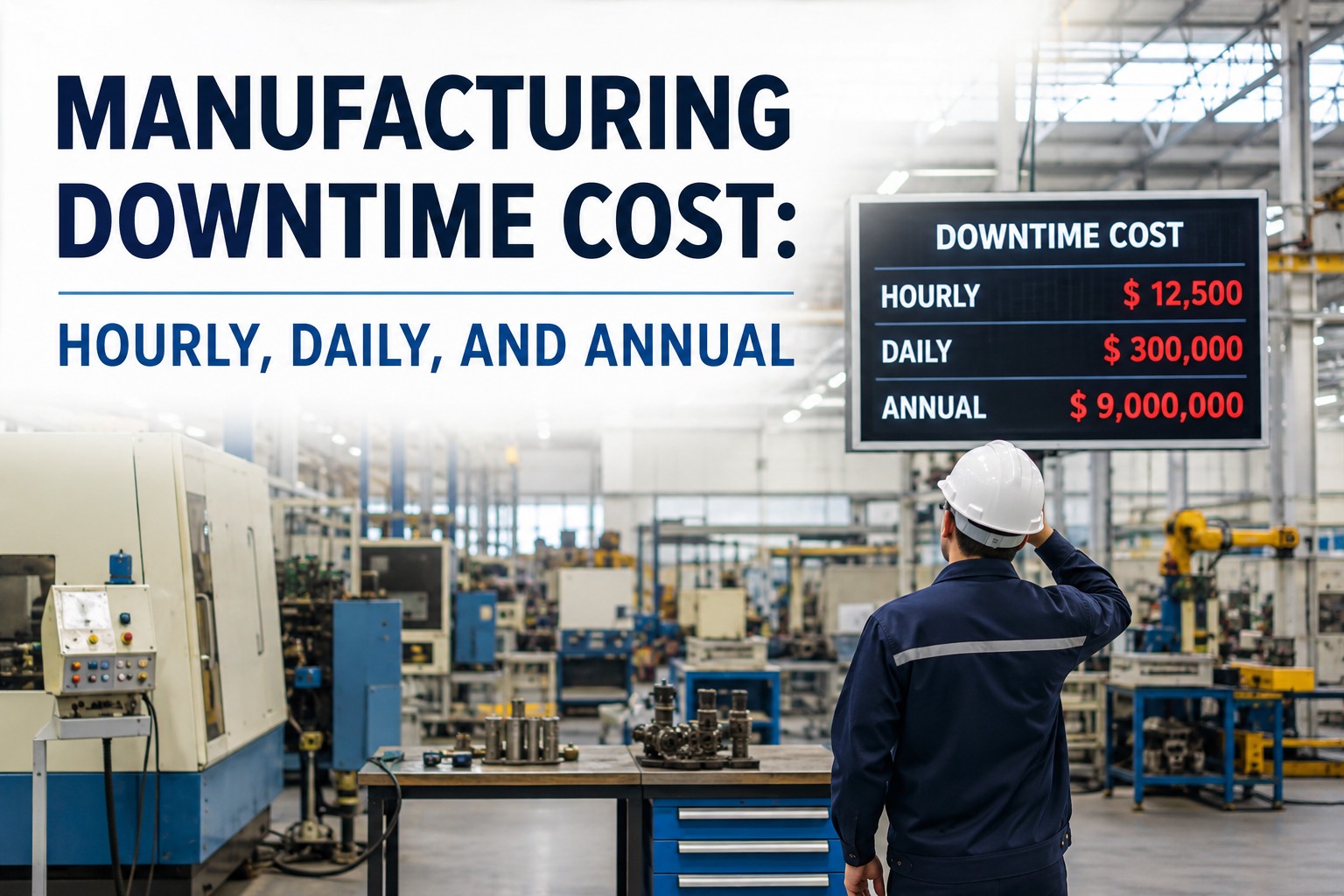
Manufacturing downtime is the silent killer of productivity and profitability. Every minute your equipment sits idle waiting for a spare part costs money, disrupts schedules, and frustrates teams. Traditional spare parts management—with its massive inventories, long lead times, and obsolescence risks—is becoming increasingly inadequate for today's fast-paced manufacturing environment.
Enter 3D printing technology, which is transforming how manufacturers approach spare parts production. This revolutionary technology enables on-demand manufacturing of components exactly when and where they're needed, eliminating many of the pain points that have plagued spare parts management for decades.
The Current Challenge in Spare Parts Management
Traditional spare parts management presents several critical challenges that directly impact manufacturing efficiency:
- Inventory Costs: Maintaining extensive spare parts inventories ties up significant capital and requires substantial warehouse space
- Obsolescence Risk: Parts become outdated or equipment changes, leaving manufacturers with worthless inventory
- Lead Times: Critical components often have weeks or months-long delivery times, extending unplanned downtime
- Storage Requirements: Different environmental conditions needed for various materials complicate storage logistics
- Availability Issues: Original equipment manufacturers may discontinue parts or go out of business entirely
These challenges force manufacturers into an impossible choice: either maintain expensive, comprehensive inventories or risk extended downtime when parts fail. 3D printing offers a third option that eliminates this dilemma.
How 3D Printing Transforms Spare Parts Production
3D printing, also known as additive manufacturing, creates physical objects by building them layer by layer from digital designs. For spare parts production, this technology offers unprecedented flexibility and speed.
Digital Inventory Management
Instead of storing physical parts, manufacturers can maintain digital libraries of 3D models. These digital files take up virtually no physical space and never become obsolete—they can be updated, modified, or improved as needed.
On-Demand Production
Parts are manufactured only when needed, eliminating the guesswork involved in inventory planning. This approach dramatically reduces carrying costs while ensuring parts are always available when required.
Customization and Improvement
Digital designs can be easily modified to improve part performance, adapt to different applications, or incorporate lessons learned from field experience. This iterative improvement process is impossible with traditional manufacturing approaches.
Key Benefits for Manufacturing Operations
Reduced Downtime
The most significant advantage of 3D printing for spare parts is the dramatic reduction in equipment downtime. Parts can often be produced within hours rather than weeks, keeping production lines running and maintaining delivery schedules.
Cost Optimization
While the per-unit cost of 3D printed parts may be higher than mass-produced alternatives, the total cost of ownership is often lower when factoring in:
- Eliminated inventory carrying costs
- Reduced warehouse space requirements
- Lower obsolescence risk
- Decreased expedited shipping costs
- Minimized production downtime costs
Supply Chain Resilience
3D printing provides supply chain independence by enabling local production of parts. This capability proved invaluable during recent global supply chain disruptions and continues to provide strategic advantages in uncertain economic conditions.
Quality and Performance
Modern 3D printing technologies can produce parts that meet or exceed the performance characteristics of traditionally manufactured components. Advanced materials and printing techniques enable production of complex geometries that would be impossible or prohibitively expensive with conventional manufacturing methods.
Implementation Strategies and Best Practices
Successfully implementing 3D printing for spare parts requires a strategic approach that considers both technical and organizational factors.
Start with High-Impact, Low-Risk Parts
Begin your 3D printing journey by identifying parts that offer the greatest potential benefit with minimal risk. These typically include:
- Non-critical components with long lead times
- Parts with high inventory costs relative to their value
- Components that frequently require customization
- Items that are often damaged during handling or shipping
Develop Digital Design Capabilities
Building internal 3D modeling and design capabilities is crucial for long-term success. This investment enables rapid prototyping, design optimization, and the ability to reverse-engineer parts when original designs aren't available.
Establish Quality Control Procedures
Implement rigorous quality control processes to ensure 3D printed parts meet required specifications. This includes material testing, dimensional verification, and performance validation under actual operating conditions.
Partner with Experienced Providers
Working with established 3D printing service providers can accelerate implementation while providing access to advanced technologies and expertise that would be prohibitively expensive to develop internally.
Future-Proofing Your Manufacturing Operations
3D printing technology continues to evolve rapidly, with new materials, faster printing speeds, and improved quality becoming available regularly. Manufacturers who begin implementing these technologies now will be best positioned to capitalize on future advances.
The integration of 3D printing with other Industry 4.0 technologies—including IoT sensors, predictive analytics, and automated inventory management—promises even greater benefits. Imagine systems that automatically detect component wear, generate 3D print jobs, and have replacement parts ready before failures occur.
Forward-thinking manufacturers are already building these capabilities, creating competitive advantages that will compound over time. The question isn't whether 3D printing will transform spare parts management—it's whether your organization will lead or follow this transformation.
Don't let outdated spare parts management hold back your manufacturing operations. Discover how 3D printing can reduce downtime, cut costs, and improve operational efficiency.
Getting Started Book a DemoFrequently Asked Questions
1. What types of spare parts are best suited for 3D printing?
Parts made from thermoplastics, certain metals, and ceramics work well for 3D printing. Ideal candidates include brackets, housings, gaskets, connectors, and custom fixtures. Parts requiring high strength, extreme temperatures, or specific regulatory compliance may need special materials or traditional manufacturing methods.
2. How do 3D printed parts compare in quality to traditionally manufactured parts?
Modern 3D printing technologies can produce parts that meet or exceed traditional manufacturing quality standards. Material properties, surface finish, and dimensional accuracy have improved significantly. However, part orientation, post-processing, and material selection all impact final quality.
3. What's the typical cost comparison between 3D printed and traditional spare parts?
While per-unit costs for 3D printed parts may be higher, total cost of ownership is often lower when considering inventory carrying costs, obsolescence risk, shipping expenses, and downtime costs. The break-even point typically occurs when annual usage is low to moderate volumes.
4. How long does it take to 3D print a typical spare part?
Print times vary based on part size, complexity, and technology used. Simple parts may take 1-4 hours, while complex components could require 8-24 hours. However, this is still significantly faster than traditional procurement lead times of weeks or months.
5. What equipment and training are needed to implement 3D printing for spare parts?
Implementation can range from partnering with service providers (minimal equipment needed) to establishing in-house capabilities (requiring 3D printers, materials, software, and trained operators). Many manufacturers start with outsourcing and gradually build internal capabilities as volume and expertise grow.