In 2025, roughly 44% of energy companies tested quadruped robots for predictive maintenance — and by 2026, the market is projected to grow at over 20% CAGR as industries from oil and gas to data centers adopt four-legged robots carrying thermal, acoustic, visual, and LiDAR sensor payloads. The real challenge is no longer whether to deploy a robot dog for inspections, but how to configure the right sensor combination and pipe that multi-modal data into a CMMS that turns raw readings into work orders, predictive trends, and compliance records. Schedule a free demo to see how Oxmaint CMMS connects with quadruped robot platforms at your facility.
What Are Multi-Sensor Payloads and Why Do They Matter for Maintenance
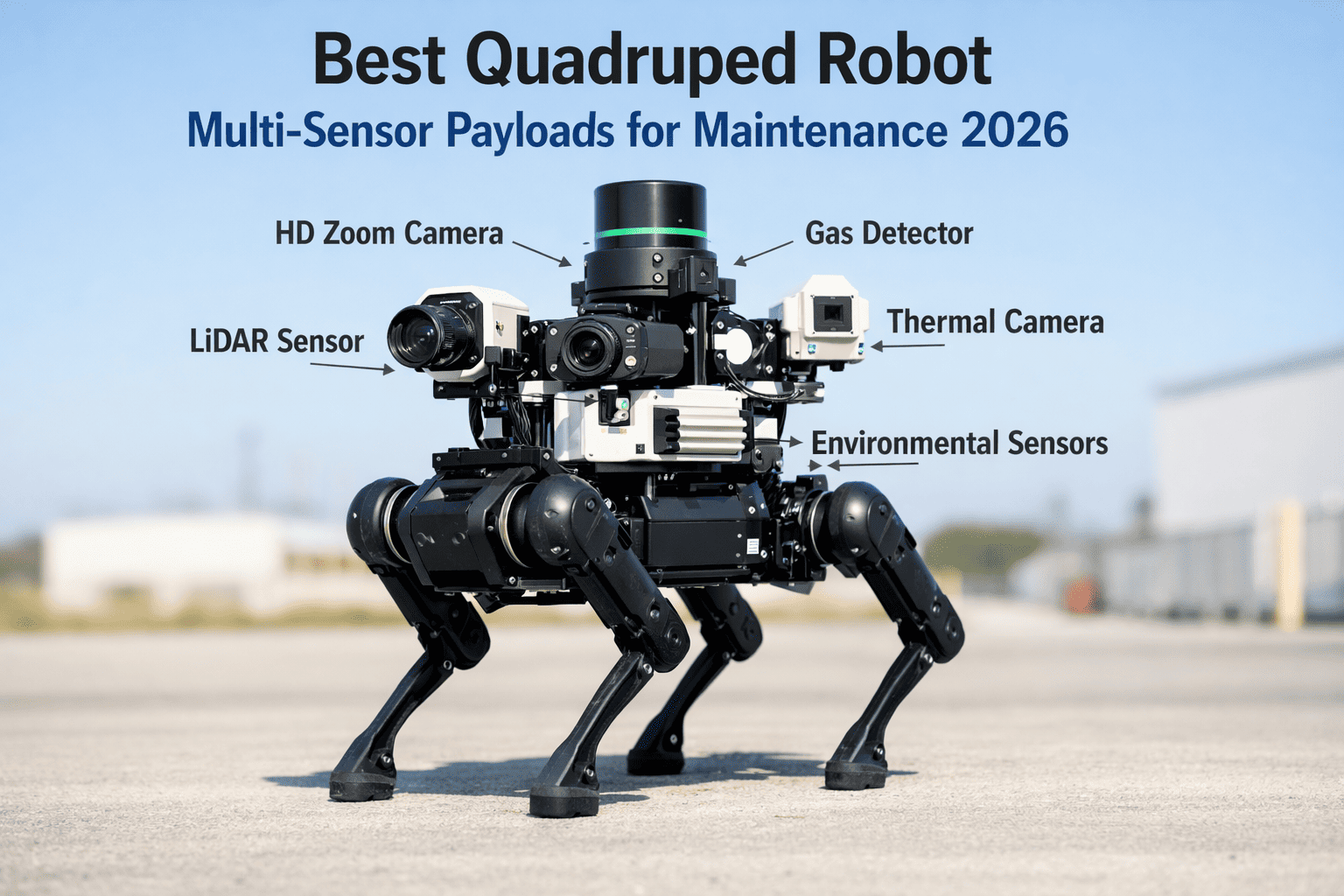
A multi-sensor payload is a modular package of inspection instruments — thermal cameras, ultrasonic microphones, 3D LiDAR scanners, gas detectors, and vibration sensors — mounted on a quadruped robot's back or payload bay. Instead of sending a technician with a single handheld instrument on each visit, a robot dog captures four or more data types simultaneously in a single autonomous patrol. That sensor fusion is what separates a basic surveillance camera from genuine predictive maintenance intelligence.
4-6
Sensor modalities captured per autonomous mission simultaneously
92%
Reduction in technician exposure to hazardous inspection zones
5x
Faster asset coverage compared to manual walkthrough inspections
$9.9B
Projected industrial quadruped robot market size by 2033
Want to centralize robot inspection data in one platform? Oxmaint CMMS ingests multi-sensor feeds from Spot, ANYmal, and Unitree — auto-generating work orders with thermal images, acoustic maps, and LiDAR scans attached.
Top Sensor Configurations for Robot Dog Inspections in 2026
Choosing the right payload depends on your assets, environment, and the failure modes you need to catch. Here are the six core sensor types that make up the most effective multi-sensor payloads for industrial quadruped platforms available today.
128-microphone array, 2kHz-100kHz frequency range, 50m+ detection. Pinpoints compressed air leaks, partial discharge in switchgear, and early bearing degradation through acoustic signature analysis. Sound maps overlay on facility models for precise fault localization.
Visual
4K PTZ Camera with On-Board AI (Spot Cam 2 / 25x Optical Zoom)
4K at 30fps with 25x optical zoom and 360x130 degree spherical view. Edge AI classifies corrosion, reads analog gauges, identifies cracks, and verifies labels in real-time — tagging anomalies on the robot before data reaches your CMMS. Sign up free to see how visual AI data flows into Oxmaint.
LiDAR
3D Laser Scanner (Leica BLK ARC / Velodyne VLP-16)
Up to 300m range, 300,000 points per second, +/-2mm accuracy. Generates 3D point clouds for structural deformation monitoring, pipe displacement tracking, and digital twin updates. Change-detection algorithms flag dimensional shifts between consecutive missions.
Detects LEL, O2, CO, H2S, and VOCs with sub-15-second response. Continuous atmospheric monitoring during robot patrols in refineries, chemical plants, and confined spaces — with geo-tagged concentration data streaming to compliance systems.
Vibration
Tri-Axial Vibration Sensor (Contact + Non-Contact / ISO 10816)
0.5Hz to 20kHz frequency range across three axes. Collects vibration signatures from motors, pumps, and compressors during autonomous routes. Spectral analysis detects imbalance, misalignment, and bearing wear — schedule a demo to see vibration-to-work-order automation in Oxmaint.
How Quadruped Robots Deliver Multi-Modal Data to Your CMMS
Collecting sensor data on a robot is only half the story. The real maintenance value emerges when thermal, acoustic, visual, and LiDAR readings flow into a centralized CMMS as unified asset health records — triggering automated work orders when anomalies cross configured thresholds.
Robot-to-CMMS Data Pipeline
1
Mission Scheduling
CMMS defines routes from asset criticality, PM schedules, and historical fault data. Waypoints and sensor triggers are pre-programmed per mission segment.
2
Autonomous Patrol
Quadruped navigates the facility, activating thermal, acoustic, visual, and LiDAR at each waypoint. Edge AI screens anomalies on-board the robot during the mission.
3
Multi-Modal Fusion
Sensor streams are correlated by asset ID, timestamp, and GPS. A thermal hotspot on a motor bearing is cross-checked against acoustic vibration and visual imagery to confirm severity.
4
CMMS Ingest
Processed data uploads to Oxmaint, updating asset health records and dashboards. Anomalies exceeding thresholds auto-generate work orders with multi-modal evidence attached.
5
Predictive Action
Teams receive prioritized WOs with thermal images, acoustic signatures, and 3D scans. Historical trending shows degradation rate, enabling optimal repair scheduling before failure.
See the robot-to-CMMS pipeline live. Book a demo and we will walk you through how Oxmaint processes multi-sensor robot data into automated maintenance actions for your industry.
Which Sensor Combination Fits Your Inspection Use Case
Different failure modes demand different sensor mixes. This matrix maps the most effective payload configurations to common industrial inspection scenarios — so your team picks the right tool for every asset type.
Most quadruped platforms support hot-swappable payload modules — reconfigure sensors between missions without specialized tools or downtime.
Spot vs ANYmal vs Unitree B2: Comparing Robot Platforms for Maintenance
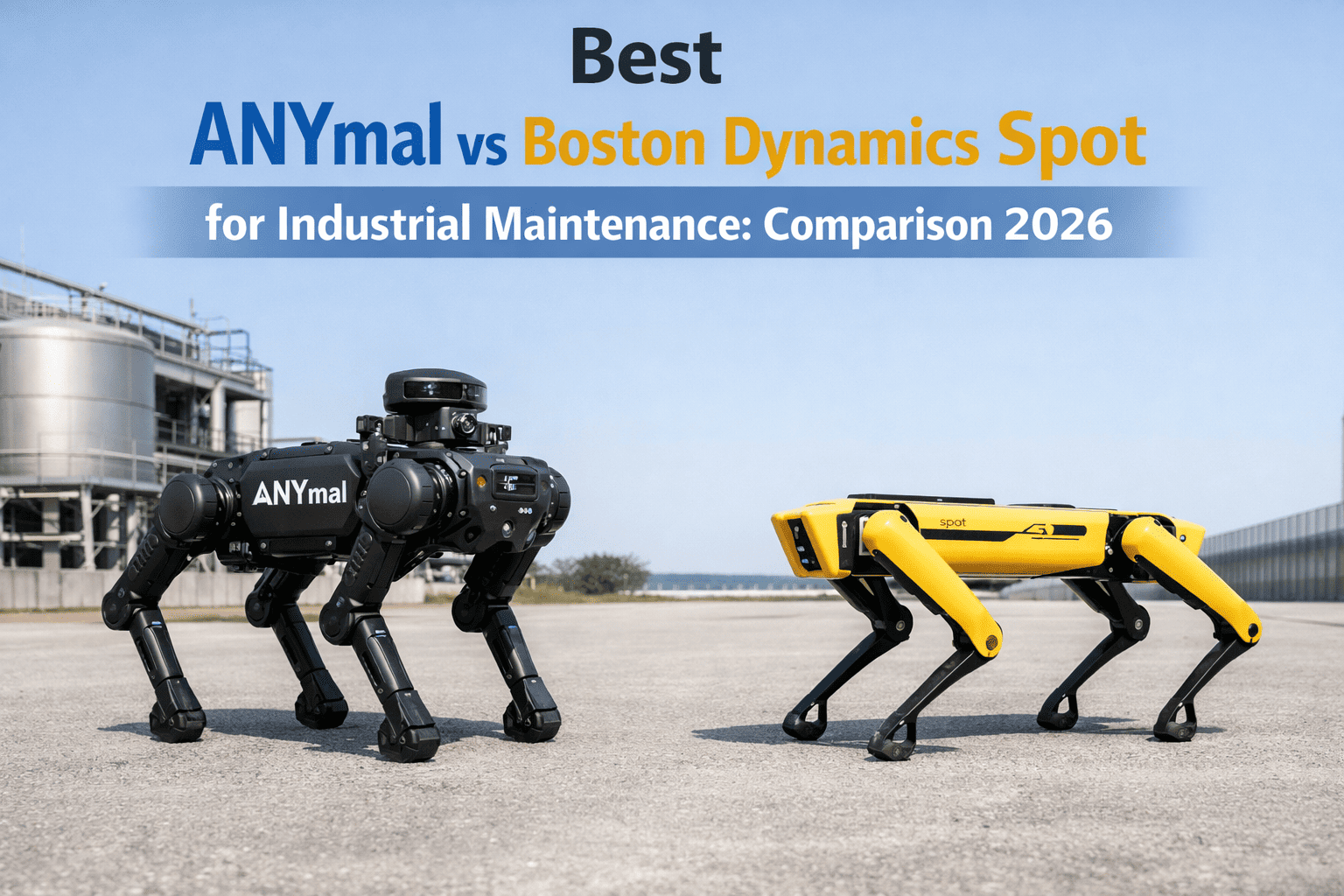
The three leading quadruped platforms each serve different operational profiles. Boston Dynamics Spot offers the broadest third-party sensor ecosystem with over 1,500 units deployed globally. ANYbotics ANYmal leads in hazardous-area certification with ATEX Zone 1 approval. Unitree B2 provides the highest payload capacity at the most competitive price point. Your choice depends on environment, payload weight, runtime needs, and CMMS integration depth.
Most Deployed
Boston Dynamics Spot
Payload14 kg
Runtime90 min
IP RatingIP54
ATEXEX variant available
AutonomyFull (Spot Enterprise + Orbit)
CMMS APIREST, MQTT, OPC-UA
Largest sensor partner ecosystem. Spot Cam 2 adds thermal + acoustic + 4K in one payload. 1,500+ units deployed globally.
Hazardous Areas
ANYbotics ANYmal X
Payload10 kg
Runtime120 min
IP RatingIP67
ATEXZone 1 certified
AutonomyFull (ANYmal X suite)
CMMS APIREST, MQTT
Purpose-built for harsh industrial environments. IP67 water/dust protection. Yokogawa OpreX integration announced Feb 2026.
Max Payload
Unitree B2
Payload20 kg
RuntimeUp to 5 hrs
IP RatingIP67
ATEXNot certified
AutonomySemi-auto, tele-op
CMMS APIREST
Highest payload capacity for heavy multi-sensor configs. Longest runtime at up to 5 hours. Most competitive price point for non-hazardous use.
Oxmaint provides pre-built connectors for Spot and ANYmal with open API support for Unitree and other platforms.
Not sure which platform is right for your facility? Our team will assess your site conditions, asset types, and hazardous area requirements to recommend the optimal robot and sensor configuration.
Industries Using Quadruped Robot Inspections in 2026
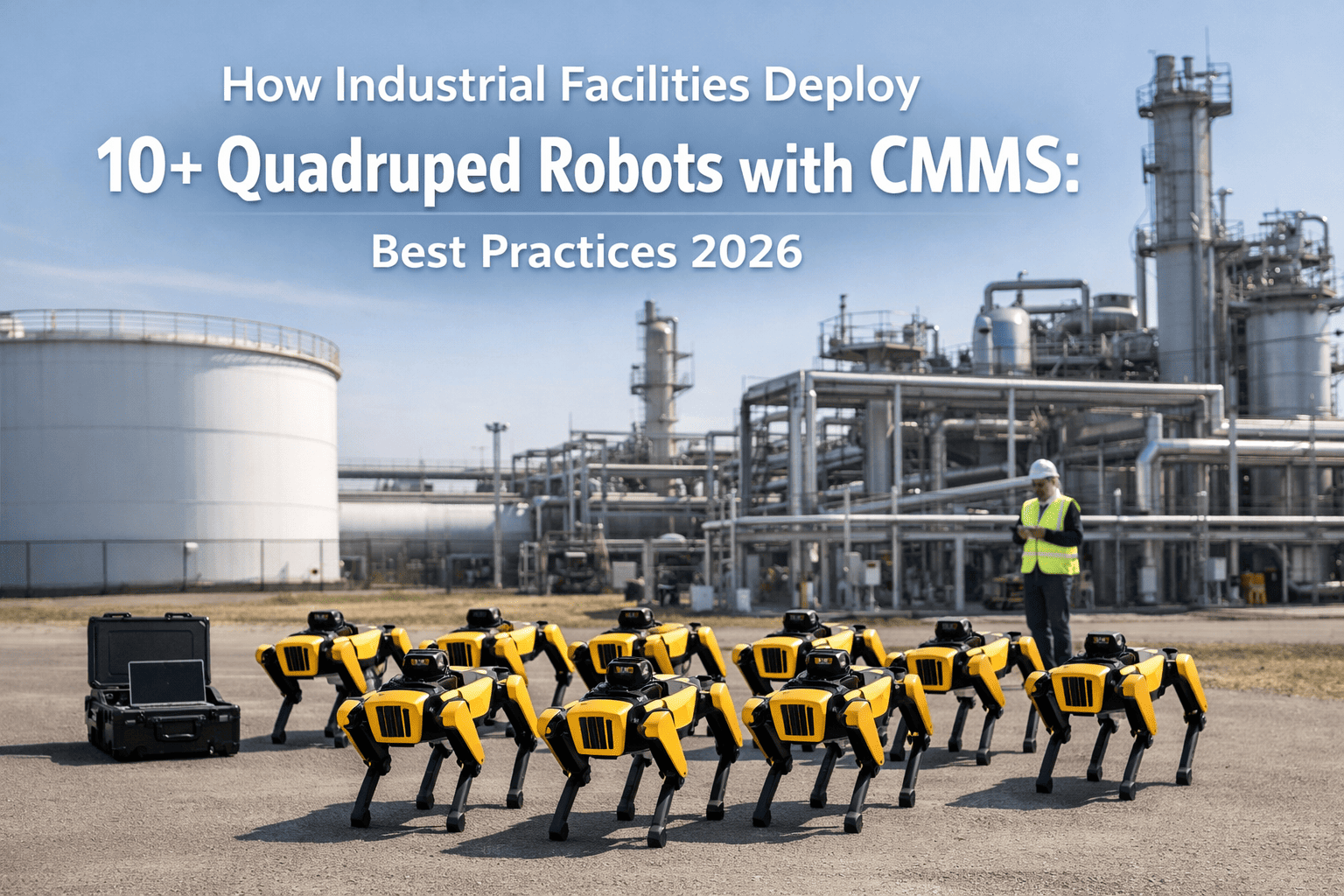
From offshore oil platforms to data center server aisles, quadruped robots are deployed across every major industrial sector. Each industry leverages specific sensor combinations matched to their unique asset types, environmental hazards, and regulatory requirements.
Oil and Gas
Gas + Thermal + Acoustic
Wellheads, pipe racks, compressor stations. Leak detection logs, compliance reporting, predictive PM scheduling. ATEX-rated ANYmal X leads deployments in Zone 1 areas.
Production lines, motors, conveyors, electrical rooms. Equipment health scoring, energy waste detection, and PM scheduling. 36% of large manufacturers integrated robots into safety workflows by 2025.
Mining
LiDAR + Gas + Thermal
Crushers, conveyors, ventilation shafts, underground tunnels. Structural monitoring, atmospheric compliance, and fleet tracking in environments too dangerous for regular human entry.
Data Centers
Thermal + Visual + Acoustic
Server racks, cooling systems, UPS units, cable trays. Hotspot trending, cooling efficiency analytics, and capacity planning across large-footprint facilities with repeatable aisle patrols.
Utilities and Infrastructure
Thermal + Visual + LiDAR
Substations, water treatment plants, distribution networks. Asset registry updates, regulatory inspection records, and digital twin creation for aging infrastructure assessment.
Real-World ROI from Autonomous Multi-Sensor Robot Inspections
Organizations deploying quadruped robots report measurable returns across safety, inspection speed, fault detection quality, and maintenance cost reduction. The compounding effect of consistent, high-frequency, multi-modal data collection accelerates the transition from reactive to predictive maintenance.
Documented Industrial Deployment Benefits
Safety Incident Reduction85%
Faster Inspection Cycle Time60%
Early Fault Detection Improvement42%
Unplanned Downtime Reduction28%
Manual Patrol Hours Eliminated40%
Based on industrial quadruped deployments across energy, manufacturing, and infrastructure sectors including documented results from North American refinery fleet deployments.
Calculate your facility's inspection ROI. Create a free Oxmaint account and our team will model the savings for your specific asset base and inspection frequency.
How to Deploy Multi-Sensor Quadruped Robots Step by Step
Successful deployment follows a phased approach that delivers quick inspection wins while building toward comprehensive multi-modal coverage and full CMMS integration. Most organizations move from pilot to production in under two months.
Week 1-2
Site Assessment and Route Mapping
Map critical assets, define inspection waypoints, evaluate terrain and environmental conditions. Select primary sensor payloads based on your top failure modes and compliance requirements.
Week 3-4
CMMS Integration and Threshold Configuration
Connect the robot platform API to Oxmaint. Map asset IDs to waypoints. Configure alert thresholds and auto-generated work order rules for each sensor modality and asset type.
Week 5-6
Pilot Missions and Data Validation
Run initial autonomous patrols on priority routes. Validate data quality across all sensor modalities. Calibrate AI detection models against your specific equipment and environmental baselines.
Week 7+
Scale Routes and Optimize Continuously
Expand inspection coverage areas. Add sensor modalities as needs evolve. Refine AI models with accumulated inspection data. Integrate additional robot platforms for multi-site coverage.
The shift from single-sensor handheld inspections to multi-modal robotic data collection is the biggest leap in maintenance intelligence since the introduction of vibration analysis. When thermal, acoustic, visual, and LiDAR data converge on a single asset record in your CMMS, you are not just finding faults — you are understanding failure mechanisms.
Unify Multi-Sensor Robot Data in One CMMS Platform
Your maintenance team deserves more than spreadsheets and disconnected inspection reports. Oxmaint CMMS ingests thermal, acoustic, visual, LiDAR, gas, and vibration data from quadruped robot missions — correlating multi-modal evidence into actionable work orders, predictive trends, and asset health scores that prevent failures before they happen.
Which quadruped robot is best for multi-sensor maintenance inspections?
It depends on your environment. Boston Dynamics Spot has the broadest third-party sensor ecosystem and over 1,500 units deployed worldwide, making it ideal for general industrial use. ANYbotics ANYmal X is the only ATEX Zone 1 certified quadruped, built specifically for hazardous area inspections in refineries and chemical plants. Unitree B2 offers the highest payload capacity at 20 kg with up to 5 hours of runtime at the most competitive price point. Oxmaint CMMS integrates with all three platforms. Schedule a free demo to find the right platform for your facility.
How does multi-sensor robot data integrate with a CMMS?
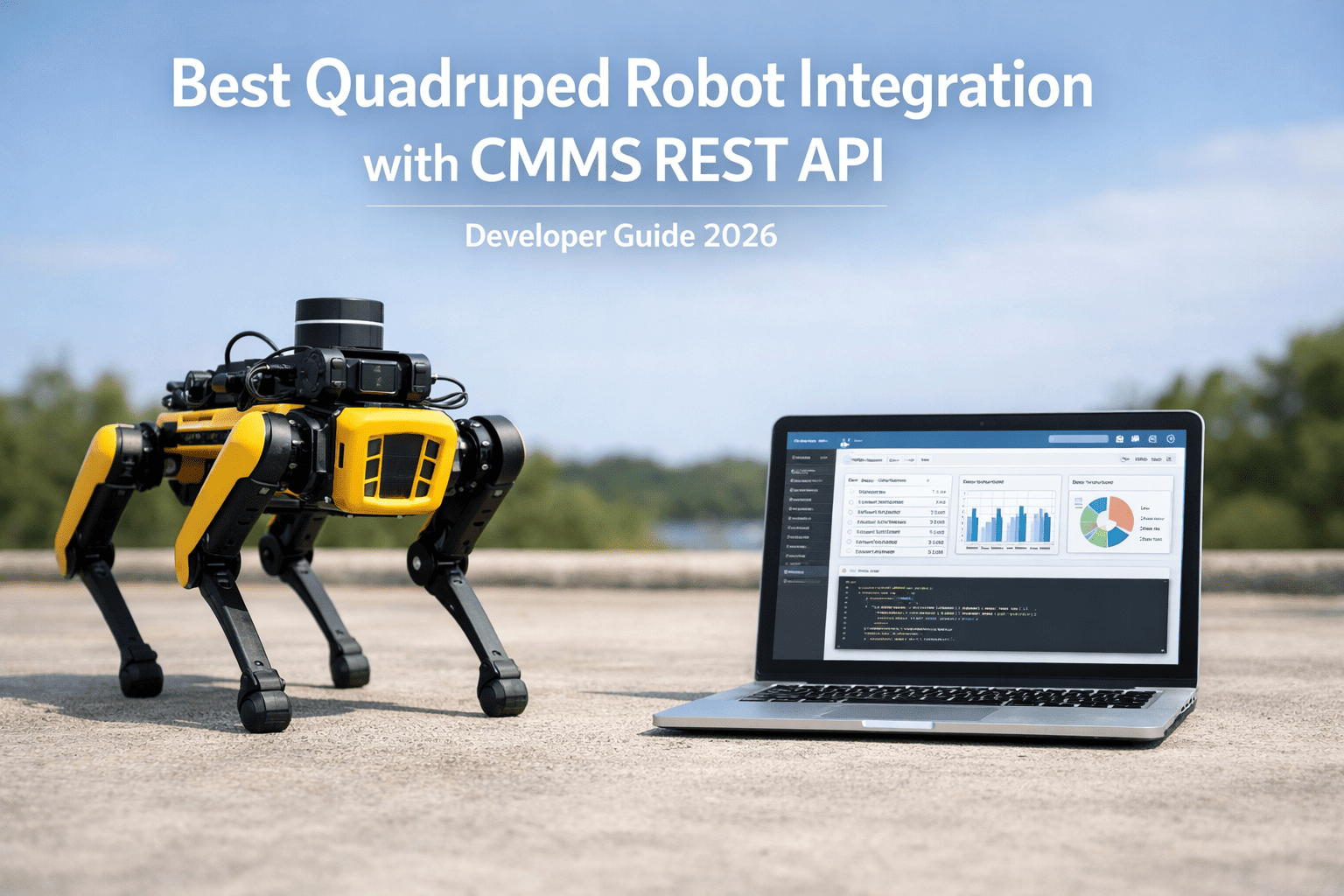
Oxmaint provides pre-built API connectors that ingest inspection data from robot platforms, map sensor readings to asset records by ID and location, and auto-generate work orders when anomalies exceed configured thresholds. Thermal images, acoustic sound maps, vibration spectra, and 3D LiDAR scans attach directly to asset histories for full traceability and trending. Sign up free and explore the robot integration dashboard yourself.
Can robot dogs inspect ATEX-rated hazardous or confined spaces?
Yes. ANYbotics ANYmal X is certified for ATEX and IECEx Zone 1 hazardous areas and carries IP67 dust and water protection. Equipped with multi-gas detectors, thermal cameras, and visual sensors, it inspects environments too dangerous for human entry — eliminating confined space risks while collecting higher-quality multi-modal data than manual walkdowns. Yokogawa recently announced OpreX integration with ANYmal for autonomous plant operations.
What is the typical ROI timeline for robotic inspection programs?
Most organizations see positive ROI within 6 to 12 months. Quick wins from hazard avoidance and early fault detection often justify the investment within the first quarter. One North American refinery reported cutting manual patrol hours by 40% while improving early fault detection across high-risk units. Facilities with large asset footprints or high-hazard environments achieve payback fastest.
Do we need specialized operators to run quadruped robots?
No. Modern platforms like Spot Enterprise and ANYmal X are designed for fully autonomous operation. After initial route programming — which Oxmaint can assist with during onboarding — robots execute missions on schedule or on-demand, recharge autonomously at docking stations, and replan around new obstacles. Maintenance technicians review inspection results in the CMMS dashboard, not operate the robot. Book a demo to see the fully autonomous inspection-to-work-order workflow.
By oxmaint
✨
Experience Oxmaint's Power
Take a personalized tour with our product expert to see how OXmaint can help you streamline your maintenance operations and minimize downtime.