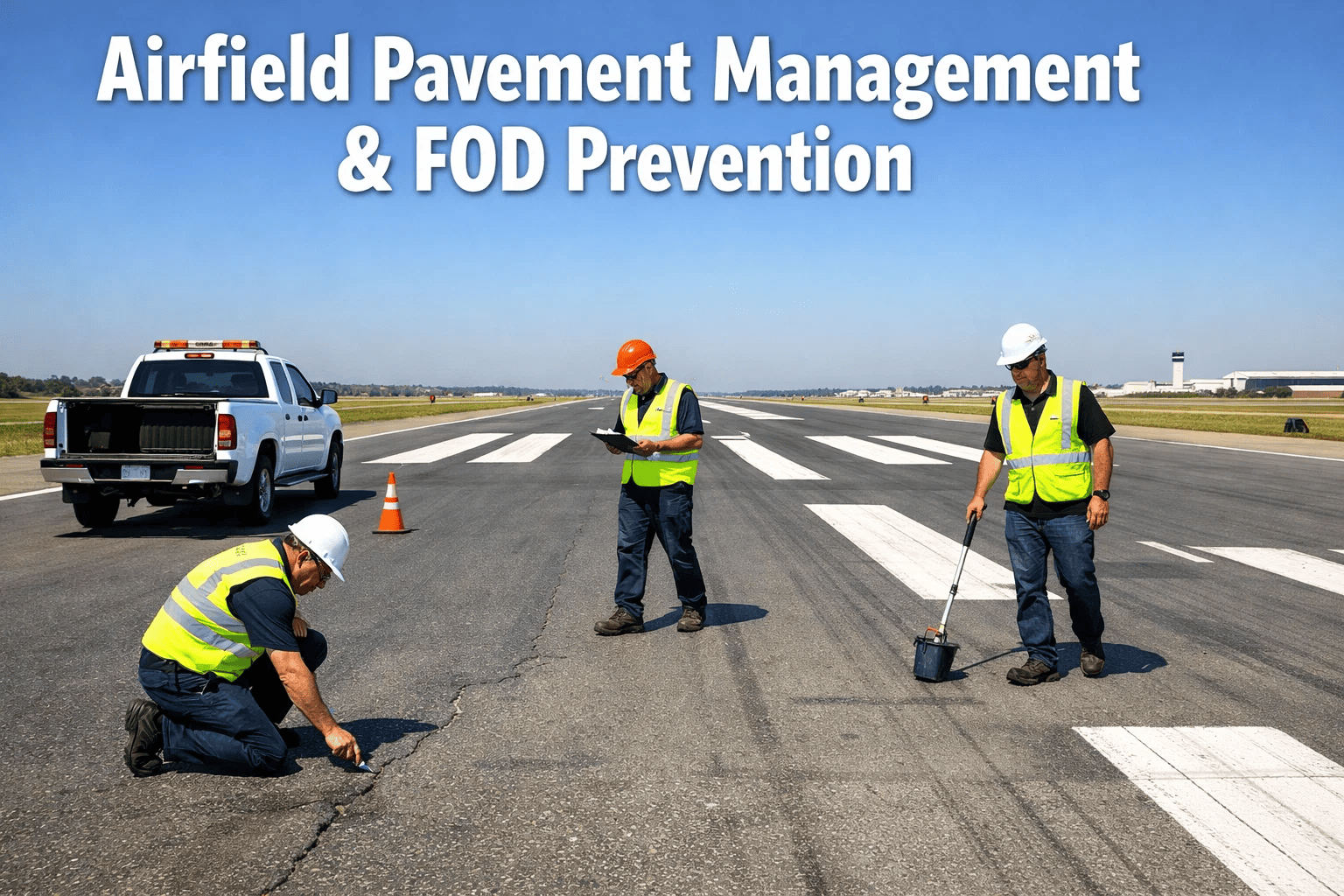
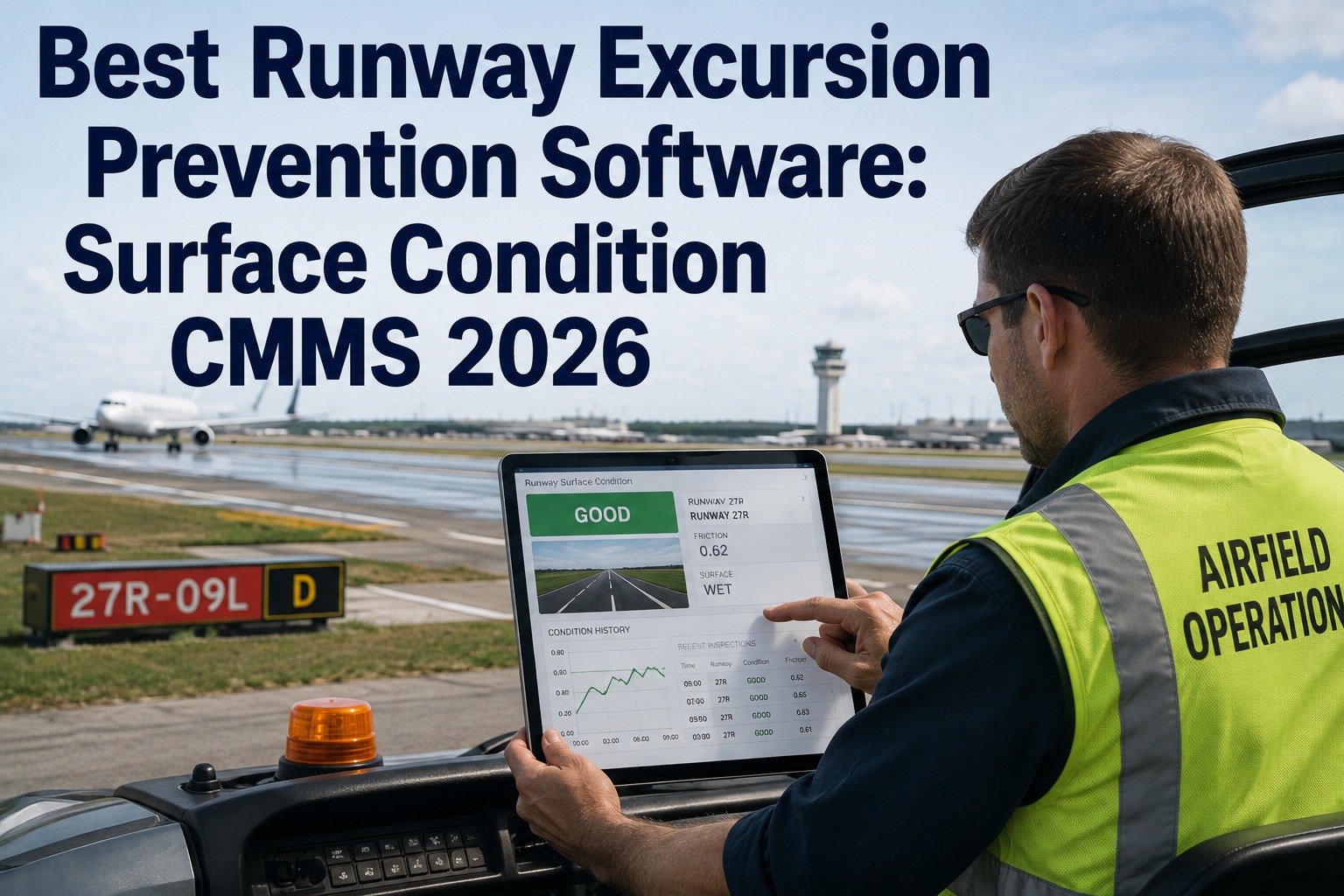
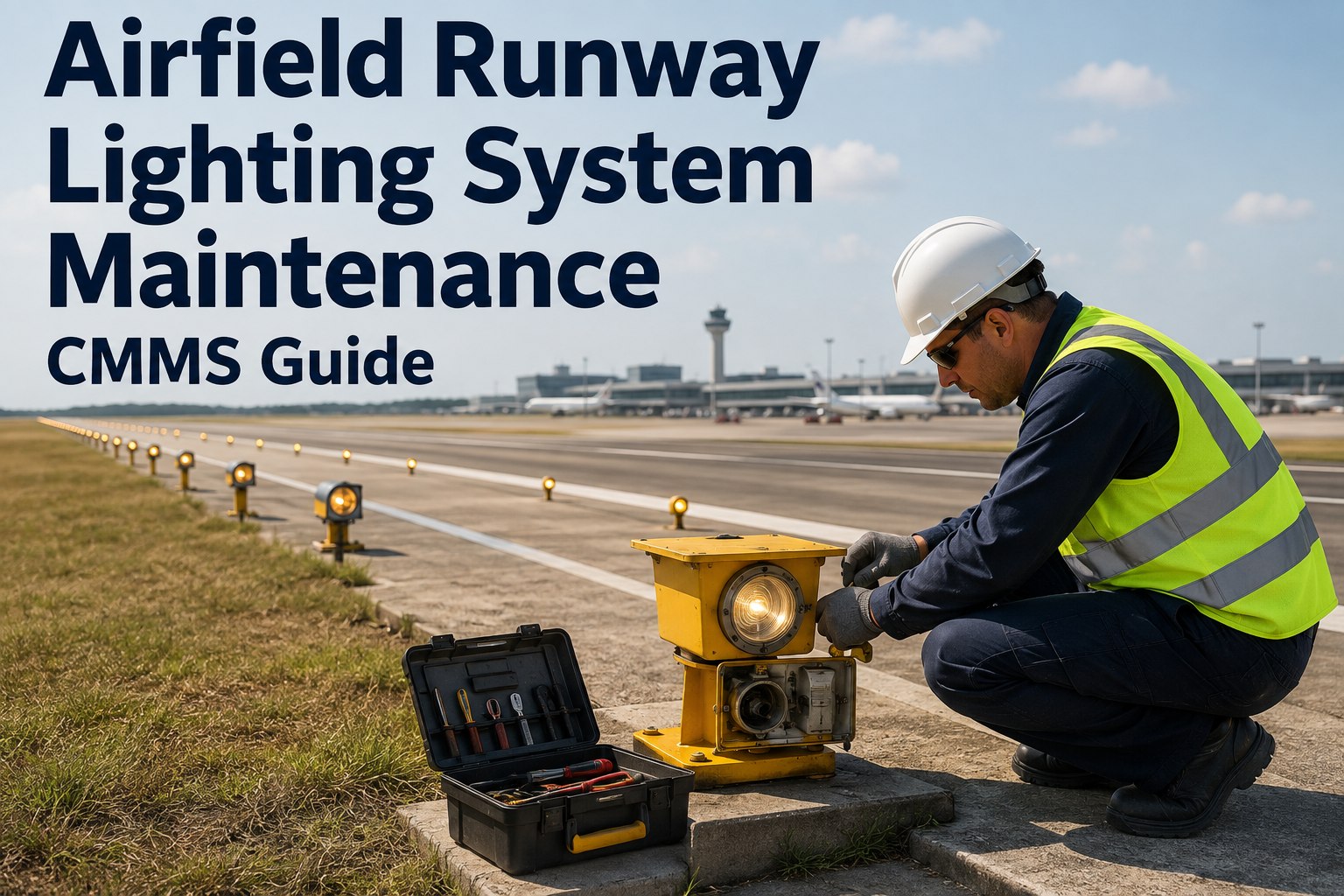
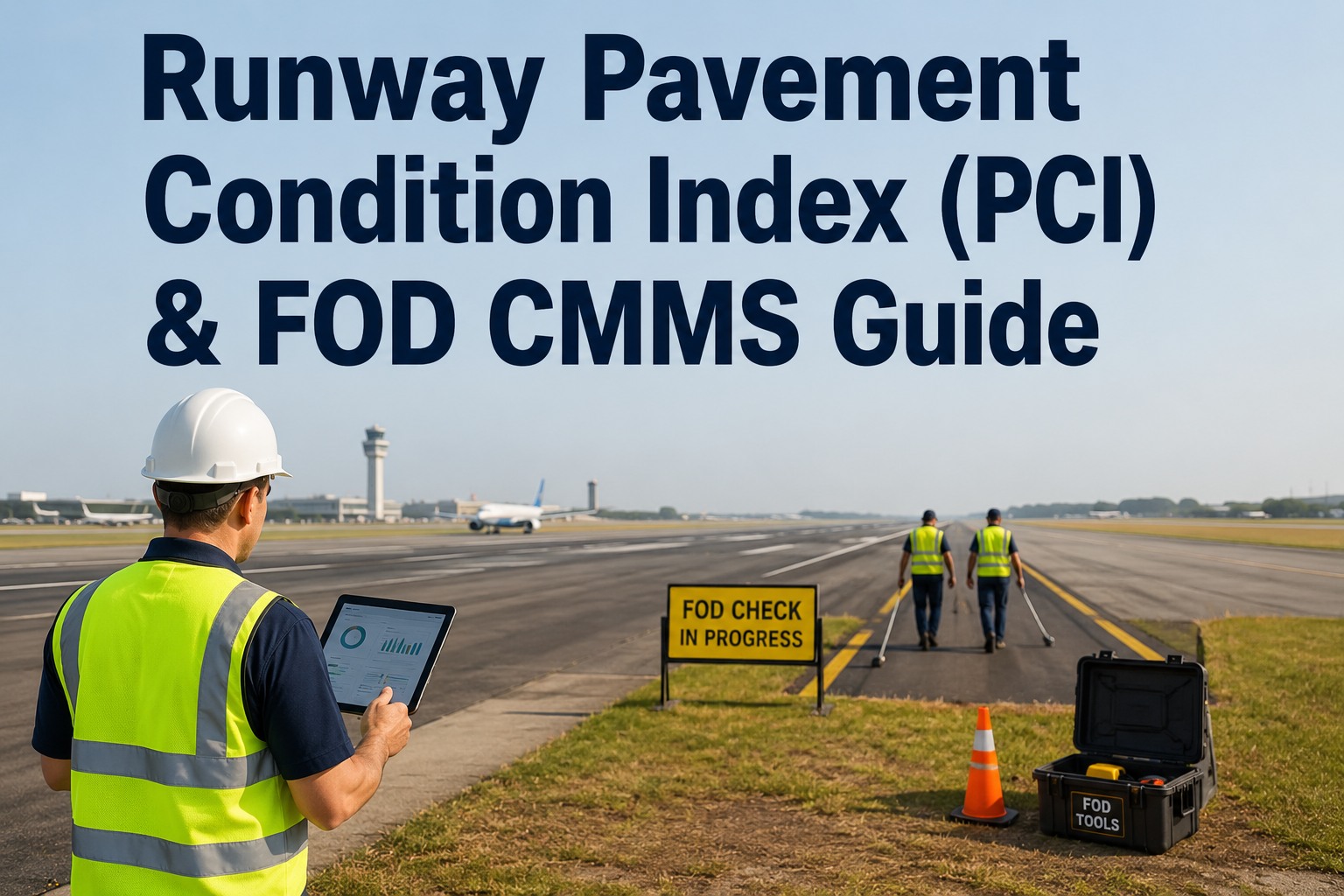
A single Foreign Object Debris incident on an active runway can ground a fleet, close an airfield for hours, and trigger an FAA investigation — yet at most airports, FOD walkdowns are still tracked on paper clipboards and pavement condition surveys are conducted reactively when surface damage becomes visible. A structured airfield pavement management program changes this from a reactive safety exercise into a predictive asset lifecycle operation. Start a free trial to see how Oxmaint manages airfield pavement assets at the asset level, or book a demo to walk through a live pavement inspection and FOD workflow.
Airside Operations / Asset Lifecycle Management
Airfield Pavement Management: FOD Prevention, Surface Testing, and Rehabilitation
How data-driven pavement condition assessment, FOD management programs, and CMMS-driven rehabilitation planning protect runway safety and reduce airside infrastructure lifecycle costs.
$13B
Annual cost of FOD-related incidents to global aviation industry
4x
Higher rehabilitation cost when pavement intervention is delayed beyond the PCI trigger threshold
65%
Of airfield pavement failures are preventable with structured surface monitoring and timely crack sealing
40%
Reduction in total pavement lifecycle cost achieved through proactive PCI-based rehabilitation scheduling
Airfield Asset Lifecycle Management
From FOD Walkdowns to 10-Year Rehab Planning — In One Platform
Oxmaint registers every runway, taxiway, and apron section as a managed asset — with PCI history, FOD incident records, friction test results, and rehabilitation forecasts linked to every pavement section. Start a free trial or book a demo to see the airfield pavement management workflow.
Understanding Airfield Pavement Management
Airfield Pavement Management is the systematic process of assessing surface condition, predicting deterioration, prioritising intervention, and planning rehabilitation investment across runways, taxiways, aprons, and service roads. It replaces the reactive "repair when broken" model with a lifecycle approach where every pavement section has condition data, a maintenance history, and a projected intervention timeline.
01
Pavement Condition Index (PCI) Assessment
The internationally standardised 0–100 scale measuring pavement structural health. Runways below PCI 70 require prioritised maintenance planning. Below PCI 40 signals urgent rehabilitation need before structural failure risk escalates.
02
FOD Prevention and Detection Programs
Systematic walkdowns, automated FOD detection systems, and incident tracking targeting debris on runways, taxiways, and aprons. FOD management must be documented — not just conducted — to satisfy FAA Part 139 and ICAO safety requirements.
03
Friction and Skid Resistance Testing
Runway friction testing using continuous friction measuring equipment (CFME) identifies surface depolishing, rubber contamination, and drainage groove infill that reduces braking performance. ICAO Annex 14 and FAA AC 150/5370 define friction action limits.
Surface Distress Mapping
04
Systematic cataloguing of surface distresses — cracking, rutting, ravelling, joint failure, and delamination — by type, severity, and location. Distress maps for each pavement section drive repair prioritisation and contractor scope development.
05
Rehabilitation Planning and CapEx Forecasting
PCI deterioration curves and condition data build multi-year rehabilitation scenarios — crack sealing today to avoid mill-and-overlay in 3 years, or full reconstruction deferred with functional overlay. CapEx planning grounded in asset data, not gut feel.
06
Rubber Removal and Surface Treatment
Rubber accumulation in touchdown zones reduces friction below ICAO action levels. Scheduled rubber removal programs based on aircraft movement data maintain landing surface performance and extend time between major resurfacing interventions.
07
Pavement Drainage Management
Edge drains, runway shoulders, and surface drainage channels require periodic inspection and clearing. Standing water on airfield pavement creates aquaplaning risk, accelerates surface deterioration, and provides ideal conditions for freeze-thaw pavement damage in cold climates.
08
Pavement Marking Maintenance
Runway threshold, centreline, and touchdown zone markings must meet FAA/ICAO retroreflectivity standards. Faded or non-conforming markings are a safety deficiency and a certification issue. Marking condition is tracked as a separate maintenance metric per pavement section.
FOD: The Most Visible Airfield Safety Failure
Foreign Object Debris on airfield surfaces is responsible for over 400 aircraft incidents per year globally — including engine ingestion events, tyre blowouts, and landing gear damage. The challenge is not awareness of FOD risk — airports universally conduct FOD walkdowns. The challenge is documentation, pattern analysis, and connecting FOD incidents to pavement condition deterioration as a source. Start a free trial to track FOD incidents and pavement defects in a unified asset record, or book a demo and see how FOD walkdown management works in practice.
FOD Source
Pavement Deterioration
Spalling concrete, ravelling asphalt, and failed joint sealant generate aggregate and debris directly on the airfield surface. High-traffic areas with deferred maintenance produce the highest FOD frequency from pavement sources — trackable when PCI and FOD data are linked.
FOD Source
Construction and Maintenance Activity
Tool drops, material remnants, and construction debris from airfield maintenance projects account for a significant portion of FOD incidents. Work zone FOD inspections and post-maintenance sweeping requirements must be part of every maintenance work order on the airfield.
FOD Source
Aircraft and GSE Shed Items
Panel fasteners, hydraulic fittings, cargo tie-downs, and ground support equipment components represent the second-largest FOD category. Cross-terminal incident tracking reveals whether specific aircraft types, gates, or GSE fleets correlate with elevated FOD occurrence.
FOD Source
Wildlife and Environmental Ingress
Stones, wood, and animal remains on airfield surfaces — particularly near drainage channels and un-paved shoulders. Perimeter inspection records and drainage maintenance compliance directly reduce environmental FOD frequency in airports adjacent to natural habitats.
Reactive vs. Programmatic: The Pavement Management Cost Gap
| Management Action |
Reactive (No PMS) |
Programmatic with Oxmaint |
Cost and Safety Impact |
| Crack Sealing |
Applied when cracks become visible — by then water infiltration has begun |
Scheduled based on PCI trend and seasonal cycle to intercept crack initiation |
Timely sealing costs $2–$5/sq yd vs. $60–$120/sq yd for overlay triggered by delayed action |
| FOD Walkdowns |
Conducted but paper-logged — no incident pattern analysis possible |
Digital FOD log linked to pavement section, date, and debris type — automated trend reports |
Pavement-sourced FOD identified and remediated before escalating to engine ingestion risk |
| Friction Testing |
Annual test — rubber accumulation between tests goes undetected |
Scheduled by aircraft movements in touchdown zone — condition-triggered testing frequency |
Braking performance maintained above ICAO action levels continuously, not just at test time |
| Rehabilitation Planning |
Capital request submitted when surface failure is visible and operationally disruptive |
5–10 year CapEx model built from PCI deterioration curves — budgets approved in advance |
Rehabilitation time-windows selected to minimise airfield operational disruption and contractor cost peaks |
| Rubber Removal |
Scheduled annually regardless of touchdown zone usage intensity |
Triggered by aircraft movement count crossing threshold per pavement section |
Friction maintained above action level with minimum interventions — removes rubber only when needed |
| Drainage Inspection |
Checked during routine airfield inspection — no asset-level tracking |
Edge drains and channels registered as assets — quarterly PM work orders by zone |
Water infiltration events eliminated as a pavement deterioration accelerator |
How Oxmaint Manages Airfield Pavement Assets
Step 1
Pavement Asset Registry
Every runway, taxiway, apron section, and service road is registered as a distinct asset with location, construction date, surface type, traffic classification, and current PCI score — creating the baseline for all downstream maintenance decisions.
Step 2
PCI Inspection Work Orders
Structured PCI inspection checklists are issued as work orders on a scheduled cycle. Inspectors log distress type, severity, and extent on mobile devices directly at the pavement section — results update the asset condition score immediately.
Step 3
FOD Walkdown Digital Logging
FOD walkdown work orders are issued at the start of each inspection period. Debris type, location, and origin assessment are captured on mobile with photo evidence. Incident patterns by zone and pavement section are surfaced in reporting dashboards.
Step 4
Friction Test Result Tracking
Friction measurement results from CFME equipment are logged against each runway section asset record in Oxmaint. Results below ICAO Minimum Friction Level automatically generate a remediation work order — rubber removal or emergency treatment — with urgency classification.
Step 5
Rehabilitation CapEx Forecasting
PCI trend data and deterioration rates feed Oxmaint's 5–10 year CapEx model. Each pavement section's projected intervention year, treatment type, and estimated cost are visible in portfolio-level reporting — giving airport management and finance teams a defensible capital plan.
Step 6
Regulatory Compliance Records
FAA Part 139 inspection records, ICAO Annex 14 friction test documentation, and self-inspection logs are all stored against the relevant asset in Oxmaint — exportable for certification renewal, FAA inspection, or incident investigation at any time.
Step 7
Construction FOD Control Management
Airfield construction and maintenance work orders include mandatory FOD sweep completion sign-off and photographic verification before work zone is returned to service. No pavement maintenance work order closes without FOD clearance documented by the responsible technician.
Step 8
Multi-Airfield Portfolio View
For airport authorities managing multiple airfields or remote strips, Oxmaint's portfolio view shows PCI distribution, FOD incident frequency, overdue friction tests, and rehabilitation budget requirements across the entire airfield network in a single dashboard.
Results: What Structured Pavement Programs Deliver
40%
Lower Pavement Lifecycle Cost
Proactive PCI-based intervention scheduling reduces total pavement lifecycle expenditure versus reactive rehabilitation-on-failure approaches.
Zero
FOD-Related Engine Incidents from Pavement Sources
Airports linking PCI deterioration to FOD source analysis and scheduling pavement repair before spalling occurs eliminate the pavement-debris FOD category entirely.
3x
Faster CapEx Budget Approval
PCI-backed CapEx proposals with 10-year rehabilitation forecasts receive airport authority and government approval significantly faster than proposals without supporting asset condition data.
92%
Inspection Compliance Rate
CMMS-driven scheduled inspection work orders with mobile completion tracking achieve near-complete inspection compliance versus paper-based programs averaging 61% completion verification.
Frequently Asked Questions
How does Oxmaint track PCI scores and pavement deterioration over time?
Each runway, taxiway, and apron section is registered as an individual asset in Oxmaint with its own condition score history. PCI inspection results are logged via structured mobile work orders — distress type, severity, and percentage affected are captured per section. Condition scores update the asset record on each inspection, and Oxmaint's reporting shows PCI trend lines over time, identifying which sections are deteriorating faster than the average and need prioritised intervention.
Start a free trial to set up your pavement asset registry today.
What FOD management documentation does FAA Part 139 specifically require?
FAA Part 139 requires airports to have a self-inspection program that includes FOD walkdowns with records demonstrating frequency, coverage, and findings. Specifically, airports filing under Part 139 must maintain inspection records showing the date, time, and results of each airfield inspection, and must document corrective actions taken for identified deficiencies. Oxmaint digitises this entire workflow — inspection work orders, FOD incident logs, corrective action tracking, and sign-off documentation — creating Part 139-compliant records automatically without additional administrative effort.
Book a demo to see the compliance documentation workflow.
How does CMMS-driven pavement management support budget requests for major rehabilitation projects?
Oxmaint's CapEx forecasting module takes PCI scores, deterioration rates, and treatment costs for each pavement section and builds a rolling 5–10 year rehabilitation scenario that shows when each runway, taxiway, and apron section will require intervention and at what cost. This is the format airport authorities, government funding bodies, and airport boards expect for capital program approval — and it is generated from real inspection data rather than engineering estimates, which significantly strengthens the case for approval and for AIP grant applications under FAA programs.
Can Oxmaint manage both FOD prevention and pavement condition in a single system?
Yes — and that integration is where airfield pavement management generates its highest value. When FOD incident records are linked to pavement section assets alongside PCI scores, it becomes immediately visible that sections with PCI below 60 generate 3–4 times more pavement-sourced FOD than sections with PCI above 75. That correlation drives repair prioritisation that is grounded in safety data, not just structural condition — and it is an argument for earlier rehabilitation that resonates with airport safety committees.
Start a free trial to begin your integrated pavement management program.
Airfield Pavement Program
Every Runway Section Deserves a Maintenance History, a Condition Score, and a Rehabilitation Plan
Oxmaint brings structured asset management to airfield pavement — PCI tracking, FOD walkdown records, friction test history, and 10-year CapEx forecasting linked to every pavement section across your airfield. Stop managing runway condition from spreadsheets and annual survey reports.