Managing maintenance across a single terminal is complex enough. Multiply that across multiple concourses, satellite buildings, and inter-terminal connectors operating simultaneously under 24/7 aviation pressure — and fragmented maintenance systems stop being an inconvenience and start becoming an operational liability. Airports that coordinate multi-terminal maintenance through a centralized CMMS consistently outperform those running siloed workflows: fewer cross-terminal coverage gaps, faster crew redeployment, and a single compliance record for every asset across every building. Start a free trial to see centralized multi-terminal maintenance in action, or book a demo with an Oxmaint aviation specialist.
$3.87B
Airport Management Software Market (2025)
Growing to $6.61B by 2034 — driven by multi-site operational demands
10,000+
Assets per Mid-Size Airport
Spread across terminals, airside, GSE, and utilities — impossible to track manually
97%
Compliance Audit Pass Rate
Achieved after CMMS centralisation vs. 64% baseline — documented airport outcome
82%
BHS Downtime Reduction
Baggage handling system downtime drop after centralized CMMS deployment
What Is Multi-Terminal Maintenance Coordination?
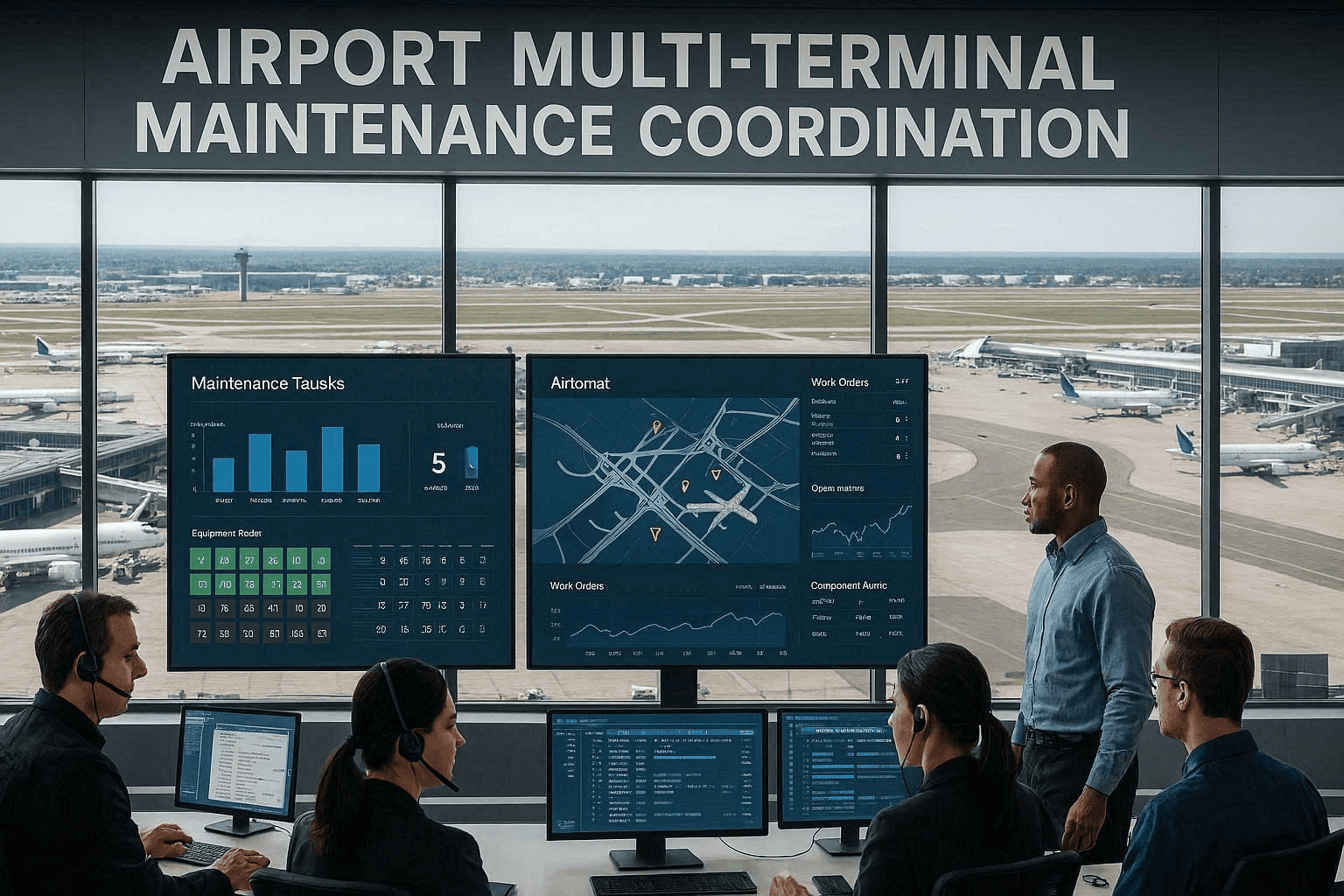
Multi-terminal maintenance coordination is the practice of managing preventive and corrective maintenance across all terminals, concourses, and airside zones from a single operational dashboard — with unified work order queues, shared crew pools, synchronized asset records, and consolidated compliance documentation. Without it, Terminal A doesn't know Terminal B's technician is idle. Overnight escalator PM in Concourse C gets missed because the crew was pulled to an emergency in Terminal 1. Audit records live in four different spreadsheets. Centralized coordination eliminates these gaps by connecting every technician, every asset, and every work order into one command view — regardless of how many buildings an airport operates.
The 6 Infrastructure Zones a Centralized CMMS Must Cover
Terminal Systems
HVAC, escalators, elevators, passenger boarding bridges, retail infrastructure — each terminal with its own asset register linked to the central dashboard
Baggage Handling (BHS)
Conveyor motors, sortation systems, carousel drives, and chute mechanisms — high-frequency PM with IoT anomaly detection to prevent peak-hour failures
Airfield Infrastructure
Runway lighting, taxiway systems, PAPI/VASI aids, pavement condition — all requiring strict documentation for FAA/ICAO certification maintenance
Ground Support Equipment
Tugs, belt loaders, pushback tractors, deicers, fuel trucks — runtime-based PM scheduling across the full GSE fleet with operator inspection checklists
Utility Systems
Electrical distribution, backup generators, water systems, fuel hydrant corridors — centralized monitoring with SCADA integration and automated fault work orders
Security Infrastructure
CCTV systems, access control, checkpoint equipment, perimeter fencing — maintenance actions logged with zone-access permissions and permit-to-work workflows
Why Siloed Terminal Maintenance Fails at Scale
The operational cost of fragmented terminal maintenance rarely shows up in one dramatic number. It accumulates invisibly — in deferred PMs that were never rescheduled, technician travel time that wasn't tracked, spare parts ordered twice because two terminals didn't know about each other's inventory. Here's where the real damage occurs. Book a demo to see how Oxmaint eliminates these coordination gaps across your terminal footprint.
Terminal supervisors can't see which technicians are available in adjacent concourses. A technician idle in Terminal B can't be redeployed to an urgent job in Terminal C. Cross-terminal labor efficiency drops 25–35%.
Each terminal keeps its own inspection logs, PM records, and safety documentation. Auditors must cross-reference multiple systems. Compliance gaps fall between the cracks — costing airports FAA certification risk.
Parts stocked at Terminal A aren't visible to Terminal B. Emergency repairs trigger duplicate ordering. Carrying cost inflates, stockouts still happen, and critical spares age out unused in the wrong building.
Airport leadership sees individual terminal reports, not portfolio-level MTBF, compliance rates, or CapEx exposure. Capital decisions are made without knowing which terminal assets are approaching end-of-life simultaneously.
How Oxmaint Centralizes Multi-Terminal Operations
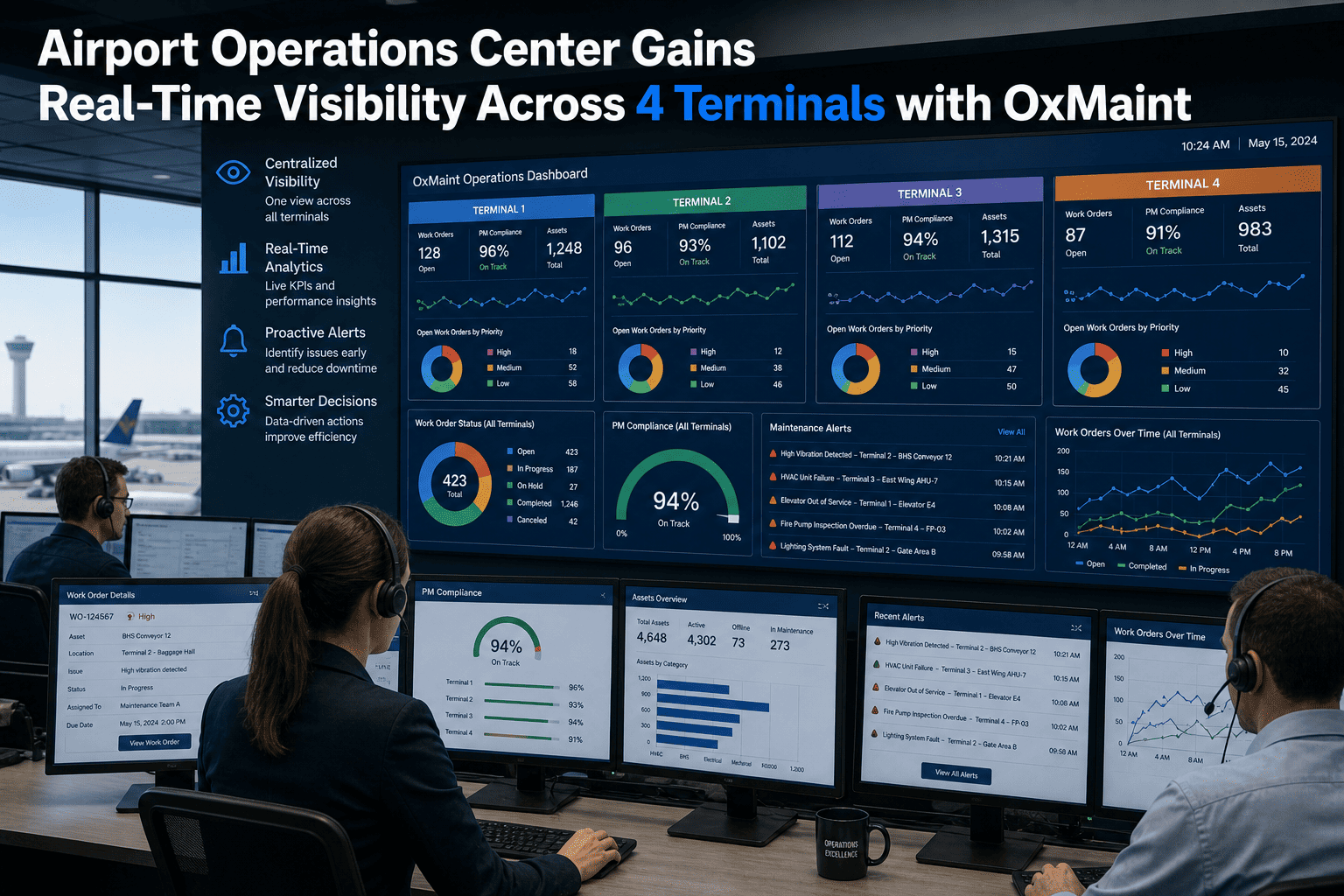
Oxmaint's airport CMMS is built around a hierarchy that mirrors how airports actually operate: Portfolio → Terminal → System → Asset → Component. Every work order, inspection, and compliance record sits within this structure — giving operations leadership a single dashboard that shows the health of every terminal without losing asset-level detail. Start a free trial and build your airport's asset hierarchy in the first week.
Crew Allocation
Cross-Terminal Dispatch
Live technician availability map across all terminals. Supervisors assign work orders to the nearest qualified technician regardless of their home terminal — reducing travel time and idle capacity
Work Order Management
Unified Work Queue
All terminals feed into one work order queue with priority ranking, terminal tagging, and zone-access permissions. No job falls through the cracks between buildings
Compliance Automation
Single Audit Record
Every maintenance action across every terminal is auto-tagged with its regulatory domain — FAA, ICAO, NFPA, TSA — and compiled into one-click audit reports for any authority
Inventory Control
Shared Parts Visibility
One inventory view covers all terminal storerooms. When Terminal A uses the last bearing for a BHS motor, Terminal B's job with the same part gets flagged and reorder is triggered automatically
Flight Integration
Schedule-Aware PM Booking
CMMS ingests live flight schedule data and automatically schedules gate, bridge, and airfield maintenance during defined operational windows — pre-dawn, between banks, or overnight
Executive Reporting
Portfolio Performance Dashboard
Airport directors see terminal-by-terminal KPIs — PM compliance, MTBF, backlog age, cost per terminal — with drill-down to individual asset health and CapEx forecasts per building
Centralized vs. Siloed: The Operational Comparison
Siloed Terminal Maintenance
✕ Separate spreadsheets per terminal — no consolidated view
✕ Technicians idle in one terminal while another is short-staffed
✕ Duplicate parts orders across terminal storerooms
✕ Compliance gaps fall between building records at audit time
✕ No portfolio CapEx visibility — decisions made on guesswork
✕ Flight schedule conflicts discovered after maintenance is booked
Centralized CMMS (Oxmaint)
✓ One dashboard — all terminals, all assets, all work orders
✓ Cross-terminal crew dispatch — no idle technician goes unused
✓ Single inventory pool — shared visibility eliminates duplicates
✓ All compliance records unified — 97% audit pass rate achieved
✓ 5–10 year CapEx model covers all terminals simultaneously
✓ Flight-schedule integration auto-books maintenance windows
Results: What Airports Achieve After Centralization
25–35%
Labor efficiency gain from cross-terminal crew visibility and dispatch
82%
BHS downtime reduction after centralized predictive monitoring
97%
Compliance audit pass rate — up from 64% pre-centralization
4–8×
Emergency repair cost avoided vs. planned maintenance interventions
Your Terminals Are Running. Your Maintenance Data Shouldn't Be Siloed.
Oxmaint connects every terminal, every technician, and every asset into one command dashboard — with centralized compliance, shared inventory, and cross-terminal crew dispatch built for 24/7 aviation operations.
Frequently Asked Questions
How does Oxmaint handle maintenance across terminals with different regulatory requirements?
Oxmaint supports multi-standard compliance tracking with separate inspection templates, schedules, and documentation requirements for each regulatory framework — ICAO, FAA Part 139, NFPA, TSA. Every maintenance action is auto-tagged to its regulatory domain and compiled into agency-specific audit reports. One airport CMMS can simultaneously satisfy multiple overlapping standards without manual cross-referencing.
Start a free trial and configure your compliance frameworks in week one.
Can the CMMS schedule maintenance around flight operations across different gates and terminals?
Yes. Oxmaint integrates live flight schedule data so maintenance on gates, boarding bridges, and airfield areas is automatically scheduled during defined operational windows — overnight, pre-dawn, or between scheduled flight banks. When a gate becomes available unexpectedly, the CMMS can push forward queued PM tasks. Emergency work orders on active gates trigger automatic airline operations notification to coordinate access.
What's the realistic timeline to get multi-terminal coordination operational?
Most airports establish baseline multi-terminal visibility within the first two weeks — asset hierarchy setup, work order templates, and mobile technician access. Full cross-terminal crew dispatch and shared inventory visibility is typically running within 30 days. Predictive monitoring on BHS and critical terminal systems follows in month two as IoT sensor integration completes. Oxmaint's implementation doesn't require long onboarding engagements or heavy IT involvement.
How does centralized reporting help airport leadership make CapEx decisions?
Oxmaint's portfolio dashboard gives airport directors terminal-by-terminal asset condition scores, age profiles, maintenance cost histories, and failure rates — all feeding into a rolling 5–10 year CapEx forecast. Leadership can see which terminals have the most assets approaching end-of-life simultaneously, rank capital investments by risk exposure, and present data-backed budget requests rather than estimates. This investor-grade reporting replaces guesswork with documented evidence.

.png)