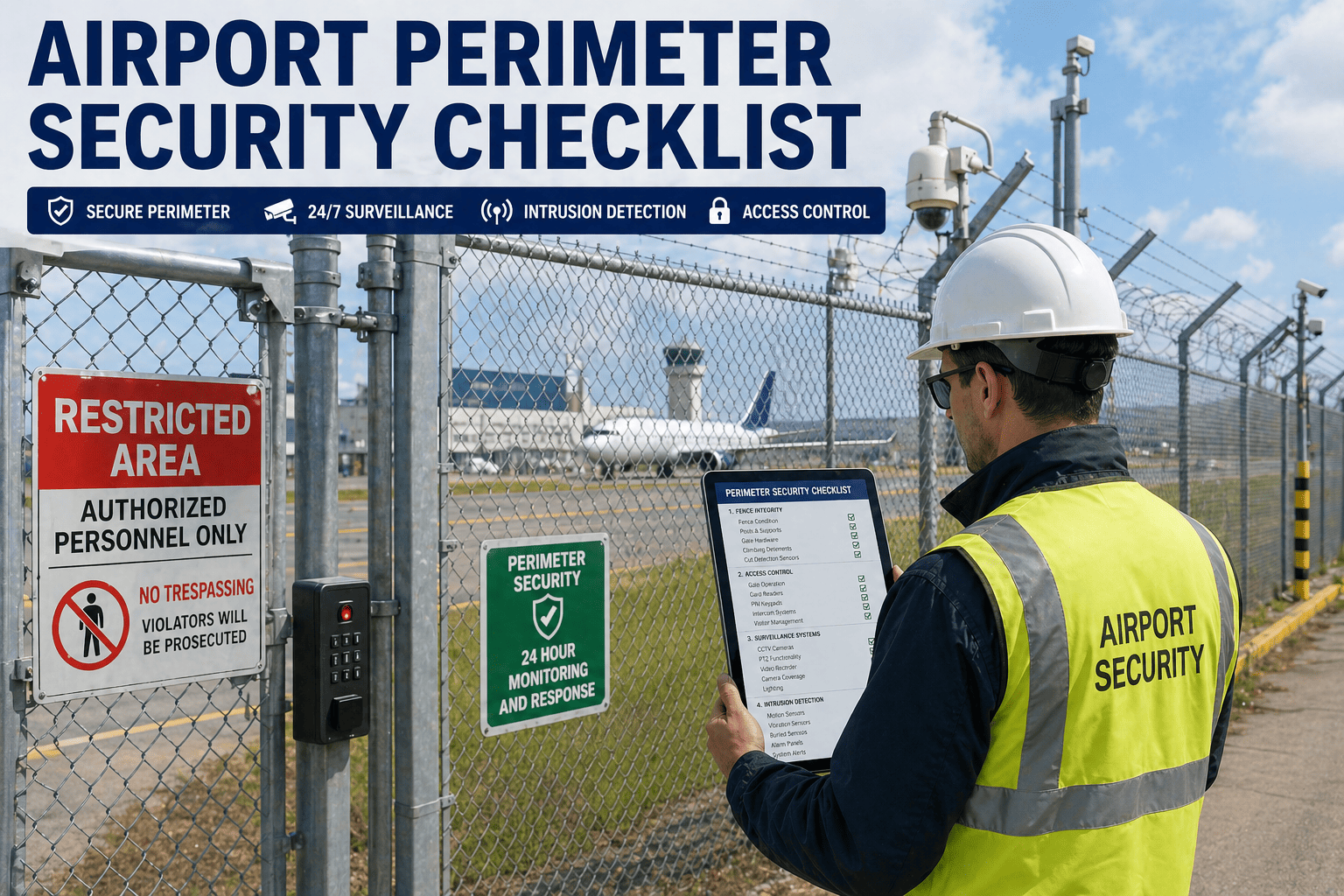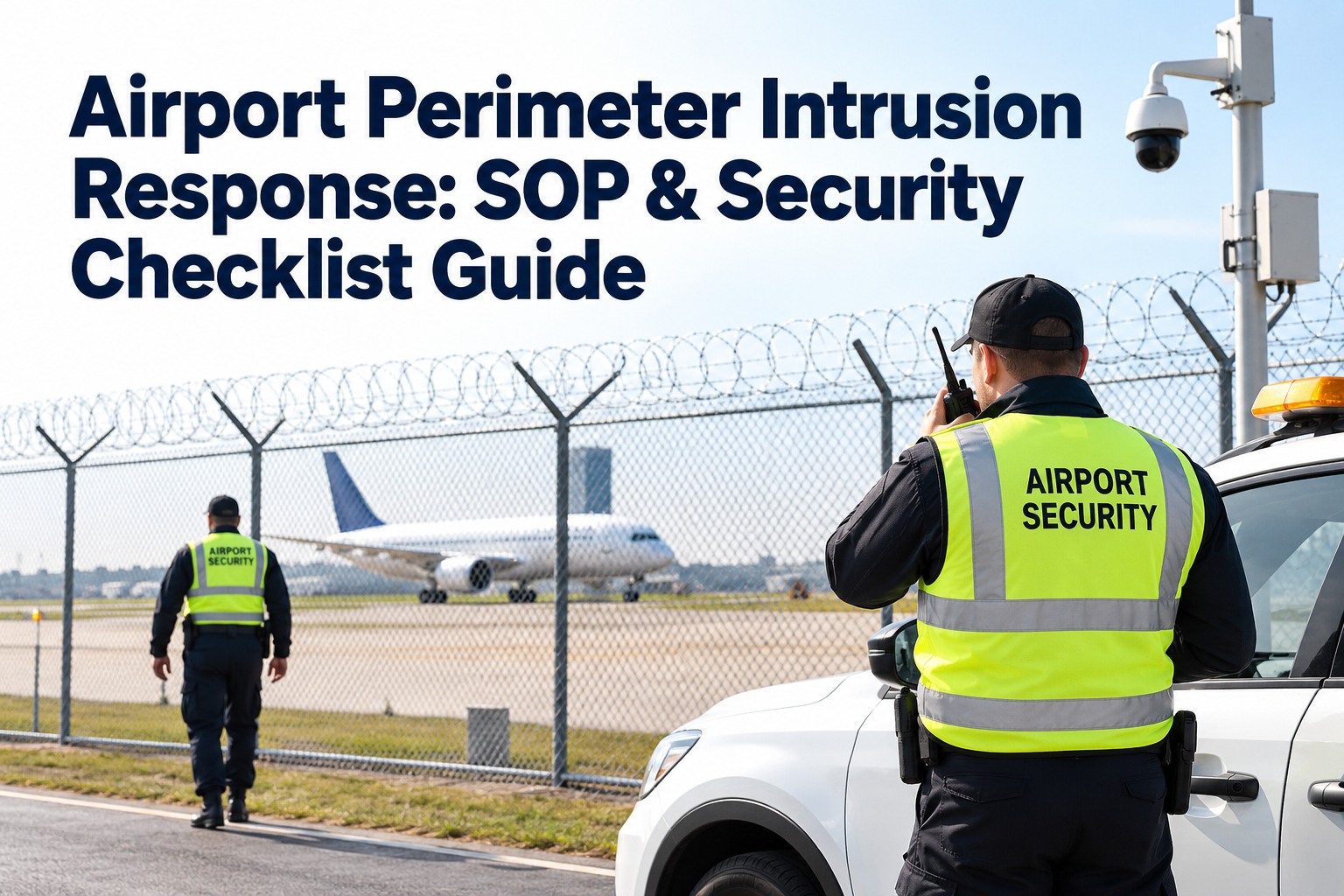
A fence sensor trips at the far end of the airfield at 2 a.m. — and the next ninety seconds decide whether it becomes a logged non-event or a security incident on the air operations area. Without a standard response procedure, the operator hesitates, the notification chain is improvised, evidence is lost, and the corrective action never gets tracked. This guide lays out a phase-by-phase perimeter intrusion response SOP with an action checklist for each stage, and shows how OXMAINT AI, the AI-powered airport CMMS, logs every intrusion as an incident with its corrective-action trail intact for TSA review.
Airport Perimeter Intrusion Response: SOP & Security Checklist
A sensor alarm with no procedure behind it, a notification chain made up on the spot, an incident report that never links to a corrective action — that's how a perimeter breach becomes a TSA finding. OXMAINT AI, the AI-powered CMMS and maintenance management software, runs the response as a standard workflow: verify the detection, drive the notification and containment steps, capture the evidence, and log the whole incident with its corrective actions against the affected perimeter asset.
Why a Standard Response Beats a Scramble
An intrusion alarm is a decision made under time pressure, in the dark, often by a lone operator — exactly when improvisation fails. A written SOP removes the guesswork: who verifies, who gets called, what gets contained, what gets recorded. It also satisfies the paperwork, since every perimeter incident under TSA Part 1542 needs a documented response and corrective-action trail. Build the sequence once and the operator just follows it. Book a demo to see the response SOP in OXMAINT AI.
The Six-Phase Intrusion Response
Every intrusion runs through the same six phases in order — skip one and the response has a gap a reviewer will find. OXMAINT AI structures each phase with its checklist, timestamping the progression against the perimeter asset. Start free and run the phased response in OXMAINT AI.
A Breach You Can’t Document Is a Finding Waiting to Happen.
The response may be flawless, but under Part 1542 the record is what the review turns on — detection time, classification, notifications, compensating measures, and the corrective action that closed the gap. OXMAINT AI captures all of it as one incident against the perimeter asset, exportable on demand.
The Notification Chain
Notification is where improvised responses break down — the wrong person called, or the right one called too late. A defined chain fixes the order in advance so no one has to decide under pressure. OXMAINT AI records each notification with its timestamp. Book a demo to map your notification chain in OXMAINT AI.
What Part 1542 Expects on the Record
The response SOP exists inside a regulatory frame, and the record it produces has to meet TSA Part 1542. These are the obligations the incident file has to satisfy. OXMAINT AI captures each as a structured field. Start free and build a 1542-ready record in OXMAINT AI.
| Obligation | What the record holds | Retention |
|---|---|---|
| Incident report | Type, time, location, description and corrective actions linked to the asset | Per ASP — often longer for incidents |
| Access-control malfunction | Date/time, location, security risk, compensating measures, repair completion | Per ASP |
| Perimeter inspection log | Timestamped, GPS-logged gate, fence and lighting checks | Minimum per ASP |
| Security Directive action | Completion dates and responsible parties for TSA directives | Per directive |
| Corrective-action trail | Owner, due date, verification and closeout for each finding | With the incident |
Retention periods are set by the airport's own Security Program — commonly a minimum of around two years for most record types and longer for certain incident records. OXMAINT AI keeps every record retrievable by asset, zone and date for the full period.
From Alarm to Closed Incident in One System
The value of running the SOP in a CMMS is that the response and its record are the same act — nothing is reconstructed afterward. OXMAINT AI carries the event from the alarm to a closed, exportable incident. Book a demo to walk the full incident loop in OXMAINT AI.
We had good people and good sensors, but every intrusion response looked a little different depending on who was on console — and the paperwork was always the weak point when TSA came through. Putting the SOP into the system fixed both: the operator follows the same six phases every time, the notifications are timestamped as they happen, and the breach repair is a work order linked straight to the incident. When an inspector asks how we handled an alarm from three months ago, it's one record with the whole trail in it.
Frequently Asked Questions
Respond the Same Way Every Time — and Prove It.
Run perimeter intrusion response on the OXMAINT AI maintenance management software — a six-phase SOP from detection to corrective action, a fixed notification chain, GPS-tagged evidence, compensating-measure logging, and a 1542-ready incident record retrievable by asset and zone. Take the guesswork out of the alarm and the gaps out of the file.