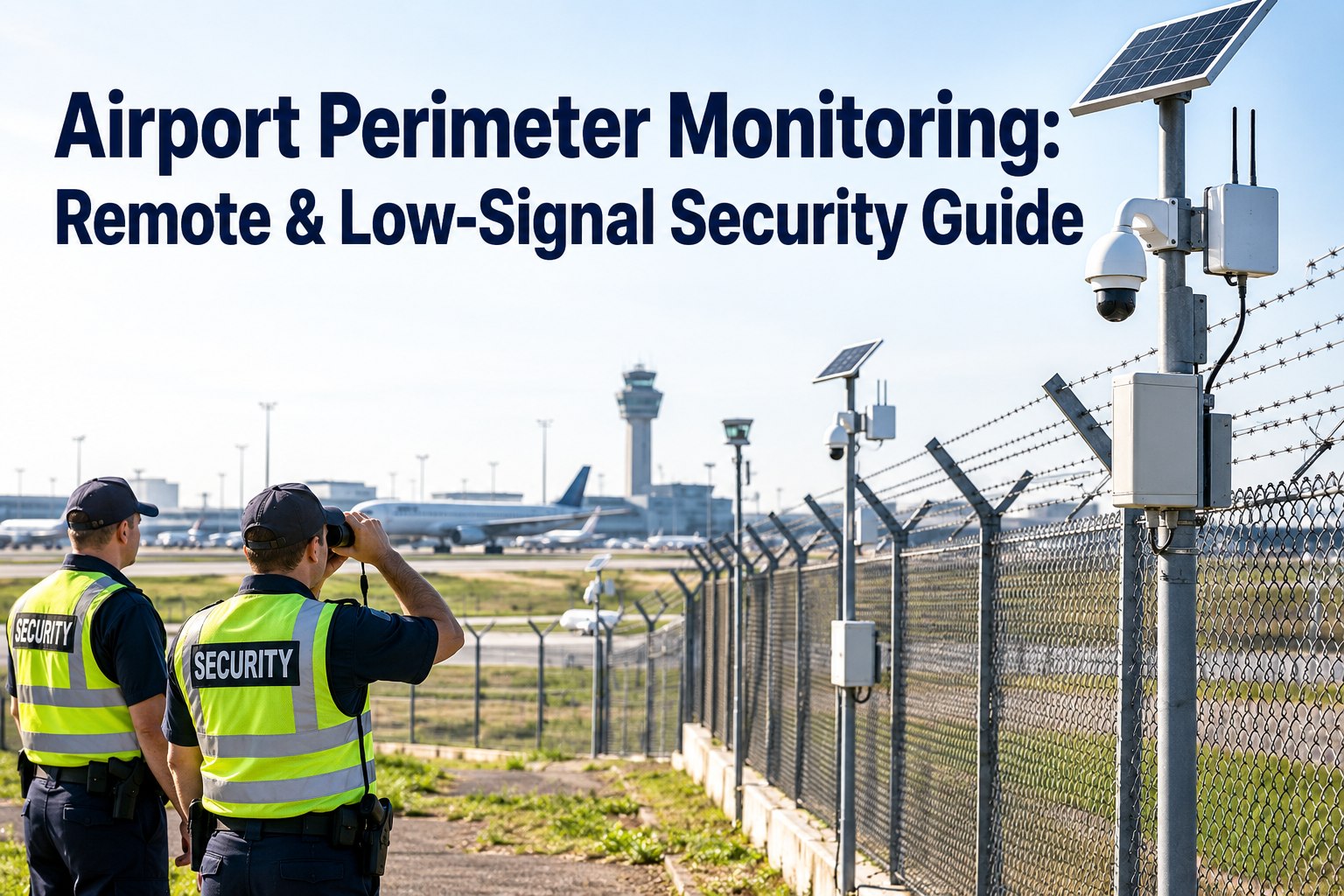
Airport Perimeter Monitoring: Remote & Low-Signal Security Guide

By William Jerry on October 6, 2026

airport-perimeter-monitoring-remote-low-signal-guide

A sensor on the far fence goes quiet at 2 a.m. — no cell tower, no mains power, and a cut i  the fence nobody sees until the morning walk. Those dark stretches aren't dark because sensors are missing, but because the signal and power give out before the fence does. OXMAINT AI is the AI-powered maintenance management software that keeps every remote node alive and turns each intrusion alert and weak-battery warning into a tracked, prioritized work order — even over a satellite link with no bars.

Remote Perimeter · Low-Signal IoT · Solar Nodes · Mesh · Satellite Backhaul · 2026

Airport Perimeter Monitoring Where the Signal Runs Out

Most of a 20–40 km fence line sits far from a cell tower and farther from a power feed — and those low-signal zones are exactly where blind spots form. The OXMAINT AI maintenance management software closes them: it carries both the intrusion alert and the node's own health back over mesh and satellite, then turns each into a ranked, assigned, verified work order before anyone finds the gap.

1Detect → 2Relay → 3Alert → 4Work Order
Solar sensor node
battery + panel, sips power
→
LoRa mesh hop
node-to-node, long range
→
Edge gateway
buffers, then forwards
→
Satellite / cellular
backhaul off-grid
→
OXMAINT AI
alert → work order
20–40 km
typical fence line a hub airport must watch end to end
345
perimeter breaches an AP investigation logged across 31 of the busiest US airports
Up to 16 km
perimeter a single fiber-optic sensor line can cover from one point
Years
a solar-and-battery LoRa node can run between service visits

Why the Edge of the Perimeter Goes Dark

A fence line is continuous; the cell coverage and power behind it are not. That leaves long, quiet runs where a sensor can fail — or be defeated — and nobody knows for hours. The OXMAINT AI maintenance management software puts every remote node on one view, so those dark zones stop being a guess; book a demo to map the low-signal zones on your fence line in OXMAINT AI.

No cellular signal
Past the apron, bars fade to nothing. A sensor that can't phone home is a sensor you're trusting on faith.
No mains power
Trenching power to every corner is cost-prohibitive, so remote nodes live on solar and a battery — and batteries fade.
Distance from the room
A breach at the far fence is kilometres from the responders. Minutes of blind time is all an intruder needs.
Alarm fatigue
Dial sensitivity up and wildlife trips it all night; dial it down and a real intrusion slips through unseen.

The Low-Signal Connectivity Stack, Layer by Layer

Monitoring a perimeter with no coverage or power isn't one device — it's four layers, each covering the weak link in the next: the node senses, the mesh relays, the gateway backhauls, and the OXMAINT AI maintenance management software turns whatever lands into a work order. Get the layering right and a corner with zero bars still reports for years on a small panel; start free and put your remote nodes on one live view in OXMAINT AI.

LAYER 1Node
Solar sensor node — sips power, listens all day
A low-power radio node runs on a small panel and battery, waking only to send short messages. It carries the detection sensor — vibration, seismic, beam-break — and its own health readings: charge level, link quality, a heartbeat.
Survives low signal by sending tiny packets rarely
LAYER 2Mesh
Self-forming mesh — every node is also a relay
Nodes pass messages node-to-node, so a corner far from any gateway still gets its data out through its neighbours. A self-organizing LoRa mesh can span tens of square kilometres and reroute itself when one path weakens.
Survives low signal by routing around the weak hop
LAYER 3Backhaul
Edge gateway — buffers, then backhauls off-grid
The gateway gathers the mesh traffic and sends it onward over whatever reaches the sky: cellular where it exists, satellite where it doesn't. If the link is down, it holds the events and forwards them the moment a window opens.
Survives low signal by store-and-forward over satellite
LAYER 4Platform
OXMAINT AI — turns the signal into action
Every alert and every health reading lands in one platform. A detection becomes a ranked work order; a fading battery becomes a service task before the node dies. Nothing ends in a dashboard nobody is watching.
Closes the loop with an auto work order

What the Sensors on the Fence Actually Watch

No single sensor fits every stretch of fence, and at the edge each one's power and bandwidth appetite decides where it can live. Whichever mix you run, the OXMAINT AI maintenance management software takes the feed and keeps every sensor on a service and health schedule; book a demo to match sensor types to your fence zones in OXMAINT AI.

Sensor typeWhat it sensesPower & data profileWhat a breach looks like
Fiber-optic fence line Vibration of a cut, climb or lean on the fence fabric Passive cable; processing at one powered controller covers a long run A vibration signature pinned to a spot along the cable
Buried seismic cable Footsteps and digging near a covert, fenceless line Low-power zones; small event packets suit mesh relay Ground movement where no one should be walking
Microwave or radar beam A body crossing an invisible beam or open gap Higher draw, short reach; best at a powered gate or gap A beam broken, or a track moving toward the line
Thermal camera Heat of a person in zero visibility, day or night Power- and bandwidth-heavy; needs local analytics at the edge A warm shape loitering or approaching the fence
Drone (UAS) detection Radio signature of an aircraft over or near the field Moderate draw; sited at zone hubs to listen wide An unknown signal with no friend-or-foe match

A Sensor That Can't Report Is Already a Blind Spot.

The point of a remote perimeter isn't more hardware on the fence — it's making sure every node's signal reaches software that acts on it. The OXMAINT AI maintenance management software carries both the intrusion alert and the node's own health back over mesh and satellite, and turns each one into a ranked, assigned, verified work order.

How an Event Gets Home When the Link Is Down

The hard part isn't detecting an event — it's not losing it while the backhaul is asleep. Store-and-forward holds the event at the edge and delivers it the moment a window opens, in order, with nothing lost. The OXMAINT AI maintenance management software runs that chain end to end, so no detection slips through a weak link; start free and see a buffered alert arrive intact in OXMAINT AI.

01
Event detected
A fiber or seismic sensor picks up a cut, a climb or digging and tags it with the node's exact location.
↓
02
Buffered at the edge
If the backhaul link is down, the event is held at the gateway rather than lost — the message waits, it doesn't vanish.
↓
03
Relayed on the next window
The moment a satellite pass or cellular window opens, buffered events backhaul in order, timestamped as they occurred.
↓
04
Classified by zone
OXMAINT AI reads the event, weighs it by the zone's criticality, and tells a real intrusion apart from a known nuisance.
↓
05
Work order raised
A prioritized, assigned work order lands with location, sensor and history attached — the responder gets a job, not a ping.

Two Failures Hide at the Edge — and Only One Trips an Alarm

Everyone plans for the intruder; far fewer plan for the sensor that quietly dies first and leaves a blind spot behind. The OXMAINT AI maintenance management software makes that silence loud — it treats a missed heartbeat as a job, not a footnote, and works both failures at once; book a demo to see a silent node raise a work order in OXMAINT AI.

THE INTRUSION
Someone cuts, climbs or digs
Sensor fires a located detection
Event classified against the zone's criticality
Work order to secure the point and repair the fence
Response and repair logged with time and evidence
Loud by design — the alarm is the easy half.
THE DEAD NODE
A sensor quietly stops reporting
Battery fades, mesh path lost, or heartbeat missed
No alarm fires — the node simply goes silent
OXMAINT AI flags the silence as a health work order
Node restored before the gap can be exploited
Silent by nature — the half most systems miss.

Reading a Node by Its Health, Not Just Its Alarms

A remote node is never just on or off — it shifts through states as its battery, link and heartbeat move. The OXMAINT AI maintenance management software keys an action to each one, so a node is serviced on the way down instead of replaced after it's gone dark; start free and watch your nodes on this ladder in OXMAINT AI.


Online — strong link
Reporting on schedule, battery healthy, clean signal.
Routine heartbeat — no action

Online — weak signal
Still reporting, but retries are climbing and the mesh path is marginal.
Health task queued — check the path

Low battery
Solar charge is falling behind the draw; days of runtime left, not weeks.
Service work order before it dies

Missed heartbeat
Silent past its reporting window — a possible tamper, fault or flat battery.
Priority check — treat as suspect

Offline
No contact at all; the stretch it covered is now unwatched.
Immediate dispatch — zone is a blind spot

How OXMAINT AI Keeps a Low-Signal Perimeter Alive

The sensors, mesh and backhaul get the signal out of the dark; the OXMAINT AI maintenance management software is what makes it matter — ingesting every event, watching every node's health, and running the loop to a closed job. It sits on top of the detection you already own; book a demo to see it run on your perimeter in OXMAINT AI.

Any-sensor ingest
Fiber, seismic, radar, thermal and drone alerts flow into one event stream, whatever the brand on the fence.
Node-health watch
Battery, signal quality and heartbeat are tracked per node, so a fading sensor is a job long before it's a gap.
Outage-tolerant
Built for store-and-forward links — buffered events arrive in order over mesh or satellite, with nothing lost.
Auto work orders
An alert or a health warning becomes a ranked, assigned, verified work order — no manual re-keying in between.
Zone criticality routing
Runway-adjacent and airside zones jump the queue; a quiet back-fence nuisance never outranks a real threat.
Audit-ready record
Every alert, check and repair is timestamped and retained — the evidence trail a perimeter program is asked to show.

The Rules That Sit Behind the Fence

A remote perimeter answers to the same rules as the rest of the airport, and most come down to one demand: prove it was watched and maintained. The OXMAINT AI maintenance management software keeps that proof — timestamped and ready for an inspector — though holding the evidence is not the same as being compliant on its own; start free and let the evidence trail build itself in OXMAINT AI.

TSA 49 CFR 1542
A documented Airport Security Program covering perimeter inspection — conducted, recorded and retained for review.
FAA PART 139
Aerodrome operating standards under which the fence line and its safety-related upkeep are held to account.
ICAO ANNEX 17 & 14
Security fencing and perimeter protection (Annex 17) over the aerodrome boundary fence baseline (Annex 14).
ICAO DOC 8973
Aviation Security Manual guidance, including a clear, unobstructed space of at least six metres outside the fence.
“

Our blind spots were always the same two corners — no power, no signal, and a half-hour drive to check them. The change wasn't the sensors; it was that a flat battery now opens a work order on its own, days before the node would have gone dark. We stopped finding out about dead sensors from the fence and started finding out from the system.

Airport Operations & Facilities Manager · Regional International Airport

Frequently Asked Questions

What is remote, low-signal perimeter monitoring?
It's watching the stretches of fence that sit beyond cell coverage and mains power using self-powered sensor nodes, a mesh to carry their data, and satellite or cellular backhaul to reach a platform. The OXMAINT AI maintenance management software is the layer that turns what arrives into action. Start free and connect a remote node.
How do you monitor a fence with no signal or power?
Nodes run on solar and a battery and send tiny messages through a mesh, hop by hop, to a gateway that stores them and forwards over satellite when a window opens. Nothing is lost while the link is down — it's buffered and delivered in order.
Do we have to replace our existing PIDS, fiber or radar?
No. OXMAINT AI is built to ingest alerts from the fiber, seismic, radar and thermal sensors you already run and turn them into ranked work orders. You add the action and upkeep layer, not a second detection system. Book a demo to map your current setup.
How does this help with TSA and ICAO requirements?
Every alert, inspection and repair is timestamped and retained, so a documented perimeter record becomes a search instead of a scramble. The software keeps the proof; it doesn't by itself certify compliance, which rests on your security program.
What happens when a sensor itself fails?
A fading battery, a weak link or a missed heartbeat is flagged as a health work order before the node goes dark — so a silent sensor becomes a job, not an unseen blind spot. Start free and see a silent node raise a work order.

Light Up the Dark Corners of Your Fence Line.

Put every remote node on one live view with the OXMAINT AI maintenance management software — intrusion alerts and node health carried home over mesh and satellite, each one turned into a ranked, assigned, verified work order, and the whole trail timestamped for the next inspection. See the gaps before an intruder does.
Share This Story, Choose Your Platform!