A major international airport loses measurable non-aeronautical revenue every day its restrooms are below standard. Research from Airport Council International shows restroom cleanliness accounts for more than 50% of the total terminal cleanliness score — and cleanliness is the single largest weighted driver of passenger satisfaction in ASQ surveys globally. Hartsfield-Jackson Atlanta International Airport reported a 14.5% increase in customer satisfaction scores after implementing a data-driven restroom management system. That number is not cosmetic — it translates directly into dwell time, retail spend, and passenger loyalty. The airports that treat restroom and amenity maintenance as a facility management discipline — not a cleaning schedule — are pulling measurably ahead. Start a free trial with Oxmaint and build a demand-based amenity maintenance program from day one — or book a demo to see how work order automation drives restroom uptime.
Passenger Amenities · Smart Restrooms · Demand-Based Cleaning · CMMS
Restroom Maintenance That
Drives Passenger Satisfaction.
Not Just Cleanliness Scores.
Passengers judge airports by their restrooms. A missed cleaning cycle during a peak arrival bank is visible to thousands of travelers simultaneously. A smart, CMMS-driven maintenance program turns restroom management from a reactive cleaning schedule into a proactive, data-backed passenger experience operation.
Oxmaint helps airport operations teams manage restroom and amenity maintenance at scale — with real-time work orders, inspection tracking, and compliance records in one platform.
Demand-Based Scheduling
IoT Sensor Integration
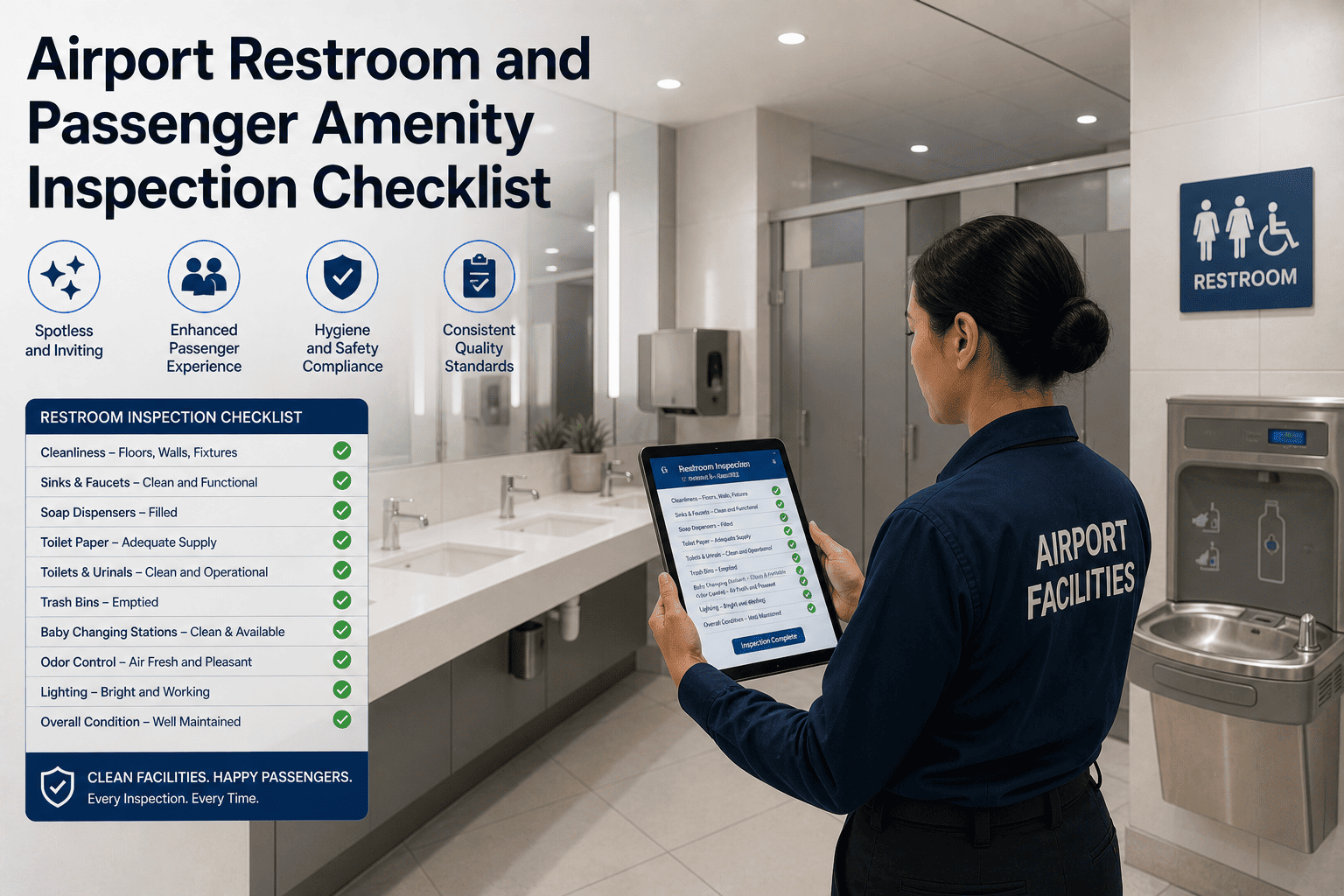
Digital Inspections
Hygiene Compliance
Amenity Asset Tracking
Passenger Satisfaction
50%+
Of Cleanliness Score
Restrooms account for over half of a terminal's total cleanliness score in global ASQ surveys
14.5%
Satisfaction Gain
ATL airport's increase in satisfaction scores after data-driven restroom management implementation
40%
Water Savings
Touchless sensor-controlled fixtures reduce water usage by up to 40% versus standard fittings
18%
Maintenance Cost Reduction
Airports using smart restroom monitoring report up to 18% lower cleaning and maintenance costs
The Fundamentals
Why Airport Restroom Maintenance Is a Revenue-Critical Discipline
Restrooms are the only airport amenity that virtually every passenger uses — often twice during a journey. The state of a restroom at the first and last contact point disproportionately shapes the traveler's overall experience rating, their dwell time, and ultimately their commercial spend in the terminal.
01
Bookend Effect
Passengers visit restrooms at arrival and departure — they form their first and final impressions there. A clean restroom on departure becomes a lasting positive memory. A dirty one on arrival creates a negative framing for the entire journey.
02
Dwell Time Link
Poor facility standards trigger escape behavior — passengers move toward their gate early instead of lingering in retail and F&B zones. A positive restroom experience encourages dwell time, directly linked to non-aeronautical revenue per passenger.
03
Perception Transfer
Passengers rate airport quality, airline selection, and overall travel sentiment based on facility standards. A clean, well-maintained terminal signals operational competence — and that perception transfers to commercial confidence in airport retail.
04
Compliance Risk
Restroom maintenance is not just about passenger experience — it is a public health compliance requirement. Inadequate sanitation records, unresolved equipment defects, and poor hygiene logs create regulatory exposure and legal liability for airport operators.
Operational Pain Points
Where Traditional Restroom Programs Break Down
Schedule-based restroom maintenance was designed for predictable traffic — it fails airports with dynamic, flight-correlated passenger surges that no static timetable can anticipate. These are the failure modes that lead to satisfaction drops and compliance issues. Book a demo to see how Oxmaint replaces static schedules with demand-based maintenance triggers.
Staff Deployed at Wrong Times
Hourly cleaning schedules do not align with flight arrival banks. Staff cleans an underused restroom at 10am and misses the 11am international arrival surge — exactly when 400 passengers need a clean facility.
No Visibility on Supply Levels
Paper towels, soap, and sanitary supplies run out mid-peak because replenishment is inspection-based, not sensor-monitored. A single empty soap dispenser during a busy period creates a hygiene incident that passengers photograph and share.
Equipment Failures Go Undetected
A broken hand dryer, faulty sensor, or leaking fixture can sit unfixed for hours — or days — because there is no automated fault reporting. Technicians only discover issues during their next scheduled round, not when the failure occurs.
Paper-Based Compliance Records
Cleaning logs completed on paper cannot be audited in real time. If a complaint or regulatory inquiry arises, manual records are incomplete, delayed, and often missing the who-what-when detail needed for defensible hygiene compliance documentation.
Oxmaint Solution Framework
How Oxmaint Powers World-Class Restroom and Amenity Maintenance
Oxmaint connects IoT sensors, work order management, and digital inspection tools into a single platform — enabling airport operations teams to shift from schedule-based to demand-based maintenance across all passenger amenity facilities. Start a free trial and build your first demand-based cleaning workflow in under a day.
Smart Scheduling
Flight-Correlated Cleaning Triggers
Oxmaint integrates with flight data feeds to anticipate passenger surge events. Cleaning work orders are automatically dispatched 15–20 minutes before large arrival banks — staff are in position before the passengers arrive.
IoT Integration
Occupancy and Supply Sensor Monitoring
Occupancy counters, soap dispensers, paper towel monitors, and air quality sensors feed real-time data into Oxmaint. When a dispenser drops below 20% capacity or a restroom exceeds threshold occupancy, a work order is automatically generated and assigned.
Digital Inspections
Mobile-First Checklist and Sign-Off
Every cleaning and inspection event is captured digitally — time-stamped, geo-tagged, and linked to the specific restroom asset record. Supervisors receive completion notifications in real time. No paper logs. No missing records.
Equipment Tracking
Restroom Asset Registry and PM Scheduling
Every hand dryer, faucet, soap dispenser, flush valve, and lighting fixture is a tracked asset in Oxmaint. Preventive maintenance schedules are attached — quarterly inspections, annual calibrations, and immediate fault reporting all managed from a single asset record.
Compliance Automation
Audit-Ready Hygiene Documentation
Oxmaint automatically generates hygiene compliance reports — technician actions, timestamps, photo evidence, and supervisor sign-offs compiled into audit-ready records. Regulatory inquiries are answered in minutes, not hours.
Multi-Terminal Management
Portfolio-Level Amenity Oversight
For airports with multiple terminals, concourses, or satellite facilities, Oxmaint provides a single view of all amenity maintenance KPIs — equipment uptime, cleaning completion rates, supply levels, and compliance status across the entire estate.
Before vs. After
Reactive Cleaning Schedule vs. CMMS-Driven Amenity Management
| Area |
Traditional Schedule-Based Approach |
Oxmaint CMMS-Driven Approach |
| Cleaning Trigger |
Fixed hourly schedule — blind to actual traffic |
Flight data + occupancy sensors — demand-based dispatch |
| Supply Replenishment |
Manual inspection rounds — supplies run out mid-peak |
Sensor-triggered work order when level drops below threshold |
| Equipment Fault Detection |
Discovered during next scheduled round — hours later |
Immediate fault alert — work order created and assigned in seconds |
| Compliance Records |
Paper logs — incomplete, delayed, not auditable in real time |
Digital, time-stamped records with photo evidence — audit-ready instantly |
| Staff Productivity |
90% of checks find no issues — wasted rounds at wrong times |
Staff deployed where and when needed — 30–40% productivity gain |
| Passenger Impact |
Reactive to complaints — damage already done to satisfaction score |
Proactive — facilities maintained at standard before passenger peak hits |
ROI Results
Measured Outcomes from Smart Restroom and Amenity Programs
90%
Fewer Unnecessary Checks
Sensor-driven dispatch eliminates redundant cleaning rounds — staff time is redirected to actual demand events
18%
Lower Maintenance Costs
Smart restroom monitoring programs consistently deliver cost reductions through optimized staffing and reduced emergency repairs
40%
Water Usage Reduction
Sensor-controlled touchless fixtures and IoT-monitored leak detection compound to deliver significant sustainability gains
25%+
Satisfaction Score Gain
Airports implementing demand-based restroom programs report passenger satisfaction gains averaging 14–25% across multiple ASQ measurement periods
Expert FAQ
Airport Restroom and Amenity Maintenance — Common Questions
How does CMMS improve airport restroom cleaning efficiency beyond a standard schedule?
A standard cleaning schedule is built on averages — average occupancy, average traffic, average supply consumption. A CMMS connected to IoT sensors operates on actuals. When occupancy counters detect a surge (e.g., a 400-person international arrival at Gate C14), the CMMS dispatches a cleaning crew before the first passenger reaches the restroom. When a soap dispenser drops below 20% fill level, a work order is generated immediately — not discovered empty an hour later during a manual round. The aggregate effect is that staff are deployed where they are actually needed, when they're needed — reducing wasted rounds by up to 90% while improving restroom availability during peak periods.
What restroom equipment should be registered as maintainable assets in a CMMS?
Every piece of fixed equipment in a restroom that has a maintenance, inspection, or replacement cycle should be in your CMMS: hand dryers, sensor faucets, soap dispensers, flush valves, ventilation fans, lighting fixtures, baby changing stations, accessible door openers, and hot water systems. For smart restrooms, this extends to occupancy counters, air quality sensors, and IoT dispensers. Each asset gets a preventive maintenance schedule, a fault reporting workflow, and a maintenance history log. When a hand dryer fails, a tech receives a precise work order — not a vague complaint from a passenger that reaches a supervisor 40 minutes later.
How does Oxmaint handle hygiene compliance documentation for airport restrooms?
Every cleaning and inspection event completed through Oxmaint's mobile app is automatically recorded with a digital timestamp, technician ID, task completion status, and optional photo evidence. The platform generates compliance reports that aggregate this data — showing inspection frequency, completion rates, and any defect resolution timelines. For regulatory audits or passenger complaint investigations, this data is searchable and exportable in minutes. Oxmaint also supports digital signatures for supervisory sign-off on completed inspections — replacing manual paper logs entirely and creating a defensible compliance trail.
Does Oxmaint connect to smart restroom sensor hardware from third-party vendors?
Yes. Oxmaint integrates with IoT sensor data through API connections and standard protocols including MQTT and REST. Smart restroom hardware vendors — occupancy counter manufacturers, dispenser sensor suppliers, and air quality monitoring platforms — typically expose their data through APIs or cloud dashboards. Oxmaint connects to these data feeds and maps sensor readings to specific asset records, triggering work orders when thresholds are breached. The maintenance team receives actionable work orders, not raw sensor data — removing the interpretation step that slows response time in manual monitoring setups.
Restroom Quality Is a Revenue Decision. Treat It Like One.
Replace Your Cleaning Schedule With a Demand-Driven Maintenance System
Oxmaint gives airport operations teams the tools to manage restroom and passenger amenity maintenance with the same rigor as critical infrastructure. IoT sensor integration, automated work orders, digital inspections, and compliance documentation — all in one platform built for multi-terminal airport operations.