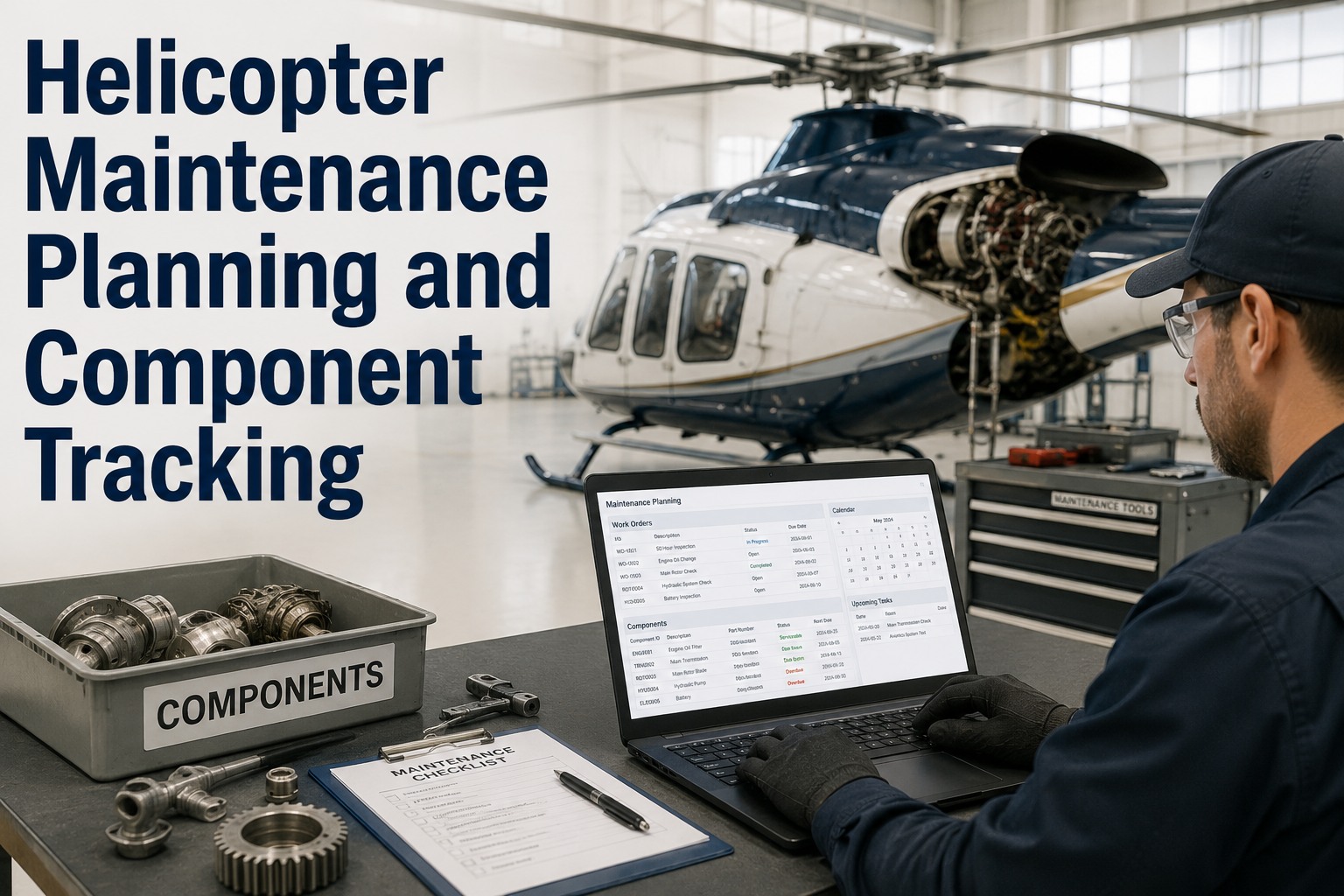
Helicopter maintenance planning is the discipline of keeping every life-limited component, inspection cycle and airworthiness directive aligned so no part ever flies past its limit — and it is measurably more demanding per flight hour than fixed-wing maintenance. Rotorcraft carry a higher density of life-limited parts (main rotor blades, gearboxes, drive shafts, swashplates), tighter inspection intervals, and mission profiles that consume component life at very different rates. This guide covers how reliability teams build a helicopter maintenance program around LLP tracking, cycle counting and mission-profile-based scheduling — and how a CMMS keeps component records and forecasts continuously aligned. If you are still tracking retirement lives in spreadsheets, you can Start Free Trial and see automated helicopter component tracking in minutes.
How do you keep every life-limited part inside its limit — on every aircraft, every day?
A single helicopter can carry 50–150 life-limited components, each with its own retirement life in flight hours, cycles or calendar time. One missed limit grounds the aircraft — or worse. This guide shows how operators plan helicopter maintenance and track components so nothing flies past its limit.
Why helicopter maintenance planning is harder than fixed-wing
Rotorcraft maintenance planning runs 2–3x more inspection events per flight hour than comparable fixed-wing operations. Four structural reasons drive that complexity — and each one multiplies the tracking burden.
Dense life-limited parts population
Main rotor heads, gearboxes, freewheel units, drive shafts and rotor blades all carry hard retirement lives. A medium twin can have 50–150 LLPs versus a fraction of that on a fixed-wing airframe — every one a compliance risk if it overruns.
Cycle counting, not just hours
Many rotorcraft components retire on cycles — engine starts, torque events, landings, hoist operations — not flight hours. A 20-minute HEMS flight with 3 landings can consume more cycle life than a 2-hour offshore shuttle.
Tighter, layered inspection cycles
Daily turnarounds, 25/50/100-hour checks, 300/600-hour inspections and annual or 12-month calendar items stack on top of each other. Miss the alignment and you ground an aircraft for a check that could have been merged with another.
Mission profiles change consumption rates
Utility lift, offshore crew change, HEMS, firefighting and training all burn component life differently. A helicopter maintenance schedule built on average hours will under-plan high-cycle fleets and over-service low-utilisation aircraft.
Helicopter component tracking: the 4 data streams you must keep aligned
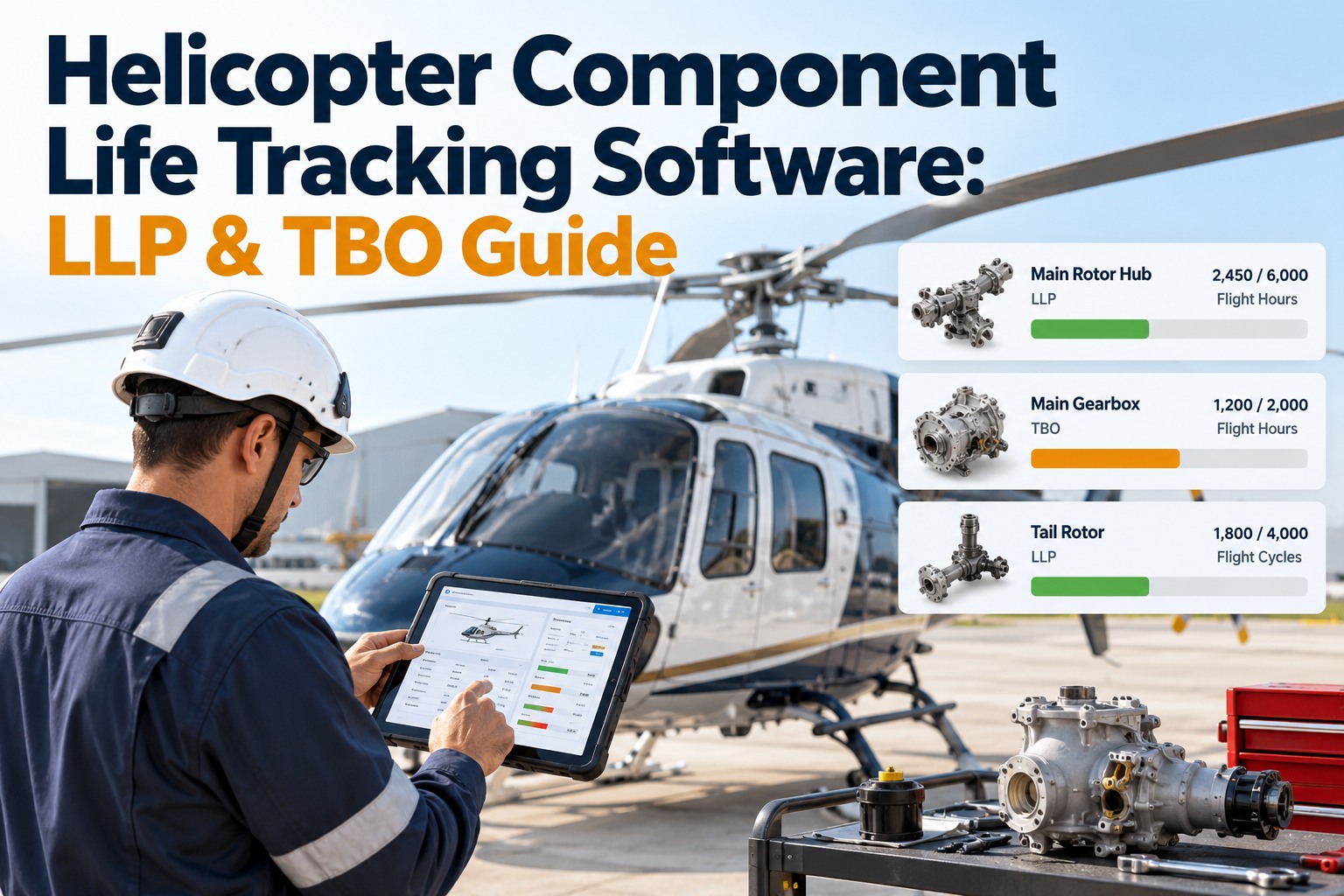
Every life-limited part lives in three clocks at once — flight hours, cycles and calendar time — plus a fourth stream of airworthiness directives. Rotorcraft component tracking fails when any one stream drifts from the others.
Flight-hour limits (TBO & retirement)
Time-between-overhaul and hard retirement lives in airframe or component hours. Source: Hobbs/airframe total time, updated after every flight. Typical error: logging delays of 24–72 hours that push forecasts out of date.
Cycle counting (starts, landings, torque events)
Engine starts, rotor engagements, landings and external-load lifts each consume cycle life. Manual cycle logs are the #1 source of LLP discrepancies found in audits — automated capture from flight logs removes the gap.
Calendar limits (months/years)
Seal life, hose life, NDI intervals and annual inspections expire on dates regardless of flying. Low-utilisation aircraft hit calendar limits first — the stream most spreadsheet-based helicopter maintenance tracking forgets.
Airworthiness directives & service bulletins
FAA/EASA ADs and manufacturer SBs add one-time and recurring tasks with their own thresholds. Each AD must be mapped to affected serial numbers and folded into the same forecast — not tracked in a separate binder.
What one missed limit costs: a real-world scenario
A 6-aircraft offshore operator tracking components in spreadsheets discovered a main-rotor hub 14 hours past retirement during a pre-audit review. The numbers below are typical for a single event of this kind.
"The part didn't fail — the paperwork did. We had the hours in three different spreadsheets and none of them agreed. After moving helicopter component management into OxMaint, our forecast is live after every flight and audit prep went from three weeks to two days."
How to build a helicopter maintenance schedule that matches your mission profile
Operators who align inspections to actual utilisation cut scheduled downtime 20–35% versus calendar-driven planning. The method is a rolling, usage-based forecast built in five steps.
Baseline every component's life status
Import each LLP with its serial number, total time, total cycles, calendar limit and remaining life. Verify against the aircraft logbooks — this one-time reconciliation is where most legacy errors surface.
Model utilisation per aircraft and mission
Set expected hours/month and cycles/hour by tail number and mission type. A HEMS aircraft at 3.5 cycles/hour forecasts very differently from an offshore shuttle at 1.2 — your helicopter maintenance program must reflect both.
Forecast due dates across all three clocks
Project every limit forward in hours, cycles and calendar simultaneously. The earliest of the three wins. This produces a 90/180/365-day due list per aircraft — the backbone of rotorcraft maintenance planning.
Cluster tasks into maintenance events
Group items due within a tolerance window (typically ±10%) into one hangar visit. Clustering a 100-hour check with two LLP changes and an AD inspection saves a full aircraft-grounding event per cluster.
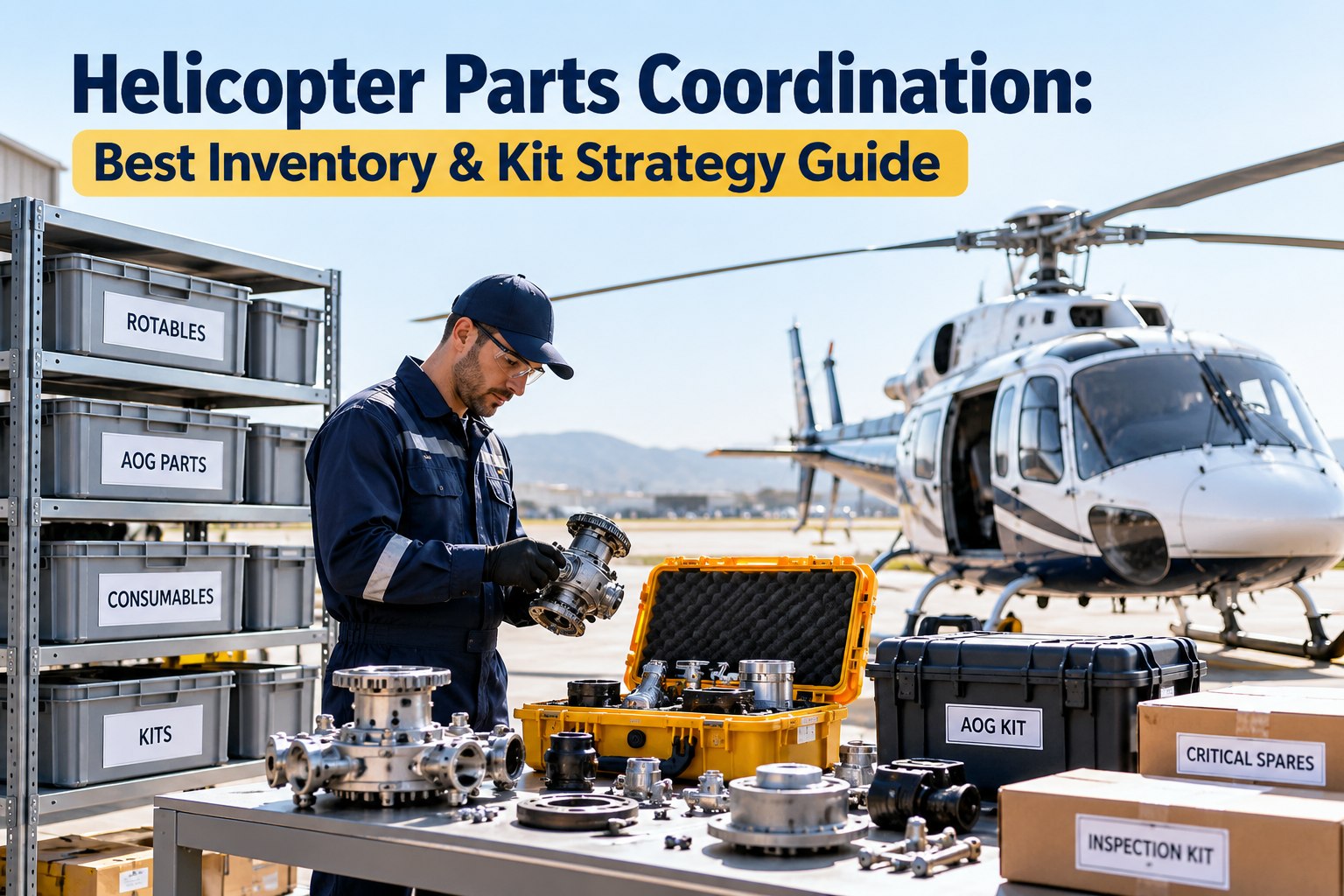
Pre-position parts and labour
Link the forecast to spare-parts inventory so rotables and life-limited spares are on the shelf 30–60 days before the event. Stockouts of a single rotable can idle a $12M aircraft — inventory must follow the forecast, not gut feel.
Helicopter maintenance compliance: what auditors check first
FAA Part 135 and EASA Part-CAMO audits consistently open with the same five records. Operators with continuous, system-generated component tracking close these items in hours; spreadsheet operators take weeks.
| Audit item | What the auditor wants | Spreadsheet risk | With OxMaint |
|---|---|---|---|
| LLP status report | Remaining life per part, per tail, current as of last flight | 24–72h stale; manual math errors | Live after every flight log |
| Cycle count reconciliation | Starts/landings matching flight records | #1 source of findings | Auto-captured from flight logs |
| AD compliance matrix | Every AD mapped to affected S/N with sign-off | Separate binder, easy to miss | ADs as tracked recurring tasks |
| Component history cards | Full life history: installs, removals, overhauls | Gaps between operators/MROs | Unbroken digital thread per S/N |
| Forecast vs. actual | Proof the maintenance schedule is controlled | No version control | Time-stamped, auditable forecast |
Helicopter maintenance management with OxMaint: from limits to lift-off
OxMaint is an AI-powered CMMS/EAM built for exactly this problem — multi-clock component tracking, usage-based forecasting and audit-ready records in one platform.
Life-limited parts tracking
Track every LLP by serial number across hours, cycles and calendar simultaneously, with automatic remaining-life calculation after each flight log. Outcome: zero over-flown components and a live LLP status report per tail.
Usage-based maintenance forecasting
Model utilisation per aircraft and mission profile; OxMaint projects due dates 90/180/365 days out and clusters tasks into single hangar events. Outcome: 20–35% less scheduled downtime and no surprise groundings.
Rotable & spare-parts inventory
Link forecasts to inventory so rotables, LLPs and consumables are reserved before the event, with reorder alerts on min levels. Outcome: no AOG stockouts on life-limited spares and lower carrying cost.
Compliance & analytics
AD/SB tracking, digital work orders with sign-offs, and a complete component history thread per serial number — exportable in one click. Outcome: audit prep cut from weeks to days, with findings near zero.
See your entire fleet's remaining life — in one live dashboard
Book a 30-minute demo and we'll walk through your own LLP list, cycle counting and forecast inside OxMaint.
Helicopter maintenance planning: frequently asked questions
What are life-limited parts on a helicopter?
Life-limited parts (LLPs) are components with a mandatory retirement life set by the manufacturer and approved by the regulator — typically main and tail rotor blades, rotor heads, gearboxes, drive shafts and swashplates. When a part reaches its limit in flight hours, cycles or calendar time, it must be removed from service regardless of condition. A medium twin helicopter commonly carries 50–150 LLPs.
How is helicopter component tracking different from fixed-wing?
Rotorcraft component tracking must manage three clocks at once — flight hours, cycles (starts, landings, torque events) and calendar time — for a far denser population of life-limited parts. Fixed-wing tracking is dominated by hours and calendar; helicopters add high-rate cycle consumption that varies sharply by mission profile, making manual tracking error-prone.
How do you count cycles on a helicopter?
Cycles are counted per the aircraft maintenance manual: typically engine starts, rotor engagements, landings and defined torque or lift events, with some components using weighted formulas. The reliable method is capturing them directly from the flight log after every flight — OxMaint does this automatically and updates remaining life in real time, eliminating the manual logs that cause most audit findings.
What happens if a helicopter part flies past its limit?
The aircraft is immediately unairworthy and grounded until the component is replaced, and the operator faces regulatory findings, potential certificate action and insurance complications. A single over-flown LLP typically costs $200K–$400K once expedited parts, lost revenue and audit remediation are counted — far more than the cost of a proper helicopter maintenance tracking system.
Can a CMMS replace spreadsheet-based helicopter maintenance tracking?
Yes — a CMMS with multi-clock component tracking replaces spreadsheets entirely and removes their two fatal flaws: stale data and manual math. Migration is a one-time import of your LLP list and logbook reconciliation, usually completed in days. Most operators book a demo with their own component list to see the live forecast before committing.
Nothing flies past its limit. Ever.
Put every hour, cycle and calendar limit on autopilot with OxMaint's helicopter component tracking — live forecasts, clustered events and audit-ready records.