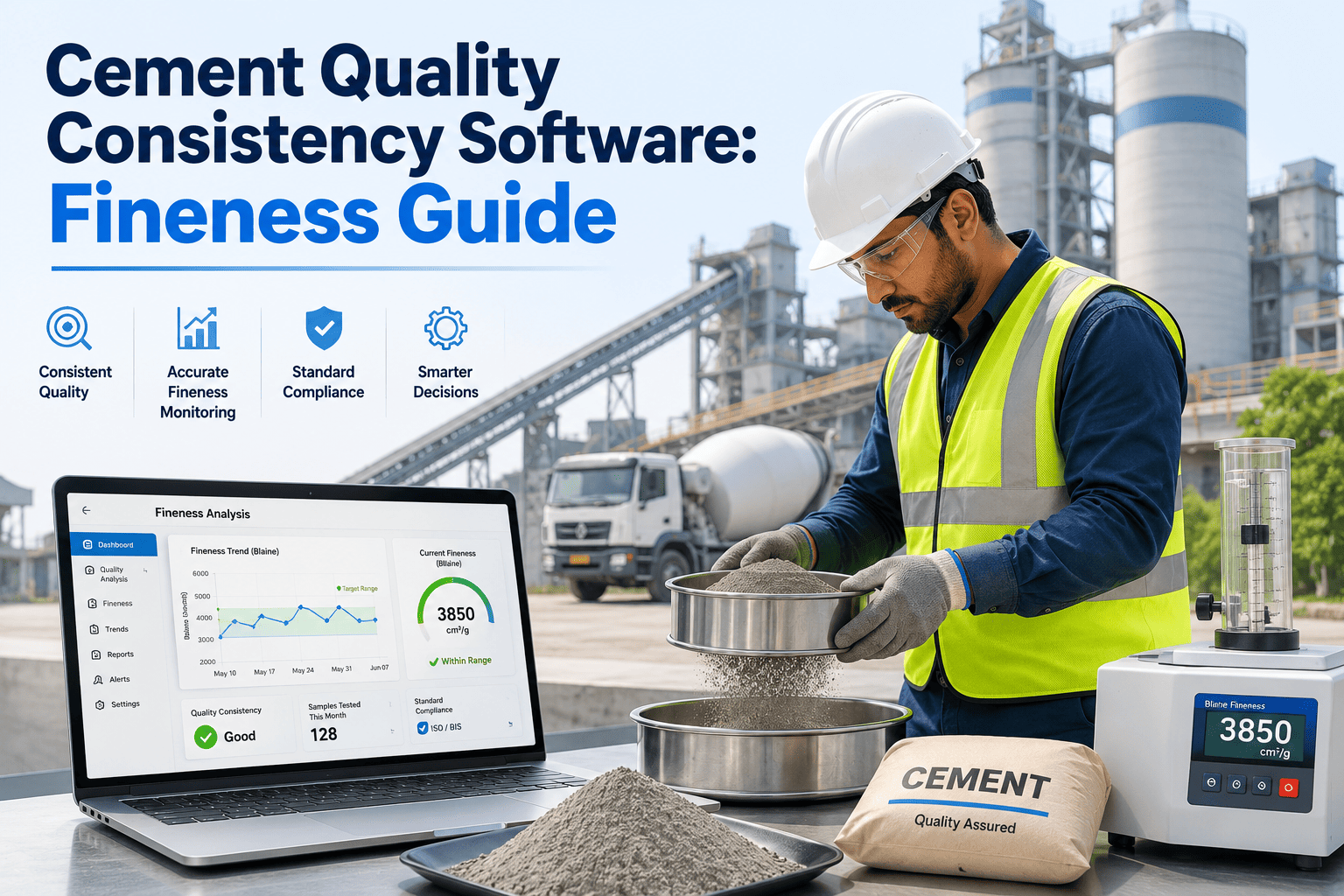
Cement manufacturing demands precision at every stage—from raw material blending through clinker production to final grinding. Traditional quality control relies on periodic lab sampling, often catching problems hours after they occur. AI-powered quality control transforms this reactive approach into real-time optimization, predicting quality outcomes before cement leaves the kiln and adjusting process parameters automatically to maintain consistency.
The cement industry faces unique quality challenges: variable raw materials, extreme process temperatures, energy-intensive operations, and increasingly stringent environmental regulations. AI-driven quality platforms address these challenges by analyzing thousands of variables simultaneously—something human operators simply cannot do.
The Cement Quality Control Challenge
Cement plants operate continuously, producing thousands of tons daily. Quality deviations are expensive—off-spec cement means reprocessing, blending, or downgrading. Yet traditional QC methods create significant blind spots.
Raw Materials
Limestone, clay, iron ore—variable composition from quarry
Raw Mill
Grinding and blending to target chemistry
Kiln
Clinker formation at 1,450°C—the critical transformation
Finish Mill
Final grinding with gypsum for setting control
Testing
Lab analysis confirms quality—hours later
The Quality Gap
By the time lab results confirm a problem, the plant has produced 500-2,000 tons of potentially off-spec cement. Traditional QC is inherently reactive.
How AI Transforms Cement Quality Control
Talk to our cement industry specialists about implementing AI-powered quality control.
Predictive Quality Modeling
AI models learn the relationship between process inputs and quality outcomes. They predict cement properties—compressive strength, setting time, fineness—before physical testing.
Real-Time Process Optimization
Continuous analysis of kiln temperature profiles, feed rates, and fuel consumption. AI recommends—or automatically implements—adjustments to maintain quality targets while minimizing energy use.
Anomaly Detection
AI monitors hundreds of sensors simultaneously, detecting subtle patterns that indicate developing problems—kiln coating issues, raw mill inefficiencies, clinker cooling variations.
Raw Material Compensation
As quarry composition varies, AI calculates optimal raw mix ratios in real-time. Maintains consistent clinker chemistry despite fluctuating limestone, clay, and corrective material quality.
AI Quality Control Architecture
Key Quality Parameters AI Monitors
Clinker Quality
Indicates complete burning. High free lime causes expansion and cracking.
Controls alite formation—the primary strength-giving compound.
Affects liquid phase in kiln. Too high = difficult burning.
Influences setting behavior and sulfate resistance.
Cement Properties
1-day, 3-day, 7-day, 28-day strength development curves.
Affects hydration rate, strength development, and workability.
Controlled by gypsum addition. Critical for concrete placement.
Optimum sulfate for strength. Too much causes expansion.
Implementation Roadmap
Deploying AI quality control in a cement plant follows a phased approach, building capability while demonstrating value.
Data Foundation
- Audit existing sensors and data quality
- Establish data collection infrastructure
- Integrate historian, lab, and process data
- Define quality KPIs and targets
Model Development
- Train predictive models on historical data
- Validate against lab results
- Develop anomaly detection algorithms
- Create operator dashboards
Pilot Deployment
- Deploy predictions in advisory mode
- Compare AI recommendations vs. operator actions
- Refine models based on feedback
- Quantify accuracy and value
Full Operation
- Enable closed-loop control where appropriate
- Expand to additional production lines
- Continuous model improvement
- Integrate with maintenance and planning
ROI of AI Quality Control in Cement
Cement plants implementing AI quality control typically see returns across multiple dimensions. Here's what the data shows from actual implementations.
Example: Mid-Size Cement Plant (1.5 MTPA)
Success Factors
Data Quality Matters Most
AI is only as good as its inputs. Invest in sensor calibration, data validation, and consistent sampling before expecting accurate predictions.
Operator Buy-In Is Essential
AI recommendations are useless if operators don't trust them. Involve control room staff early, explain the models, and demonstrate accuracy before asking for behavior change.
Start Advisory, Then Automate
Don't jump to closed-loop control. Let AI prove itself in advisory mode first—operators verify recommendations, building trust and catching model errors.
Continuous Learning
Cement plants evolve—new raw materials, equipment wear, process changes. AI models need periodic retraining to maintain accuracy.
Transform Your Cement Quality Control
From reactive testing to predictive intelligence—Oxmaint helps cement manufacturers implement AI quality control that delivers measurable results.