Most cement plants run maintenance programs built around one assumption: reliability is a maintenance team problem. The kilns run hot, the mills grind continuously, and when something breaks, technicians respond. That model has a ceiling — and almost every plant running below 80% kiln availability has already hit it. The real jump to 90%+ OEE comes from a different strategy: Total Productive Maintenance, where operators own the first line of defence. Plants in Japan and Germany that consistently achieve 94%+ kiln availability don't have bigger maintenance crews — they have operators who inspect, clean, lubricate, and escalate daily. This page breaks down exactly how 5S, TPM's seven pillars, CILT routines, and focused improvement Kaizen work in a cement plant context, and how Oxmaint CMMS makes every step trackable, auditable, and scalable. Sign up on Oxmaint and start building your autonomous maintenance program today.
94%+
Kiln availability in world-class TPM plants
65%
Average OEE before TPM — vs 85%+ target
7
TPM pillars, all trackable in Oxmaint CMMS
30%
Reduction in breakdowns with structured AM
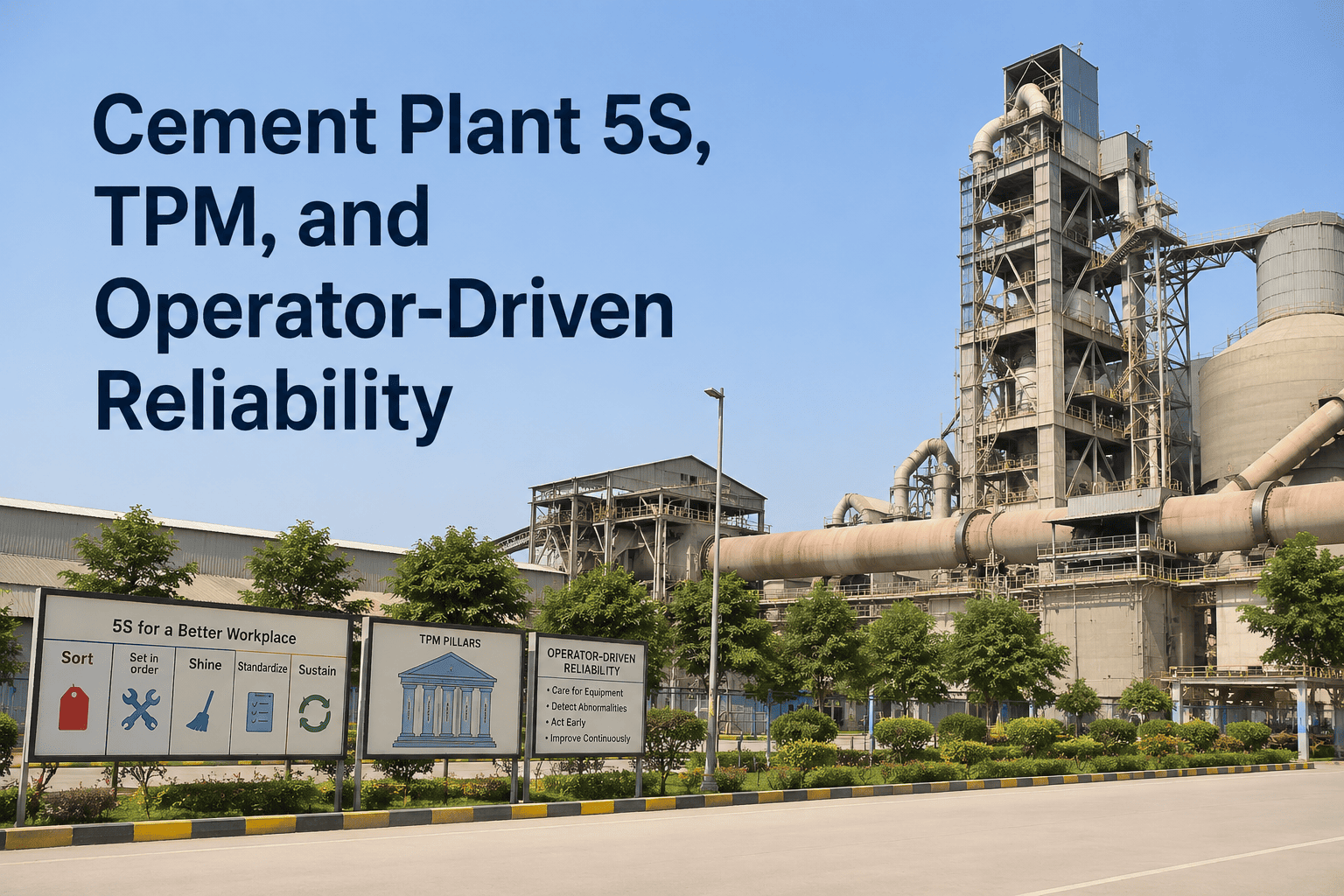
Why 5S Is the Foundation — Not a Housekeeping Exercise
Maintenance teams that skip 5S and jump straight to predictive tools consistently underperform. The reason is structural: without workplace organization, inspection routines become inconsistent, abnormal conditions are buried under clutter, and technicians waste significant time locating tools and parts. 5S in a cement plant is not a tidiness initiative — it is the physical infrastructure that makes every other reliability practice possible.
S1
Sort
Remove everything from the work area that does not belong there — redundant tools, expired lubricants, worn-out spare parts kept "just in case." In cement plants, sorting typically reveals 20–40% of stored items are obsolete or unidentifiable.
S2
Set in Order
A place for everything, and everything in its place. Shadow boards for tools, labelled lubricant storage by grade, designated part staging areas near high-consumption equipment. Technicians stop wasting shift time searching.
S3
Shine
Cleaning is inspection. When operators clean kiln drives, mill gearboxes, and conveyor pulleys, they discover oil leaks, loose fasteners, and cracks hidden under dust. Shine transforms cleaning from a chore into a structured fault-finding round.
S4
Standardize
Documented standards prevent backsliding. Visual management boards, colour-coded lubrication points, and CMMS-enforced checklist templates ensure every shift maintains the standard — not just the shift that started the program.
S5
Sustain
5S audit scores tracked monthly in Oxmaint CMMS with photo evidence keep standards alive. Plants that skip this step see 5S decay within 60 days. Monthly audits tied to work orders sustain the gains permanently.
Build Your 5S Foundation in Oxmaint — Start in Under 48 Hours
Oxmaint's digital checklist builder lets you deploy 5S audit templates, assign area owners, and track scores on a live dashboard. No spreadsheets. No paper forms. Full audit trail from day one.
The 7 Pillars of TPM in a Cement Plant — Mapped to Equipment
TPM's seven pillars are not abstract theory — each one has a direct translation to cement plant assets and daily operations. The pillar sequence matters: you cannot reliably implement focused improvement on a kiln you have not yet cleaned and stabilized through autonomous maintenance. The order is deliberate.
01
Autonomous Maintenance (AM)
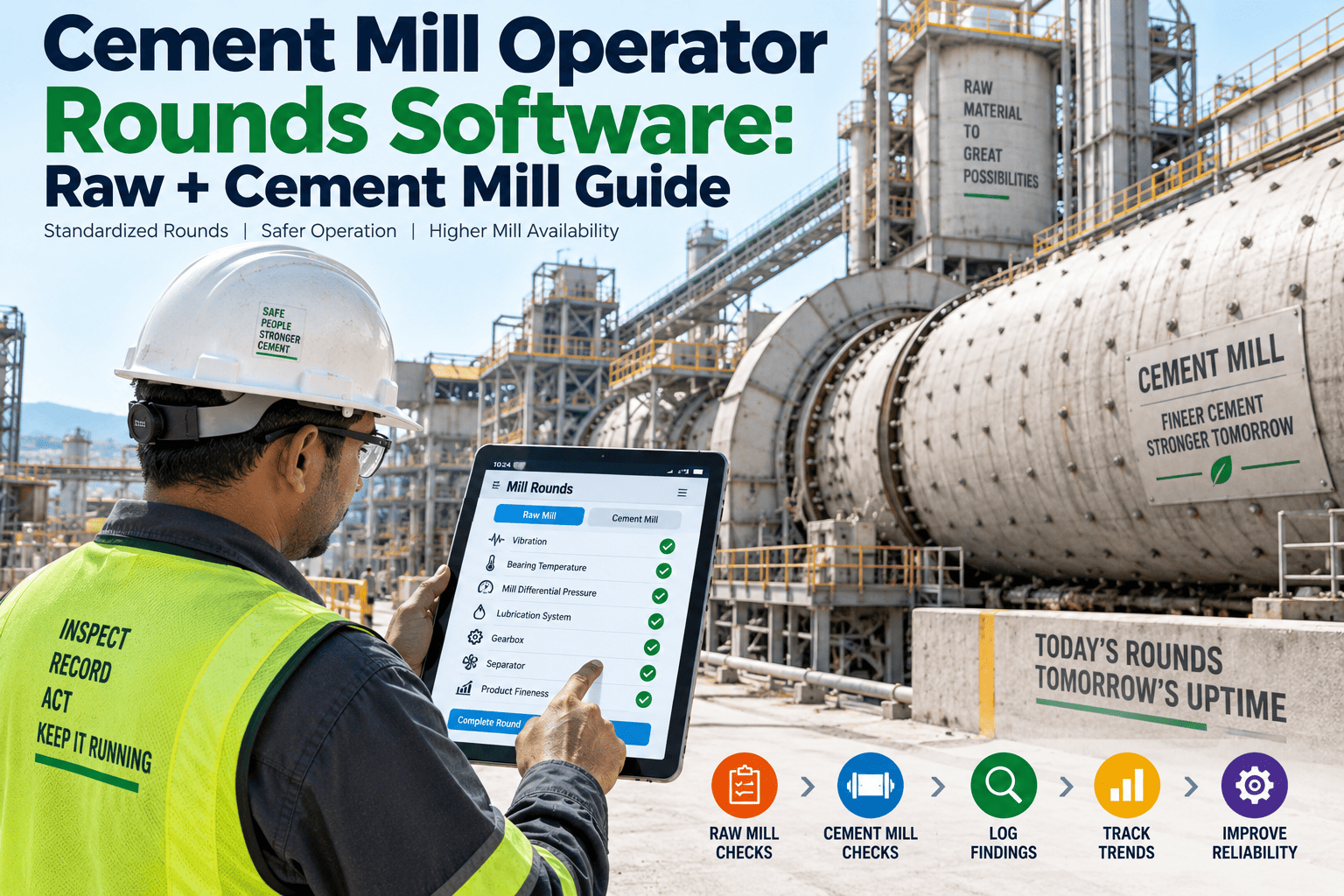
Operators perform daily cleaning, lubrication, inspection, and basic adjustments on their assigned equipment. In a cement plant, this means kiln operators check roller temperatures and lubrication daily, mill operators inspect gearbox oil levels and bearing temperatures, and crusher operators monitor jaw plate wear — all logged in Oxmaint mobile work orders with photo evidence.
Kiln, Ball Mills, VRMs, Crushers, Baghouse Fans
02
Planned Maintenance
Maintenance engineers own the planned PM schedule — girth gear inspections, refractory lining surveys, major bearing replacements, and gearbox oil changes — triggered by operating hours rather than calendar dates. CMMS-generated work orders prevent both over-maintenance and missed critical PMs.
Girth Gear, Refractory, Gearboxes, Preheater
03
Focused Improvement (Kaizen)
Cross-functional teams attack the top three recurring breakdowns with structured root-cause analysis, countermeasure implementation, and before-and-after measurement. In cement plants, Kaizen events on conveyor belt splice failures, ball mill liner change intervals, and preheater fan bearing life consistently deliver measurable MTBF improvements within 90 days.
Conveyors, Mill Liners, ID Fans, Raw Mill
04
Early Equipment Management
Maintenance input during procurement and design reduces lifetime maintenance cost. Specifying sealed bearings on high-dust conveyors, designing lubrication access points into new gearboxes, and selecting wear-resistant materials for crusher liners prevents maintenance problems before equipment arrives on site.
New Equipment, Capital Projects, Upgrades
05
Quality Maintenance
Equipment condition directly drives product quality in cement. Raw mill separator efficiency affects PSD, kiln thermal stability affects clinker quality, and finish mill liner wear affects product Blaine. Tracking equipment condition against quality output creates a direct cost-of-poor-maintenance figure that finance teams engage with.
Raw Mill, Kiln, Finish Mill, Separator
06
Training and Education
Operator skill certification for each AM task level, technician competency records in CMMS, and structured onboarding for new maintenance staff. Oxmaint tracks skill certifications per operator per equipment type — ensuring the right person performs each task and documenting the training trail for audits.
All Equipment, All Teams, Audit Compliance
07
Safety, Health and Environment
LOTO procedures, confined space permits, dust exposure controls, and hazard reporting integrated into every work order. Oxmaint enforces SHE compliance as a work order prerequisite — technicians cannot close high-risk tasks without completing safety sign-offs, creating an automatic SHE audit trail across the plant.
All Equipment, Permit System, EHS Reporting
CILT in Cement Plants — What Operators Do Every Shift
CILT stands for Clean, Inspect, Lubricate, Tighten. It is the daily operational backbone of autonomous maintenance — the specific tasks operators perform on their equipment before and after each shift. In cement plants, CILT routines on critical equipment have consistently shown the ability to catch 60–70% of developing failures before they become breakdowns.
CILT Task Reference — Cement Plant Equipment by Shift Priority
Focused Improvement — Kaizen Events That Deliver Real MTBF Gains
Focused improvement is where TPM converts effort into measurable financial results. Each Kaizen event targets one recurring failure, analyses its root cause systematically, implements a countermeasure, and measures the result. In cement plants, three categories of Kaizen events deliver the fastest and most significant returns.
Kaizen Type A
Conveyor Belt Splice Failures
Belt splice failures on raw meal and clinker conveyors account for a disproportionate share of unplanned downtime in most cement plants. A focused Kaizen on splice procedure standardization, tension monitoring, and splice joint inspection during CILT rounds typically reduces splice-related stoppages by 50–70% within 60 days.
Typical MTBF improvement: 2.1x to 3.4x on affected conveyors
Kaizen Type B
Preheater Fan Bearing Life
ID and preheater exhaust fans operate in high-temperature, high-dust environments where bearing contamination and over-greasing are the primary failure modes. Kaizen events addressing lubrication quantity standardization, bearing isolator installation, and temperature-triggered PM intervals extend bearing life by 40–80% without capital investment.
Typical cost saving: ₹8–15L per fan per year in replacement and downtime costs
Kaizen Type C
Ball Mill Liner Change Interval
Liner wear measurement standardization and OEE correlation analysis consistently reveals that cement plants are either changing liners too early (wasting usable life) or too late (running degraded grinding efficiency). Data-driven Kaizen on liner change decision criteria reduces both liner cost and specific energy consumption simultaneously.
Typical outcome: 15–25% reduction in liner consumption cost, 2–4% specific energy improvement
TPM Rollout Timeline — From 5S Launch to Full AM Programme
Months 1–2
5S Launch & Equipment Baseline
5S campaigns across all production areas. CMMS asset register built with equipment history. Initial cleaning reveals hidden defects. Equipment condition baseline documented with photos for every critical asset.
Months 3–4
CILT Standards & Operator Training
CILT task lists built per equipment type in Oxmaint. Operators trained on each task with skill certification records. Digital checklists deployed on mobile devices. First 30 days of CILT compliance tracked and reported.
Months 5–6
Planned Maintenance Integration
PM schedules configured for all critical assets. Operating-hour-based triggers replace calendar PMs. Planned vs reactive ratio tracked weekly. First OEE baseline established per production line.
Months 7–12
Focused Improvement & KPI Review Cycle
Monthly Kaizen events on top three failure modes. MTBF trend measured per asset class. TPM audit scores tracked quarterly. OEE improvement vs. baseline reported to plant management. Continuous improvement cycle embedded in operations.
Your Kiln Could Be Running at 90%+ — Start Measuring What Holds It Back
Oxmaint gives your maintenance team the CMMS platform to deploy 5S audits, build CILT checklists, track operator AM compliance, and measure Kaizen results — all in one system your technicians will actually use on the plant floor. Plants that implement structured TPM with Oxmaint report 25–40% reduction in unplanned downtime within 6 months. Book a demo built around your cement plant's specific equipment and current maintenance maturity level.
Frequently Asked Questions
How long does it realistically take to implement TPM in a cement plant?
A credible TPM rollout takes 9–18 months to reach sustained results, with the first measurable MTBF improvements visible at the 4–6 month mark after CILT routines are consistently executed. Plants that rush to later pillars before stabilising 5S and AM invariably fail to sustain gains. Using a CMMS like
Oxmaint from the start accelerates each phase by making compliance visible and deviations actionable in real time.
What is the difference between CILT and a standard operator round?
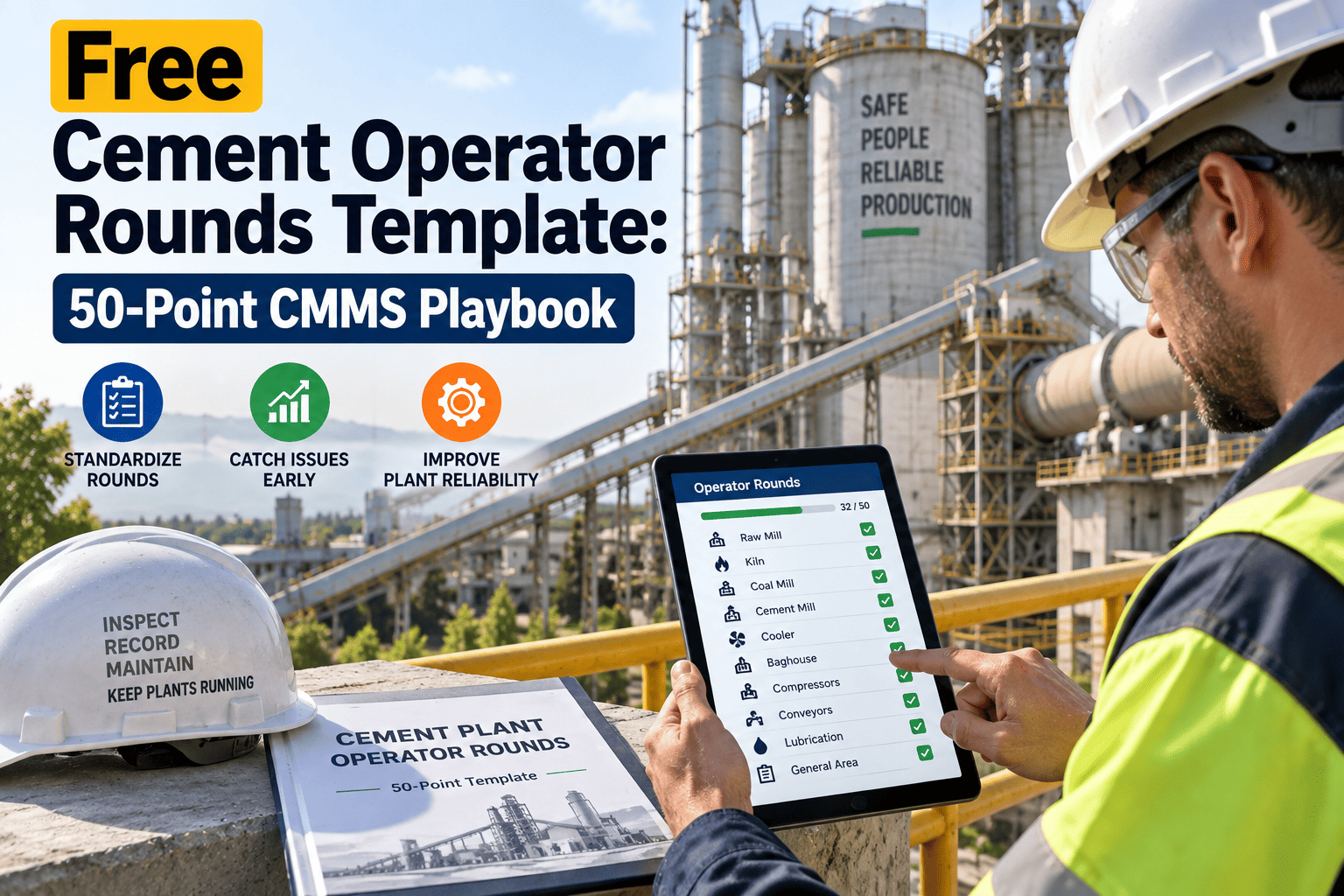
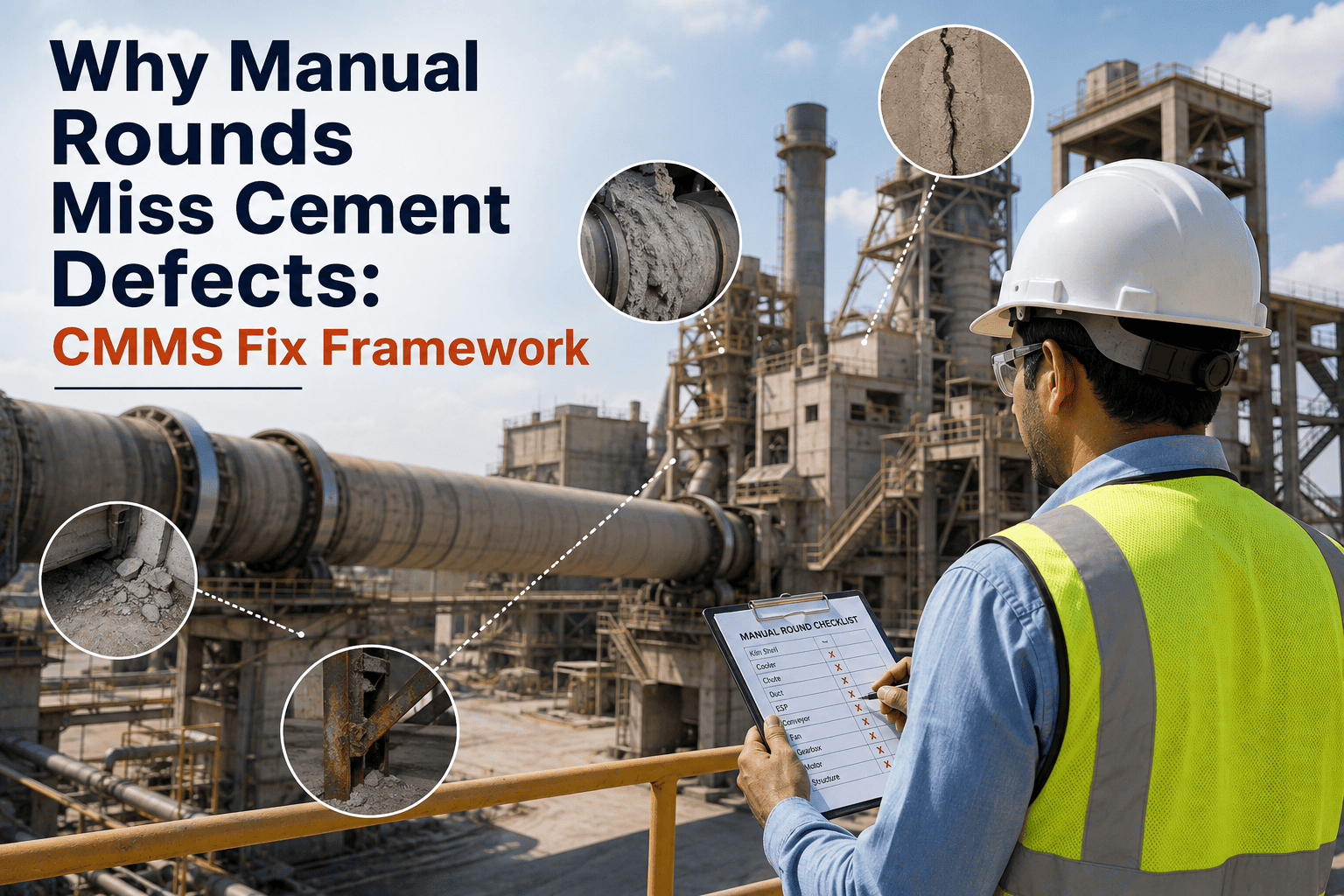
A standard operator round is a visual walkthrough with no defined task, no completion verification, and no data record. CILT is a structured routine with specific cleaning actions, inspection criteria, lubrication quantities, and tightening torques — each step documented and photo-verified in a CMMS work order. The difference in fault detection rate is typically 5x to 8x in favour of structured CILT.
Book a demo to see how Oxmaint templates CILT by equipment type.
How does Oxmaint support TPM audit tracking?
Oxmaint includes configurable audit templates for each TPM pillar — 5S audit scores, AM compliance rates, PM completion percentages, and Kaizen progress tracking. Every audit generates a timestamped report with photo evidence, assignee records, and trend data against previous periods.
Sign up free to see the audit module in action.
Can small cement plants with limited maintenance teams benefit from TPM?
Smaller plants benefit proportionally more because operator-driven maintenance reduces the burden on stretched maintenance teams. A 2,000 TPD plant with 8 maintenance technicians can extend coverage across the entire plant by training operators on structured CILT — effectively multiplying maintenance coverage without hiring.
Oxmaint scales from a single production line to multi-kiln operations.
What OEE improvement is realistic from a structured TPM programme?
Cement plants starting from a 65–70% OEE baseline consistently reach 80–85% within 12 months of a structured TPM implementation. World-class integrated plants run at 85–92% OEE. The gains come primarily from availability improvement — fewer unplanned stoppages — rather than performance or quality rate changes.
Book a demo to see how your plant's current availability compares to the benchmark.