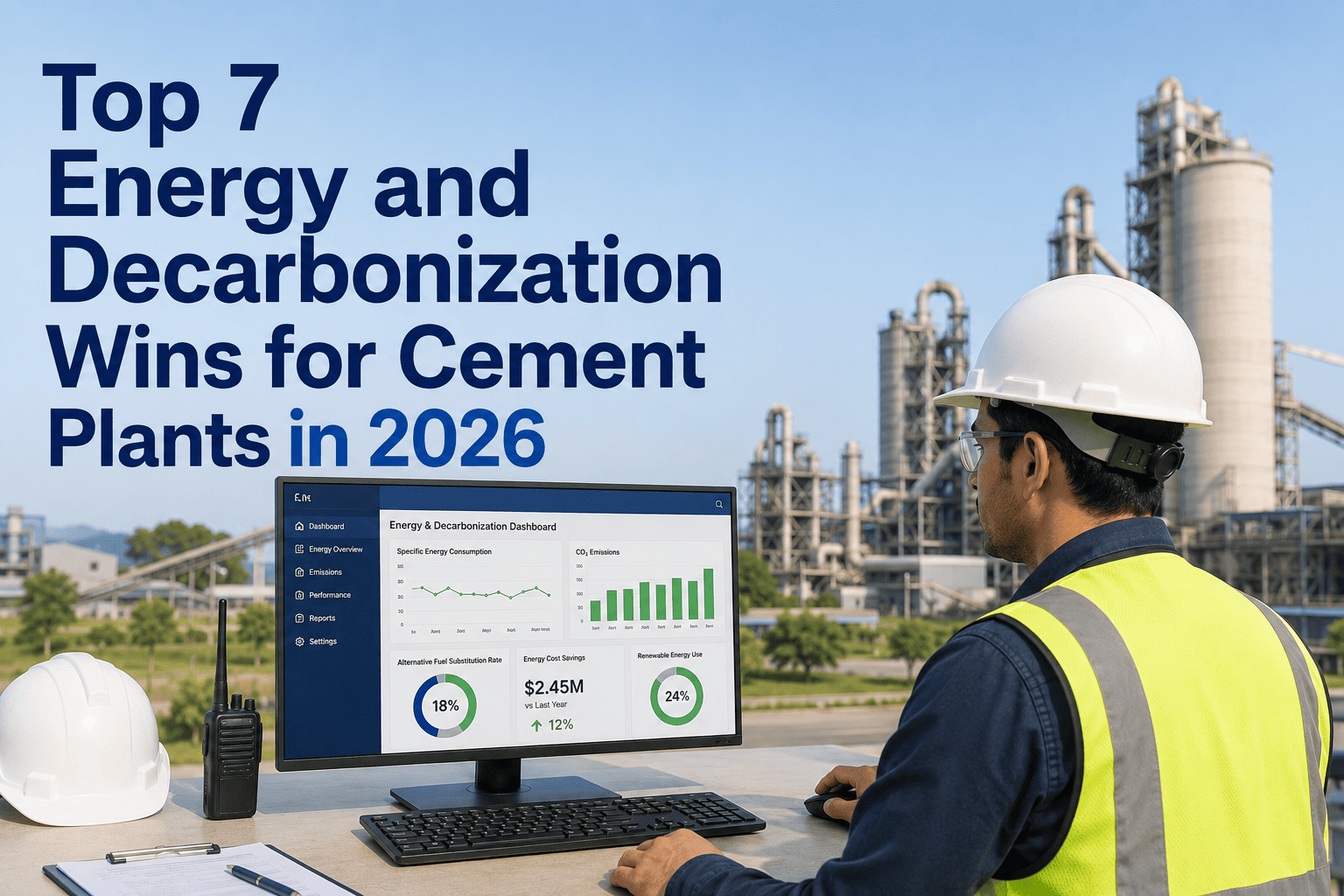
Cement kilns consume 30 to 40% of a plant's total production cost in fuel alone — and in 2026, that cost is under pressure from two directions simultaneously: rising energy prices and tightening carbon regulations. Global cement production exceeds 4.3 billion tons annually, making the industry responsible for roughly 7% of global CO2 emissions. For plant engineers and operations directors navigating this environment, the pressure to cut energy costs and carbon intensity is no longer a future agenda item — it's the agenda. The good news is that the most impactful interventions are well-proven, and the cement plants deploying them are seeing measurable results in months, not years. This guide covers the 7 highest-impact energy and decarbonization wins available to cement plants in 2026, ranked by implementation readiness and cost impact. Track energy performance and maintenance linkage in Oxmaint — start a free trial and connect your plant's energy data to your maintenance programme today.
Decarbonization Guide · Cement Plants · 2026
Top 7 Energy and Decarbonization Wins for Cement Plants in 2026
AFR rate, false air elimination, VFD retrofits, waste heat recovery, separator upgrades, kiln optimization, and CCUS. Here's what the leading cement plants are doing — and what the numbers look like.
7%
of global CO2 emissions from cement
30–40%
of production cost in kiln fuel
3%
kiln efficiency gain = major cost impact
2030
Net-zero target for major global cement groups
The 2026 Energy Pressure Map
Why Energy and Decarbonization Can't Wait Any Longer
01
Carbon pricing is arriving
EU ETS carbon prices and emerging carbon border adjustment mechanisms are raising the real cost of every tonne of clinker produced above industry-best efficiency levels. Plants without a documented decarbonization path are accumulating increasing cost exposure every quarter.
02
OEM and customer ESG pressure
Major construction and infrastructure buyers are building carbon intensity requirements into procurement specifications. Cement suppliers without a credible sustainability narrative are losing RFQ access — not in 2030, but in 2026 tender rounds already.
03
Energy cost volatility
Coal, petcoke, and natural gas price volatility since 2022 has exposed every percentage point of thermal inefficiency directly in the P&L. The plants with the lowest specific heat consumption are simply more resilient to energy market shocks than plants running legacy kiln configurations.
04
Investor scrutiny on CDP reporting
Cement companies reporting to CDP and aligned sustainability frameworks are under increasing scrutiny on Scope 1 intensity per tonne and progress against science-based targets. Corporate sustainability commitments are translating directly into plant-level decarbonization KPIs with board-level visibility.
The 7 Wins
Ranked by Implementation Readiness and Financial Impact
Alternative Fuel Rate (AFR) Increase
Energy cost reduction potential
Up to 40% thermal cost reduction
Replacing coal and petcoke with alternative fuels — waste-derived fuels, agricultural residues, industrial waste streams — is the single highest-impact thermal cost reduction available to cement plants today. European cement leaders are running AFR rates above 80%. The global average is below 20%. Every percentage point of AFR substitution directly reduces net carbon intensity and fuel cost. The barriers are operational — kiln stability, combustion consistency, fuel quality variability — and the right CMMS tracks AFR rate against specific heat consumption in real time, closing the feedback loop between fuel mix decisions and kiln performance.
80%+
AFR rate at leading European plants
20%
Global average AFR rate in 2026
1%
AFR gain = $80–120K annual saving (3,000 TPD plant)
False Air Elimination in Preheater and Kiln Systems
Specific heat reduction potential
3–8% specific heat reduction
False air infiltration through preheater expansion joints, kiln inlet seals, and cyclone inspection ports is one of the most underdiagnosed energy losses in cement plants. Every 1% increase in false air raises specific heat consumption by approximately 6 kJ/kg clinker. Plants with aging infrastructure often carry 15 to 25% false air in the preheater string — a figure that has compounded for years because it's invisible without continuous measurement. Systematic false air measurement campaigns, tracked in the CMMS with corrective work orders, typically recover 3 to 8% in specific heat consumption within 6 months.
15–25%
False air in typical aging preheater
6 kJ/kg
Specific heat rise per 1% false air
6 months
Typical timeline to recover 3–8% specific heat
VFD Retrofit on High-Load Fan and Drive Applications
Electrical energy reduction on target assets
20–35% power reduction on retrofitted drives
Variable frequency drives on ID fans, cooler fans, and raw mill drives eliminate the throttling losses that damper-controlled fans generate at partial load. A cement plant running three major fan systems without VFDs is burning 20 to 35% more electrical energy on those assets than necessary. The payback on individual VFD retrofits is typically 14 to 24 months. CMMS-tracked energy performance confirms the reduction per asset after installation, building the business case for the next retrofit in sequence.
20–35%
Power savings on VFD-retrofitted fans
14–24 mo
Typical payback period per drive
$42K+
Annual saving per major fan at 3,500 TPD scale
Waste Heat Recovery (WHR) Power Generation
Electrical self-generation potential
25–35% of plant electrical demand
Organic Rankine Cycle and steam-based waste heat recovery systems capture surplus thermal energy from preheater exit gases and cooler exhaust air — energy that currently exits the stack as waste. A 3,000 TPD cement plant typically generates 6 to 10 MW of electrical power from WHR, covering 25 to 35% of plant electrical demand with zero additional fuel burn. The capital investment is significant, but plants that have deployed WHR report paybacks in 5 to 8 years with carbon intensity reductions of 15 to 20% on Scope 2 emissions.
6–10 MW
Typical WHR output at 3,000 TPD
25–35%
Plant electrical demand covered
5–8 yr
Payback period at current electricity prices
Separator Upgrade for Grinding Circuit Efficiency
Specific grinding energy reduction
10–20% grinding energy reduction
Third-generation high-efficiency separators in cement mill circuits dramatically reduce overgrinding by improving classification efficiency — returning coarse particles to the mill instead of allowing fine particles to recirculate. Plants upgrading from first or second-generation separators consistently report 10 to 20% reductions in specific grinding energy with no production rate loss. The CMMS tracks post-upgrade specific power consumption against baseline, confirming savings and informing the next improvement cycle.
10–20%
Grinding energy reduction with 3rd-gen separator
Zero
Production rate loss in a well-executed upgrade
18–36 mo
Typical payback for major separator upgrade
Kiln Process Optimization via AI and Advanced Process Control
Specific heat consumption reduction
2–5% specific heat reduction
Advanced process control systems using AI to optimize burner management, kiln draft, and feed rate respond to kiln condition changes in milliseconds — far faster than human operators managing the same variables manually. The result is more stable burning zone temperature, reduced excess air, and lower NOx with lower specific heat consumption. A 2 to 5% improvement in specific heat consumption on a 3,000 TPD kiln running 310 days per year represents $800K to $2M in annual fuel savings, making APC one of the fastest payback investments available in cement today.
2–5%
Specific heat reduction with APC
$800K–2M
Annual fuel saving at 3,000 TPD scale
6–14 mo
Typical payback for APC implementation
Carbon Capture, Utilization, and Storage (CCUS)
Net CO2 reduction potential
Up to 95% of process CO2 captured
CCUS is the only technology pathway that addresses process CO2 — the emissions inherent in calcination that cannot be eliminated by fuel switching or efficiency improvement alone. Pilot projects across Europe and North America are proving amine scrubbing and calcium looping capture technologies at cement plant scale. Full commercial deployment requires substantial capital and CO2 transport or utilization infrastructure, but the plant teams beginning feasibility studies and FEED work now are positioning themselves for the decade ahead. CMMS integration tracks process CO2 intensity per tonne as the baseline metric that CCUS investment will measure against.
95%
Process CO2 capture rate at best-proven technology
2 pilots
Commercial-scale cement CCUS projects operating 2026
2030
First commercial full-scale plants anticipated
Connect Maintenance to Energy Performance
Track Specific Heat, kWh/ton, and CO2 Intensity Alongside Every Maintenance Event
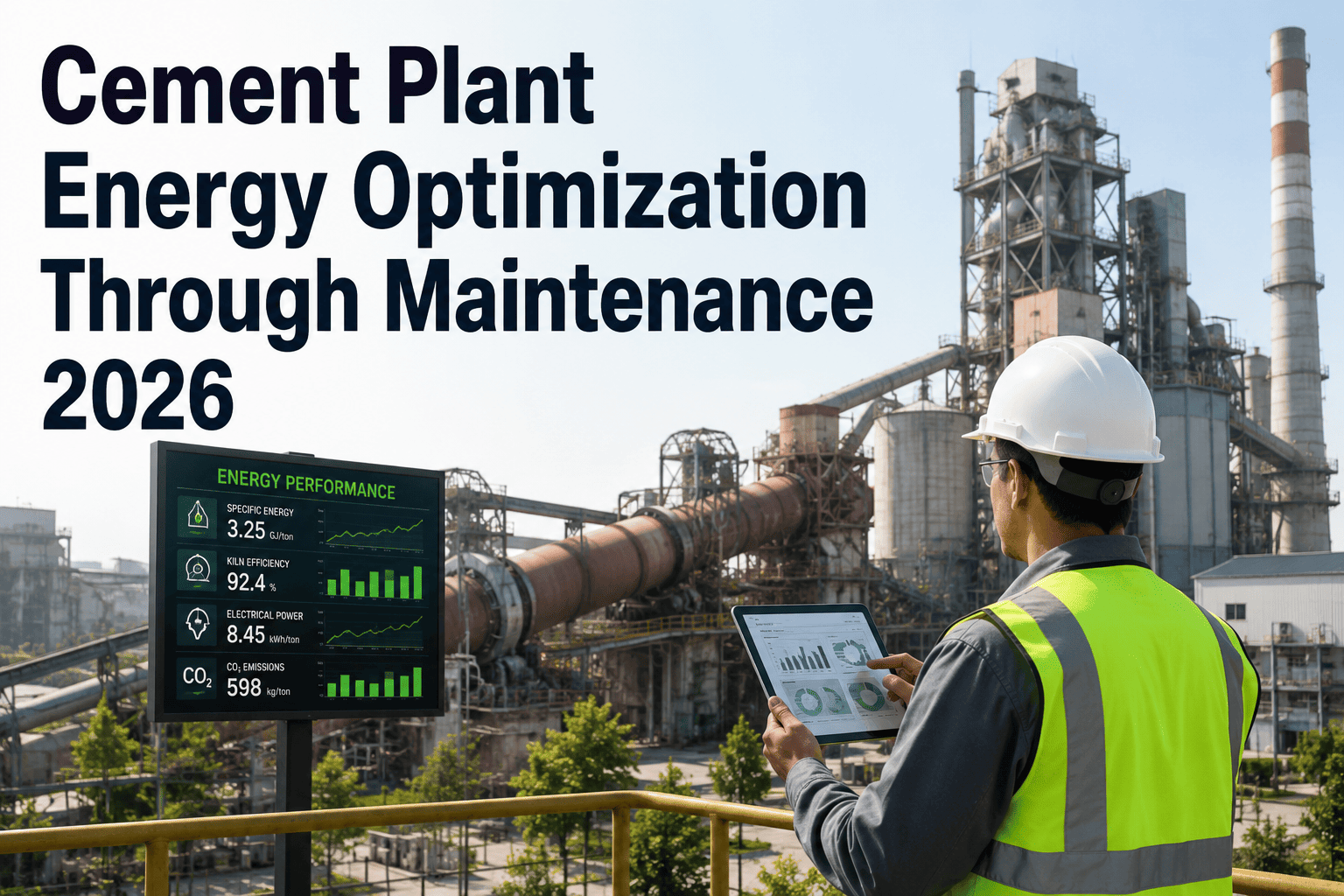
Oxmaint links maintenance records to energy performance data — so when a kiln alignment job reduces specific heat by 1.3%, you have the data to prove it. Track every win, report to CDP, and build the business case for the next intervention.
Comparison
The 7 Wins Ranked by Speed and Scale of Impact
| Win |
Deployment Speed |
Thermal / CO2 Impact |
Financial Impact |
CMMS Role |
| AFR Rate Increase |
Immediate |
Up to 40% thermal cost reduction |
Very High |
AFR vs. heat consumption tracking |
| False Air Elimination |
0–6 months |
3–8% specific heat reduction |
High |
Corrective work order management |
| VFD Retrofit |
3–12 months |
20–35% per retrofitted asset |
High |
Energy KPI per asset post-install |
| Waste Heat Recovery |
12–24 months |
15–20% Scope 2 reduction |
Medium-Long ROI |
WHR asset PM and performance |
| Separator Upgrade |
6–18 months |
10–20% grinding energy |
High |
Specific power tracking by circuit |
| Kiln APC |
6–14 months |
2–5% specific heat |
Very High ROI |
Kiln efficiency KPI dashboard |
| CCUS |
3–7 year programme |
Up to 95% process CO2 |
Long-term strategic |
Process CO2 intensity baseline |
Frequently Asked Questions
Energy and Decarbonization in Cement — Common Questions
How does a CMMS help cement plants track energy performance against decarbonization targets?
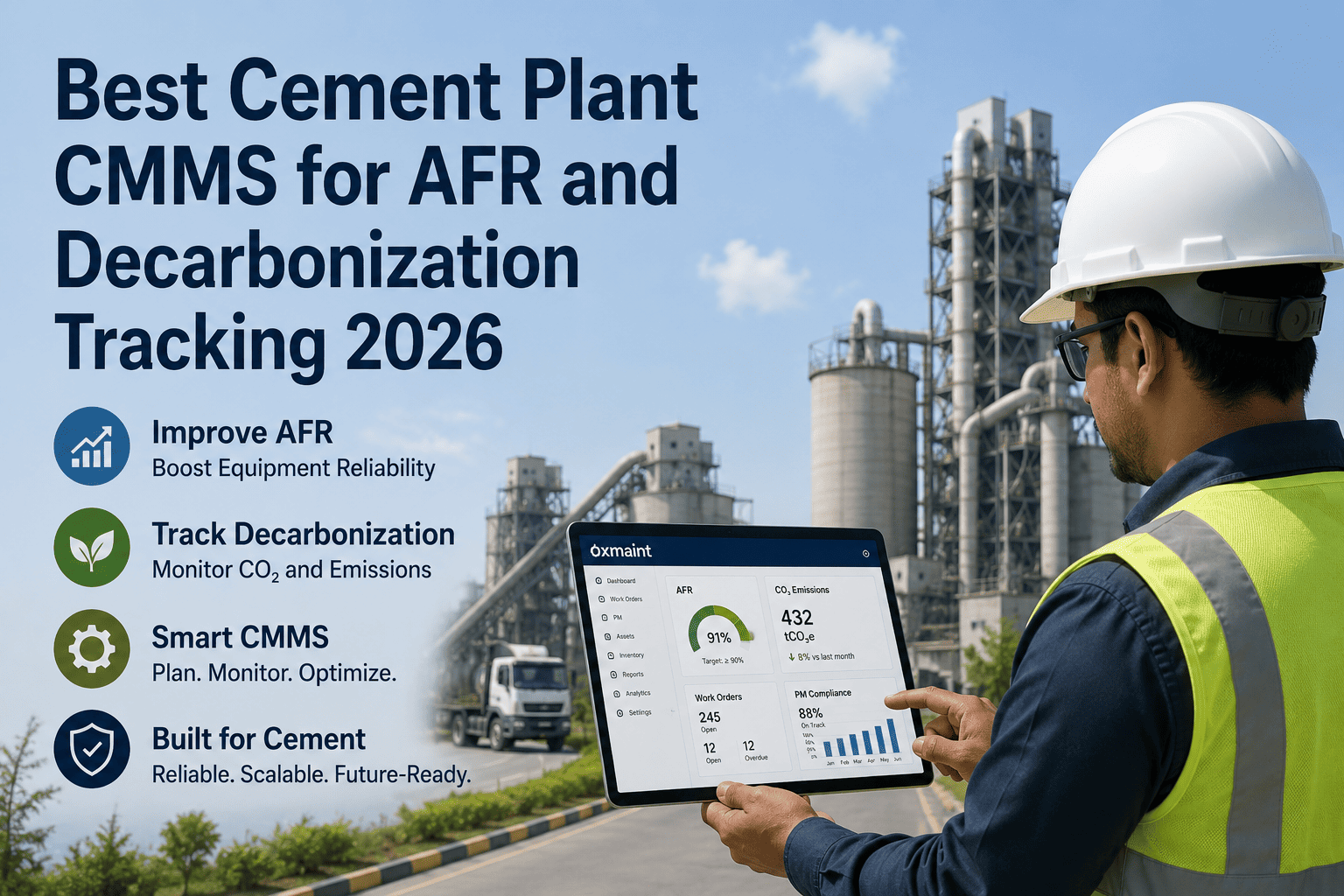
Oxmaint links maintenance events directly to energy performance metrics — specific heat consumption, kWh per tonne, and CO2 intensity per tonne — so every maintenance intervention is measured against its energy impact. This creates an audit-ready evidence trail for CDP reporting and internal sustainability KPIs.
Start a free trial to see the energy performance dashboard configured for cement plant operations.
What's the most accessible decarbonization win for a cement plant that has no current sustainability programme?
False air elimination is the fastest, lowest-cost, highest-certainty energy win available to most cement plants. It requires a measurement campaign, basic sealing work, and systematic CMMS tracking — no capital investment, no fuel contract changes.
Book a demo to see how Oxmaint structures false air measurement and corrective work order tracking.
Can Oxmaint report CO2 intensity data for CDP and ESG disclosures?
Yes. Oxmaint tracks specific CO2 per tonne clinker and per tonne cement against configurable baselines, generates trend reports by time period, and exports data in formats compatible with CDP climate reporting frameworks.
Book a demo to review the sustainability reporting module for your plant configuration.
How long before a VFD retrofit programme shows measurable energy savings?
Energy savings on VFD retrofits are measurable from the first full operating week after installation — typically a 20 to 35% reduction in electrical draw on the retrofitted asset. Oxmaint logs pre and post-retrofit energy data per asset automatically, providing the documentation needed to confirm and communicate the saving.
Start a free trial to configure asset-level energy tracking for your plant.
Is CCUS a realistic option for cement plants outside Europe in 2026?
CCUS is in active development and feasibility stages globally, with the first commercial-scale projects expected around 2030. In 2026, the most practical step for any cement plant is establishing accurate process CO2 intensity baselines and beginning feasibility engagement — which Oxmaint's carbon tracking module supports directly.
Book a demo to discuss how to position your plant for future CCUS readiness.
Start Tracking Every Energy Win
7 Wins. Each One Measurable. All of Them Trackable in Oxmaint.
From AFR rate to kiln APC performance to CCUS baseline CO2 intensity — Oxmaint connects your maintenance programme to your energy performance data, so every improvement is documented, reported, and repeatable.