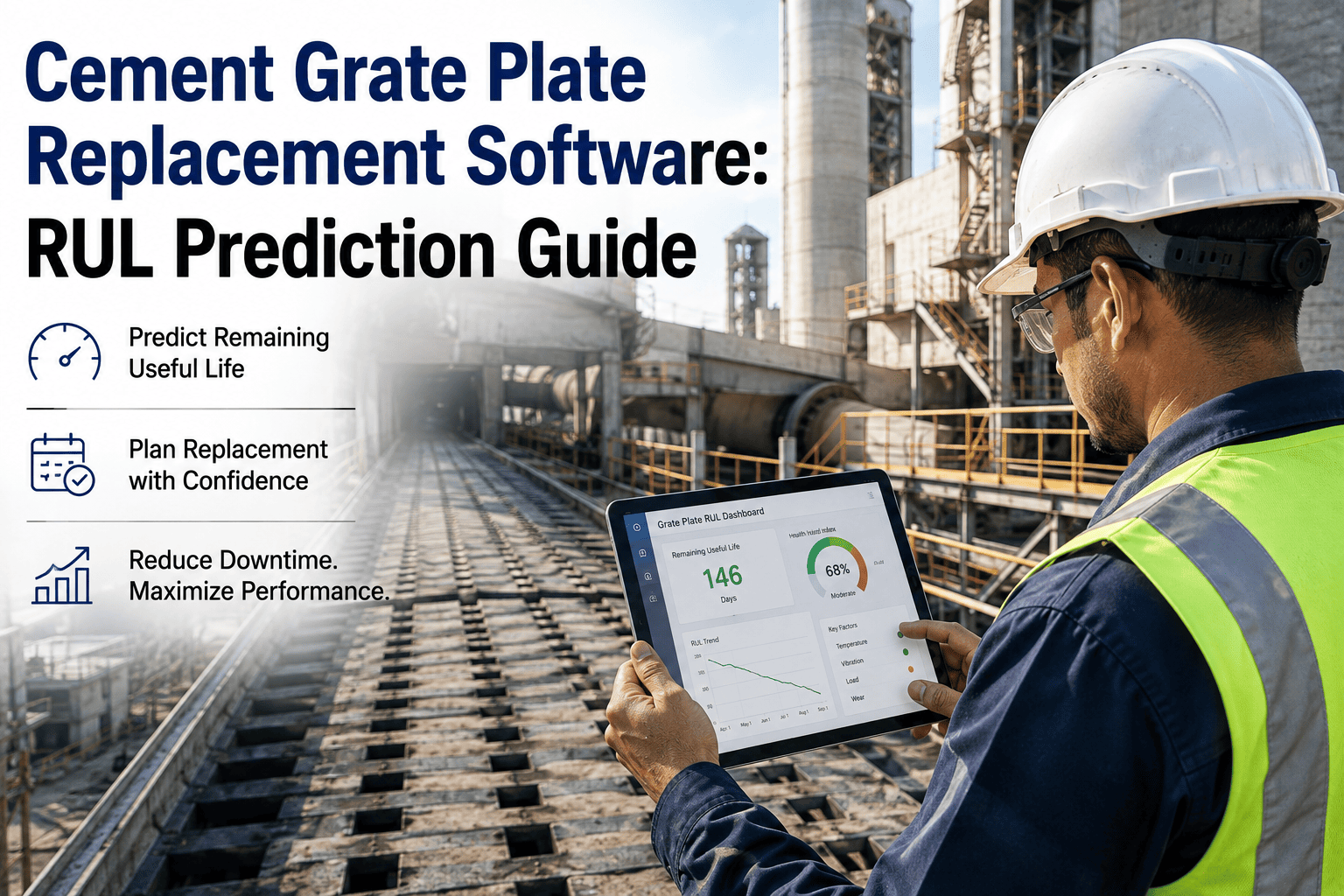
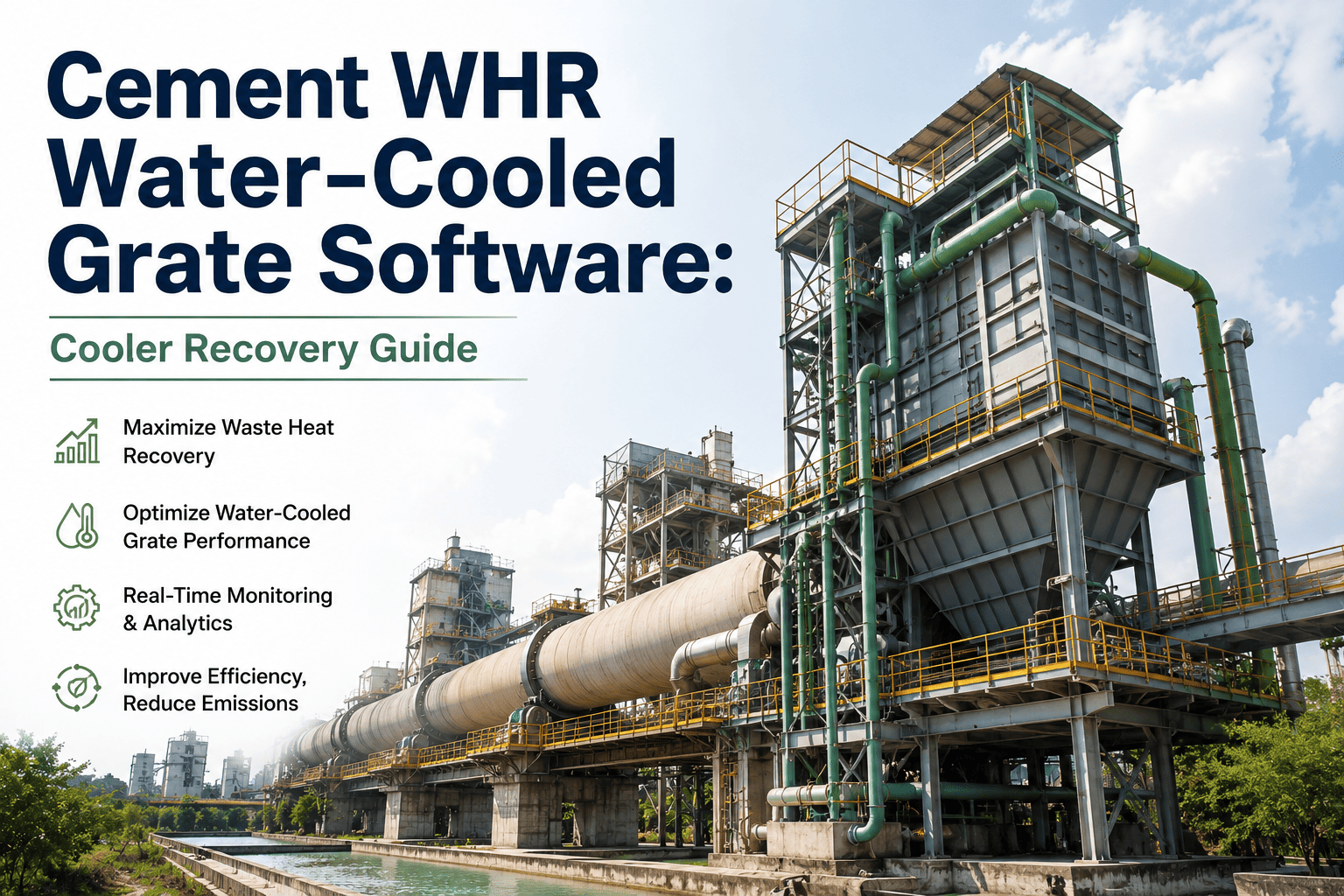
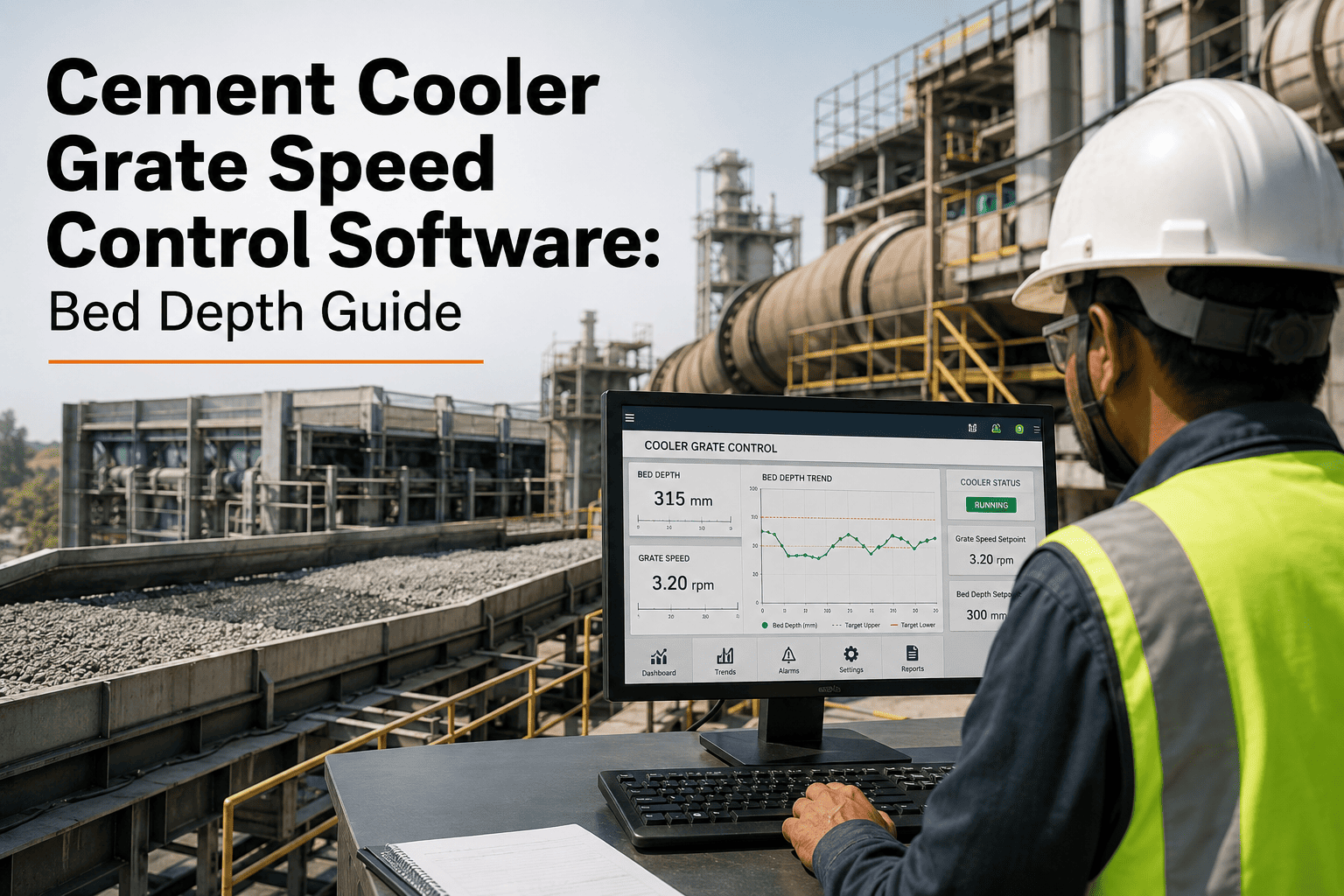
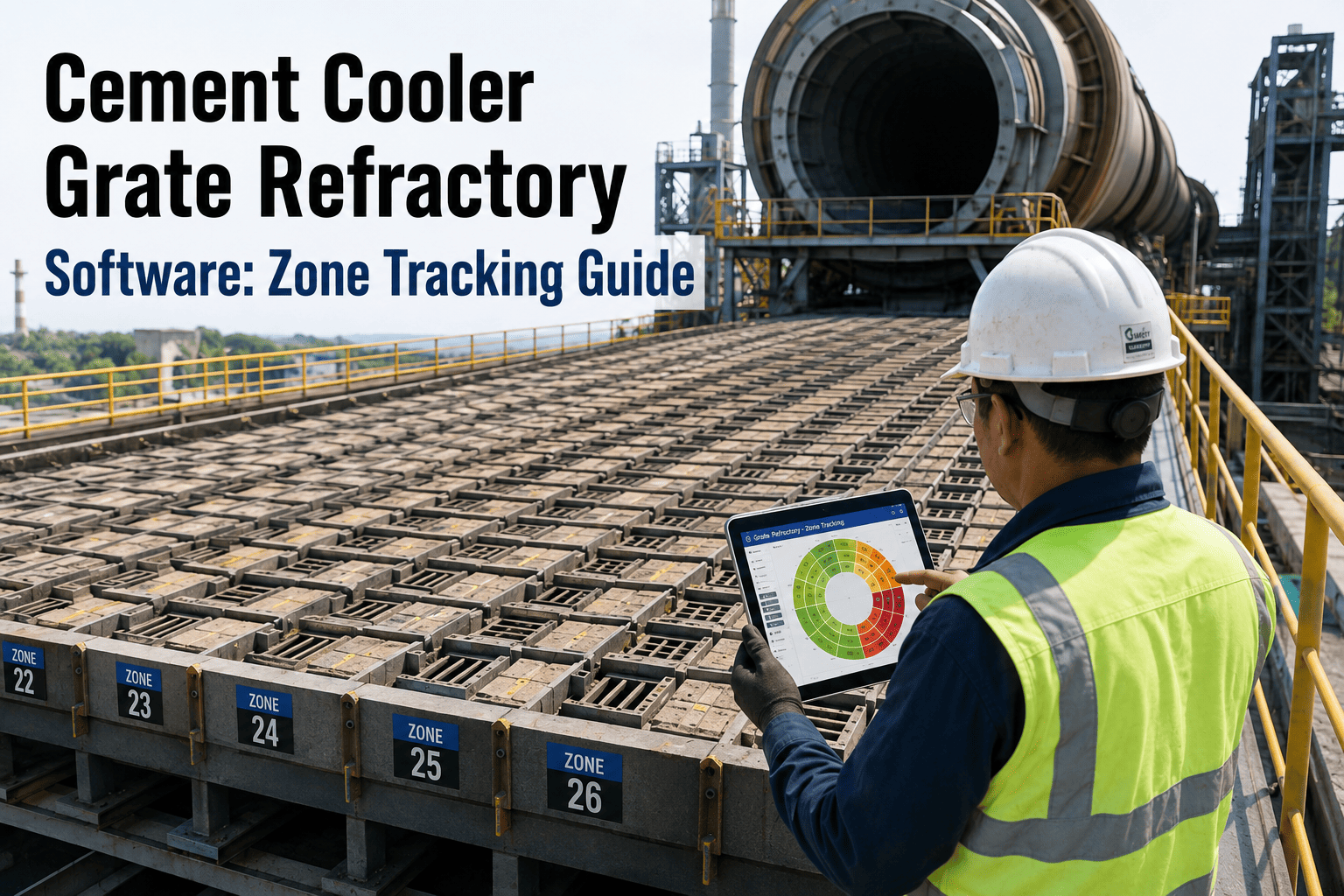
Grate plates in a cement clinker cooler typically survive 10–18 months, yet the majority of plants swap them on a fixed calendar cycle that wastes 20–30% of usable residual life while still allowing premature failures between intervals. A cement grate plate RUL prediction approach—driven by CMMS work orders, IoT temperature and vibration feeds, and travel-grate speed logs—lets reliability engineers pin the remaining useful life of every plate to within ±10% and trigger replacement only when the margin narrows. For a 10,000 TPD kiln running a six-stage cooler, that translates to roughly $80,000–$140,000 in annual plate spend and 40–70 hours of avoided cooler downtime. OxMaint's clinker grate RUL software consolidates inspection rounds, sensor data, and permit-to-work compliance into a single dashboard so cement plant teams can replace the right plate at the right hour. Ready to stop guessing? You can Start Free Trial and connect your cooler assets today.
Grate Plate RUL Prediction
What if you could forecast every grate plate's failure month—before it cost you a kiln trip?
Stop replacing plates on a fixed 12-month cycle that wastes 30% of usable steel. OxMaint's RUL engine fuses CMMS work-order history, clinker-bed temperature, under-grate pressure drop, and vibration signatures to predict remaining useful life within ±10%—so you swap the right plate in the right outage, not the wrong one in an emergency.
30%
Reduction in annual grate plate spend when plants shift from calendar swap to RUL-based replacement—without raising clinker-temperature excursion risk.
The Cost Of Calendar Swaps
Why fixed-interval grate replacement bleeds cement plants dry
A 10,000 TPD kiln running a modern third-generation stationary grate cooler carries 1,200–1,800 individual grate plates across roughly 40 rows. Each plate costs $35–$120 depending on alloy grade and geometry. At a 12-month blanket swap, most plants throw away plates with 25–35% residual life—while simultaneously missing the 8% that fail early at month 8 or 9.
$140K
Annual grate plate spend on a single 10,000 TPD cooler line—often 60% oversized because of premature swaps
70 hrs
Mean unplanned cooler downtime per premature grate failure event, including kiln ramp-down and bed stabilization
±10%
Typical RUL prediction accuracy window OxMaint delivers when IoT temperature + vibration feeds are live on the cooler grate
8%
Share of plates that fail before a 12-month cycle—usually undetected until a red-clinker hotspot breaches the bed
The RUL Prediction Formula
How OxMaint computes remaining useful life for every grate plate
RUL isn't a single sensor reading. It's a fusion of operational load history, material condition signals, and inspection evidence. OxMaint's clinker grate RUL tool combines four weighted inputs into a per-plate degradation score that updates every shift.
42%
Clinker Bed Temperature History
Sustained excursions above 1,400 °C accelerate high-chrome alloy oxidation. OxMaint ingests pyrometer and thermocouple logs every 60 seconds.
26%
Vibration Signature Trend
Rising 1× and 2× line-frequency peaks on the grate drive indicate plate loosening, cracking, or uneven bed support before visible failure.
19%
Under-Grate Pressure Delta
A 12–18% drop in static chamber pressure across a row signals plate gap widening or localized burn-through—captured from existing DCS tags.
13%
Inspection & Thickness Logs
Borescope and UAV hotspot maps plus manual thickness gauges captured in OxMaint mobile rounds calibrate the model against ground truth.
Worked Example
A 12,000 TPD plant cuts grate spend by $96,000 in year one
Consider a single-line integrated cement plant in South Asia operating a 12,000 TPD kiln with a sixth-generation cross-bar cooler. Before OxMaint, the reliability team replaced all grate plates on a rigid 12-month schedule—1,640 plates per outage at an all-in cost of $118 per plate (material + labor + refractory patching), totalling $193,520 annually, plus an average of two mid-cycle failures per year costing 54 hours of downtime.
Before OxMaint
Replacement policyFixed 12-month blanket swap
Annual plate spend$193,520
Mid-cycle failures / yr2 events
Unplanned downtime / yr108 hours
Residual life discarded~31% of plates
With OxMaint RUL
Replacement policyPer-plate RUL-triggered swap
Annual plate spend$97,400
Mid-cycle failures / yr0 events
Unplanned downtime / yr11 hours
Residual life discardedUnder 4% of plates
Net result: $96,120 saved in plate spend, 97 fewer downtime hours, and a 2.1% kiln-availability gain—all without raising clinker discharge temperature or excursion risk. The RUL model paid for itself inside the first cooler inspection cycle.
Implementation Timeline
From sensor audit to first RUL-driven swap in 90 days
OxMaint's clinker grate replacement software deploys in four phases. Most single-plant rollouts go live within 12 weeks; multi-site cement groups reach full portfolio coverage in one cooler cycle.
01
Weeks 1–3
Asset Hierarchy & Sensor Audit
Map every grate row, chamber, and drive to OxMaint's asset tree. Identify existing DCS tags (temperature, pressure, speed, vibration) and gap-fill with wireless accelerometers on critical drive frames.
02
Weeks 4–6
Historical Data Ingestion
Pull 24 months of cooler operating data, prior work orders, inspection photos, and failure logs. OxMaint's engine baselines each plate's degradation curve against OEM design life.
03
Weeks 7–10
Model Calibration & Pilot
Run the RUL engine in shadow mode for one cooler row. Compare predictions against the next scheduled inspection. Adjust weighting factors until prediction error drops below ±12%.
04
Weeks 11–12
Go-Live & Auto Work Orders
Activate RUL-triggered work-order generation. Plates crossing the 20% residual-life threshold auto-create replacement jobs with LOTO permits, parts reservations, and crew assignments.
Feature Matrix
What OxMaint delivers beyond a basic cement CMMS
Generic maintenance software tracks work orders. OxMaint's clinker grate life platform predicts them—fusing IoT, inspection rounds, and compliance into a single per-plate RUL score.
Per-Plate RUL Dashboard
Live residual-life score for every grate plate, color-coded green/amber/red, drillable to sensor trend, inspection photo, and last work-order history.
IoT & Vibration Integration
Native connectors for SKF, Bently Nevada, Pruftechnik, and plant DCS tags. No manual export—data flows every 60 seconds into the degradation model.
LOTO & Permit-To-Work
Digitized OSHA 1910.147 lockout-tagout and hot-work permits auto-attach to every grate replacement work order—MSHA and ISO 55000 audit-ready out of the box.
Auto Work-Order Generation
Plates crossing the 20% RUL threshold auto-generate replacement jobs with parts, crew, tooling, and outage-window alignment—zero manual triage.
Cost & Savings Tracking
Every avoided swap, extended plate life, and prevented failure is logged against a baseline—giving plant managers a live ROI dashboard for board reporting.
Mobile Inspection Rounds
Technicians log thickness gauges, hotspot photos, and borescope video on tablets or phones—offline-capable in dead-zone areas of the cooler building.
Stop swapping plates on guesswork. Start predicting.
Connect your cooler's sensors and work-order history to OxMaint's RUL engine in under 90 days. See your first per-plate residual-life score before your next outage.
Frequently Asked Questions
Cement grate plate RUL prediction, answered
How accurate is OxMaint's grate plate RUL prediction?
When IoT temperature and vibration feeds are live on the cooler grate, OxMaint typically delivers a ±10% prediction window on per-plate remaining useful life. Plants running inspection-only mode (no live sensors) still achieve ±18–22% by leveraging manual thickness gauges, borescope imagery, and DCS pressure-drop trends calibrated against 24 months of historical failure data.
Can OxMaint integrate with our existing DCS and vibration monitoring system?
Yes. OxMaint has native connectors for major cement DCS platforms (ABB 800xA, Siemens PCS 7, Honeywell Experion) and vibration systems from SKF, Bently Nevada, and Pruftechnik. If your sensors output OPC-UA, Modbus, or a REST API, ingestion takes days—not months. You can
Book a Demo to walk our integration team through your specific stack.
What size cement plant benefits most from grate plate RUL software?
Any plant operating a kiln above 3,000 TPD with a stationary or cross-bar cooler sees payback within the first cooler cycle. Single-line plants typically save $40,000–$100,000 annually; multi-site integrated groups with 4+ cooler lines often exceed $500,000 in combined plate spend reduction and avoided downtime within year one.
Does OxMaint handle LOTO and permit-to-work for grate replacement jobs?
Yes. Every RUL-triggered work order auto-generates an OSHA 1910.147-compliant lockout-tagout plan and hot-work permit tied to the specific cooler chamber and drive isolation points. The system is also MSHA-ready and aligns with ISO 55000 asset-management requirements, so audit prep becomes a report export—not a scramble.
How long does it take to deploy OxMaint's grate RUL module?
A single-plant rollout goes live in 90 days: three weeks for asset hierarchy and sensor audit, three weeks for historical data ingestion, four weeks for model calibration and shadow-mode pilot, and two weeks for go-live with auto work-order generation. Multi-site portfolios add roughly two weeks per additional cooler line for sensor mapping and baseline calibration.
Your next grate replacement should be the last one you guess about.
Join cement operators worldwide who use OxMaint to predict clinker grate plate remaining useful life, cut plate spend by 30%, and pass every safety audit with confidence.
Free 14-day trial · No credit card