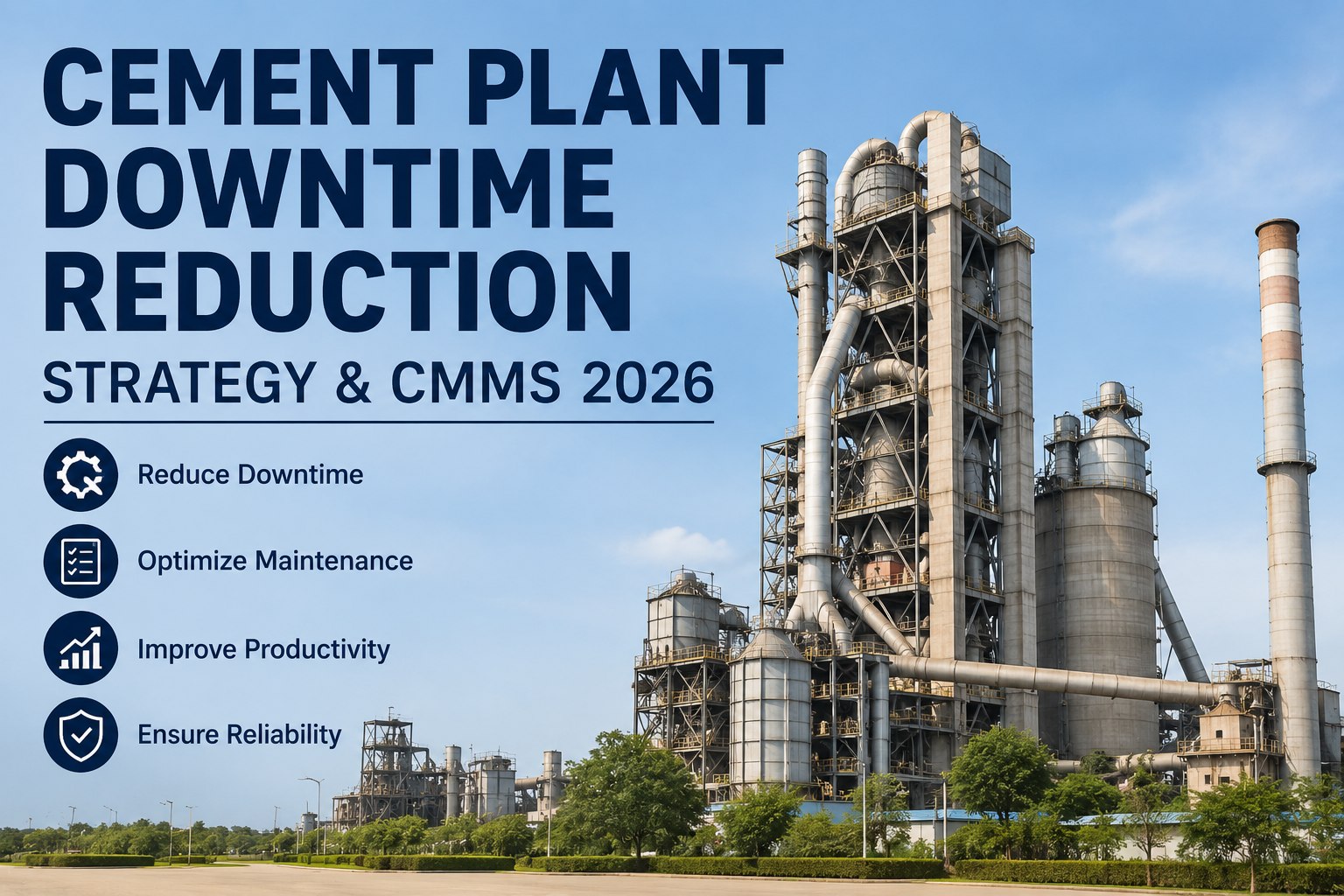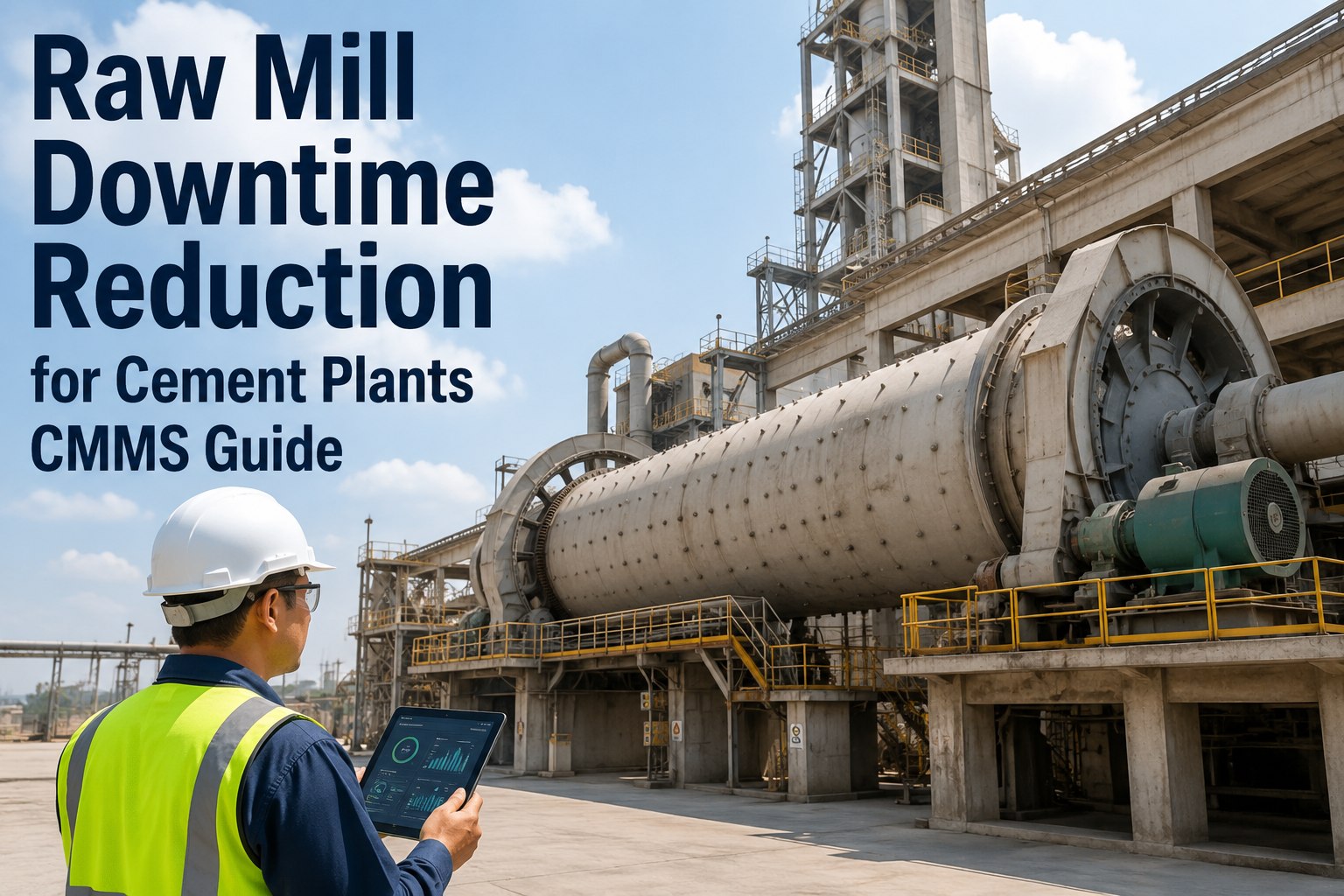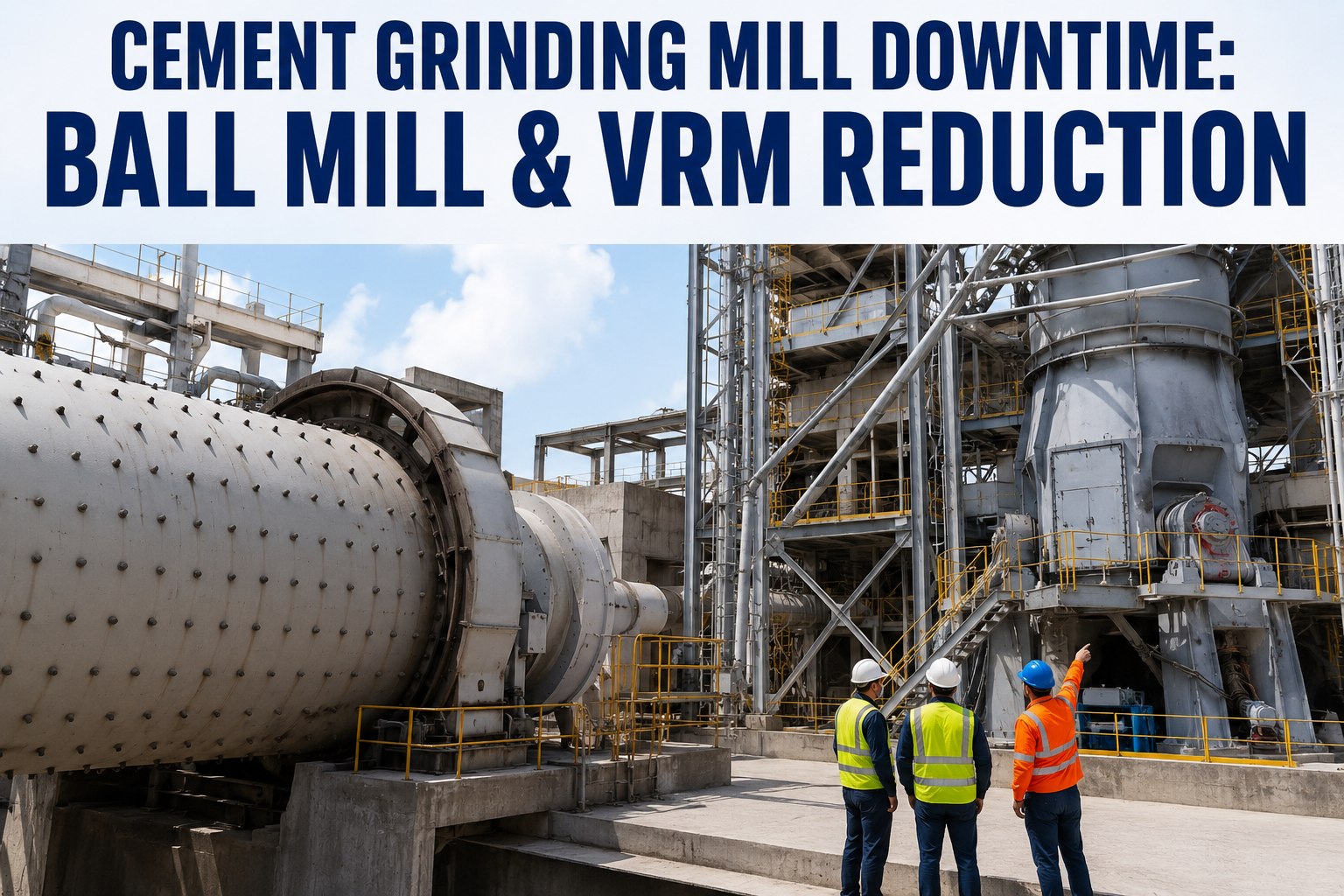
Cement grinding consumes 40–60% of a plant's electrical energy and sits at the narrow end of the production funnel — when the ball mill or vertical roller mill (VRM) stops, clinker inventory backs up, dispatch windows slip, and every idle hour converts directly into lost margin. Industry benchmarking across integrated cement plants shows unplanned grinding downtime averaging 120–180 hours per mill per year, with a single VRM trip cascade costing roughly 18–24 hours of cement volume. A CMMS-driven reliability program — combining preventive maintenance (PM), condition-based predictive maintenance (PdM), and disciplined wear-parts management — typically cuts unplanned grinding downtime by 35–50% within the first operating cycle. Ready to stop losing tons to bearing failures, separator stalls, and vibration trips? Start Free Trial and configure your grinding-circuit reliability program today.
Every hour your grinding mill sits idle is cement you will never ship.
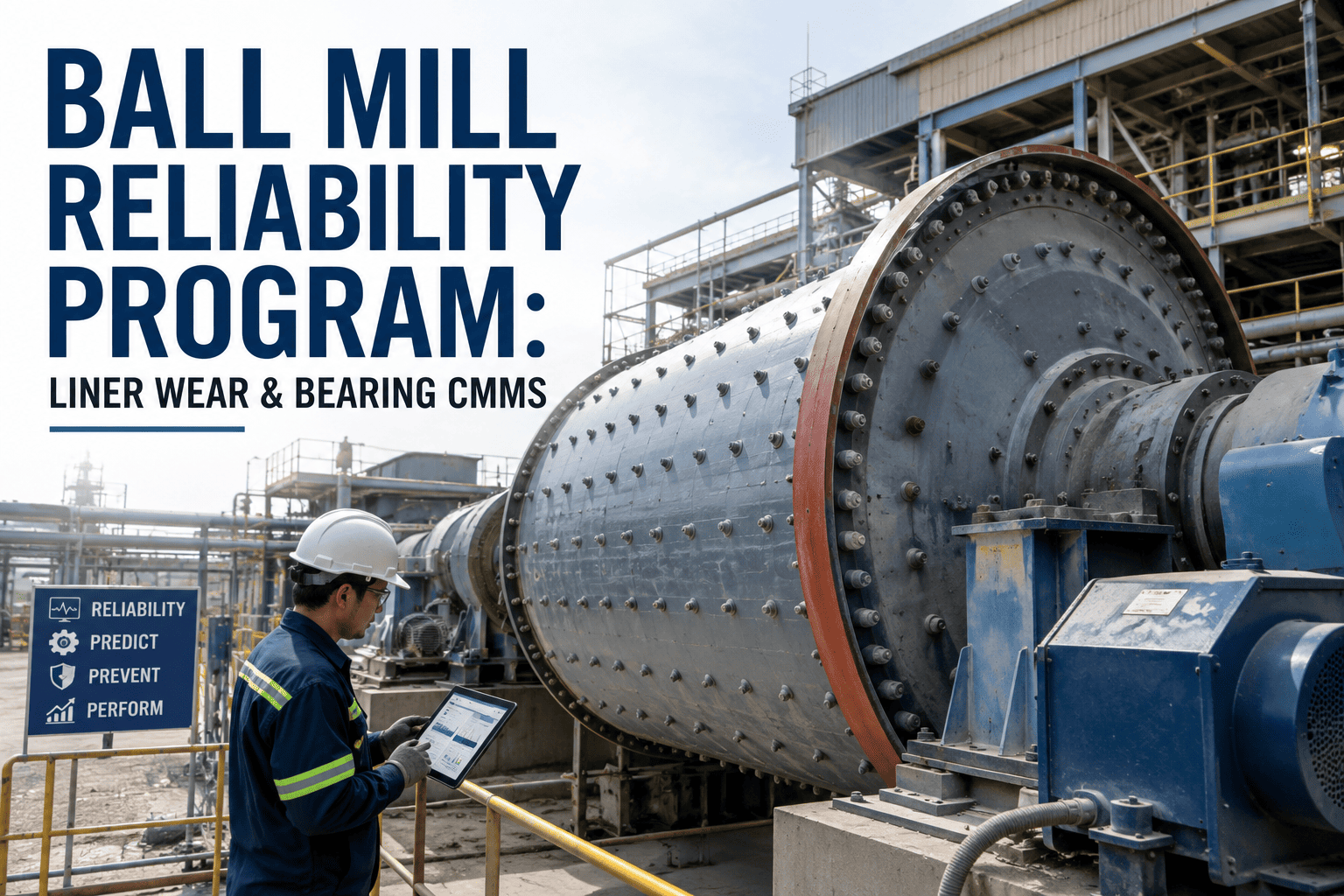
Ball mills and VRMs fail for predictable reasons — trunnion bearing hot spots, main-drive coupling misalignment, separator rotor imbalance, table-liner wear, and vibration trips. A CMMS-structured availability program turns those failure modes into scheduled, 4-hour work orders instead of 24-hour emergencies.
Where grinding mill downtime actually comes from
Across 300+ cement grinding circuits benchmarked over five years, six failure families account for 88% of unplanned downtime hours. Each one has a detectable precursor — the CMMS exists to catch that precursor before it becomes a trip.
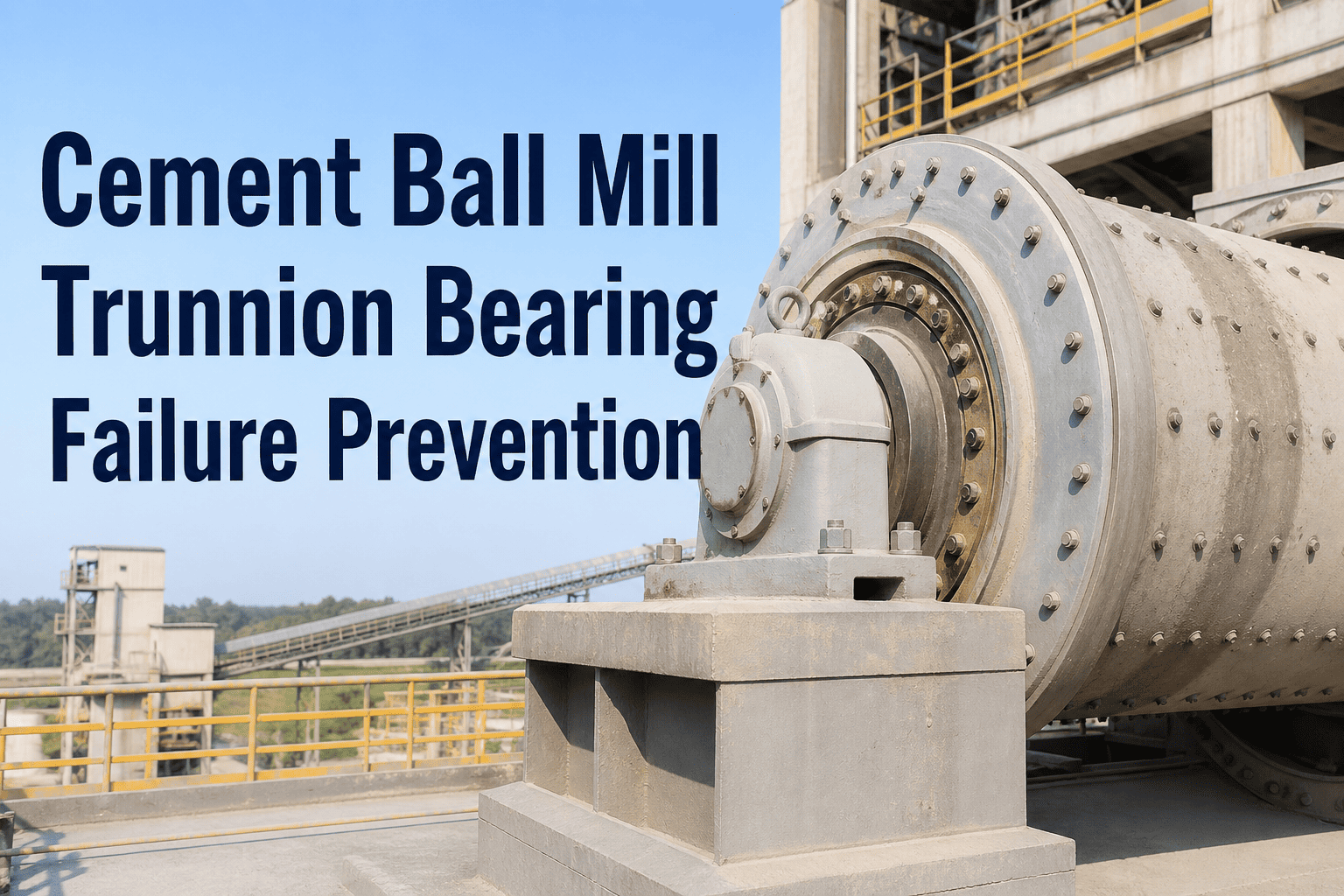
Trunnion Bearing Hot Spots
Lubrication film breakdown and white-metal babbitt fatigue drive 22% of ball-mill stoppages. Continuous temperature + vibration trending inside the CMMS catches the 8–12°C rise that precedes a catastrophic seizure.
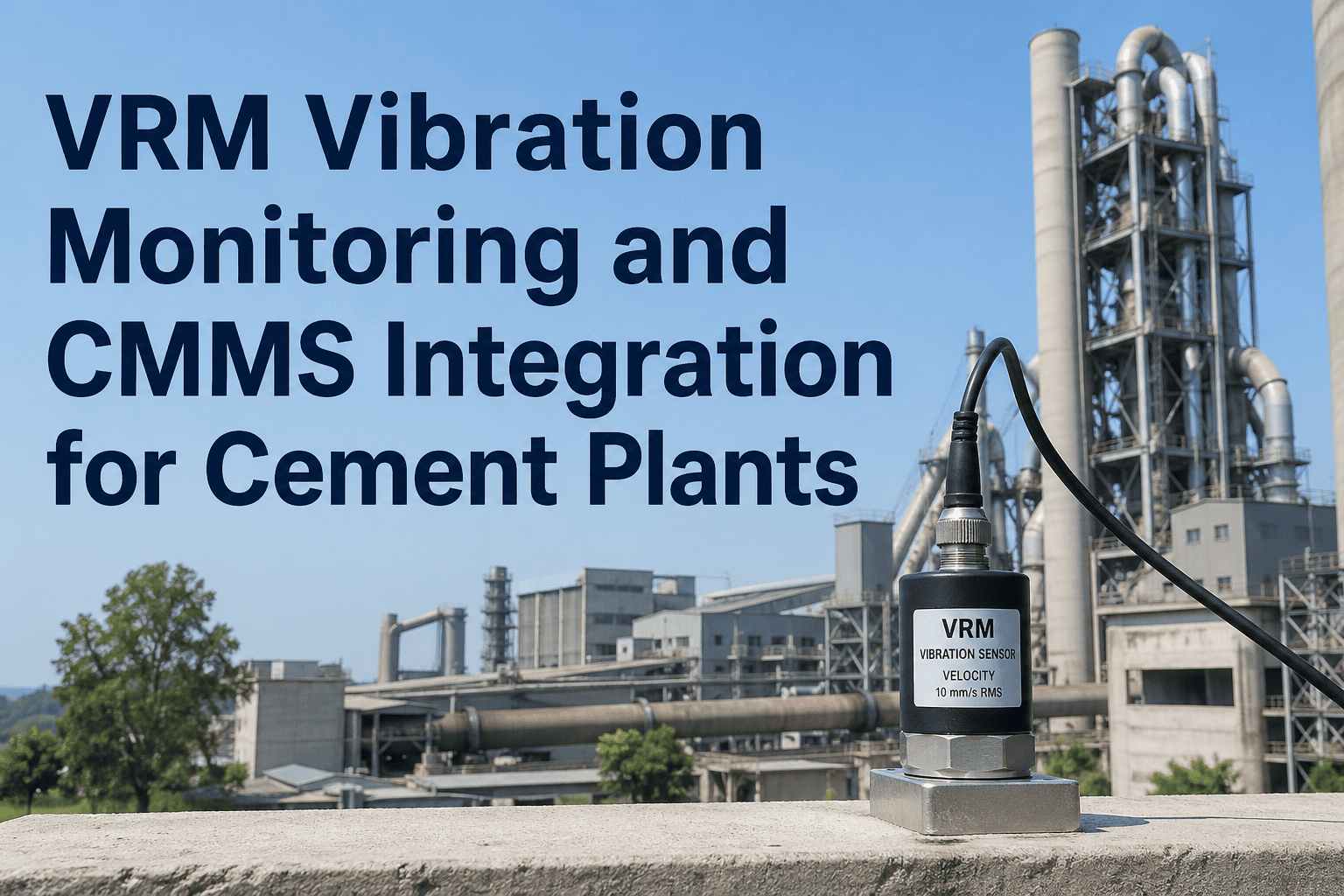
Vibration Trips & Roller Instability
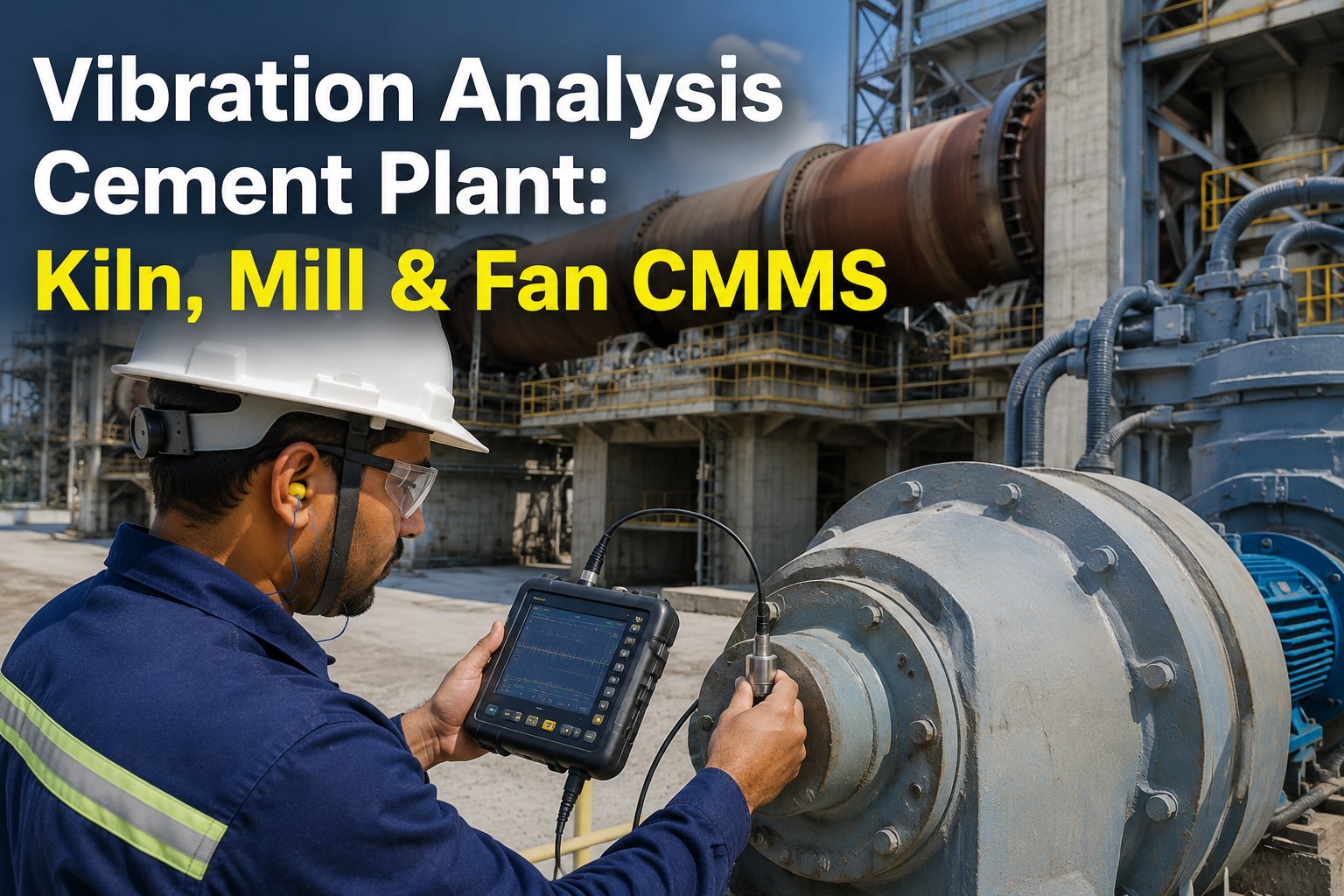
Hard-bed formation, metal foreign objects, and hydraulic-pressure drift push VRM vibration past 14 mm/s trip thresholds. CMMS trend alerts at 9–10 mm/s give operators a 40-minute intervention window.
Main Drive Coupling Wear
Gear-coupling lubricant degradation and shim-pack fatigue produce torque spikes on the pinion. Monthly thermography + oil-analysis work orders in the CMMS catch coupling failure 60–90 days early.
Separator Rotor Imbalance
Cyclone-liner wear and rotor-vane fouling shift the dynamic balance, dropping Blaine consistency and tripping the variable-frequency drive. PdM vibration routes logged in the CMMS flag the imbalance before quality rejects stack up.
From time-based PM to condition-based PdM — without abandoning either
A reliable grinding circuit runs on a layered strategy: time-based PM handles the predictable (lubrication, filter swaps), condition-based PdM handles the variable (vibration, thermography, oil debris), and the CMMS is the single system that schedules, captures, and closes both.
Time-based PM baseline
- Trunnion bearing oil change every 4,000 operating hours
- VRM hydraulic filter replacement at 2,000-hour intervals
- Separator rotor bearing grease every 1,500 hours
- Pinion coupling inspection + relube every 90 days
- Mill diaphragm slot cleaning during planned outages
Condition-based PdM triggers
- Vibration route weekly — alert at 7 mm/s, work order at 9 mm/s
- Oil analysis monthly — Fe >120 ppm or Si >30 ppm opens a CMMS task
- Thermography quarterly — bearing delta >15°C above baseline
- Motor current signature analysis — broken-rotor-bar screening
- Ultrasonic thickness on mill shell & separator vanes
A 180-asset integrated plant running two cement ball mills and one VRM was logging 410 unplanned grinding hours per year and spending $42K on emergency bearing replacements. After integrating PM and PdM triggers inside a single CMMS, the reliability team cut unplanned hours to 196 in year one (-52%), reduced emergency MRO spend by $24K, and lifted grinding-circuit availability from 89.1% to 94.6% — recovering roughly 28,000 tons of annual cement capacity.
Stop letting wear-parts lead time dictate your outage calendar
Grinding media, table liners, roller tires, and diaphragm plates carry 6–18 month lead times and consume 25–35% of the grinding-circuit maintenance budget. The CMMS tracks remaining-life estimates against measured wear rates so procurement triggers fire 90 days before a critical dimension is reached — not the day after.
| Wear Component | Service Life | Replacement Trigger | Lead Time | Stockout Risk |
|---|---|---|---|---|
| Ball Mill Shell Liners | 14,000–18,000 h | Thickness loss >35% | 10–14 weeks | High |
| VRM Table Liner | 8,000–12,000 h | Hard-facing wear >40% | 14–18 weeks | Critical |
| VRM Roller Tires | 6,000–9,000 h | Diameter loss >8% | 12–16 weeks | Critical |
| Grinding Media (balls) | Continuous top-up | Consumption 35–50 g/kWh | 4–6 weeks | Medium |
| Separator Rotor Vanes | 20,000–24,000 h | Slot gap increase >20% | 8–10 weeks | Medium |
| Diaphragm Plates | 12,000–16,000 h | Slot blockage >25% | 6–8 weeks | Low–Medium |
The 12-month grinding availability rollout
A CMMS-driven availability program is not a software launch — it is a staged reliability transformation. The four-phase timeline below shows how plants move from reactive firefighting to predictable, market-aligned grinding capacity in a single operating cycle.
Asset & Failure-Mode Baseline
Register every grinding asset, sub-assembly, and critical spare in the CMMS. Build the asset hierarchy down to bearing, coupling, and hydraulic cylinder. Import 24 months of work-order history to calculate baseline MTBF, MTTR, and availability per mill.
PM Library & PdM Route Build
Map each failure mode to a PM checklists or PdM route. Configure trigger thresholds (vibration, temperature, oil debris, wear dimension). Set auto-generated work orders with labor, parts, and safety permits pre-loaded.
Wear-Parts & Inventory Linkage
Connect each wear component to a min/max inventory record and a procurement alert. The CMMS converts measured wear-rate trends into remaining-life estimates and fires purchase requisitions 90 days before critical dimension is reached.
Stabilize, Review & Tighten
Weekly reliability huddles review CMMS dashboards: plan-versus-actual compliance, PdM alert resolution time, and downtime-by-failure-mode Pareto. Tighten thresholds, retire low-value PMs, and lock the annual grinding availability target.
Turn 200 unplanned grinding hours into 100.
Configure your cement grinding reliability program in oxmaint and start recovering tons from your ball mill and VRM this quarter.
Cement grinding mill downtime — your questions answered
What is the single biggest cause of unplanned ball mill downtime?
Trunnion and pinion-bearing failures lead the pack, responsible for roughly 22% of unplanned ball-mill stoppages. The root cause is almost always lubrication-film breakdown or babbitt fatigue that develops over weeks. A CMMS that trends bearing temperature and vibration daily catches the 8–12°C rise that precedes seizure, converting a 24-hour emergency into a planned 4-hour lube-and-inspection intervention.
How does a CMMS reduce VRM vibration trips?
VRM vibration trips are the end-state of a deteriorating condition — hard-bed formation, roller-pressure drift, or foreign metal — that builds over 30–90 minutes. The CMMS logs vibration readings on a weekly route and raises an alert at 7 mm/s, well below the 14 mm/s trip threshold. Operators get a 40-minute window to adjust hydraulic pressure, water spray, or feed gradation before a trip ever occurs.
Can a CMMS manage both PM and PdM for grinding circuits in one system?
Yes — and that integration is where most of the downtime reduction comes from. Time-based PM work orders handle lubrication, filter changes, and scheduled inspections, while condition-based PdM triggers generate work orders automatically when vibration, oil-analysis, or thermography thresholds are crossed. Both live in the same asset hierarchy, so a PdM alert can open a PM-merged work order with parts, labor, and permits pre-staged.
How quickly can a cement plant see measurable downtime reduction?
Plants that complete the four-phase CMMS rollout typically see a 25–35% reduction in unplanned grinding downtime within the first six months, climbing to 40–50% by month twelve as PdM thresholds tighten and wear-parts procurement stabilizes. You can Book a Demo to walk through a baseline calculation for your specific mill configuration.
Does the CMMS support ISO 55000 asset-management alignment?
Absolutely. The CMMS enforces the asset-register, risk-assessment, and performance-monitoring pillars that ISO 55000 requires. Every grinding asset carries a criticality rating, a documented failure-mode profile, and a measurable availability target — giving auditors a clean, defensible trail from strategic asset objective down to the individual work order executed on the shop floor.
Stop losing cement tons to grinding mill downtime.
Build your ball mill and VRM reliability program in oxmaint — PM, PdM, wear-parts, and downtime analytics in one CMMS built for cement.
Free 14-day trial · No credit card