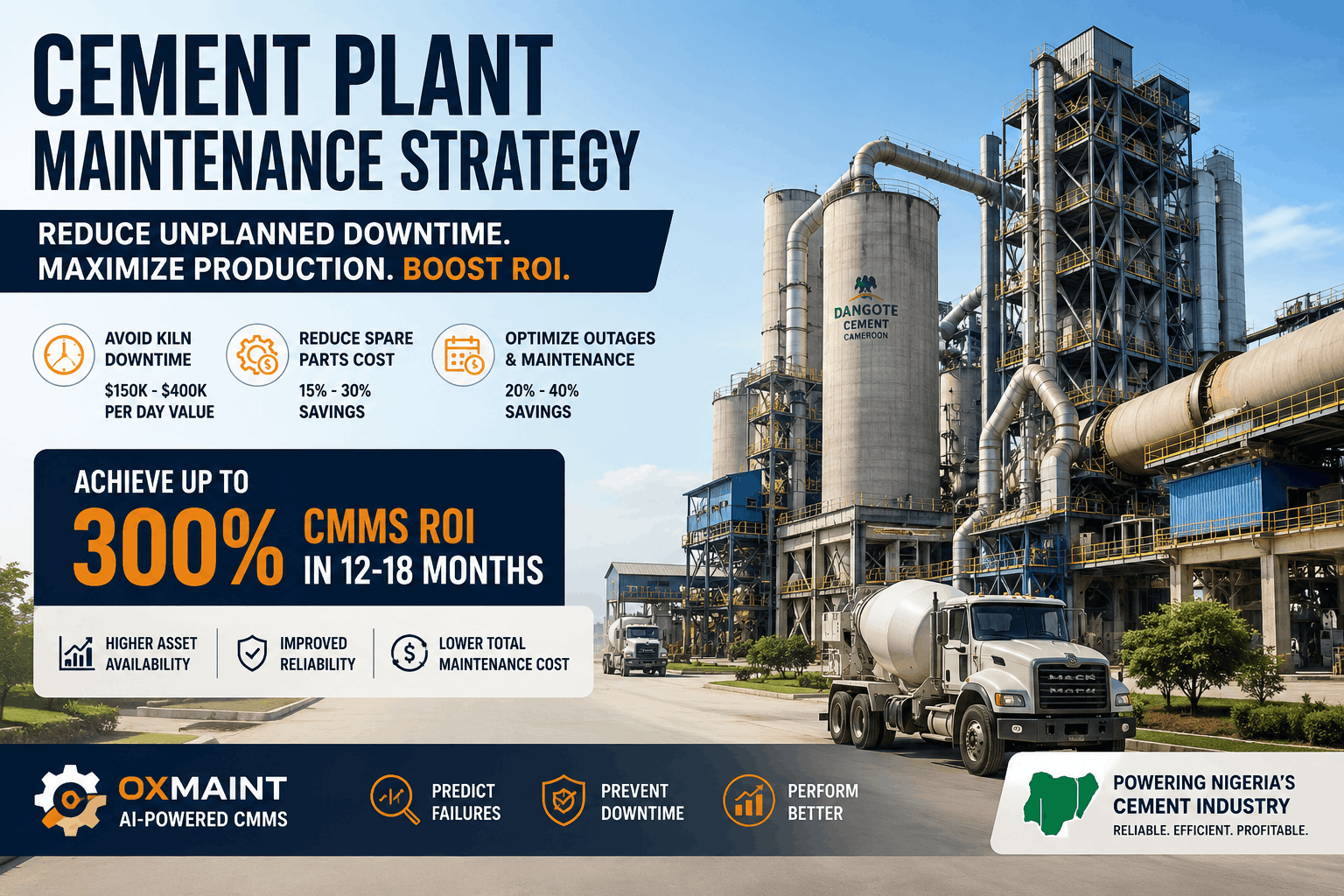
Unplanned downtime in a cement plant is not just a maintenance problem — it is a direct, measurable hit to clinker output, kiln fuel efficiency, and monthly margin. Industry benchmarks show that best-in-class cement producers hold unplanned downtime below 3% of available hours, while median plants lose 6–10% of annual capacity to breakdowns, with a single kiln stop costing anywhere from $25,000 to $120,000 per day depending on tonnage and fuel mix. A 2026-grade downtime reduction strategy combines rigorous downtime taxonomy, root-cause discipline, PM/PdM optimization, and a CMMS that turns maintenance data into availability gains. Build that operating model in OxMaint — Start Free Trial — and move plant availability upward within the first quarter of deployment.
Every unplanned kiln hour is measurable margin lost — a CMMS-driven program can recover 8–12% of annual clinker capacity.
Cement downtime reduction sits where reliability, cost, and safety converge. This guide maps the downtime taxonomy, root-cause discipline, PM/PdM optimization, and the CMMS operating model that consistently pushes plant availability upward — across kiln, raw mill, crusher, and clinker cooler circuits.
Name the loss before you can fix it
Plants that cannot classify downtime cannot reduce it. The first job of a CMMS is to enforce a consistent taxonomy so every stop — from a 12-minute feeder trip to a 6-day kiln refractory outage — is categorized against the same standard.
Scheduled kiln shutdowns, refractory brick replacement, annual overhauls, and statutory inspections. Typically 5–8% of calendar hours. Target: compress scope and duration, not eliminate.
KPI · Shutdown duration vs planBreakdowns, equipment failures, and forced stops on the kiln, raw mill, cement mill, or cooler. Median plants run 6–10%; best-in-class hold it under 3%.
KPI · MTBF, MTTR, breakdown %Rate losses, minor stops under 5 minutes, and quality deviations that do not appear as full outages but quietly drag OEE down 4–7 points.
KPI · OEE, rate loss %Grid outages, raw material shortages, fuel supply interruptions, and logistics bottlenecks. Often 1–3% of available hours and frequently under-reported.
KPI · External loss hoursFrom symptom to source in five disciplined steps
RCA is where most cement plants leak value — 70% of "root causes" logged in legacy systems are actually symptoms. A CMMS-enforced RCA workflow forces teams past the first answer to the underlying failure mechanism.
Capture the failure event inside the CMMS work order
Operator logs the stop with failure code, asset tag, timestamp, and observed symptom — not a free-text note. Standard failure-code libraries for kiln, mill, cooler, and crusher circuits eliminate ambiguity and make trends searchable.
Build the 5-Whys chain with evidence at each level
Each "why" must cite inspection data, condition-monitoring trend, or maintenance history from the CMMS. A chain that ends at "operator error" or "bad luck" is rejected and reopened.
Map to a failure mode and ISO 14224 code
Translate the verified cause into a standardized failure mode — erosion, fatigue, thermal shock, lubrication breakdown — so the event becomes a searchable data point across the fleet of identical assets.
Assign corrective and preventive actions with owners
Every RCA closes with one or more work orders — a redesign, a PM frequency change, a training intervention, or a PdM sensor addition — each with an owner, due date, and measurable success criterion.
Verify the fix held at 30, 60, and 90 days
The CMMS automatically reopens the RCA if the same failure mode recurs on the asset within the review window — closing the loop and preventing "fix-and-forget" cycles.
Rebalance the maintenance mix to cut failures, not budgets
Most cement plants still run 65–75% reactive and calendar-based PM. The 2026 target is a 50/30/20 split — reactive, planned, and condition-based — which typically cuts unplanned downtime 35–50% inside 12 months.
Every CMMS-driven intervention either raises MTBF (fewer failures) or lowers MTTR (faster recovery). Both move availability in the same direction.
A 200 t/h kiln losing 14 hours to a cooler grate failure at $35/t margin = $98,000 in lost margin alone — before the $40K repair bill.
Continuous monitoring on raw mill fan bearings, kiln drives, and crusher gearboxes detects bearing degradation 4–8 weeks before failure — converting a 12-hour breakdown into a 2-hour planned swap.
Quarterly IR scans on switchgear, motor connections, and preheater cyclones catch hot spots before they become arc-flash events or refractory collapses.
Monthly spectrographic oil analysis on large gearboxes and hydraulic systems flags wear-metal trends, water ingress, and viscosity loss — extending oil life 20–40% and preventing catastrophic seizure.
Kiln shell temperature, cooler under-grate pressure, and mill motor current trends integrated into the CMMS reveal drift toward failure hours before a trip — the cheapest PdM sensor is often the one already installed.
Where the hours go — and where to win them back
A worked example: a 180-asset cement plant running two kiln lines tracked downtime across its four critical circuits for 12 months inside a CMMS. The breakdown below shows where the losses concentrated and the targeted intervention for each.
| Asset Circuit | Annual Downtime Hours | Primary Failure Mode | CMMS Intervention | Projected Recovery |
|---|---|---|---|---|
| Kiln (rotary) | 386 h | Refractory hot-face wear, tire creep | Shell-scan PdM + brick-life PM triggers | −22% |
| Clinker Cooler | 214 h | Grate plate failure, hydraulic ram seizure | Vibration + pressure-trend monitoring | −31% |
| Raw Mill | 168 h | Bearing wear, separator fan imbalance | Oil analysis + quarterly thermography | −27% |
| Crusher (limestone) | 96 h | Hammer wear, drive coupling fatigue | Wear-based PM + coupling IR scan | −19% |
| Cement Mill | 132 h | Pinion bearing, slide-shoe lubrication | Vibration PdM + lube-auto PM | −24% |
Total projected annual margin recovery from the five interventions above: 996 downtime hours eliminated × average 1.9 t/h per asset × $35/t contribution margin = roughly $1.9M — against a CMMS + sensors investment of $145K, a payback inside the first quarter of deployment.
Turn maintenance data into availability — this quarter
Deploy OxMaint's CMMS across your kiln, mill, cooler, and crusher circuits and watch unplanned downtime drop week over week.
Cement plant downtime reduction — answered
The five questions cement reliability leaders ask most when evaluating a CMMS-driven downtime program for 2026.
How much downtime reduction is realistic in the first year of CMMS deployment?
Plants that enforce failure coding, PM compliance above 90%, and at least two PdM technologies (typically vibration + oil analysis) on critical circuits see 25–40% unplanned downtime reduction in 12 months. The largest gains come in months 4–8 as RCA loops mature.
Which cement assets should be prioritized first for PdM?
Sequence by criticality and failure frequency: kiln drive and tire assembly first, clinker cooler grates and hydraulics second, raw mill and cement mill pinion bearings third, then crusher drivetrains. Each carries a downtime cost of $25K–$120K/day, so even a single prevented failure funds the sensor investment. You can map your own asset ranking when you Start Free Trial.
Does a CMMS replace the existing maintenance team or empower it?
Empower — decisively. A CMMS removes paperwork, manual PM scheduling, and spreadsheet-based failure tracking so planners and technicians spend more time on analysis and execution. Most plants redeploy 15–20% of maintenance hours from admin to reliability work within the first quarter.
How does the CMMS handle kiln shutdown planning and turnaround scope?
The CMMS builds a shutdown work-order bundle from the accumulated deferred-PM list, PdM-flagged repairs, and statutory inspections — each with parts, labor hours, and sequence dependencies assigned. Plants using this approach compress shutdown duration 8–15% versus spreadsheet-planned turnarounds. To see the shutdown module in action, Book a Demo.
What KPIs should the plant manager review weekly to confirm the program is working?
Track five: unplanned downtime hours per week, PM compliance %, MTBF trend on critical assets, open high-priority work orders past due, and cost per ton of clinker attributable to maintenance. If the first three move in the right direction for three consecutive weeks, the program is taking hold.
Recover 8–12% of annual clinker capacity with OxMaint
Deploy a CMMS built for cement — failure coding, RCA workflows, PdM integration, and shutdown planning in one platform.
Free 14-day trial · No credit card