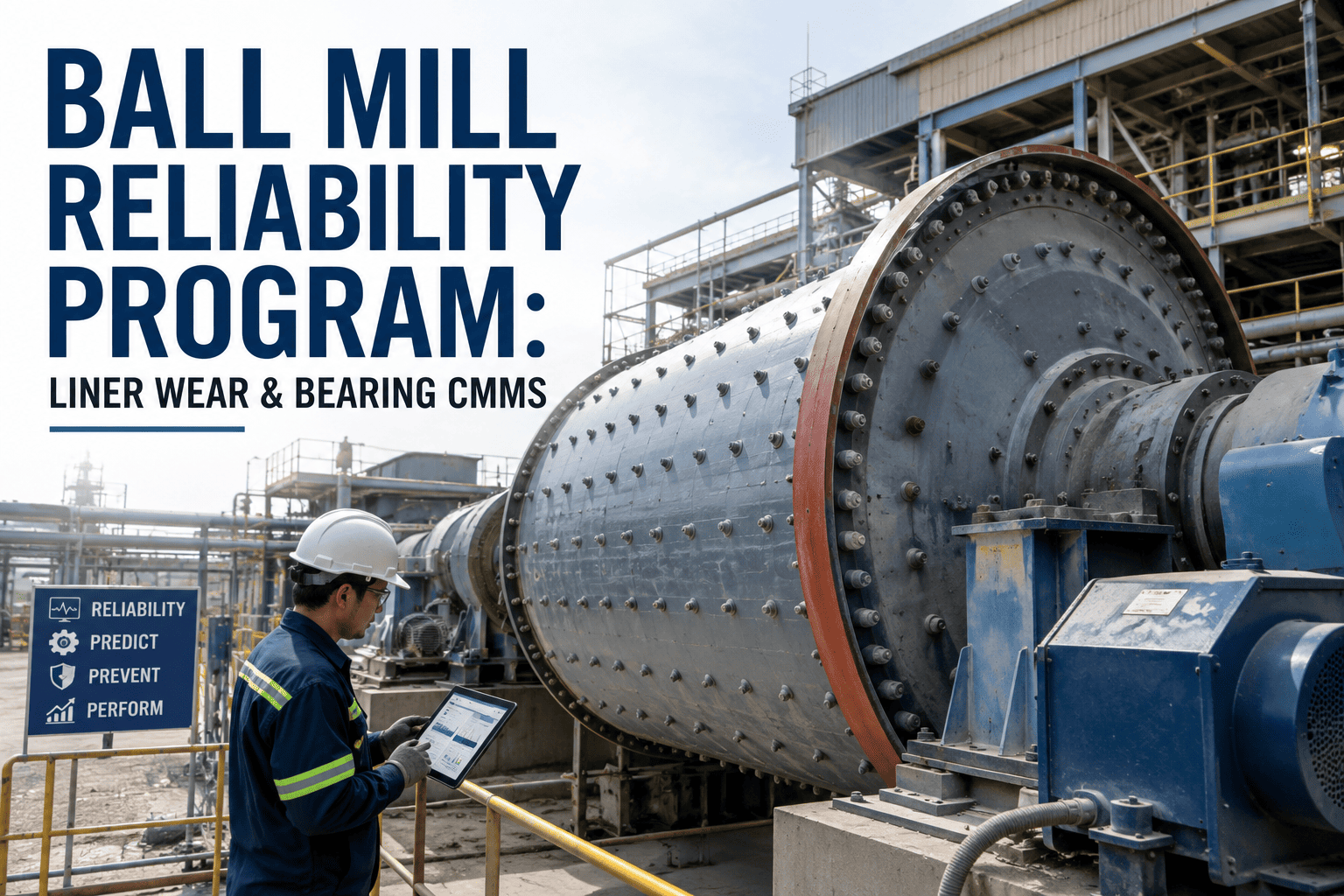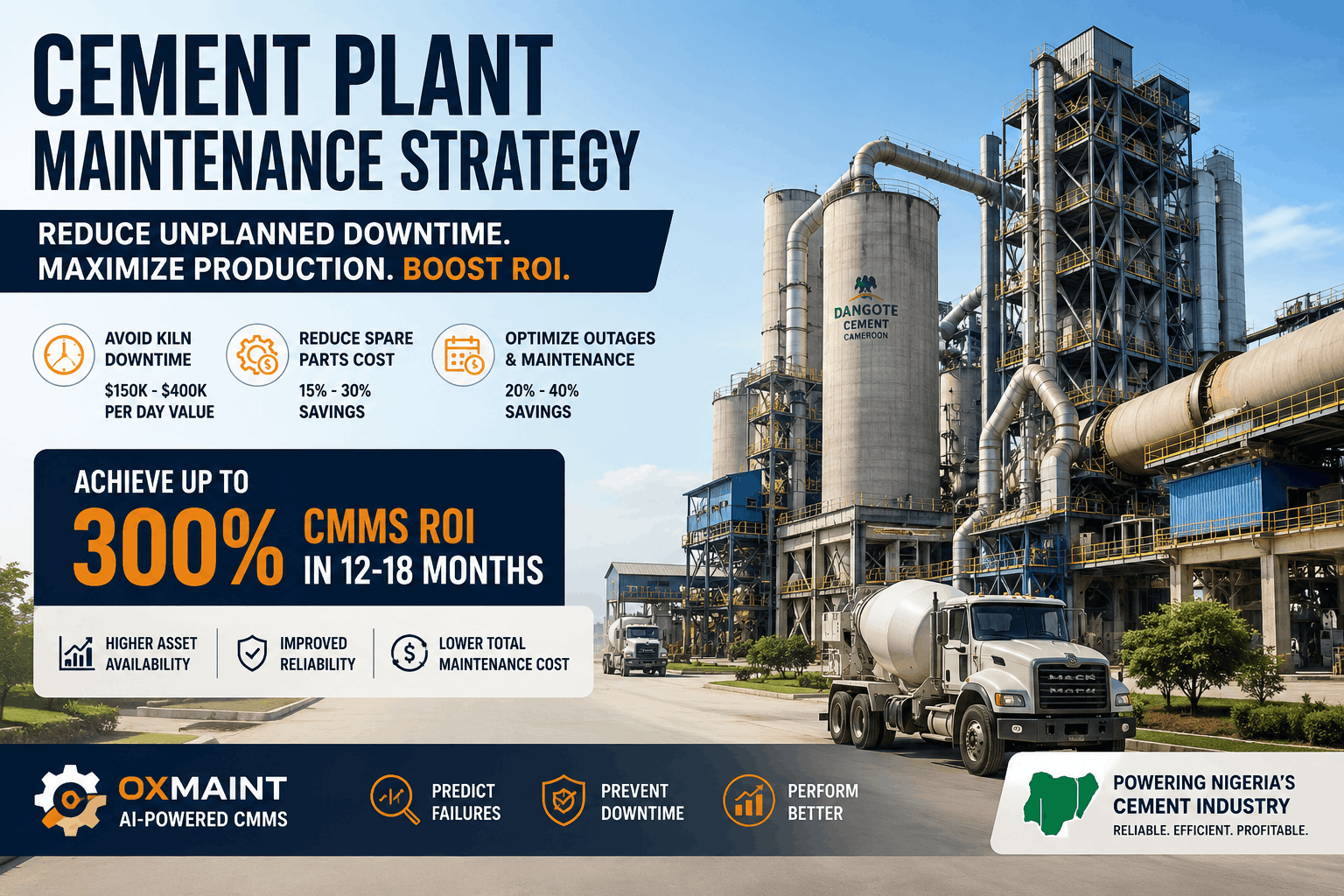
Raw mill downtime cascades directly into kiln feed problems — every hour your raw mill sits idle becomes an hour of risk for kiln continuity, clinker output, and the day's production target. A modern CMMS flips that dynamic by converting reactive firefighting into condition-driven, scheduler-aware maintenance: bag filter jamming is flagged before pressure drop spikes, separator bearings are greased on measured vibration trends, and false-air ingress is logged against monthly tonnage loss. This guide walks through the four pillars of raw mill reliability — PM optimization, wear management, drive-train reliability, and the CMMS-driven uptime program that keeps availability above kiln feed requirements. Plant teams can Start Free Trial to operationalize these workflows within days, or read on for the engineering playbook.
Why does every hour of raw mill downtime threaten your kiln?
A raw mill outage of just 6 hours can starve the kiln of 2,400–3,000 tonnes of feed, forcing operators to draw from silo reserves — and once those reserves drop below the 12-hour safety mark, kiln continuity itself is at risk. The CMMS-driven program below shows how leading plants hold availability above 92% and push MTBF past 760 hours on the same asset base.
Where raw mill downtime actually comes from
Across 40+ cement plant audits, four failure clusters account for 78% of unplanned raw mill hours. Ranking them by mean downtime per event — not by frequency alone — is what separates a 92% available mill from an 84% one.
The tiered PM checklist that holds availability above 92%
Tiering work by frequency — daily operator rounds, weekly mechanical checks, and monthly condition-based inspections — is the single fastest lever for raw mill uptime. Each item below maps to a CMMS work-order template with checkpoint, tolerance, and escalation rule pre-loaded.
- Inspect bag filter pressure drop; flag if delta > 1,800 Pa
- Log mill main drive bearing temperature vs. 70°C trip point
- Verify feed belt weigh-feeder deviation < ±2%
- Listen for separator cage irregularity at idle & load
- Grease separator bearings per OEM chart; record strokes
- False-air survey at mill inlet, seal air, and duct expansion joints
- Inspect table liner & roller tire wear with template gauge
- Sample mill fan vibration ISO 10816 zone boundary
- Full vibration spectrum on gearbox — trending vs. baseline
- Clean preheater cyclone choke points feeding the mill
- Oil analysis (ISO 4406) on gearbox & hydraulic power unit
- Recalibrate feed weigh-feeders against silo stock-out
What one hour of raw mill downtime really costs
Most plants track downtime hours but never convert them to rupees or dollars — which is why PM budgets get cut. The formula below, validated against three 8,000 tpd clinker lines, makes the cost visible so maintenance spend can be defended at the board level.
8,000 tpd line · 6 h stoppage
- Feed shortfall2,520 t × $58/t
- Restart scrap180 t × $42/t
- Silo draw recovery6 h × $1,200/h
- Total DCH$161,640
From reactive to condition-driven in three months
A structured 90-day rollout turns a CMMS from a work-order filing cabinet into the operating system of raw mill reliability. Each phase below has a measurable exit gate — plants that hit all three gates typically reach 92% availability inside one quarter.
Asset hierarchy + criticality ranking
Build the mill's asset tree down to component level (separator cage, grinding table, hydraulic tension). Rank by criticality × detectability. Tag 14 high-risk components for vibration and temperature monitoring. Exit gate: 100% of critical assets in CMMS with PM templates loaded.
Rework intervals against failure data
Compare current PM frequency to 18 months of failure history. Shorten or lengthen intervals using mean-time-between-failure (MTBF) and P-F interval analysis. Add condition triggers (vibration > 4.5 mm/s, ΔP > 1,800 Pa) as automatic work-order generators. Exit gate: 30% PM hours reallocated without raising downtime.
Condition-based dispatch + kiln sync
Wire live sensor feeds to the CMMS scheduler so emerging defects are queued against the kiln's planned-feed window. Bundle minor fixes into a single 8-hour shutdown window aligned with clinker silo turnover. Exit gate: unplanned downtime reduced 35% vs. baseline; availability ≥ 92%.
Stop logging downtime you already know how to prevent.
Deploy Oxmaint CMMS on your raw mill in under 14 days and start converting unplanned hours into scheduled ones.
Three raw mill failure modes — root cause to CMMS trigger
The table below pairs each high-frequency failure mode with its physical root cause, the leading indicator a CMMS should monitor, and the preventive work order that fires automatically when the threshold is crossed.
| Failure mode | Root cause | Leading indicator | CMMS trigger & WO | Avg downtime saved |
|---|---|---|---|---|
| Bag filter jamming | Moisture condensation on dirty side + lime hydrate bridging | ΔP rising > 1,800 Pa over 4 h | Auto WO: clean pulse valves, inspect cage bags, dew-point audit | 3.8 h/event |
| Separator bearing failure | Over-greasing & lubricant degradation at 78°C housing | Vibration > 4.5 mm/s RMS (ISO 10816 zone C) | Auto WO: relube per trend, oil sample, bearing temp log | 6.2 h/event |
| False air ingress | Duct expansion-joint wear + mill inlet seal erosion | O2 at preheater exit > 5% with feed stable | Auto WO: seal air survey, joint replacement scheduled | 1.9 h/event |
| Feed fluctuation | Weigh-feeder drift > ±2% & bin bridging | Mill motor amperage swing > 8% in 60 s | Auto WO: recalibrate feeder, inspect bin aeration | 1.4 h/event |
A 180-asset plant cut raw mill downtime 38% in two quarters
When a North Indian cement producer deployed Oxmaint CMMS across two vertical roller mills feeding a single 8,000 tpd kiln, the program paid for itself inside five months — and unlocked a 2.1% clinker output gain from steady kiln feed alone.
Before Oxmaint, every bag filter jam was a fire drill. Now the CMMS fires a work order the moment ΔP crosses 1,600 Pa, and the mill crew fixes it in the next scheduled window — not at 2 a.m. on a Sunday.
— Maintenance Head, 8,000 tpd integrated cement plantRaw mill downtime reduction — the five questions plant teams ask most
How much raw mill downtime is actually preventable?
Roughly 65–75% of unplanned raw mill hours are preventable with existing condition-monitoring signals. The remaining 25–35% are genuine random failures (roller fatigue, sudden gearbox tooth pitting) that even the best CMMS can only shorten — not eliminate — through faster diagnosis and pre-staged spares.
Which raw mill failure mode should we tackle first?
Start with bag filter jamming — it is the highest-frequency event (34% of unplanned hours in audit data) and the cheapest to instrument. A differential-pressure transmitter on the clean-gas side, wired to the CMMS, typically pays back in under 90 days by catching condensation-driven bridging before it chokes the duct.
Can a CMMS really keep availability above kiln feed requirements?
Yes, when the system links condition triggers to the kiln's feed-silo buffer. The CMMS queues emerging-defect work orders against planned clinker-silo turnover windows, so most fixes land in a single 8-hour shutdown instead of forcing an unscheduled mill stop. Plants that hit this sync pattern hold availability above 92%. Start Free Trial to test the scheduler on your own mill.
How long does it take to deploy a CMMS on a raw mill?
A focused deployment is 14–30 days: asset hierarchy and criticality ranking in week one, PM templates and condition triggers in week two, and scheduler integration with kiln feed planning in week three or four. Sensor retrofit (vibration, ΔP, temperature) can run in parallel without halting the mill.
What ROI should we expect in the first year?
Typical first-year returns range from 4× to 9× the CMMS spend on a single 8,000 tpd line. A 38% downtime cut on two mills yields around $1.2M annualized recovered production — against software, sensor, and training costs of $130K–$180K. To model your own numbers, Book a Demo and we'll run the formula on your feed rate and clinker value.
Your kiln never stops demanding feed. Give the raw mill the system it deserves.
Deploy Oxmaint CMMS, wire your existing sensors, and watch unplanned hours convert into scheduled ones — in under 90 days.
Free 14-day trial · No credit card