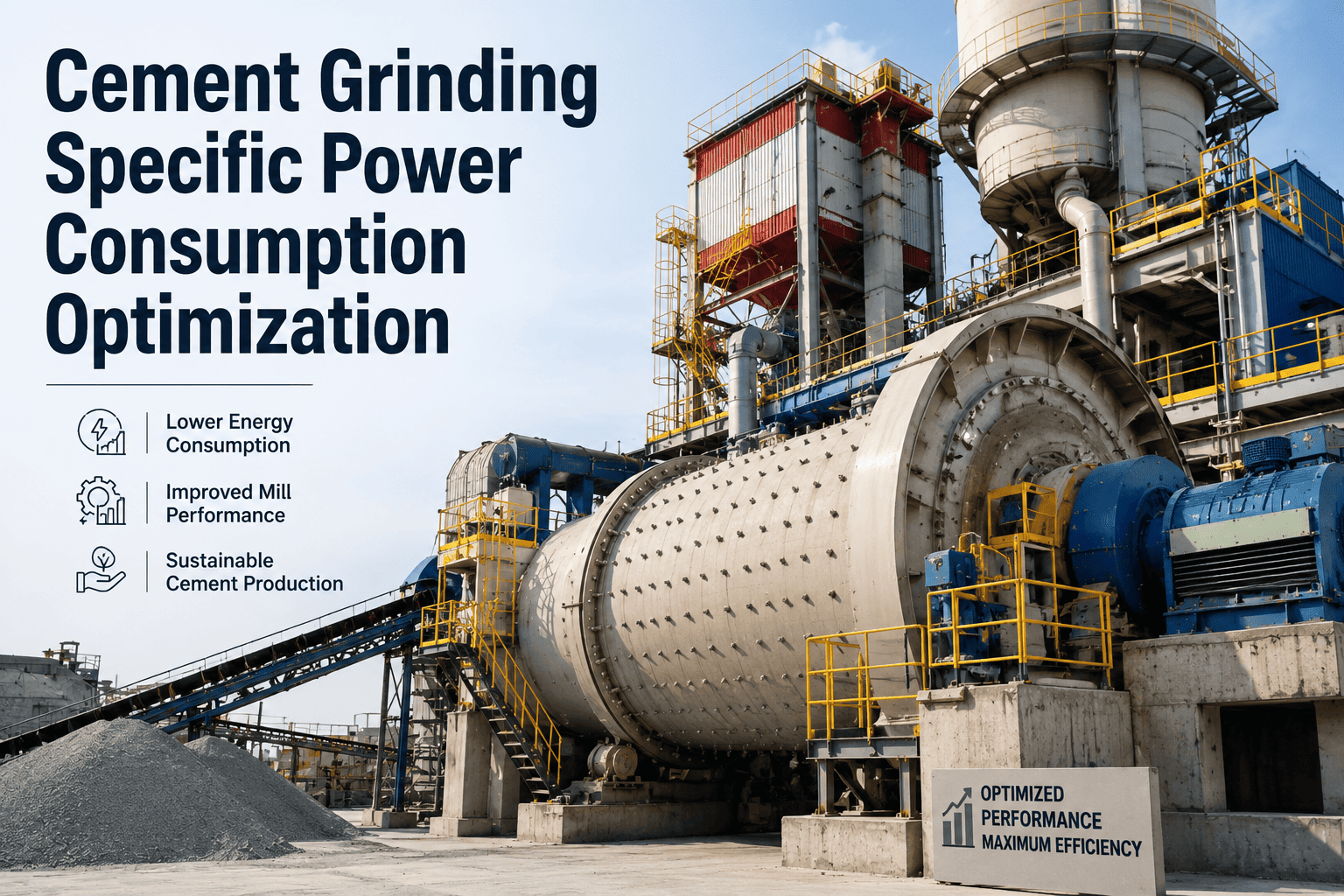
Cement grinding accounts for 30–40% of a plant's total electrical draw, which means every 1 kWh/tonne shaved off the mill circuit drops straight to the bottom line. Optimizing specific power consumption is rarely about a single lever — it is the combined effect of ball mill liner profile, VRM grinding pressure, separator efficiency, grinding aid dosage and the discipline of tracking every parameter over time. Plants that pair operational tuning with a CMMS-driven maintenance rhythm routinely hold grinding energy 8–15% below industry benchmarks without sacrificing Blaine or 28-day strength. Ready to see the numbers for your circuit? Start Free Trial and benchmark your mills this week.
Energy Performance · Cement Grinding
Stop bleeding kWh in the finish-grind circuit — measure, tune, sustain.
A 100 tph cement mill running at 38 kWh/t burns roughly $2.4M a year in power alone. Cut 4 kWh/t through liner, pressure and separator work and you reclaim $250K+ annually — without touching clinker factor or cement quality.
Baseline Diagnosis
Where your grinding kWh actually goes
Specific power consumption is the sum of mechanical, pneumatic and classification losses. Before optimizing, you need a clean baseline — measured at the motor terminal, not the switchgear, over a stable 72-hour window at target throughput and Blaine.
A 2.4 Mtpa plant spending $0.09/kWh on a 38 kWh/t finish grind carries an annual grinding power bill near $8.2M. A 10% reduction returns $820K/yr — typically achievable inside one maintenance cycle.
Ball Mill Internals
Liner profile and media charge drive 4–7 kWh/t of hidden loss
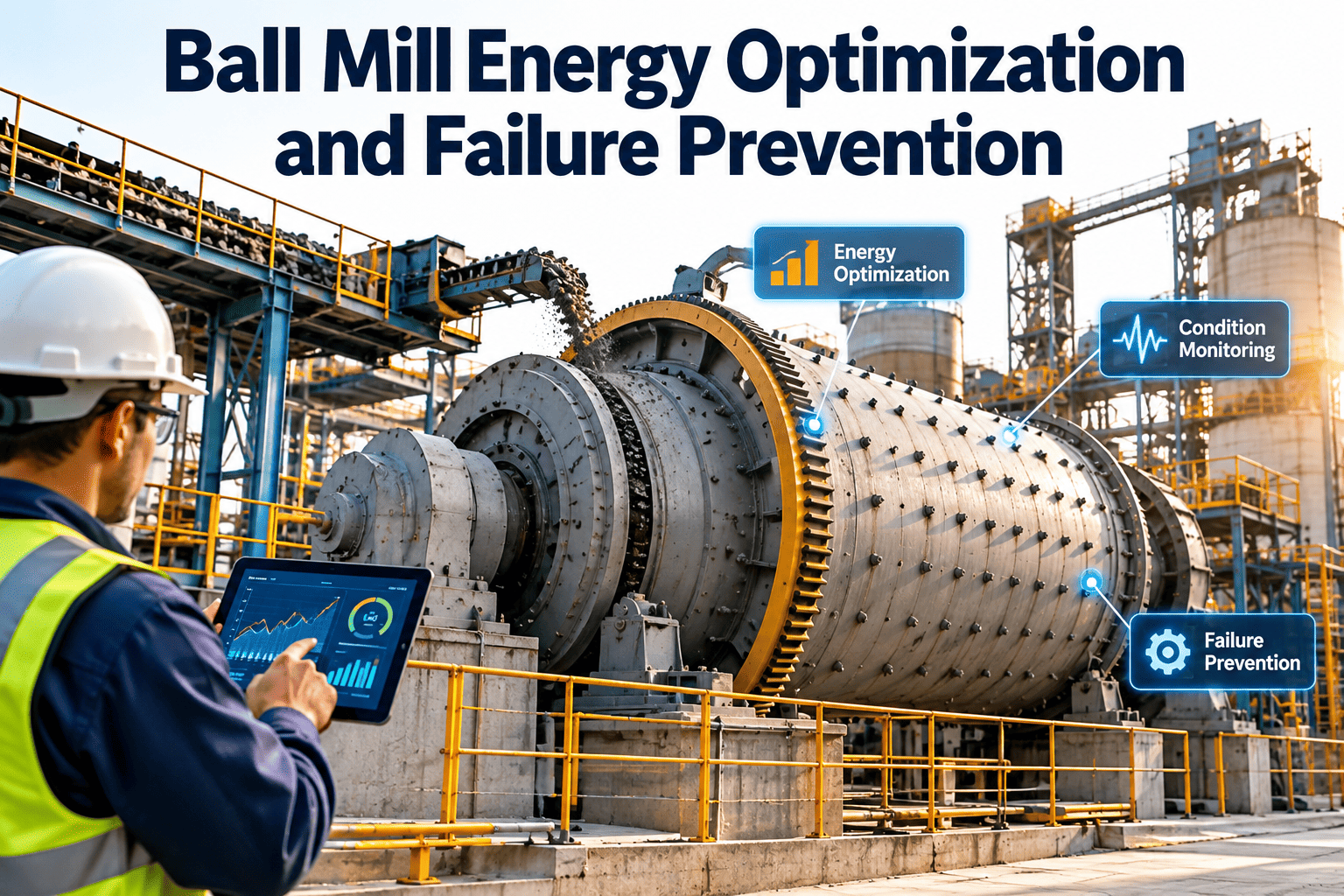
Lifter geometry, classifying liner wear and media gradation determine how efficiently impact and attrition energy transfer to particle breakage. A worn 4th chamber liner can push specific consumption up 6% before throughput visibly drops.
Specific Power Consumption
SPC = (kWhmill + kWhsep + kWhfan) ÷ tfinished cement
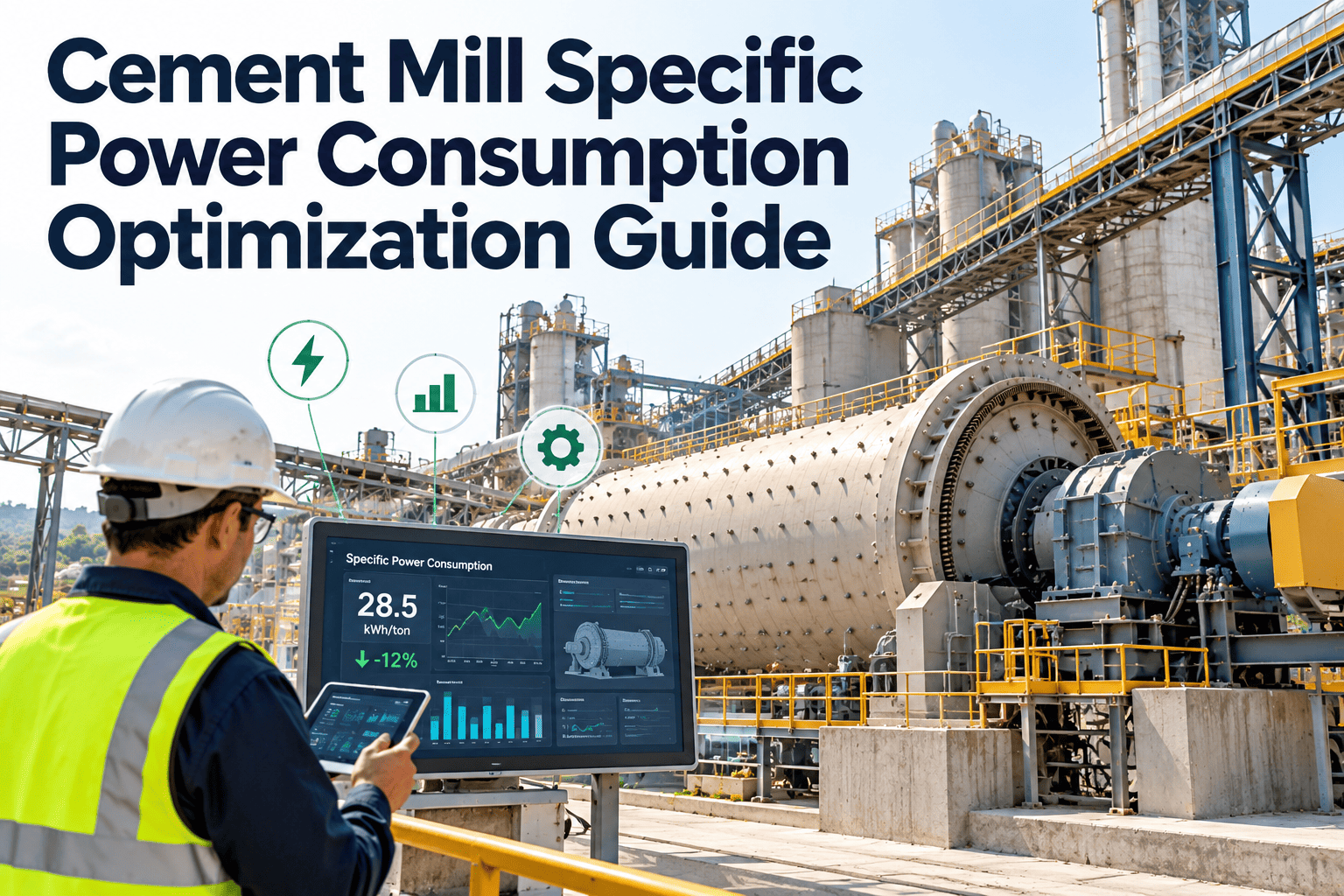
Target: 28–34 kWh/t OPC at 3,300–3,800 Blaine for a closed-circuit ball mill; 18–26 kWh/t for a VRM.
Media Charge Filling Ratio
φ = (Vmedia ÷ Vmill) × 100
Sweet spot: 28–32% for first chamber, 24–28% for second. Below 24%, impact energy collapses; above 34%, dead load rises.
Lifter face angle
A 17° face angle optimizes cataracting for Ø 4.2 m mills; as lifter height wears below 60% of nominal, slip rises and SPC climbs 3–5%. Track lifter height in CMMS every 2,000 operating hours.
Classifying liner integrity
Reverse-spiral and wave liners lose their classification effect once the leading edge rounds off. Result: coarser media drifts toward the discharge, reducing grinding efficiency 4–7%.
Media gradation drift
Top-up with single-size balls shifts the curve fine. Re-gradation every 4–6 months using a Slegten or Magotteaux model holds the 25/20/17/12 mm distribution and prevents a 1.5–2.5 kWh/t creep.
Diaphragm slot condition
Plugged or worn slots alter inter-chamber material flow, starving the second chamber. Clean and inspect center diaphragms at every 8-week shutdown; log slot openness in CMMS.
VRM Pressure Map
Vertical roller mill pressure, table and nozzle tuning
A VRM trades ball-on-steel impact for compression-then-shear between roller and table. Grinding pressure, dam ring height and nozzle ring velocity together set the kWh/t — small moves produce outsized savings.
| VRM Parameter | Typical Range | Effect of +10% Change | Recommended CMMS Cadence |
|---|---|---|---|
| Hydraulic grinding pressure | 8–14 MPa | +0.8 kWh/t, finer Blaine, higher roller vibration | Trend daily · review weekly |
| Dam ring height | 30–55 mm | Higher ring → longer residence → lower tph, finer product | Inspect at 4-week shutdown |
| Nozzle ring velocity | 70–90 m/s | +10% velocity → 1.2 kWh/t extra fan power, more rejects | Measure monthly |
| Roller wear | 0–12 mm profile loss | At >8 mm loss, nip angle shifts and SPC rises 2–3 kWh/t | Gauge every 2,000 h |
| Separator rotor speed | 60–140 rpm | Controls residue on 45µm; tuning affects recycle load 5–15% | Auto-logged via CMMS |
A 240 tph VRM at 24 kWh/t moved to 21 kWh/t via pressure trim and dam ring reset saves 2,700 MWh/yr — about $243K at $0.09/kWh. Most VRM optimizations pay back inside 4 weeks.
Separator & Circuit
Separator efficiency is the cheapest kWh you will ever recover
A dynamic separator running below 65% Tromp sharpness over-grinds already-fine particles, then recycles them. Improving cut sharpness by 8–10 percentage points typically drops SPC 1.5–2.5 kWh/t with zero capex — only maintenance and tuning.
Rotor blade condition
Worn blades reduce centrifugal cut. Rebuild or replace at 3 mm edge wear. Log blade profile in CMMS and trend separator bypass % monthly.
Airflow and fan balance
Separator fan should sit within 5% of design flow. Excess air carries coarse to fines; insufficient air sends fines to rejects. Tune with a Pitot traverse.
Rejects return path
Rejects re-entering ahead of the mill feed (not at the elevator boot) cut recycle load 8–12% and trim 0.8–1.4 kWh/t. Inspect the chute every shutdown.
Sealing and leakage
False air above 10% of total separator flow destroys cut efficiency. Smoke-test seals at the rotor shaft, guide vane housing and discharge cone quarterly.
Guide vane angle
Optimal vane angle ±2° of the rotor blade exit angle. Out-of-spec angles create vortex dead zones. Verify during every major kiln/mill stop.
Grinding aid dosing
0.02–0.05% GA on cement weight reduces agglomeration, lifts Blaine throughput 8–15%, and cuts SPC 1–3 kWh/t. Track dosing pump calibration in CMMS weekly.
90-Day Optimization Timeline
From baseline to sustained 4 kWh/t reduction in one quarter
A disciplined, CMMS-tracked roadmap turns one-off tweaks into a controlled program. Each phase has defined work orders, measurement gates and sign-off — so gains do not evaporate when the crew changes shift.
Baseline & audit
Install or verify motor kW meters; capture 72-h baseline at 3 target Blaine levels. CMMS auto-creates asset records for mill, separator, fan and elevator with rated vs. actual kW.
Mechanical correction
Re-grade media, replace worn lifters, reset dam ring, calibrate GA pump. Target 1.5–2.5 kWh/t from internals alone. Every task closes with a measured post-work kW reading.
Process tuning
Separator rotor sweep, fan damper trim, nozzle ring velocity test. Run design-of-experiments on 3 setpoints; pick lowest SPC that holds residue and 28-day strength.
Sustain & control
Lock setpoints, schedule weekly CMMS work orders for GA pump and separator seal checks, trend SPC daily. Drift beyond ±1.5 kWh/t triggers an automated work order.
Plant Scenario
A 2.4 Mtpa plant cut grinding power 11% in 11 weeks
Worked example of a mid-size integrated plant in South-East Asia running two Ø4.2×13 m ball mills and one OK-33 VRM, all logged in a CMMS for the first time.
Before
38.2 kWh/t
Mixed OPC + PPC · SPC untracked per mill · separator bypass 22% · GA pump 14% out of calibration
After (11 weeks)
34.0 kWh/t
Same product slate · per-mill SPC dashboards · separator bypass 9% · GA dosing re-calibrated weekly via CMMS work order
Annual Savings
$907K
2.4 Mt × 4.2 kWh/t × $0.09/kWh · payback 5.3 weeks · zero capex, only maintenance discipline and tuning
Your next 4 kWh/t is sitting inside the data you already log
Oxmaint CMMS turns mill motor trends, separator audits and GA dosing logs into a live SPC dashboard — with auto-triggered work orders the moment a parameter drifts.
Frequently Asked Questions
Cement grinding SPC — what plant teams ask us most
What is a realistic specific power consumption target for a closed-circuit ball mill producing OPC?
For a modern Ø4.2×13 m closed-circuit ball mill producing OPC at 3,300–3,600 Blaine, a well-tuned circuit should hold 30–34 kWh/t at the motor terminal. Older circuits with worn internals and inefficient separators often sit at 38–42 kWh/t. Closing that 6–8 kWh/t gap is usually achievable without major capex through liner, media and separator work — start by Start Free Trial to baseline your mill today.
How much energy can VRM grinding pressure optimization realistically save?
Trimming hydraulic pressure to the minimum that holds target Blaine and residue typically saves 1.0–1.8 kWh/t — about 4–7% of VRM specific consumption. The bigger wins come from combining pressure tuning with dam ring height, nozzle ring velocity and roller wear correction, which together can deliver 2–4 kWh/t.
Does lowering SPC hurt cement strength or setting time?
Not if separator efficiency and particle size distribution are held. The goal is to stop over-grinding already-fine particles, not to coarsen the product. A sharper Tromp curve at the same 45µm residue usually maintains or even improves 28-day strength while reducing SPC. Always validate with lab mortar tests during tuning.
How does a CMMS actually reduce grinding kWh per tonne?
A CMMS enforces the maintenance rhythm that keeps low-SPC setpoints stable: scheduled lifter inspections, media top-up work orders, GA pump calibrations, separator seal checks and diaphragm cleaning. It also trends motor kW against throughput so drift is caught within days, not quarters. Without that discipline, even the best optimization reverts within 3–6 months.
What is the typical payback period for a cement grinding optimization program?
For a plant spending $2M+ annually on grinding power, a CMMS-led optimization program targeting 4 kWh/t typically pays back in 4–8 weeks. The cost is mostly labor, gauging and minor wear-part spend — no major equipment. A 2.4 Mtpa plant saving 4.2 kWh/t at $0.09/kWh recovers over $900K per year. To scope your circuit, Book a Demo with our engineering team.
Begin Your Optimization Sprint
Install Oxmaint today. Watch kWh/t drop next quarter.
Connect mill motor data, separator audits and grinding aid logs in one CMMS — and let automated work orders hold your gains for years, not weeks.
Free 14-day trial · No credit card