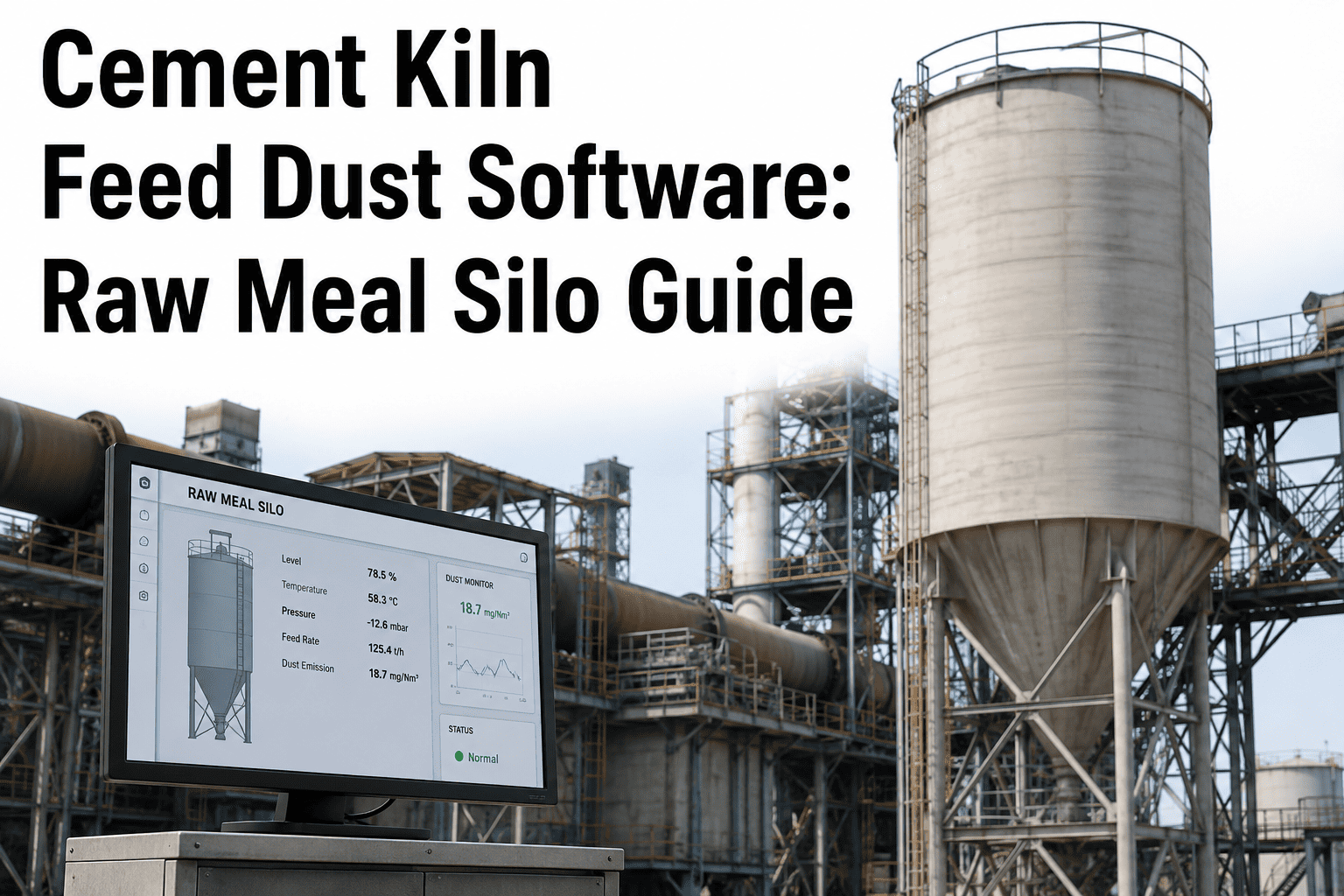
Kiln feed dust rarely announces itself with one dramatic leak. It escapes a few grams at a time — through a bin vent filter bag that lost its seal, an airslide fluidizing panel gone porous, a screw conveyor gland packed loose enough to puff dust on every stroke. None of these show up on a control room screen, but they add up across a raw meal silo circuit moving hundreds of tonnes an hour, turning into visible plumes, housekeeping complaints, and eventually an emissions reading that fails a spot check. Digital dust-source tracking turns each of those small failure points into a scheduled inspection instead of a surprise. Sign up free at https://app.oxmaint.ai and map every dust point on your kiln feed circuit this week.
Kiln Feed Dust, By The Numbers
99.9%
Particulate removal efficiency achievable by a well-maintained baghouse filter
<0.2 kg/t
Dust generation per tonne of clinker achievable with a well-maintained recovery system
628 kN
Upward force a 4-meter silo can face at just 0.5 bar of vent overpressure
30 mg/Nm³
Typical fugitive dust limit under common regional air quality norms
The Five Points Where Kiln Feed Dust Actually Escapes
Kiln feed dust is not created at one location — it leaks from a chain of equipment that moves raw meal from the mill to the kiln, and each link in that chain has its own failure mode. A raw mill discharge chute with a worn seal loses fine material every time it tumbles through. An airslide with a clogged fabric panel stops fluidizing properly and starts spilling material at the joints. A kiln feed bin's screw conveyor gland wears until dust puffs with every revolution. A bin vent filter with a torn bag stops capturing fines and starts venting them straight to atmosphere. And a silo roof vent clogged with caked dust can do worse than leak — it can trap enough pressure during pneumatic filling to bulge or lift the silo shell itself. Book a demo at https://calendly.com/oxmaintapp/30min and see how each point gets tracked on one dashboard.
1
Raw Mill Discharge & Airslides
Worn discharge seals and clogged fluidizing panels are the earliest and most overlooked source, losing fine material before it ever reaches the kiln feed bin.
2
Kiln Feed Bin & Screw Conveyor Seals
Gland packing wears with every revolution, and a loose seal here lets dust puff out with the conveyor's normal operating cycle.
3
Bin Vent Filter
A torn bag or a pulse-jet cleaning system running out of sequence stops capturing fines and starts venting them straight to atmosphere.
4
Silo Roof Pressure Relief
A clogged vent filter during pneumatic filling can trap enough internal pressure to bulge or lift a silo shell, not just leak dust.
5
Pneumatic Filling Line
Loose flange connections and worn rotary valve seals along the filling line are a common source of visible dust during truck or rail unloading.
A Torn Filter Bag Doesn't Send an Alert. Your Neighbors Will.
Oxmaint tracks every bin vent filter, airslide, and pressure relief point on your kiln feed circuit before dust becomes a compliance call. Free to start, no credit card.
How Oxmaint Tracks Kiln Feed Dust Before It Becomes a Compliance Problem
Tracking dust points only matters if it changes what a technician does before the next inspection round. Oxmaint is built around two capabilities that keep the whole kiln feed circuit visible on one screen.
Core Capability
Dust Point Inspection & Condition Tracking
Every bin vent filter, airslide panel, and conveyor seal gets its own inspection schedule and condition history, so a filter bag replaced eighteen months ago and one due for inspection today are never mixed up on the same paper sheet.
Core Capability
Pressure & Emissions Threshold Alerts
Link differential pressure readings and silo vent status to automatic work order triggers, so a filter drifting outside its baseline band generates a scheduled repair before it becomes a visible plume or a failed spot check.
What a Missed Bin Vent Filter Really Costs
A torn filter bag looks like a small maintenance item until the consequences show up somewhere else entirely.
Environmental
A single failed filter bag can push visible particulate past regional limits during a spot check, triggering a citation, a corrective action plan, and a follow-up inspection that keeps the plant on a regulator's watch list for months.
Structural
A clogged silo vent during pneumatic filling can trap enough internal pressure to bulge, crack, or in rare cases lift a silo shell off its base, turning a filter changeout into a multi-week structural repair and shutdown.
Production
Persistent dust loss along the kiln feed circuit changes raw meal chemistry reaching the kiln, adding variability that raw mix control has to correct for downstream, one more variable feeding into clinker quality swings.
Implementation Roadmap
Most kiln feed circuits are fully mapped and reporting live dust point data within roughly three weeks, with no disruption to the current production schedule.
Week 1
Dust Point Mapping
Register every bin vent filter, airslide, screw conveyor seal, and silo vent across the kiln feed circuit with baseline condition data.
Week 2
Pressure & DP Integration
Connect differential pressure readings and silo vent status feeds so drift shows up automatically instead of during a manual walk.
Week 3
Mobile Inspection Go-Live
Deploy the mobile app for filter and seal inspections, with photo capture replacing paper logs across the circuit.
Ongoing
Trend Forecasting & Compliance Reporting
The system learns each point's wear rate and exports audit-ready dust point history whenever a regulator or corporate EHS team asks for it.
Every Dust Point Has a Failure Date. Know It Before the Inspector Does.
Oxmaint tracks condition and pressure trends across your entire kiln feed circuit. Free to start, live in under three weeks.
Proven Results
Dust points with a documented, timestamped inspection history90%
Faster identification of filters or seals drifting toward failure73%
Reduction in visible dust events reported by plant housekeeping58%
Reduction in time spent preparing emissions and dust compliance reports82%
18 Days
Average time to full dust-point dashboard go-live
$0
Implementation fees, free to start
91%
Filter and seal inspections completed on mobile
99.9%
Platform uptime SLA
Oxmaint vs Competitors
Swipe to view full comparison table
| Capability |
Oxmaint |
MaintainX |
UpKeep |
Limble CMMS |
eMaint |
Fiix (Rockwell) |
ManagerPlus |
| Dust Point / Filter Condition Tracking |
Native, point-by-point |
Generic checklists |
Generic checklists |
Generic checklists |
Configurable |
Not available |
Generic checklists |
| Differential Pressure Trend Alerts |
Built-in, threshold-driven |
Not available |
Not available |
Not available |
Custom build |
Not available |
Not available |
| Cement-Specific Kiln Feed Templates |
Pre-built |
Generic industrial |
Generic industrial |
Generic industrial |
Generic industrial |
Generic industrial |
Generic industrial |
| Silo Vent & Pressure Relief Tracking |
Native, structural risk flagged |
Not available |
Not available |
Not available |
Not available |
Not available |
Not available |
| Offline Mobile for Plant Floor |
Full offline + sync |
Online only |
Limited offline |
Limited offline |
Limited offline |
Limited offline |
Limited offline |
| Audit-Ready Compliance Export |
One-click, per site |
Basic export |
Basic export |
Basic export |
Configurable |
Basic export |
Basic export |
| Deploy Time |
18–21 days |
2–3 weeks |
2–4 weeks |
1–2 weeks |
2–4 weeks |
4–12 weeks |
4–8 weeks |
Data Security
AES-256
Encryption
Every inspection record, pressure reading, and compliance export is encrypted at rest and in transit between the silo deck and the dashboard.
SOC 2 Type II
Certified Security
Independently audited every year, satisfying the vendor security review requirements of plant IT and corporate EHS teams.
RBAC
Access Control
Role-based access from field inspector to EHS director, with a full audit log on every reading logged and every report exported.
GDPR
Global Compliance
GDPR and regional data-privacy alignment for plant and personnel records, with regional data residency available on request.
Frequently Asked Questions
How does Oxmaint track bin vent filter condition?
Each filter gets a digital record combining inspection notes, differential pressure readings, and bag or cage replacement history, so its current condition is visible in seconds instead of pieced together from separate logs.
Sign up free to map your own filters.
Can Oxmaint alert us before a silo vent gets dangerously restricted?
Yes. Vent and filter pressure readings are tracked against a baseline band, and a work order is triggered automatically once a reading drifts outside the safe range, well before it becomes a structural risk.
Book a demo to see the alert thresholds.
Does this replace our existing dust collector PM checklist?
Your existing checklist items import directly into the platform, so technicians follow the same inspection steps they already know, just on a mobile device with a full condition history attached.
Start free and import your checklist.
Can we export dust point history for a regulatory audit?
Every inspection, pressure reading, and repair is timestamped and technician-attributed, with one-click export by equipment, date range, or site, ready to hand to an inspector or corporate EHS on request.
Book a demo to review a sample export.
Does the mobile app work for inspections without signal near the silos?
Stop Losing Raw Meal Through a Filter Nobody's Watching.
Track every bin vent filter, airslide, and silo vent on one dashboard before the next spot check. Free to start. Live in under three weeks.