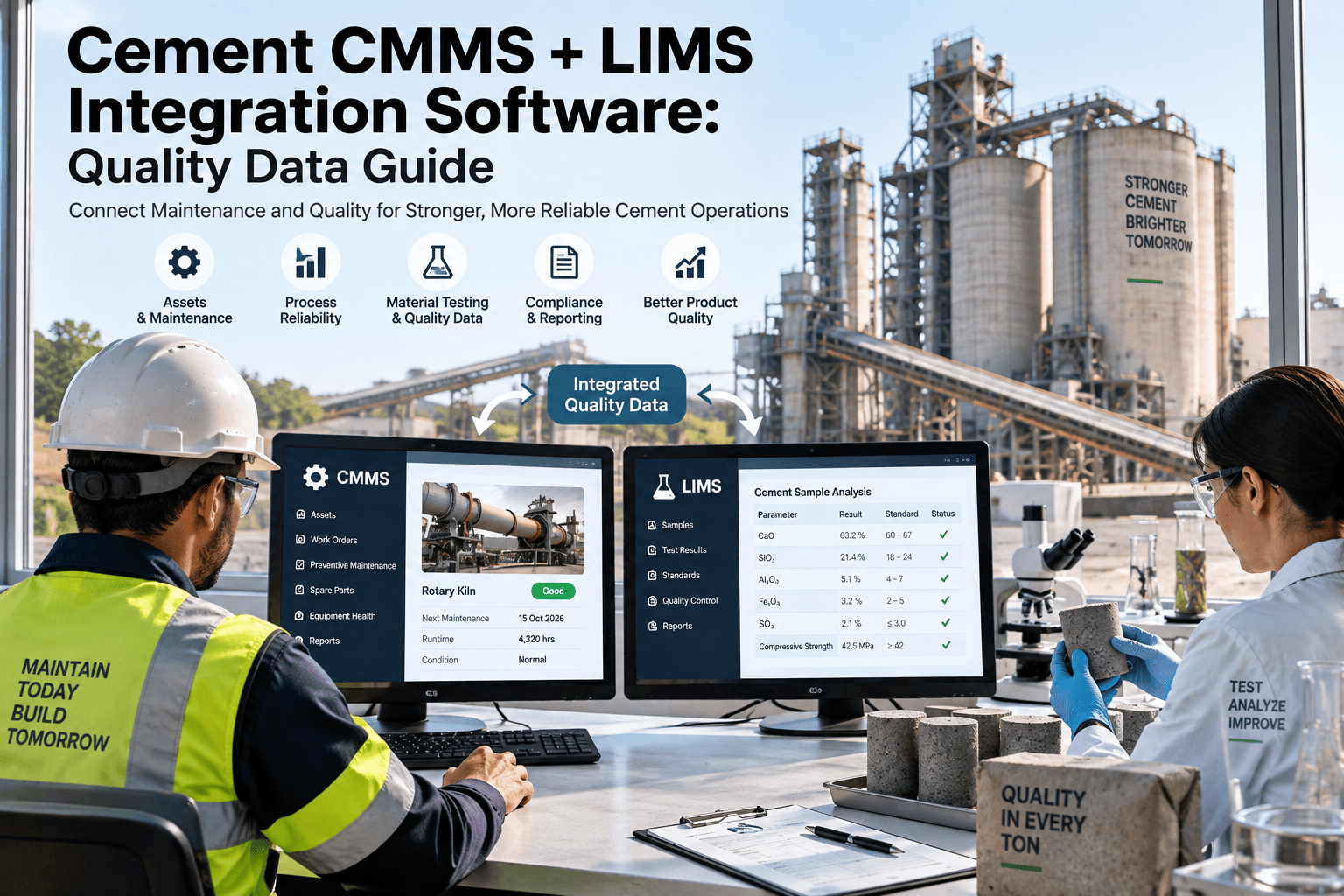
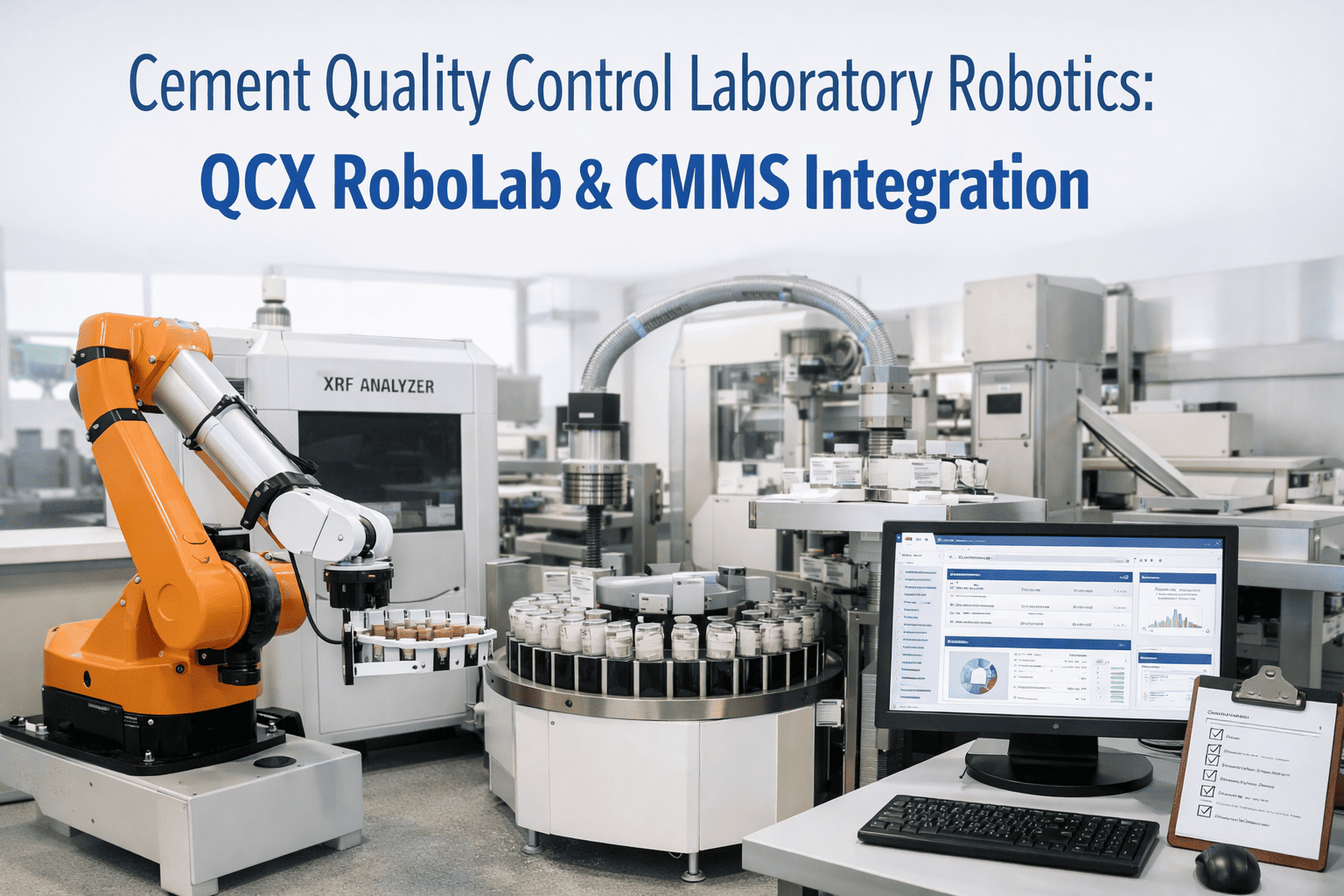
A cement plant laboratory generates thousands of data points every day — XRF raw meal analysis, free-lime measurements, Blaine fineness readings, compressive strength results, particle size distributions, and sulfate balance checks. In most plants, this data lives in spreadsheets, paper logbooks, and disconnected instrument software that cannot communicate with the process control system, the maintenance department, or the quality management team simultaneously. The result is a 2–4 hour lag between lab measurement and operational response, during which hundreds of tonnes of clinker may have already been produced out of specification. A Laboratory Information Management System (LIMS) eliminates this lag by digitizing the entire sample-to-result workflow, integrating instrument data directly, and pushing quality results to process control and maintenance systems in real time. Fuller's QCX/Manager LIMS platform already enables multi-plant quality tracking with automated sustainability reporting. ABB's Knowledge Manager provides the foundation for direct process and quality control decisions. The question is no longer whether digital lab management makes sense — it is how quickly your plant can implement it. Oxmaint's CMMS platform completes the integration loop by connecting lab-triggered quality deviations to automated corrective maintenance work orders — ensuring that when the lab flags a problem, the right equipment gets inspected and fixed before production suffers.
XRF / XRD Analyzers
Auto-capture oxide analysis and phase composition directly from instruments. No manual transcription.
Process Control (DCS)
Push LSF, SM, AM values to kiln operators in real time. Enable closed-loop quality control.
CMMS (Oxmaint)
Quality deviations auto-generate maintenance work orders for linked equipment.
Strength Testing Machines
Compressive and flexural strength results logged against clinker batch and cement blend ID.
ERP / SAP
Quality certificates, batch release, and compliance documentation flow into enterprise systems.
Sampling Systems
Automated and manual sample registration with barcode tracking from collection to result.
The Cost of Manual Lab Management in Cement Plants
Before diving into solutions, it is worth quantifying what manual lab workflows actually cost. Most cement plant quality managers underestimate the hidden losses because they accumulate across dozens of small inefficiencies daily rather than appearing as a single dramatic failure.
2–4 Hour Lab Lag
Free-lime results arrive hours after sampling. By then, 200–400 tonnes of clinker have left the burning zone unverified. Out-of-spec material requires reprocessing or downgrading — costing $5–15 per tonne in lost value.
Impact: $50,000–$300,000/year in quality downgradesManual Data Entry Errors
Transcribing XRF readings, strength results, and Blaine values from instrument screens to spreadsheets introduces 3–5% error rates. A single mistyped LSF value can trigger incorrect raw mix adjustments that cascade through the process for hours.
Impact: 15–20 hours/month of rework and verificationKnowledge Silos
Lab data in personal spreadsheets means quality trends are visible only to the person who created them. When that technician is off-shift, the institutional knowledge disappears. Audit preparation requires weeks of assembling records from multiple sources.
Impact: 40+ hours per audit cycle for data compilationDisconnected Quality-Maintenance Loop
When lab results show raw meal fineness drifting coarse, there is no automatic linkage to check the raw mill classifier. The quality team emails maintenance, who adds it to their list. Days pass before the equipment is inspected — quality suffers the entire time.
Impact: 3–7 day average response on equipment-related quality issuesClose the Gap Between Lab Data and Maintenance Action
Oxmaint connects your LIMS quality outputs to automated maintenance work orders — when free-lime spikes, when Blaine drops, when strength results trend down, the right corrective maintenance action is triggered instantly.
Core LIMS Capabilities for Cement Laboratories
A cement-specific LIMS must handle the unique testing workflows, sample types, and integration requirements of the cement manufacturing process. Generic laboratory software designed for pharmaceutical or environmental labs lacks the cement-specific calculations (LSF, SM, AM, Bogue phases), the instrument interfaces (XRF, XRD, Blaine, strength press), and the process control linkages that cement operations demand. Sign up for Oxmaint to connect LIMS quality data with your equipment maintenance workflows in one unified system.
Automated Sample Registration & Tracking
Assigns unique barcode to every sample at collection point. Tracks location, status, and assigned tests through entire lifecycle. Auto-schedules recurring samples (hourly kiln feed, shift-end clinker, daily cement composite) based on configurable rules.
Eliminates lost samples and duplicate testing. Creates complete chain of custody for every result. Reduces sample registration time from 5 minutes to 30 seconds per sample.
Instrument Integration & Auto-Capture
Connects directly to XRF analyzers, XRD diffractometers, Blaine apparatus, compression testing machines, particle size analyzers, and free-lime titration systems. Results transfer automatically from instrument to LIMS database with zero manual entry.
Eliminates 3–5% transcription error rate. Reduces result turnaround by 15–30 minutes per test batch. Creates an unbroken digital audit trail from instrument measurement to reported value.
Cement-Specific Calculations & Moduli
Auto-calculates LSF, SM, AM, Bogue phases (C₃S, C₂S, C₃A, C₄AF), liquid phase percentage, burnability index, and target raw mix proportions from oxide data. Supports both Bogue and Rietveld-refined XRD phase quantification.
Removes calculation errors that propagate into raw mix adjustments. Standardizes quality evaluation across shifts and operators. Enables instant comparison between current results and specification limits with automated flagging.
Real-Time Process Control Integration
Pushes verified lab results to the DCS/process control system in real time. Kiln operators see current raw meal chemistry, clinker free-lime, and cement fineness on their HMI screens without calling the lab. Supports OPC-UA, Modbus, and API-based integrations.
Cuts the 2–4 hour information lag to near-zero. Enables operators to make proactive kiln adjustments based on fresh data rather than stale numbers. Foundation for AI-driven kiln optimization systems that need high-frequency quality inputs.
Statistical Process Control (SPC) & Trending
Generates control charts (X-bar, R, CUSUM) for every quality parameter. Applies Western Electric rules for out-of-control detection. Tracks process capability indices (Cpk) against specification limits. Historical trending with drill-down to individual measurements.
Detects systematic quality drift before it triggers a specification failure. Quantifies process variability to drive targeted improvements. Provides audit evidence that the quality system is under statistical control.
CMMS Integration for Quality-Triggered Maintenance
When lab results breach configurable thresholds (raw meal fineness >16%, f-CaO >2.0%, Blaine <3,000 cm²/g), the LIMS sends a trigger to Oxmaint which auto-generates a corrective work order for the linked equipment — raw mill classifier, kiln thermocouple, cement mill separator.
Closes the quality-maintenance loop that manual systems leave open for days. Converts lab data into equipment action without relying on email chains or verbal handoffs. Creates a documented link between quality events and maintenance responses for root cause analysis.
Workflow Transformation: Manual vs. Digital LIMS
The difference between manual and LIMS-driven lab management is not incremental — it is structural. Every step in the sample lifecycle becomes faster, more accurate, and traceable. Here is what the transformation looks like across a typical cement lab shift.
Implementation Roadmap for Cement Plant LIMS
LIMS implementation in a cement plant typically takes 3–6 months from vendor selection to full production deployment. Rushing the process leads to instrument integration failures and user rejection. Taking a phased approach with clear milestones ensures adoption sticks. Explore Oxmaint's CMMS integration to plan the LIMS-to-maintenance connection from day one.
Assessment & Configuration
Inventory all lab instruments, sample types, test methods, and reporting requirements. Map current workflows from sample collection through result reporting. Define specification limits for every parameter. Configure LIMS sample types, test plans, and calculation rules. Set up user roles and access permissions.
Instrument Integration
Connect XRF, XRD, Blaine, strength press, and particle size analyzers to LIMS. Validate data transfer accuracy against manual readings for minimum 50 samples per instrument. Configure auto-calculation modules for LSF, SM, AM, Bogue phases. Establish bidirectional communication with DCS/process control system.
CMMS & ERP Integration
Connect LIMS quality thresholds to Oxmaint work order triggers. Map equipment IDs so that quality deviations link to the correct asset. Integrate with ERP for quality certificate generation and batch release workflow. Test end-to-end data flow from sample registration through maintenance action.
Validation & Training
Run parallel operation — all samples processed through both manual and LIMS workflows for 30 days minimum. Compare results to validate accuracy. Train all lab technicians, quality engineers, kiln operators, and maintenance staff on their respective LIMS interfaces. Document SOPs for every LIMS workflow.
Go-Live & Optimization
Transition to LIMS as primary system. Retire spreadsheets and paper logs. Monitor user adoption through LIMS usage metrics. Fine-tune SPC rules and alert thresholds based on first month of live data. Expand to additional sample types and test methods in subsequent quarters.
Complete the Digital Quality Loop with Oxmaint
Your LIMS captures quality data. Oxmaint converts it into maintenance action. Together they create a closed-loop system where quality deviations automatically trigger equipment inspections, corrective work orders, and resolution tracking — all documented for audit compliance.
Frequently Asked Questions
What is a LIMS and why do cement labs need one?
A Laboratory Information Management System (LIMS) is a digital platform that manages the entire sample lifecycle — from registration and testing through result calculation, reporting, and archiving. Cement labs need LIMS because they process thousands of samples monthly across multiple test types (XRF, XRD, Blaine, strength, free-lime) with results that must reach process operators in minutes, not hours. Manual spreadsheet-based workflows cannot achieve the speed, accuracy, or traceability that modern cement quality control requires.
How does LIMS integration with a CMMS improve quality?
LIMS-CMMS integration creates a closed loop between quality measurement and equipment maintenance. When lab results breach specification limits — for example, raw meal fineness exceeds 16% or free-lime rises above 2.0% — the LIMS sends a trigger to the CMMS, which auto-generates a corrective maintenance work order for the relevant equipment (raw mill classifier, kiln thermocouple, etc.). This eliminates the days-long delay between quality detection and maintenance response that occurs with manual communication systems.
What instruments can a cement LIMS connect to?
A cement-specific LIMS integrates with XRF analyzers (oxide composition), XRD diffractometers (phase quantification), Blaine apparatus (cement fineness), compression testing machines (mortar/concrete strength), particle size analyzers (raw meal fineness), free-lime titration systems, and online analyzers (PGNAA, prompt gamma). Modern LIMS platforms support OPC-UA, RS-232, Ethernet/IP, and API-based instrument connections for both legacy and current-generation equipment.
How long does LIMS implementation take for a cement plant?
A typical cement plant LIMS implementation takes 3–6 months from vendor selection to full production deployment. Month 1–2 covers assessment and configuration. Month 2–3 focuses on instrument integration and validation. Month 3–4 addresses CMMS and ERP connections. Month 4–5 is parallel operation and training. Month 5–6 is go-live and optimization. Rushing the process — particularly skipping the 30-day parallel validation period — leads to data quality issues and user rejection.
Can a LIMS reduce the 2–4 hour lab result delay?
Yes — dramatically. Automated instrument integration eliminates manual data transfer time (saving 10–15 minutes per batch). Auto-calculation removes manual spreadsheet work (5–10 minutes). Real-time DCS push delivers results to operators the instant verification is complete. Total workflow compression is typically 90% or more — from 45 minutes to 4 hours down to 21 minutes from sample arrival to operator visibility. For free-lime, which requires physical titration time, AI-based soft sensors can predict results 15–30 minutes ahead of lab confirmation.
What ROI can a cement lab expect from LIMS?
ROI comes from multiple streams: reduced quality downgrades ($50,000–$300,000/year from faster corrective response), eliminated transcription errors (15–20 hours/month of rework avoided), reduced audit preparation time (40+ hours saved per audit cycle), lower over-burning fuel waste (30–50 kcal/kg savings from timely quality data), and decreased customer complaints from more consistent product quality. Most cement plants achieve full LIMS payback within 12–18 months. Multi-plant LIMS deployments with centralized dashboards deliver additional savings through performance benchmarking across sites.
Does our plant need to replace existing lab instruments to implement LIMS?
No. Modern LIMS platforms support integration with both legacy and current-generation instruments through multiple communication protocols (RS-232, Ethernet, OPC-UA, file-based transfer). Even older instruments that only output to printers can be connected using serial port capture or manual-entry templates with validation rules. The LIMS adapts to your existing instrument fleet — instrument replacement is driven by analytical capability needs, not by LIMS compatibility requirements.