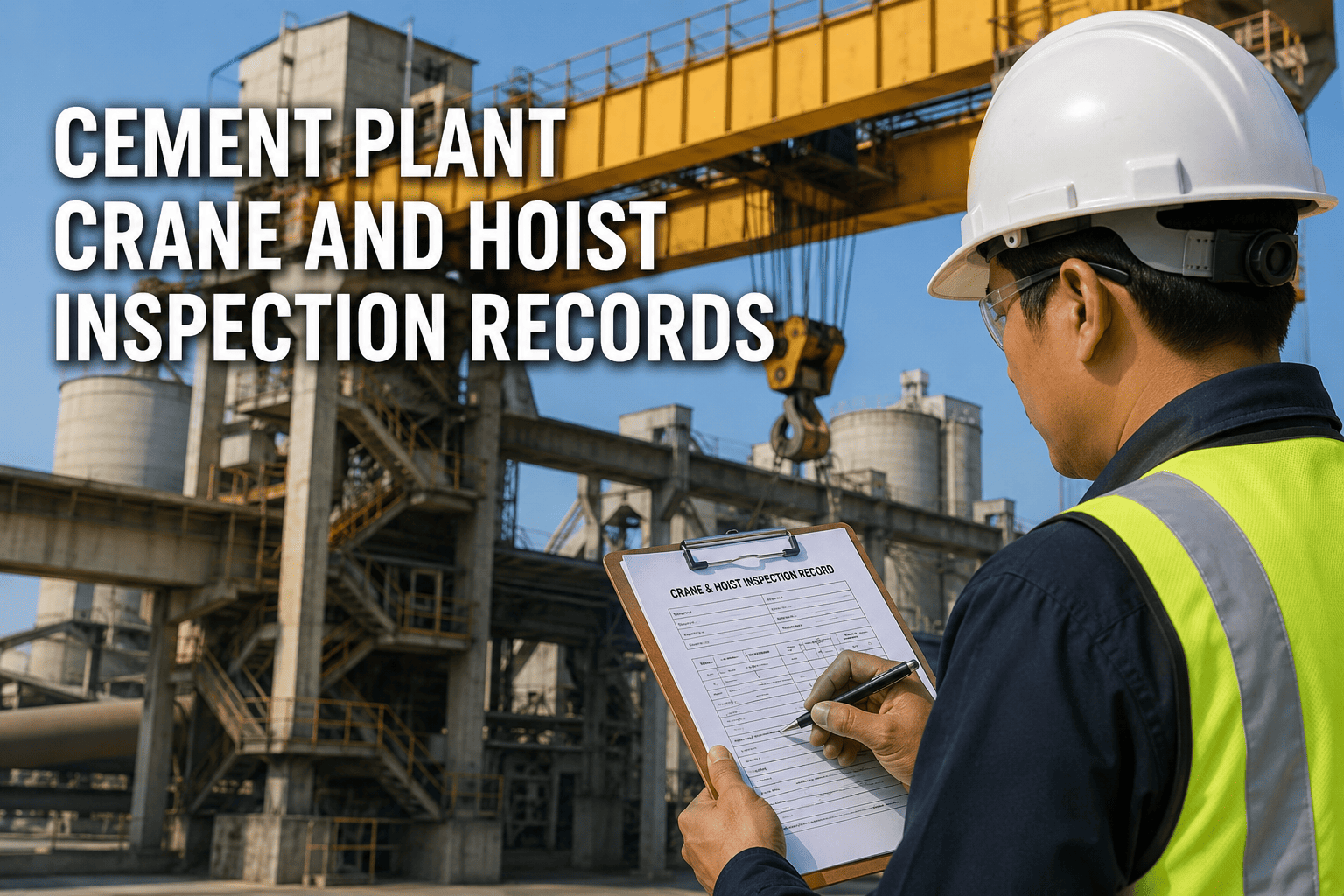
A 50-tonne EOT crane that fails mid-lift in a cement plant kiln bay does not produce a work order — book a demo to see how a live inspection programme prevents exactly this scenario — it produces a statutory incident investigation, a production shutdown while the load is made safe, and an emergency inspection programme that halts all lifting operations across the site until every crane's certification status is verified.The regulatory consequence of a thorough examination lapse on a single crane is not just a fine — it is the grounding of every crane in the plant until compliance is demonstrated; Book a demo and we will show you what a fully compliant register looks like on day one. Book a demo to see how Oxmaint structures crane inspection scheduling, certificate management, and lifting equipment compliance across cement plant operations.
Crane and Lifting Equipment: Key Performance Indicators
Compliance Standards by Region: Crane and Lifting Equipment Regulations
Lifting equipment in cement plants is subject to the most strictly enforced statutory inspection regimes in industrial safety regulation — with criminal liability for non-compliance in most jurisdictions. Oxmaint automates Thorough Examination scheduling, certificate management, and statutory inspection audit trails across every compliance framework below — Book a demo to walk through the setup for your jurisdiction.
| Region | Key Frameworks | Oxmaint Coverage |
|---|---|---|
| USA | OSHA 29 CFR 1910.179 overhead cranes, ASME B30.2 overhead cranes, ASME B30.10 hooks, ANSI/ASME B30.16 monorails | Inspection interval scheduling, load test records, operator certification tracking, digital inspection audit trails |
| UAE | Civil Defence crane safety codes, SASO lifting equipment standards, OSHAD-SF lifting plan requirements, Ministry of Labour | Certificate tracking, inspection scheduling, lifting plan documentation, multi-site compliance dashboards |
| India | Factories Act 1948 lifting machines rules, IS 3177 EOT cranes, IS 807 crane design, DGMS lifting equipment directives | Statutory inspection scheduling, load test records, F-Form certification tracking, DGMS compliance documentation |
| Germany | BetrSichV lifting equipment, DGUV regulation 54 cranes, DIN EN 15011 bridge cranes, TUV inspection requirements | TUV inspection scheduling, mandatory test record archiving, DGUV compliance documentation, certificate management |
| UK | LOLER 1998 Thorough Examination, PUWER 1998, HSE L113 guidance, BS 2573 crane design, LEEA COPSULE code | LOLER TE due date tracking with 30-day advance work orders, certificate storage, competent person scheduling |
| Canada | CSA B167 overhead cranes, provincial OHS lifting equipment regulations, ANSI/ASME B30 series, CCOHS guidance | Multi-site inspection compliance dashboards, load test record management, certificate expiry alerts |
Oxmaint delivers Thorough Examination scheduling, certificate management, load test documentation, and compliance audit trails for crane and lifting equipment across every region above — zero lapsed certificates, zero missed inspections, audit-ready at any time — Book a demo to see it live.
What Structured Lifting Equipment Management Covers in Cement Plants
Thorough Examination and Statutory Certification
The legally mandated periodic inspection by a competent person — not a routine maintenance check — that produces a statutory certificate confirming the lifting equipment is safe to operate at its rated SWL. Every crane, hoist, and lifting accessory requires a current Thorough Examination certificate. A lapsed certificate legally prohibits operation of that asset and triggers mandatory site-wide compliance review under most jurisdictions' enforcement frameworks. Oxmaint tracks every certificate expiry date with automated 30-day advance work orders to schedule the competent person, arrange access, and prepare load test weights before the due date arrives — Book a demo to see this workflow in a live cement plant.
Preventive Maintenance — Wire Rope, Brakes, and Mechanical Components
Between statutory Thorough Examinations, a structured preventive maintenance programme addresses the components most likely to fail between inspection cycles: wire rope condition and lubrication (monthly), brake pad wear and adjustment (quarterly), gearbox oil level and contamination (monthly), limit switch function testing (monthly), hook and latch condition (weekly pre-use checks), and runway rail condition including clip torque verification (quarterly). Each task scheduled as a recurring work order in Oxmaint — completion logged against the crane asset record, building the maintenance history that demonstrates due diligence and supports warranty claims — Book a demo to see how Oxmaint structures crane PM across the full component list.
Lifting Equipment Register and Accessory Tracking
Every item of lifting equipment and every lifting accessory — shackles, eyebolts, slings, spreader beams, and below-the-hook devices — registered individually with its unique identification number, SWL, date of manufacture, date of last Thorough Examination, and next examination due date. In a large cement plant, the total lifting accessory population can exceed 500 individual items — all requiring their own examination cycle, most currently tracked on spreadsheets with systematic gaps. Oxmaint provides the digital lifting register required by LOLER, ASME B30, Factories Act, and equivalent regulations in every major jurisdiction — Book a demo to see the accessory register populated for a cement plant fleet.
Operator Certification and Competency Management
Crane operator certification is a statutory requirement in all major jurisdictions — operators must hold valid certificates for the crane type and SWL they operate. In cement plants where cranes are operated by maintenance technicians as well as dedicated crane operators, the population of certified individuals and the validity periods of their certificates requires systematic tracking. Oxmaint links operator certification records to the cranes they are authorised to operate — an operator with an expired certificate cannot be assigned a crane work order in the system, eliminating the compliance gap that paper-based systems routinely miss — Book a demo to see operator authorisation management in action.
See Oxmaint Managing Crane Compliance Across a Live Cement Plant
Our team will walk you through a live demo with lifting equipment registers, Thorough Examination scheduling, wire rope PM calendars, and compliance dashboards built for cement manufacturing — in under 30 minutes.
The Four Compliance and Reliability Failures in Cement Plant Lifting Operations
These four failure patterns are present — in some combination — in the majority of cement plants that have never deployed a systematic digital lifting equipment management programme.
Thorough Examination Certificates Managed on Spreadsheets — Lapses Discovered Too Late
A cement plant with 50 cranes and hoists operating under 6-monthly and 12-monthly examination cycles generates over 70 certificate renewal events per year. Managing this on a spreadsheet requires someone to check it monthly, identify approaching due dates, arrange the competent person, organise access and load weights, and update the record after completion — without fail, every month. In practice, 2–4 certificates lapse in any given year. The lapse is discovered either when the crane is needed for a critical lift and the certificate check fails, or — worse — during a regulatory inspection after an incident. Either outcome triggers site-wide enforcement action and production disruption far more costly than the inspection that was missed. Book a demo to see how Oxmaint eliminates certificate lapses.
Wire Rope Condemned on Visual Inspection During a Lift — Not During Scheduled PM
Wire rope deterioration in cement plant crane environments is accelerated by cement dust contamination, inadequate lubrication frequency, and abrasive contact with sheave grooves worn from the correct rope diameter. A rope that appears acceptable during a monthly visual check can cross the condemnation criteria threshold — broken wires per lay length, diameter reduction, corrosion pitting — within weeks in a high-duty cycle application. Most cement plants have no quantitative wire rope inspection protocol: no broken wire count, no diameter measurement, no lay length inspection. Condemnation decisions are made subjectively when the rope looks obviously wrong — typically during a lift, which is precisely the moment when finding a condemned rope creates maximum operational disruption. Book a demo to see the quantitative rope inspection workflow.
Lifting Accessories With No Individual Register — No Examination History
Shackles, slings, eyebolts, and spreader beams in cement plants accumulate in stores, on cranes, in maintenance vehicles, and in departmental tool boxes — with no individual identification, no examination history, and no SWL marking beyond what was printed on arrival. Items are used, returned to whichever store is convenient, and used again by the next shift — with no connection between the accessory and its examination status. A sling rated at 3 tonnes SWL that has been subjected to shock loading during a dropped load incident and never reported or quarantined continues in service because no one knows its history. This is the accident waiting to happen that every lifting equipment regulation specifically tries to prevent. Book a demo to see how Oxmaint builds the individual accessory register.
Brake and Limit Switch Failures Discovered During Operation
Crane brakes in cement environments — particularly hoist brakes — accumulate cement dust contamination that affects friction pad performance in ways that are not detectable by visual inspection alone. A brake that holds adequately at low load may slip under full SWL load at elevated temperature. Limit switches that test correctly at low travel speed may miss activation at operational crane speed as cam follower wear introduces angular play. Both failure modes are entirely detectable through structured quarterly brake testing and limit switch function testing under defined conditions — and entirely preventable with PM work orders that require performance verification, not just visual inspection. Book a demo to see the brake and limit switch PM framework.
How Oxmaint Structures Crane and Lifting Equipment Management
Ready to Achieve 100% Crane Certificate Compliance?
Oxmaint deploys across a cement plant's lifting equipment programme in 60 days — starting with the highest-risk and most frequently used cranes and expanding to the full accessory register. Book a personalised 30-minute demo — your crane fleet, our platform, zero obligation.
Manual Lifting Management vs. Oxmaint: The Compliance and Safety Gap
| Factor | With Oxmaint | Manual Management |
|---|---|---|
| Certificate Compliance Rate | 100% of cranes and accessories within Thorough Examination interval. 30-day advance work orders ensure no certificate lapses across the full fleet — Book a demo to see the automation. | 2–4 certificates lapse per year in typical 50-crane fleets. Discovery during regulatory inspection or pre-lift check triggers site-wide enforcement action and production halt. |
| Wire Rope Condition Assessment | Monthly quantitative inspection — broken wire count, diameter measurement, corrosion score logged per rope. Condemn criteria set — replacement scheduled before criteria are reached during a lift. Book a demo to see the inspection checklist. | Visual inspection only — no broken wire count, no diameter measurement. Condemnation decisions made subjectively. Condemned rope discovered during a lift is a production incident and potential enforcement event. |
| Lifting Accessory Register | Every shackle, sling, eyebolt, and beam registered individually with ID, SWL, and examination history. QR scan confirms certificate status before any lift. No unregistered accessories in service — Book a demo to see QR-based accessory verification. | No individual register. Accessories used from stores with no identification or examination history. Items with unrecorded shock loading history continue in service — unquantifiable risk profile. |
| Brake and Limit Switch Testing | Quarterly full-load brake hold test with measured hold time. Limit switch tests at defined travel speeds. Results logged — performance trending identifies degrading brake assemblies before failure — Book a demo to see the brake testing PM workflow. | Visual inspection of brake pads at PM. Limit switch tested at low speed only. Failures discovered during operation — dropped load risk or crane travel overrun during production lift. |
| Operator Authorisation Verification | Operator certification linked to crane authorisation matrix. Expired certificate prevents assignment. Recertification triggered 60 days in advance. No uncertified operator assigned to a crane — Book a demo to see operator-to-crane authorisation management. | Operator certifications tracked informally or on paper. Expiry discovered when operator presents certificate for inspection — or not discovered at all until an incident forces review. |
| Regulatory Audit Readiness | Complete lifting register, certificate history, PM records, and operator authorisations generated in under 5 minutes. Regulatory inspection closed without enforcement action — Book a demo to see the audit report generated in 5 minutes. | Audit preparation requires 2–5 days of manual record assembly. Gaps in certificate history and missing accessory examination records are standard findings — enforcement notices and rectification timelines result. |
Crane and Lifting Equipment Performance Benchmarks
ROI Breakdown: Structured Lifting Equipment Management in Cement Plants
| ROI Category | Reactive Management Cost | With Oxmaint | Annual Value |
|---|---|---|---|
| Certificate Lapse Enforcement | Regulatory fine plus production halt during site-wide review — 1–3 days, $15,000–$80,000 total impact per event | Zero lapsed certificates. 30-day advance scheduling eliminates lapse risk entirely across the fleet. Book a demo to see this in action | $15K–$80K avoided per event — typically 1–2 events per year in unmanaged fleets |
| Emergency Wire Rope Replacement | Condemned rope during a lift — production stop, emergency procurement, 4–5× cost premium on parts and labour | Monthly quantitative inspection with condemn criteria triggers planned replacement before failure threshold is reached. Book a demo to see the wire rope PM setup | $8K–$25K saved per prevented emergency — 2–4 events annually in unmanaged fleets |
| Brake Assembly Failure | Dropped load or overtravel incident — incident investigation, crane grounded, emergency repair, potential injury liability | Quarterly full-load brake test identifies degrading assemblies 2–4 months before failure threshold — Book a demo to see the brake PM configuration | $20K–$100K+ per prevented incident including investigation cost and liability exposure |
| Audit Preparation Time | 2–5 days of maintenance team time assembling paper records before each statutory inspection or external audit | Complete lifting register and PM history generated in under 5 minutes from Oxmaint dashboard — Book a demo to see the report output | 20–40 engineering hours recovered annually per plant — redirected to productive maintenance |
| Premature Component Retirement | Components replaced on calendar interval regardless of actual condition — wire ropes, brake pads, and hook assemblies retired at 60–70% of serviceable life | Condition-based replacement from quantitative PM data extends average component life to 85–95% of rated service life — Book a demo to see condition-based scheduling in action | 15–25% reduction in annual lifting equipment maintenance parts spend across the fleet |
Your Lifting Equipment Compliance Starts Here
Oxmaint delivers 100% certificate compliance and measurable PM programme improvements within 60 days of deployment. Book a 30-minute demo to assess your current lifting equipment programme against statutory requirements and build a remediation roadmap for your safety team.
Frequently Asked Questions: Crane and Lifting Equipment Maintenance in Cement Plants
QWhat is the Thorough Examination interval for cranes in cement plant operations?
QWhat are the quantitative wire rope condemnation criteria for overhead cranes?
QWhat lifting accessories require individual Thorough Examination certificates in cement plants?
QWhen is a load test required for a cement plant crane?
QHow does Oxmaint handle the lifting equipment compliance requirements across multiple jurisdictions for a multinational cement group?
QHow long does Oxmaint take to deploy a crane and lifting equipment management programme?
Continue Reading: Cement Plant Asset Management and Safety Resources
Explore these in-depth guides to build a complete picture of asset management, safety compliance, and maintenance strategy across cement manufacturing operations.
Achieve 100% Crane Certificate Compliance Starting Today
Oxmaint deploys across your cement plant's complete lifting equipment programme in 60 days — no heavy implementation fees and no production shutdown. Start with the crane asset register, activate Thorough Examination scheduling, and build the compliance documentation that makes every regulatory inspection straightforward. Book a 30-minute demo — your crane fleet, our platform, zero obligation.