A cement plant in Southeast Asia operating a 4,500 TPD kiln reported specific energy consumption (SEC) averaging 3,420 kJ/kg clinker — approximately 11% above regional benchmark and 14% above best-in-class performance for comparable dry-process kilns. The plant burned natural gas at $8.40 per mmBTU, making every percentage point of excess SEC directly visible in monthly fuel invoices. Energy audits identified false air infiltration, separator wear, and inconsistent kiln operating conditions as primary contributors, but manual monitoring could not quantify individual contributions or track improvement trends with sufficient granularity to prioritize interventions. After deploying OxMaint's integrated energy monitoring and optimization platform in quarter one, the plant reduced SEC from 3,420 kJ/kg to 3,112 kJ/kg — a 9% reduction sustained over 12 months — delivering $1.8M in annual fuel savings while maintaining clinker quality specifications and kiln production rate. Sign in to OxMaint to configure SEC tracking, false air detection, and separator performance monitoring for your cement kiln — or book a demo to see the complete energy optimization workflow running on live plant data.
Case Study · Energy Efficiency
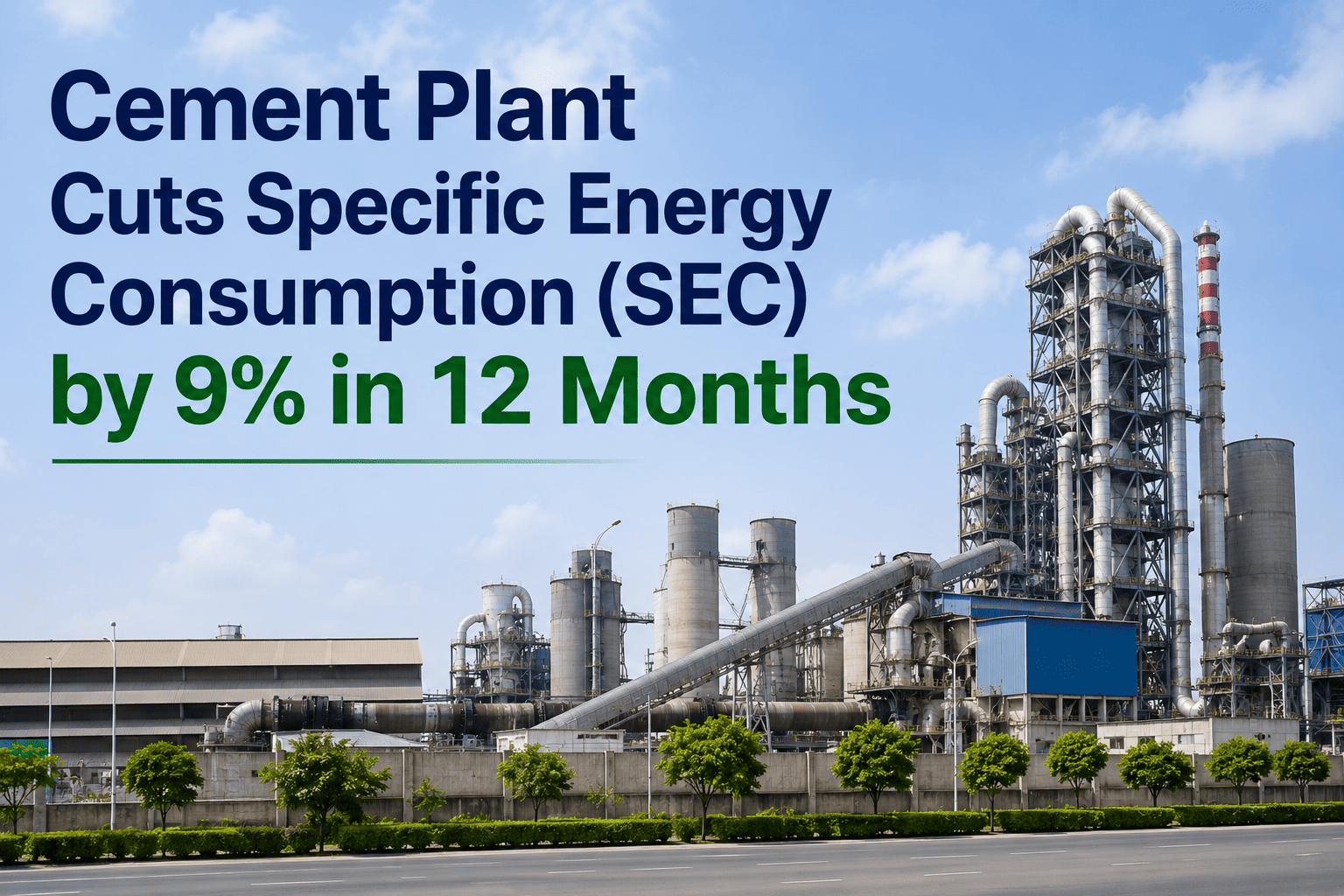
How One Cement Plant Cut Specific Energy Consumption by 9% in 12 Months
Southeast Asian cement producer transforms energy performance using AI-powered false air detection, separator wear monitoring, and kiln condition optimization — reducing SEC from 3,420 kJ/kg to 3,112 kJ/kg while maintaining production rate and clinker quality.
9%
SEC Reduction
3,420 → 3,112 kJ/kg clinker
$1.8M
Annual Fuel Savings
Year 1 sustained reduction
12%
False Air Reduction
From 18% to 6% inlet air
23%
Separator Efficiency Gain
Via predictive wear replacement
The Energy Challenge — Why SEC Was 11% Above Benchmark
The plant operated a modern 5-stage preheater kiln with inline calciner and high-efficiency separator — equipment specification suggested SEC should match regional benchmark of 3,050 kJ/kg. Actual performance averaged 3,420 kJ/kg with daily variance of ±180 kJ/kg depending on kiln conditions. Annual energy audits by external consultants identified three contributing factors — false air infiltration, separator wear degradation, and kiln condition inconsistency — but quantifying each factor's individual contribution and tracking improvement required continuous monitoring capability the plant did not have.
Challenge 01
False Air Infiltration — The Invisible Energy Thief
False air entering the kiln system through seal gaps, expansion joint leaks, and feed chute clearances dilutes kiln gas oxygen concentration and increases fan power demand. The plant measured 18% false air at the preheater inlet during the annual shutdown inspection — well above the 8% target for modern kiln systems. Each percentage point of excess false air added approximately 35 kJ/kg to SEC through increased ID fan power and reduced heat transfer efficiency. Manual seal inspections once per year could identify leaks but provided no trending data to prioritize repairs or verify improvement after maintenance.
Challenge 02
Separator Wear — Gradual Performance Degradation
The high-efficiency separator used vanes and baffles to classify finished product from coarse material requiring regrinding. Vane wear from abrasive clinker reduced separation efficiency gradually — increasing the proportion of oversized particles in finished product and undersized fines returned to the mill. As separation efficiency declined from design 85% to measured 62% over the campaign, mill recirculation load increased by 37%, adding 220 kJ/kg to grinding energy consumption. Without continuous efficiency monitoring, wear progression was invisible until the annual shutdown inspection revealed the damage.
Challenge 03
Kiln Condition Inconsistency — Operating Mode Variance
The kiln operated in three distinct thermal states depending on coating condition, feed rate stability, and burner performance — optimal condition at 3,180 kJ/kg, degraded condition at 3,550 kJ/kg, and transition condition varying between the two. Operators could not distinguish which state the kiln occupied at any moment because manual temperature and draft readings provided insufficient resolution. The plant averaged 45% time in optimal condition, 30% in degraded condition, and 25% in transition — meaning the kiln ran at elevated SEC more than half the operating hours despite having the capability to achieve benchmark performance.
SEC Reduction Is Not a One-Time Event — It Is Continuous Optimization
OxMaint connects false air monitoring, separator efficiency tracking, and kiln condition classification into a unified energy optimization platform — identifying energy losses in real time, quantifying improvement opportunities, and verifying sustained performance after each intervention.
The OxMaint Deployment — Three-Month Sensor Integration
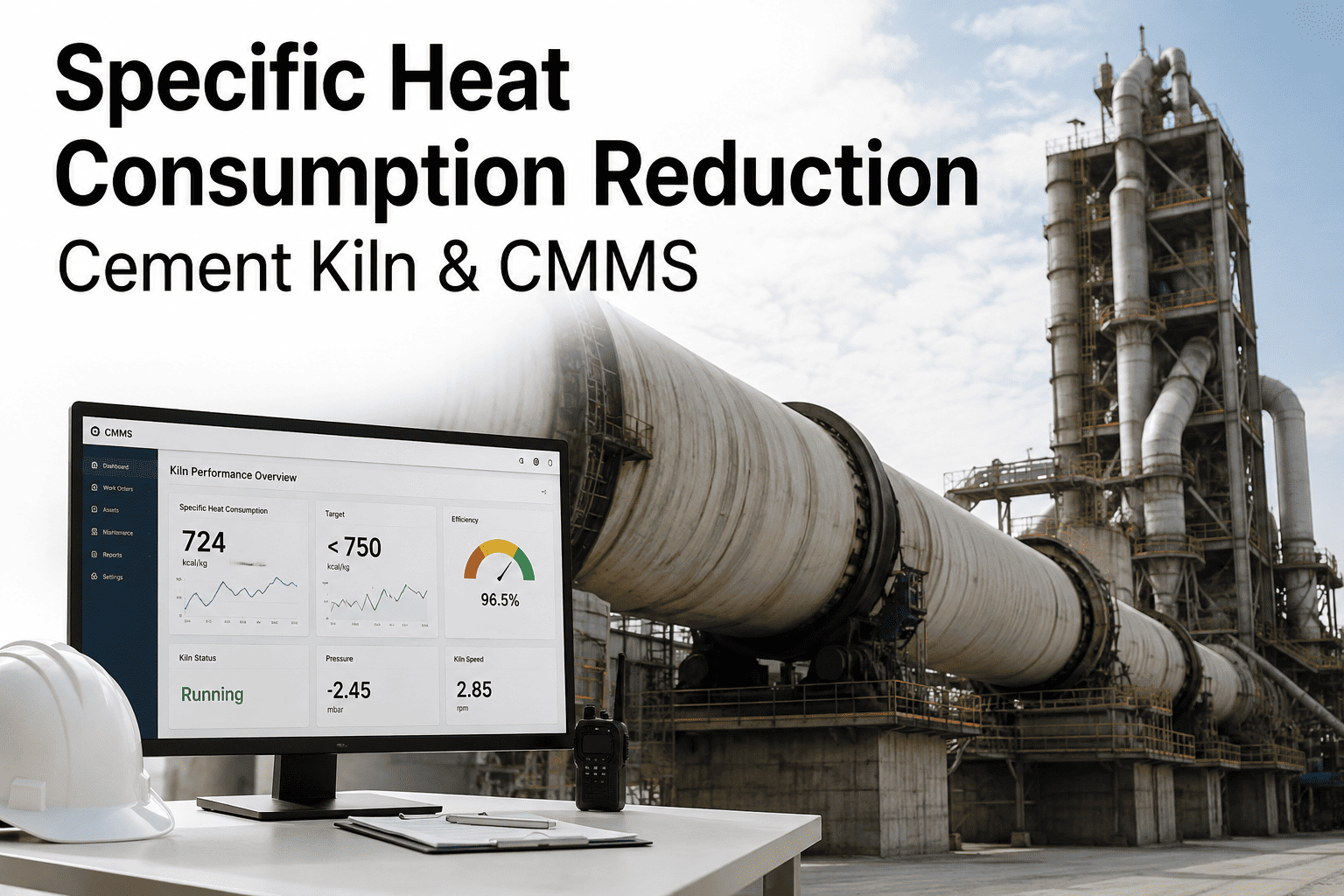
OxMaint deployment focused on instrumenting the three energy loss mechanisms identified in previous audits — false air infiltration points, separator performance indicators, and kiln thermal condition sensors. Integration required no kiln shutdown. Sensors were installed during normal operation over 11 weeks. The system went live with baseline energy mapping in month four.
Month 1
Oxygen analyzers installed at preheater inlet, calciner outlet, and kiln inlet to create false air infiltration map. Temperature sensors added at expansion joints and feed chute. OxMaint mapped baseline false air at 18% total system infiltration with 12% entering at preheater cyclone seals and 6% at calciner tertiary air duct.
Month 2
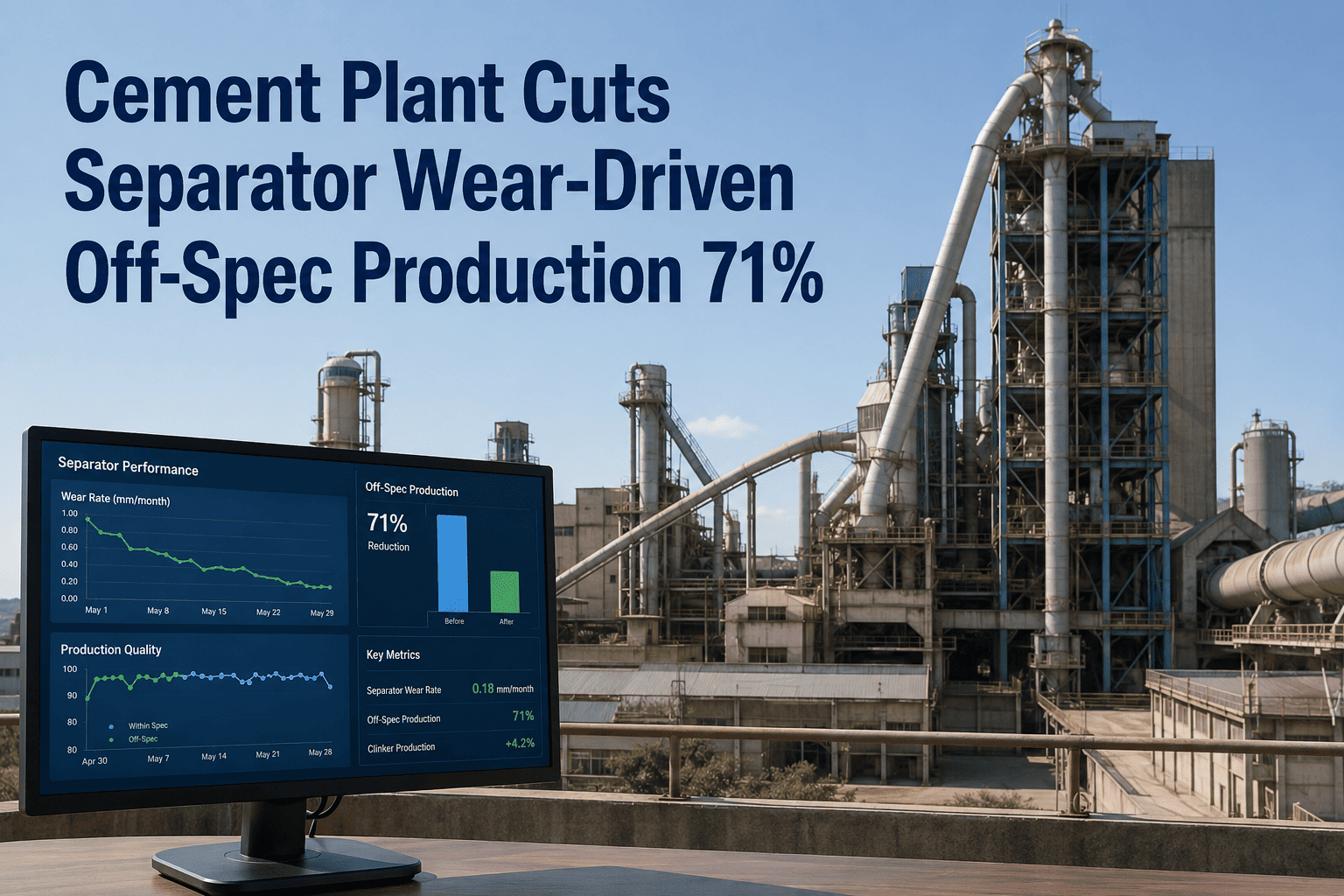
Particle size analyzers installed on separator feed, finished product, and reject streams. Separator efficiency calculated continuously from size distribution data. Baseline efficiency measured at 62% — 23 percentage points below design specification. OxMaint AI predicted separator vane replacement would recover 18 percentage points of efficiency.
Month 3
AI trained to classify kiln operating condition from multi-parameter sensor data — burning zone temperature, oxygen concentration, kiln torque, and coating thickness proxy. Three condition modes identified with distinct SEC signatures. Real-time condition display added to control room showing current mode and recommended operator actions to transition to optimal state.
Month 4–6
False air repairs prioritized by OxMaint leakage quantification — preheater cyclone seals replaced during planned 48-hour stop in month 5. Separator vanes replaced in month 6. Post-repair verification showed false air reduced to 6% and separator efficiency recovered to 80%. SEC dropped from 3,420 kJ/kg to 3,240 kJ/kg — a 5.3% reduction from two targeted interventions.
Month 7–12
Operators trained to use OxMaint condition classifier to maximize time in optimal thermal state. Burner tuning procedures revised based on AI recommendations. Kiln operated 78% of hours in optimal condition by month 12 versus 45% baseline. SEC reduced further to 3,112 kJ/kg — total 9% reduction sustained for final six months of measurement period.
Results After 12 Months — Energy Performance Transformation
Energy performance improvements were tracked across four measurement categories — SEC absolute reduction, fuel cost savings, individual contributor quantification, and performance sustainability. All metrics showed sustained improvement from month four through month twelve after initial sensor integration period.
9% SEC Reduction
Baseline: 3,420 kJ/kg clinker average in months 1–3 before interventions. Final: 3,112 kJ/kg average in months 10–12 after all interventions deployed. Reduction sustained for six consecutive months without reversion. Plant moved from 11% above regional benchmark to 2% above benchmark — entering top quartile performance for comparable kiln technology.
SEC Reduction by Contributing Factor
False Air Elimination
-142 kJ/kg
18% to 6% infiltration via seal replacement
Separator Efficiency Recovery
-98 kJ/kg
62% to 80% efficiency via vane replacement
Kiln Condition Optimization
-68 kJ/kg
45% to 78% optimal condition operation time
Annual Fuel Savings
$1.8M
1.65M tonnes clinker × 308 kJ/kg reduction × $8.40/mmBTU gas price = $1.78M year-one savings at constant production and fuel pricing
OxMaint ROI Period
3.2 months
Deployment cost $470K including sensors, integration, training. Monthly savings $148K. Payback achieved in month 7 after deployment start.
How Each Energy Loss Was Identified and Eliminated
The 9% SEC reduction resulted from attacking three distinct energy loss mechanisms in sequence — false air infiltration addressed first because it had the largest individual impact, separator wear second because it required capital parts procurement, and kiln condition optimization third because it built on the foundation of improved system efficiency from the first two interventions.
01
False Air Detection and Quantification
Before OxMaint
Annual shutdown inspection measured 18% false air at preheater inlet using portable oxygen analyzer. No data on infiltration location or progression rate between shutdowns. Seal repairs prioritized by visual inspection during shutdown rather than measured leakage impact.
OxMaint Solution
Continuous oxygen monitoring at three system points created false air map showing 12% infiltration at cyclone seals and 6% at calciner duct. AI quantified energy impact of each leak point — cyclone seals contributing 95 kJ/kg SEC penalty, calciner duct 47 kJ/kg. Repair priority ranked by kJ/kg impact rather than leak size.
Measured Result
Cyclone seal replacement in month 5 reduced false air from 18% to 6%. SEC dropped 142 kJ/kg immediately after seal replacement and improvement sustained through month 12. False air monitoring continues to flag new leaks before they reach 1% contribution threshold.
02
Separator Efficiency Tracking
Before OxMaint
Separator vane wear discovered during annual shutdown when efficiency had already degraded to 62% from design 85%. No intermediate trending data to predict replacement timing. Vanes replaced on fixed 18-month schedule regardless of actual wear condition.
OxMaint Solution
Particle size analyzers on separator streams measured efficiency continuously. AI detected efficiency declining at 1.8 percentage points per month starting in month 2. Predicted efficiency would reach 58% by month 9 if vanes not replaced. Generated work order in month 4 for vane replacement during planned month 6 stop.
Measured Result
Vane replacement in month 6 recovered efficiency from 62% to 80%. Mill recirculation load reduced 37%. Grinding energy consumption dropped 98 kJ/kg. Separator efficiency monitored continuously to detect next wear cycle beginning — predicted replacement timing extended from 18 months to 24 months based on actual wear rate data.
03
Kiln Condition Optimization
Before OxMaint
Operators adjusted kiln based on manual temperature readings and visual flame observation. No quantitative classification of kiln thermal state or guidance on optimal operating parameters. Kiln drifted between conditions based on operator shift changes and feed rate variations.
OxMaint Solution
AI classified kiln condition into three modes — optimal (3,180 kJ/kg), degraded (3,550 kJ/kg), transition (variable) — based on burning zone temperature, oxygen, torque, and coating proxy. Control room display showed current mode and recommended actions to achieve optimal state. Operator training focused on recognizing transition triggers.
Measured Result
Optimal condition operation time increased from 45% baseline to 78% by month 12. Degraded condition time reduced from 30% to 8%. SEC variance decreased from ±180 kJ/kg daily range to ±65 kJ/kg. Consistent operation in optimal mode contributed 68 kJ/kg SEC reduction beyond equipment repairs.
Every kJ/kg of Excess SEC Costs Money Every Day Your Kiln Operates
If your cement plant runs SEC above benchmark because of unmeasured false air infiltration, untracked separator wear, or inconsistent kiln conditions — you are burning fuel you do not need to burn. OxMaint quantifies each energy loss mechanism separately, prioritizes interventions by impact, and verifies sustained improvement continuously.
Key Success Factors — What Made This Energy Transformation Work
The plant's energy manager identified four factors that differentiated this SEC reduction programme from previous energy improvement initiatives that delivered temporary gains before performance reverted to baseline. All four factors involved shifting from annual audit snapshots to continuous monitoring with intervention triggering based on measured degradation rates.
01
Quantified Energy Impact by Loss Mechanism
Previous energy audits identified false air, separator wear, and kiln inconsistency as contributors but did not quantify individual impacts. OxMaint measured each factor's SEC penalty separately — 142 kJ/kg for false air, 98 kJ/kg for separator wear, 68 kJ/kg for kiln condition variance. Repair prioritization based on quantified impact rather than assumed importance produced faster payback.
02
Continuous Monitoring Instead of Annual Snapshots
Annual energy audits provided one data point per year — insufficient to detect gradual degradation like separator wear or false air infiltration progression. OxMaint continuous monitoring captured degradation rates in real time, enabling predictive intervention before performance reached critical thresholds. Separator vane replacement timing optimized from fixed 18-month schedule to condition-based 24-month replacement.
03
Operator Guidance Not Just Data Display
Previous control room energy displays showed SEC numbers but provided no actionable guidance on how to improve performance. OxMaint kiln condition classifier told operators which thermal state the kiln occupied and what actions would transition to optimal mode — increasing burner momentum, adjusting feed rate, modifying kiln speed. Operator training focused on recognizing and responding to AI recommendations rather than manual parameter tuning.
04
Post-Intervention Verification Built Into System
False air seal replacement and separator vane changes were verified by OxMaint monitoring showing immediate SEC improvement sustained over following weeks. Without continuous verification, temporary improvements from interventions often degraded undetected. OxMaint flagged when false air began increasing again in month 11 — indicating new leak developing at calciner duct — triggering proactive repair before SEC impact exceeded 15 kJ/kg.
Frequently Asked Questions
How long does OxMaint energy monitoring deployment take from contract to live operation?
Sensor integration requires 8 to 12 weeks depending on existing instrumentation coverage. Most plants begin receiving baseline energy maps within 3 months of contract signature. Full optimization with intervention recommendations typically deployed by month 4.
Book a demo to review deployment timeline for your kiln configuration.
What SEC reduction should a cement plant expect in the first year after OxMaint deployment?
Results vary by baseline condition and energy loss severity. Plants starting 10–15% above benchmark typically achieve 6–10% SEC reduction in year one. Plants already near benchmark see smaller absolute reductions but gain sustained performance stability. This case study plant achieved 9% reduction from 11% above benchmark starting point.
Does OxMaint work with coal-fired kilns or only gas-fired kilns?
OxMaint energy monitoring works with all kiln fuel types — coal, natural gas, petcoke, alternative fuels, or mixed fuel systems. The AI learns baseline SEC patterns specific to your fuel mix and operating conditions, then identifies deviations indicating energy losses regardless of fuel source.
Sign in to configure fuel-specific energy tracking.
How does OxMaint detect false air infiltration without shutdown inspection?
Oxygen analyzers installed at multiple system points create a false air infiltration map by comparing measured oxygen concentrations against theoretical values based on combustion stoichiometry. AI quantifies infiltration at each measurement point and calculates total system false air continuously. New leaks are detected within hours of development based on oxygen concentration changes.
Can OxMaint integrate with existing DCS and energy management systems?
Yes. OxMaint connects to kiln DCS via OPC-UA, Modbus, or REST API to ingest process data. Energy management system integration enables consolidated reporting across plant operations. No replacement of existing control infrastructure required.
Book a demo to verify integration compatibility with your specific systems.
Your Kiln Burns More Fuel Than It Needs To — OxMaint Shows You Exactly Why
False air infiltration, separator wear degradation, and kiln condition inconsistency combine to push SEC above benchmark at most cement plants — but without continuous monitoring, you cannot quantify which factor contributes how much or verify improvement after interventions. OxMaint measures each energy loss mechanism separately, prioritizes repairs by impact, and tracks sustained performance improvement continuously.