Excess MRO inventory is one of the most overlooked cost centers in cement manufacturing. Storerooms fill up over years of over-ordering, "just-in-case" purchasing, and the accumulation of parts for equipment that has since been retired or replaced. At one cement plant, a comprehensive audit revealed that nearly 40% of storeroom inventory — $3.4 million worth of spare parts — had not moved in over 24 months and was either obsolete, duplicated, or critically mismatched to actual equipment needs. The solution was not a spending freeze or a manual stocktake. It was OxMaint's asset-linked storeroom management paired with a structured criticality matrix — and the results reshaped how the plant thought about inventory entirely.
Case Study · MRO Inventory · Cement Plant Storeroom
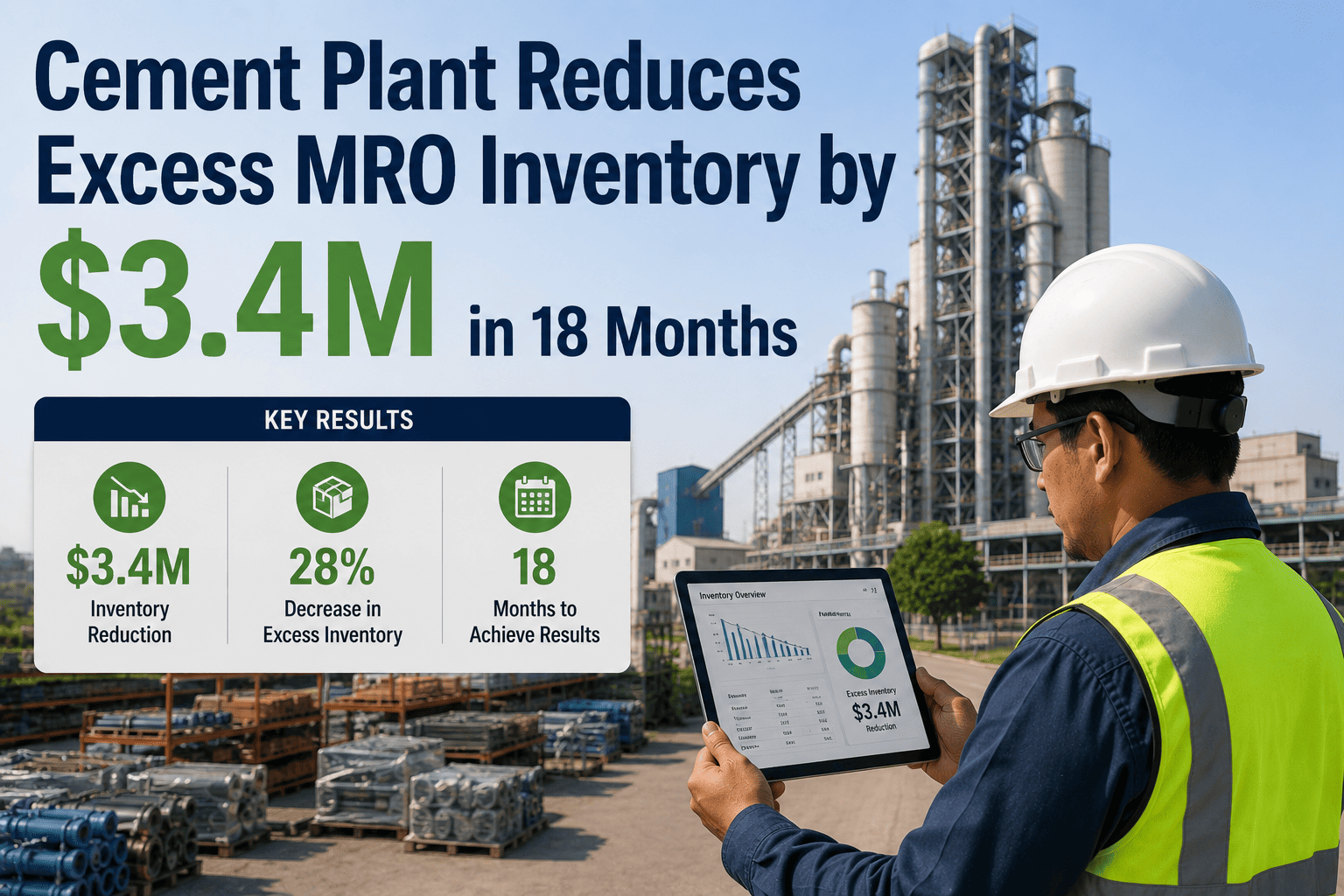
Cement Plant Reduces Excess MRO Inventory by $3.4M in 18 Months
How asset-linked storeroom management and a structured criticality matrix helped one cement plant identify $3.4 million in excess and obsolete parts — and build a leaner, smarter inventory going forward.
$3.4M
Excess Inventory Identified
40%
Of Stock Was Non-Moving
The Storeroom Problem Nobody Wanted to Measure
Before OxMaint, the plant's storeroom operated on institutional memory and manual spreadsheets. Parts were ordered when someone thought they might be needed, without systematic linkage to actual equipment criticality or consumption history.
01
No Asset Linkage
Parts in the storeroom were catalogued by part number and description, but not linked to specific equipment assets. Nobody could quickly answer which parts supported which machines — making criticality assessment impossible without manual cross-referencing.
02
Duplicate Stock Across Categories
Bearings, seals, and belts had been ordered under multiple part numbers over the years — sometimes the same physical component catalogued differently by different purchasing agents. Effective stock levels were masked by apparent variety.
03
Retired Equipment Parts Still Stocked
When equipment was decommissioned, associated spare parts remained in the storeroom indefinitely. Without asset-linked inventory, nobody knew which parts belonged to equipment that no longer existed on the plant floor.
04
Emergency Orders Despite Stockouts
The plant was simultaneously over-stocked on obsolete parts and under-stocked on critical consumables. Emergency procurement costs averaged $280,000 per year — while $3.4M in parts collected dust on shelves.
The OxMaint Approach: Asset-Linked Storeroom + Criticality Matrix
The intervention had two components that worked together — linking every part to the equipment it served, then scoring each part by the criticality of that equipment and the consequence of stockout.
Step 1
Asset Registry Completion
All 1,240 plant assets registered in OxMaint with full hierarchy — production line, sub-system, and component level. Equipment condition and maintenance history imported from existing records.
Step 2
Part-to-Asset Linkage
Every storeroom part mapped to the specific assets it supported. Parts linked to decommissioned or retired equipment flagged automatically as obsolescence candidates — no manual cross-referencing needed.
Step 3
Criticality Matrix Scoring
Each asset scored on production impact, failure frequency, and lead time for replacement parts. Criticality scores drove minimum stock levels — high-criticality assets maintained buffer stock; low-criticality assets moved to on-demand ordering.
Step 4
Excess Identification and Disposition
OxMaint reports surfaced all parts with zero consumption in 24 months, linked to retired assets, or in excess of criticality-based max levels. Each was reviewed for return, redistribution, or write-off — releasing $3.4M in inventory value over 18 months.
Financial Impact: 18-Month Breakdown
The $3.4M reduction came from three categories of inventory action — each with a different disposition and financial treatment.
| Inventory Category |
Items Identified |
Inventory Value |
Disposition |
Cash Recovery |
| Retired equipment parts |
412 line items |
$1,280,000 |
Vendor return / liquidation |
$640,000 |
| Duplicate catalog entries |
187 line items |
$880,000 |
Consolidated, excess returned |
$310,000 |
| Over-stocked non-critical parts |
634 line items |
$1,240,000 |
Reduced to criticality-based minimums |
$520,000 |
| Total |
1,233 line items |
$3,400,000 |
— |
$1,470,000 |
Note: remaining $1.93M represents inventory write-off of parts with no vendor return or resale value — reflected as balance sheet improvement and reduced carrying cost.
Storeroom Optimization
How Much Excess MRO Is Sitting in Your Storeroom?
OxMaint's asset-linked inventory analysis identifies excess, obsolete, and misaligned stock before it becomes a write-off. See the exact reports this cement plant used to find $3.4M in recoverable value.
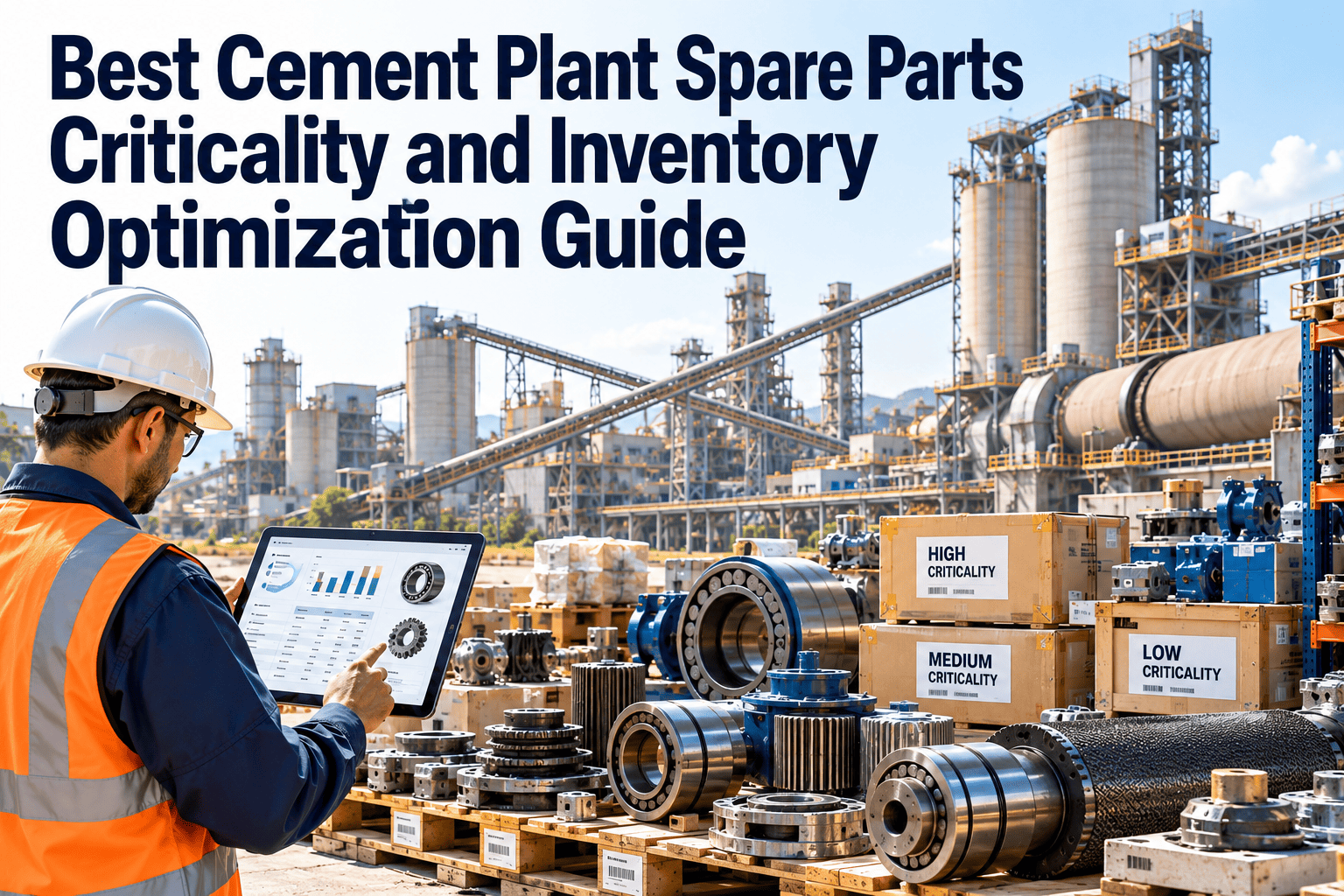
Criticality Matrix: How Parts Were Scored
Every storeroom part was scored on three dimensions to determine the correct minimum stock level — from safety stock to on-demand ordering.
Critical
Equipment failure stops production entirely. Long vendor lead time (>2 weeks). Part not substitutable. Minimum stock: 2–3 units maintained at all times regardless of cost.
Examples: kiln main bearing, primary crusher drive shaft seals, clinker elevator chain
Important
Equipment failure reduces production but does not stop it. Moderate lead time (1–2 weeks). Minimum stock: 1 unit with auto-reorder at depletion to maintain coverage.
Examples: mill fan belts, conveyor idler bearings, separator motor brushes
Non-Critical
Equipment failure causes minor inconvenience. Short lead time (<5 days) or substitutable. No safety stock required — ordered on demand when needed. Previously over-stocked.
Examples: general fasteners, filter elements, packing material, lubricants
What Changed After Month 18: Ongoing Inventory Control
$280K
Emergency Procurement Eliminated
Annual emergency order costs dropped to near zero because critical parts were now correctly stocked and auto-reorder points prevented stockouts on high-criticality items.
22%
Inventory Carrying Cost Reduction
With excess stock removed and min/max levels set by criticality rather than gut feeling, total annual carrying costs fell by 22% even as service levels for critical parts improved.
100%
Part-to-Asset Traceability
Every part in the storeroom is now linked to the equipment it supports. When a new piece of equipment is added or retired, associated parts are flagged automatically for review — preventing future obsolescence accumulation.
Expert Perspective
SB
Excess MRO inventory is the silent cost that most plant managers underestimate because it feels like an asset on the balance sheet. In reality, parts that have not moved in 18 to 24 months are almost certainly excess, obsolete, or misallocated — and they represent tied-up capital that earns nothing while depreciating in condition. The root cause is almost always the same: parts were never linked to the specific assets they serve, so there was no mechanism to know when equipment changes made parts unnecessary. Asset-linked inventory is not a luxury for sophisticated operations — it is the minimum viable control for storerooms above a few hundred line items.
Supply Chain Optimization Specialist
MRO inventory consultant, 19 years heavy industry, cement and minerals sector
Frequently Asked Questions
How does OxMaint link storeroom parts to specific equipment assets?
During the asset registry setup, each equipment item in OxMaint is associated with a parts list — specific part numbers, vendor references, and recommended stock levels. When a corrective or preventive work order is created for that equipment, the system automatically surfaces the linked parts from the storeroom catalog, allowing technicians to request parts directly from the work order. This linkage is bidirectional: from the storeroom side, you can see exactly which assets each part supports — and if that asset is decommissioned, the part is automatically flagged as an obsolescence candidate. You can explore this workflow in detail via the
free trial or
book a demo for a walkthrough using your plant's storeroom structure.
What data is needed to set up the criticality matrix in OxMaint?
OxMaint's criticality matrix uses three primary inputs for each asset: production consequence of failure (rated 1–5), historical failure frequency (from maintenance history), and vendor lead time for critical spare parts. Most plants already have this information in some form — even if it is in spreadsheets or in the knowledge of experienced technicians. OxMaint's onboarding team facilitates a structured criticality workshop where this data is captured and configured into the platform, typically over two to three sessions. The result is a living criticality score for every asset that automatically updates as failure history accumulates. Minimum stock levels are then set as a direct output of criticality scores, removing the guesswork from reorder decisions. A detailed walkthrough of this process is available in a
product demo.
How long does a full MRO inventory audit using OxMaint take for a plant of this size?
For a plant with approximately 1,200 assets and a storeroom of 2,000 to 4,000 line items, the initial asset-to-part linkage process typically takes six to eight weeks with a dedicated team of two to three people working alongside OxMaint's onboarding support. The first wave of excess identification reports is usually available within 60 days, allowing inventory disposition to begin before the full linkage project is complete. This cement plant began identifying excess stock in month two and continued the disposition process through month 18, which is why the headline result is an 18-month timeline rather than an immediate one-time audit. The ongoing benefit — automatic obsolescence flagging for future equipment changes — continues indefinitely after the initial setup. Start the process via the
free trial to assess your storeroom data quality before committing to full deployment.
Can OxMaint integrate with existing ERP or purchasing systems to automate reorder processes?
Yes. OxMaint supports integration with major ERP platforms including SAP, Oracle, and Microsoft Dynamics through API connections, allowing auto-reorder triggers generated in OxMaint to flow directly into purchase order workflows in the ERP system. For plants without ERP integration, OxMaint generates purchase requisition reports that can be exported and submitted through existing procurement processes. In this cement plant case, ERP integration was not in scope for the initial rollout — the inventory optimization results were achieved using OxMaint's standalone storeroom module with manual procurement. Integration was added in a subsequent phase to fully automate the reorder cycle.
Book a demo to discuss integration options specific to your current purchasing systems.
Find Out What Your Storeroom Is Really Worth
OxMaint's asset-linked storeroom management and criticality matrix give cement plant maintenance teams the visibility to identify excess inventory, eliminate emergency orders, and right-size stock levels permanently.