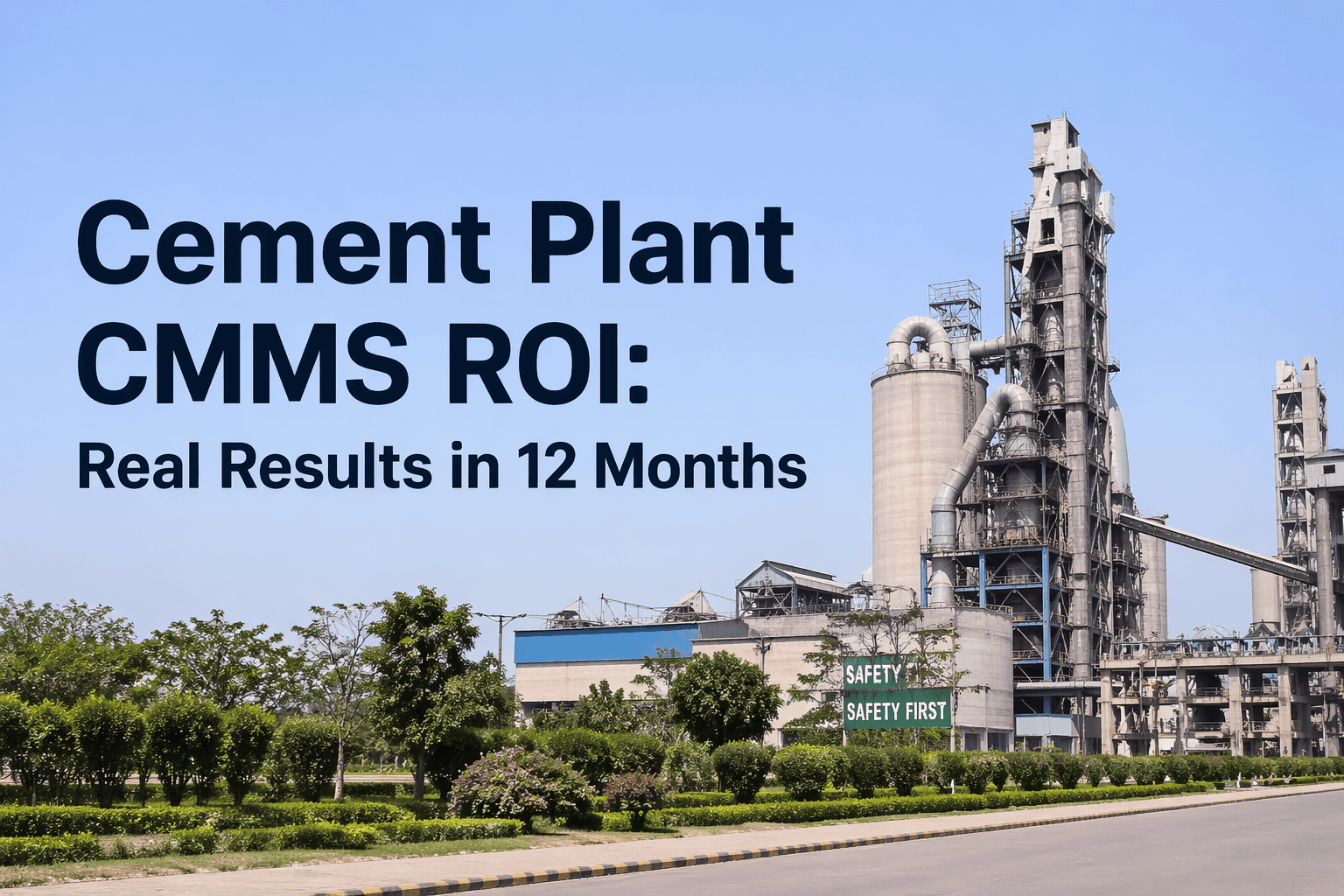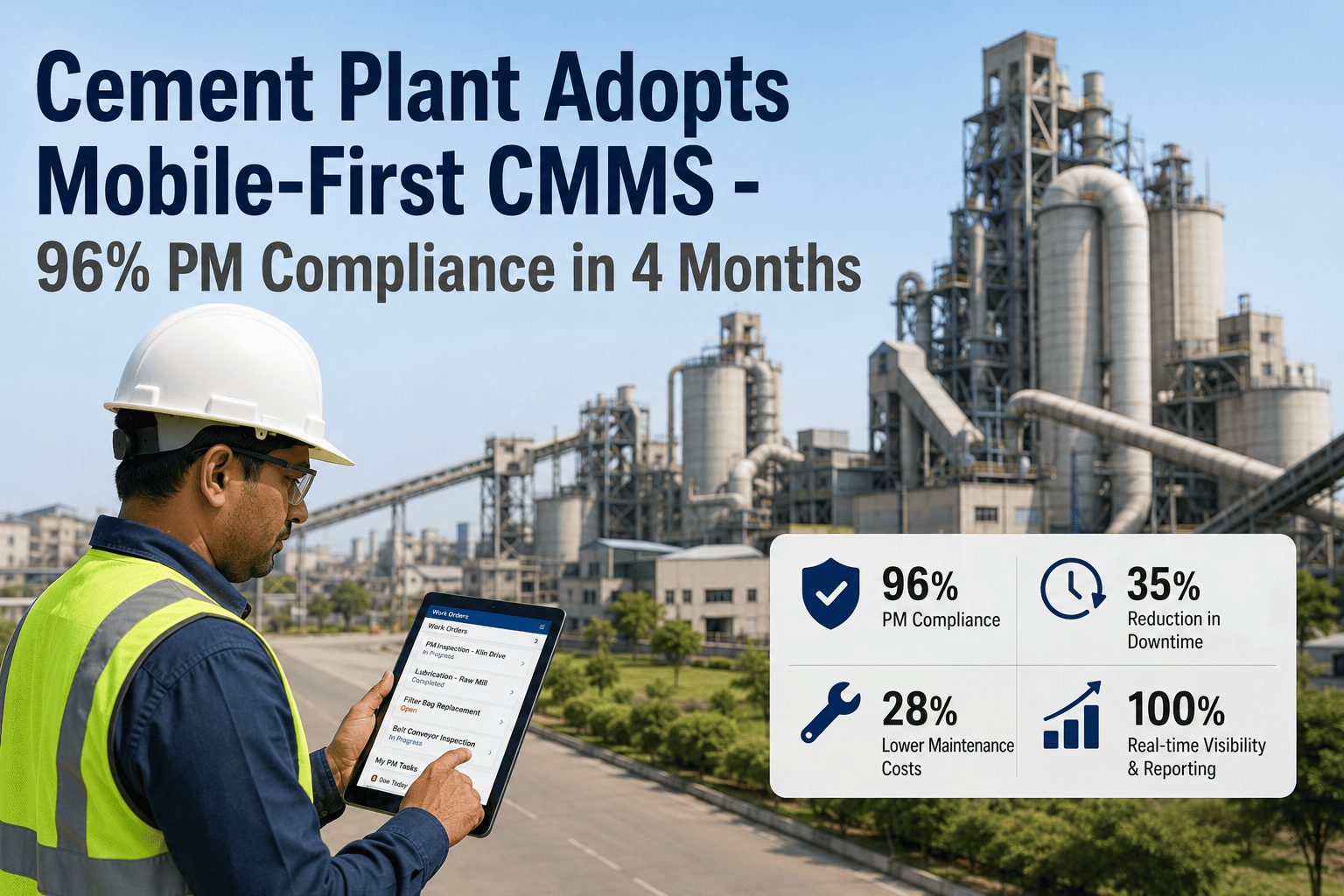
Cement Plant Adopts Mobile-First CMMS - 96% PM Compliance in 4 Months

By Johnson on May 23, 2026

cement-plant-mobile-first-cmms-96-percent-pm-compliance-4-months

When a mid-sized cement plant with three production lines and over 1,200 assets attempted its annual maintenance audit, the results were sobering — PM compliance sat at 61%, technicians were carrying paper work orders through kiln areas, and supervisors had no real-time visibility into what was completed versus skipped. The plant's maintenance manager had tried desktop-based CMMS tools twice before; both failed because floor technicians simply would not walk back to a workstation to log a completed task. The answer was not a better desktop system. It was OxMaint's mobile-first CMMS deployed on rugged Android tablets — and the results arrived faster than anyone expected.

Case Study · Cement Manufacturing · Mobile CMMS

Cement Plant Adopts Mobile-First CMMS — 96% PM Compliance in 4 Months

How one cement plant eliminated paper work orders, achieved near-perfect PM compliance, and gave supervisors live floor visibility — all within a single production quarter.

96%
PM Compliance
Month 4
4 mo
Time to Result
From rollout
61%
Baseline Compliance
Before OxMaint
0
Paper Work Orders
By week 6

The Plant at a Glance

Industry
Cement Manufacturing
Production Lines
3 (kiln, mill, packing)
Total Assets Managed
1,240 equipment items
Maintenance Crew
38 technicians across 2 shifts
Previous System
Desktop CMMS + paper WOs
PM Compliance (Pre)
61%
Deployment Devices
Rugged Android tablets, IP65

Why Paper Was the Real Problem

Cement plants are notoriously harsh on paper. Dust, heat, vibration, and moisture meant that work orders arrived back at the office smudged, torn, or — in some cases — simply lost. Technicians completing tasks near the rotary kiln had no way to log findings immediately; instead they relied on memory at shift end, which introduced errors and omissions into maintenance records.

The desktop CMMS logged completed work eventually, but the lag between task completion and record entry averaged 4.5 hours. During that window, supervisors had no idea what was done and what was outstanding — making shift handovers guesswork and compliance tracking a retroactive exercise rather than a live one.

4-Month Rollout: What Happened and When

OxMaint's implementation followed a phased approach — starting with the highest-risk production line and expanding once technician adoption was confirmed on the floor.

Month 1

Asset Import and Kiln Line Pilot

1,240 assets imported from existing records and spreadsheets. PM schedules configured for kiln line equipment — the highest-criticality area. 12 technicians onboarded on rugged tablets with offline capability for areas with limited connectivity.

PM Compliance: 67% (kiln line only)
Month 2

Mill Line Expansion + Supervisor Dashboard

Mobile rollout extended to mill line. Real-time supervisor dashboard activated — showing open, overdue, and completed PMs by shift and technician. Shift handover reports auto-generated from actual completion data, replacing manual summaries.

PM Compliance: 79% (all lines)
Month 3

Full Plant Deployment + Corrective Work Orders

Packing line onboarded. Corrective work order module activated — technicians now log breakdown findings directly in the app, with parts requests auto-routed to storeroom. Paper work orders eliminated entirely by week 10.

PM Compliance: 91% (all lines)
Month 4

Compliance Target Reached — Audit Passed

Monthly maintenance audit performed using OxMaint-generated compliance reports. PM completion rate reached 96% across all three production lines. Internal audit found zero documentation gaps — the first clean audit in three years.

PM Compliance: 96% — Target Achieved

PM Compliance — 4-Month Progression

Month-over-month compliance improvement across all three production lines after OxMaint mobile deployment.

Baseline

61%
Month 1

67%
Month 2

79%
Month 3

91%
Month 4

96%
Mobile-First CMMS

See How Mobile Changes Everything for Cement Plant Maintenance

Walk through OxMaint's rugged-environment mobile workflows, offline capability, and live supervisor dashboards in a 30-minute demo designed around your plant's reality.

Measurable Results Beyond PM Compliance

PM compliance was the headline — but the mobile-first deployment produced operational improvements across the entire maintenance function.

4.5h
to
8 min
Record Logging Time
Average time from task completion to system record dropped from 4.5 hours (paper) to 8 minutes (mobile), eliminating shift-end data entry backlogs.
Manual
to
Auto
Shift Handover Reports
Supervisors receive auto-generated handover summaries showing exactly what was completed, what is outstanding, and any findings flagged by technicians — with zero manual compilation.
3 days
to
2 hrs
Audit Report Preparation
Monthly compliance reports that previously took 3 days to compile from paper logs now generate in under 2 hours directly from OxMaint — with full equipment history per asset.

Expert Perspective

MK
Mobile-first is not a preference in heavy industry — it is a necessity. Any CMMS that requires technicians to return to a fixed terminal to log their work will fail in a cement plant. The dust alone kills desktop adoption within weeks. What this plant accomplished in four months demonstrates a well-understood principle in industrial maintenance: compliance follows convenience. When logging a PM takes 90 seconds on a rugged tablet instead of a 15-minute walk to a desktop and another 10 minutes of data entry, technicians actually do it. The technology did not change maintenance behavior — it removed the barrier that was suppressing behavior that was already there.
Maintenance Operations Consultant
Specialist in heavy industry CMMS adoption, 16 years cement and mining sector

Before vs After: The Shift in Day-to-Day Operations

Area Before OxMaint After OxMaint
Work Order Delivery Paper printed, hand-distributed at shift start Auto-assigned to technician tablet, with attachments
Task Completion Logging Written on paper, keyed into desktop at shift end Logged in app at point of task completion
Supervisor Visibility No real-time view — verbal updates only Live dashboard showing open, in-progress, overdue PMs
Findings Documentation Verbal reports or notes on paper margin Photo + text notes logged in app immediately
Overdue PM Escalation Discovered during audit — often weeks late Automated alert at 24 hours overdue
Parts Requests Manual handwritten requisitions, delays common In-app request auto-routed to storeroom
Monthly Compliance Report 3 days manual compilation from paper logs Generated in OxMaint in under 2 hours

Frequently Asked Questions

Does OxMaint work offline in areas of the cement plant with no connectivity?
Yes. OxMaint's mobile app includes full offline capability — technicians can view assigned work orders, complete checklists, take photos, and log findings without a network connection. All data syncs automatically when connectivity is restored. In this deployment, kiln area technicians operated fully offline during their shifts and data synced during transit to adjacent areas with WiFi coverage. This offline-first architecture is one of the core reasons mobile adoption succeeded where desktop-dependent systems had failed previously. You can test this capability directly via the free trial or see it demonstrated in a live product walkthrough.
How long does it typically take to import existing assets and PM schedules into OxMaint?
This plant imported 1,240 assets from a combination of spreadsheets and an older CMMS export in approximately eight business days, including PM schedule configuration and technician assignment setup. OxMaint's onboarding team provides direct support for bulk asset imports and will map your existing PM frequency data, criticality ratings, and equipment hierarchies to the platform structure. Most cement plants of this size complete a functional import within two weeks. The speed of import directly determines how quickly you reach live compliance visibility, which is why structured onboarding support is included rather than treated as a premium add-on. Book a demo to discuss your specific asset structure.
What rugged tablets are recommended for cement plant environments?
This plant used IP65-rated Android tablets with gorilla glass screens and rubberized housing — sufficient for kiln-adjacent dust exposure, occasional water splash, and the drop resistance required in a manufacturing floor environment. OxMaint is compatible with any Android or iOS device, and the mobile interface is responsive across screen sizes from 7 to 12 inches. For highly abrasive environments or tablet-mounting in fixed locations on equipment, OxMaint's team can advise on hardware configurations used by comparable plants. Specific device recommendations are covered in the technical demo session where your plant's environment can be discussed directly.
Can OxMaint scale to multiple cement plants under one account?
Yes. OxMaint supports multi-site deployments with site-specific asset hierarchies, separate PM schedules, and individual technician rosters — all accessible under a single corporate account with consolidated reporting. Regional maintenance managers can view compliance metrics across all plants simultaneously while site supervisors see only their local data. This structure is used by cement groups operating three to eighteen plants under a single OxMaint subscription. The platform handles site-level permissions granularly, so a corporate maintenance director and a plant-level technician access entirely different views of the same underlying data.

Your Cement Plant Can Reach 96% PM Compliance Too

OxMaint's mobile-first CMMS was built for the realities of heavy industry — dust, heat, offline zones, and technicians who will not walk back to a desktop. See the same results this plant achieved, in your environment.

Share This Story, Choose Your Platform!