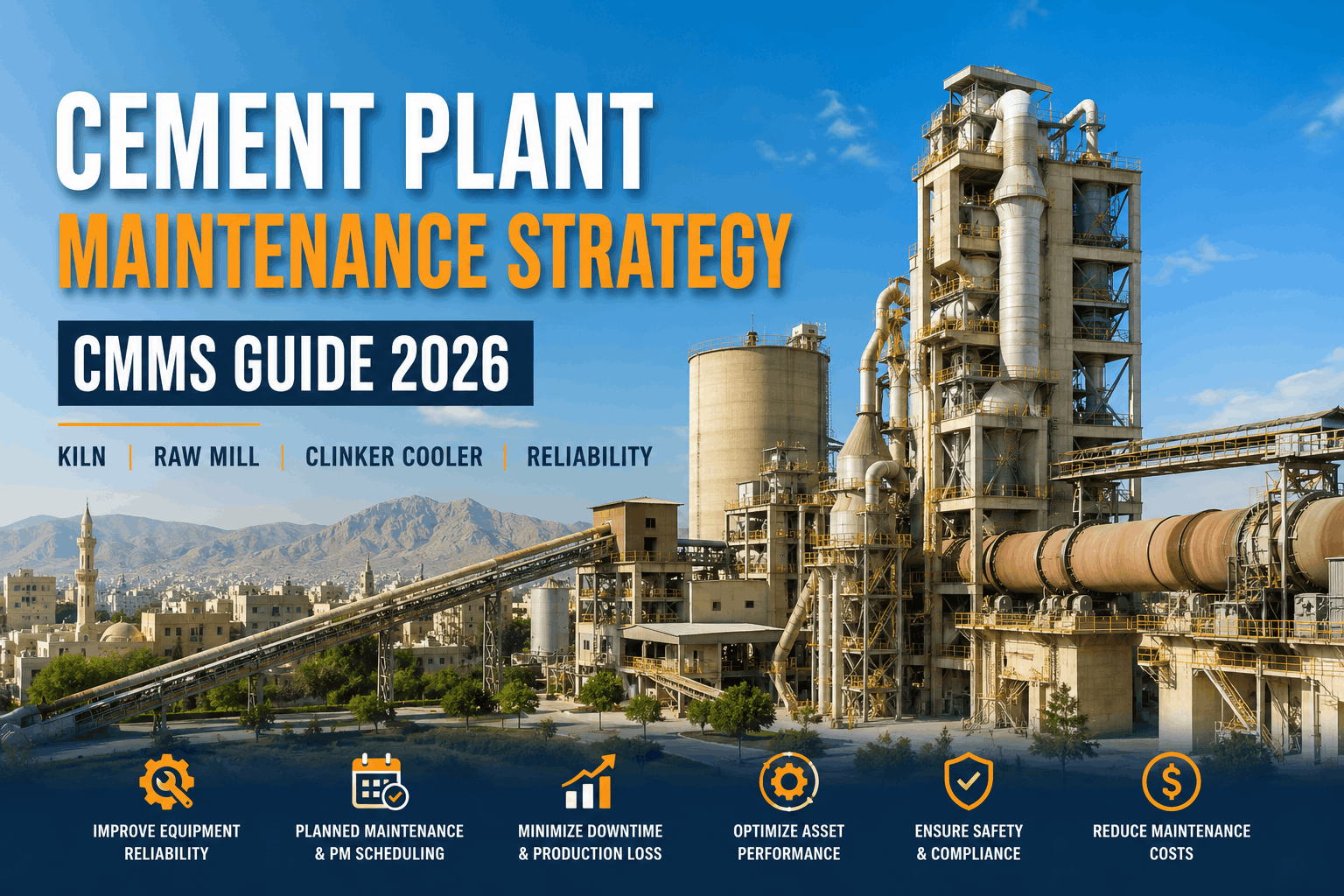
Cement manufacturing runs on razor-thin margins—one unplanned kiln shutdown costs $200,000+ in lost production within 48 hours, and raw material throughput directly ties to maintenance discipline on rotary kilns, ball mills, VRM units, clinker coolers, and support equipment. Without a structured maintenance strategy rooted in CMMS visibility, cement plants accumulate PM backlogs across critical assets, miss early fault warning signs in kiln thermal stability, and experience catastrophic failures that force multi-day repairs. Sign Up Free with Oxmaint to centralize cement plant maintenance planning, track kiln PM cycles by brick life and tonne throughput, coordinate raw mill and clinker cooler inspections, and eliminate the unstructured paper logs that hide asset deterioration until breakdown forces emergency response. Book a Demo to see how cement producers deploy CMMS-driven maintenance strategy across rotary equipment, optimize PM intervals for continuous operation, and reduce emergency repairs by 40–60% within the first six months of structured handover and open work tracking.
Why Cement Plant Maintenance Strategy Determines Run Factor and Clinker Yield
Cement plants operating without structured maintenance strategy experience run factors between 85–92%—meaning 8–15% of production capacity is permanently lost to reactive repairs, unplanned stoppages, and equipment downtime that could have been prevented through planned intervention. Plants with disciplined CMMS-driven maintenance strategies achieve run factors of 96–98%, capturing 4–6% additional production from the same installed kiln capacity. This is not optimization; this is elimination of waste. Kiln brick life degrades based on thermal cycling and clinker chemistry exposure—tracking tonne throughput against brick replacement cycles prevents catastrophic kiln lining failure. Raw mill alignment drift causes feed inconsistency that compounds in the kiln, requiring more heat input and increasing specific heat consumption (the cost per tonne to produce clinker). Clinker cooler equipment balancing failure creates hot spots that trigger kiln back-end problems and reduce clinker quality grades. Sign Up Free to deploy a CMMS platform that monitors these asset health indicators continuously, assigns PM tasks by operating condition rather than calendar date, and flags deferred maintenance before it cascades into emergency shutdown scenarios.
Core Maintenance Strategy Components: Rotary Kiln, Raw Mill, Clinker Cooler, and Support Systems
Cement plant maintenance strategy must address five critical asset clusters: the rotary kiln (heart of production), raw mill (feed preparation and consistency), clinker cooler (product stabilization), support fans and drives (indirect failure cascade points), and bulk materials handling (conveyor, crushers, elevators). Each asset class has distinct failure modes, PM intervals, and spare parts optimization requirements. Without structure, maintenance teams chase urgent breakdowns while ignoring early warning signs on high-value rotating equipment. Book a Demo to see how Oxmaint's maintenance planning module assigns priority-based PM tasks across all five asset clusters, tracks brick life and mill liner wear by tonne throughput rather than calendar weeks, and ensures no equipment operates beyond its documented reliability threshold.
Cement Plant Maintenance Strategy Failure Modes and Cascade Risks
When cement plants operate without structured maintenance strategy, the same systemic failures repeat across every production cycle. Raw mill feed inconsistency forces the kiln to demand more fuel—cascading into elevated clinker temperature, accelerated refractory wear, and clinker cooler thermal shock. Clinker cooler fan degradation reduces product cooling efficiency, sending hot clinker to the mill—where it binds to mill liners and causes jam-ups. Untracked kiln grate plate wear reaches critical thickness and burns through, dumping clinker into the kiln shell and triggering emergency shutdown. Each of these failures is foreseeable and preventable through structured PM; they only become emergencies when maintenance is purely reactive.
Refractory wear rate accelerates beyond design life when tonne throughput exceeds kiln capacity or thermal cycling stresses mount. Without tonne-based tracking, brick status is invisible until shell rupture forces 5–7 day emergency reline at $300K+ cost and lost revenue.
Gearbox oil degradation, bearing spalling, and seal leakage are invisible without scheduled oil analysis and vibration monitoring. Sudden seizure stops feed flow and causes kiln destabilization across 2–3 hours of production loss.
Fan blade erosion or recuperator fouling reduces cooling air capacity, pushing hot clinker into the mill circuit. Temperature mismatch damages mill liners prematurely and triggers mill shutdown for emergency liner replacement.
Torque spikes from kiln bind or gearbox wear propagate into coupling bolts. Unmonitored coupling wear leads to sudden catastrophic fracture, dropping the kiln into free-spin and requiring immediate shutdown and coupling replacement.
Dust-laden kiln exit gas erodes fan blades over time; blade imbalance accelerates bearing wear. Without condition monitoring, fan failure cascades into upstream draft loss, causing kiln temperature control failure and feed starvation.
Grate plates cool kiln clinker through air passage; thickness loss from chemical wear and thermal stress is silent until breakthrough dumps unsupported clinker into kiln shell, creating catastrophic damage requiring shell patch and extended shutdown.
Structured Maintenance Strategy Framework: Asset-Based PM, Tonne Triggers, and CMMS Execution
High-performing cement plants deploy maintenance strategy in three integrated layers: asset-class PM tasks tied to operational condition (kiln brick life by tonne, mill liner wear by tonne throughput), standardized inspection checklists that surface early fault signs before they cascade, and CMMS-enforced ownership transfers at shift boundaries to prevent open work from aging silently. Sign Up Free to configure maintenance strategy in Oxmaint by asset class, set up tonne-based PM triggers that automatically create inspection work orders when clinker production crosses wear-life thresholds, and ensure every technician inherits a prioritized task queue tied to equipment risk scores rather than guesswork.
| Asset Class | Maintenance Strategy Element | Trigger Type | PM Interval/Threshold | Strategy Impact |
|---|---|---|---|---|
| Rotary Kiln | Refractory brick inspection and wear assessment | Tonne-based (clinker output) | Every 50K tonnes; brick thickness <60mm triggers replacement planning | Prevents catastrophic breakthrough; extends run factor 2–4% |
| Rotary Kiln | Bearing alignment and seal inspection | Time-based (calendar + condition) | Every 90 days; or when vibration exceeds ISO 10816 zone B | Eliminates bearing seizure; reduces emergency shutdowns 30–40% |
| Raw Mill (Ball/VRM) | Liner wear inspection and replacement planning | Tonne-based (mill throughput) | Every 75K tonnes for ball mill; every 100K for VRM; plan replacement at 70% wear | Prevents jam-ups and gearbox torque spikes; improves feed consistency 15–20% |
| Raw Mill | Gearbox oil analysis and condition monitoring | Time-based | Monthly sampling; trending particle count and iron content; acid number check | Detects bearing spalling 2–4 weeks before seizure; extends gearbox life 20–30% |
| Clinker Cooler | Fan blade erosion inspection and cleaning | Time-based + condition | Every 60 days visual inspection; performance curve trending every 30 days | Maintains cooling capacity; prevents hot clinker to mill circuit; reduces mill stress 25–35% |
| Clinker Cooler | Recuperator tube fouling assessment | Time-based + thermal trending | Every 90 days; or when inlet-outlet temperature delta drops >15°C | Restores waste heat recovery; reduces fuel consumption 2–4% per tonne |
| Support Fans/Motors | Vibration monitoring and bearing condition | Continuous (online sensors) or monthly manual | ISO 10816 zones A–D thresholds; escalate from D-zone into maintenance queue immediately | Prevents catastrophic bearing failure; improves availability 8–12% |
Building Cement Plant Maintenance Strategy: Implementation Roadmap with CMMS
Deploying structured maintenance strategy requires phased rollout: establish asset hierarchy and PM templates in CMMS, configure tonne-based triggers for high-value equipment, standardize shift handover protocols to track deferred work, and embed responsibility accountability at every maintenance task. Plants that execute this roadmap within 8–12 weeks report 30–40% reduction in emergency repairs and 4–6% improvement in run factor within the first half-year of operation.
- Map kiln, raw mill, clinker cooler, and support equipment into asset hierarchy in CMMS
- Assign criticality tiers (A/B/C) based on production impact if asset fails
- Document current PM intervals and inspection procedures from operations team
- Identify gaps between current practice and best-in-class cement industry benchmarks
- Link kiln clinker production meter to CMMS and set tonne thresholds for brick inspection
- Connect raw mill throughput counters to auto-trigger liner wear assessments
- Configure escalation alerts when PM tasks age beyond assigned shift count
- Enable one-tap task assignment transfer at shift handover to eliminate ownership gaps
- Create mandatory inspection checklists for rotary kiln, raw mill, clinker cooler per shift
- Embed equipment condition notes and deferred fault documentation in shift sign-off procedure
- Track open work queue visibility and confirm ownership transfer before incoming crew starts
- Measure compliance rate and flag shifts where handover discipline drops below 85%
- Track run factor weekly and compare to pre-CMMS baseline
- Monitor emergency repair count and average repair duration per incident type
- Report maintenance cost per tonne clinker produced and trend against industry benchmark
- Review deferred maintenance aging weekly to identify strategy gaps requiring process adjustment
Cement Plant Maintenance Strategy Best Practices and Quick Wins
Cement Plant Maintenance Strategy KPIs and Performance Benchmarks
Operations teams that track maintenance strategy KPIs connect asset health discipline directly to run factor, clinker yield, and maintenance cost per tonne. Sign Up Free to access Oxmaint dashboards built for cement plant operations, tracking kiln brick life by tonne, raw mill PM completion rates, and emergency repair trends across all critical assets.
Percentage of available production hours kiln runs uninterrupted. Below 90% indicates inadequate PM strategy; reactive maintenance consuming 10%+ of calendar time. Improvement to 96%+ captures 4–6% additional clinker output without capex.
Total maintenance spending (labor + materials + contractors) divided by clinker production. Trending above $3.00 signals excessive emergency repairs and poor PM discipline. Structured strategy reduces this 20–30%.
Unplanned maintenance spending as percentage of total maintenance budget. Above 25% indicates reactive culture and missing preventive strategy. Structured CMMS-driven approach shifts this to 10–15% within 6–9 months.
Percentage of scheduled PM tasks completed on time before escalation. Below 80% indicates workload imbalance or priority confusion. CMMS-enforced discipline drives this above 90%.
Actual brick replacement tonne count vs. design life tonne target. Tracking to tonne—not calendar days—enables accurate spare parts procurement and budget forecasting. Structural maintenance strategy prevents wasteful early replacement.
Percentage of monthly gearbox oil samples analyzed and trended. 100% compliance detects bearing degradation 3–4 weeks before catastrophic failure. Below 70% compliance predicts gearbox seizure events within 6 months.
Frequently Asked Questions: Cement Plant Maintenance Strategy
"Oxmaint transformed our maintenance from a crisis-response cycle into actual planning. Within six months of deploying tonne-based PM triggers for our kiln and raw mill, our run factor went from 88% to 96%, and emergency repairs dropped from 30% of our budget to 12%. Every month now, we're capturing an extra 120 tonnes of clinker output—that's $180K in additional revenue per month from the same installed capacity. The shift handover discipline alone prevents us from losing 2–3 days of production every month."