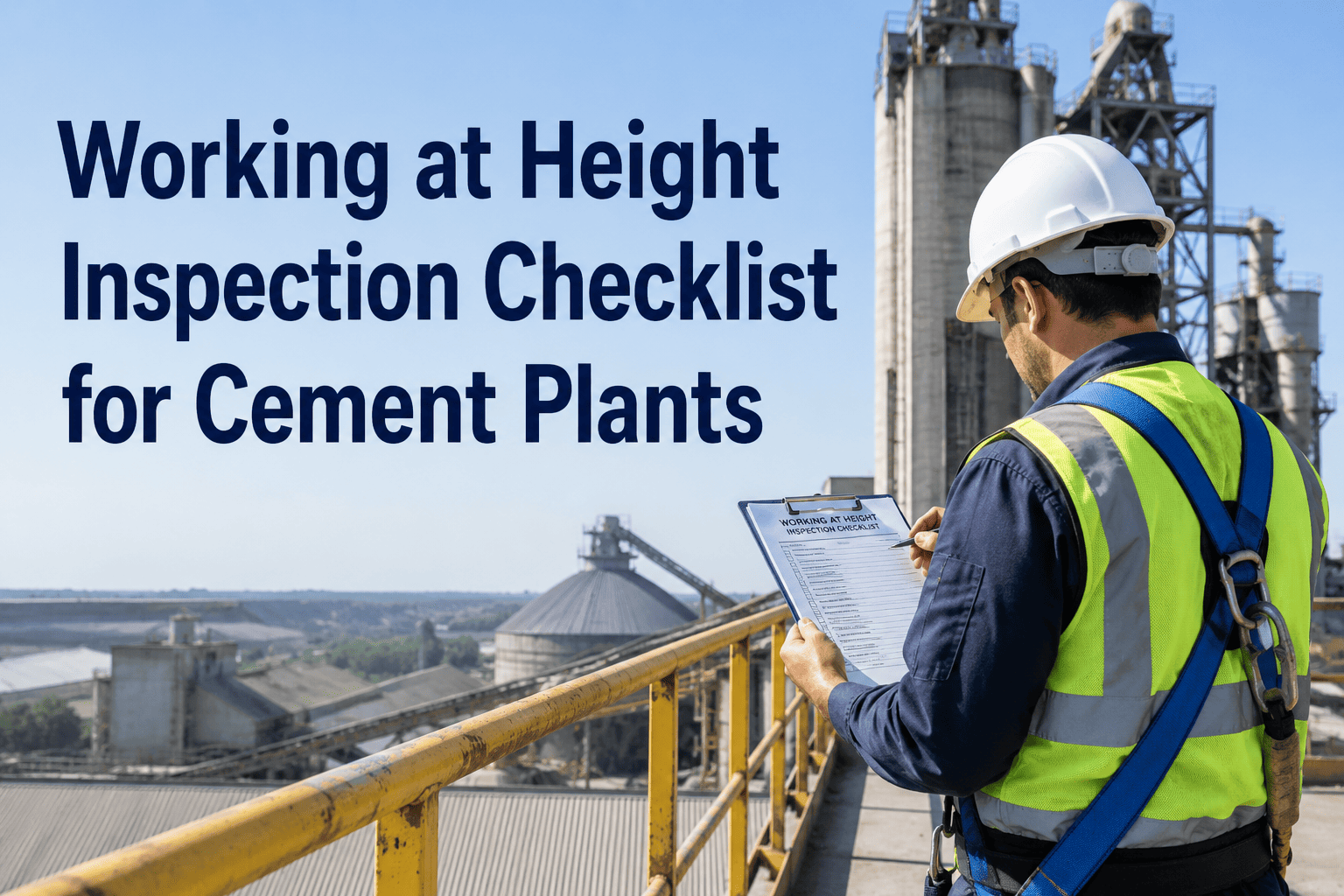
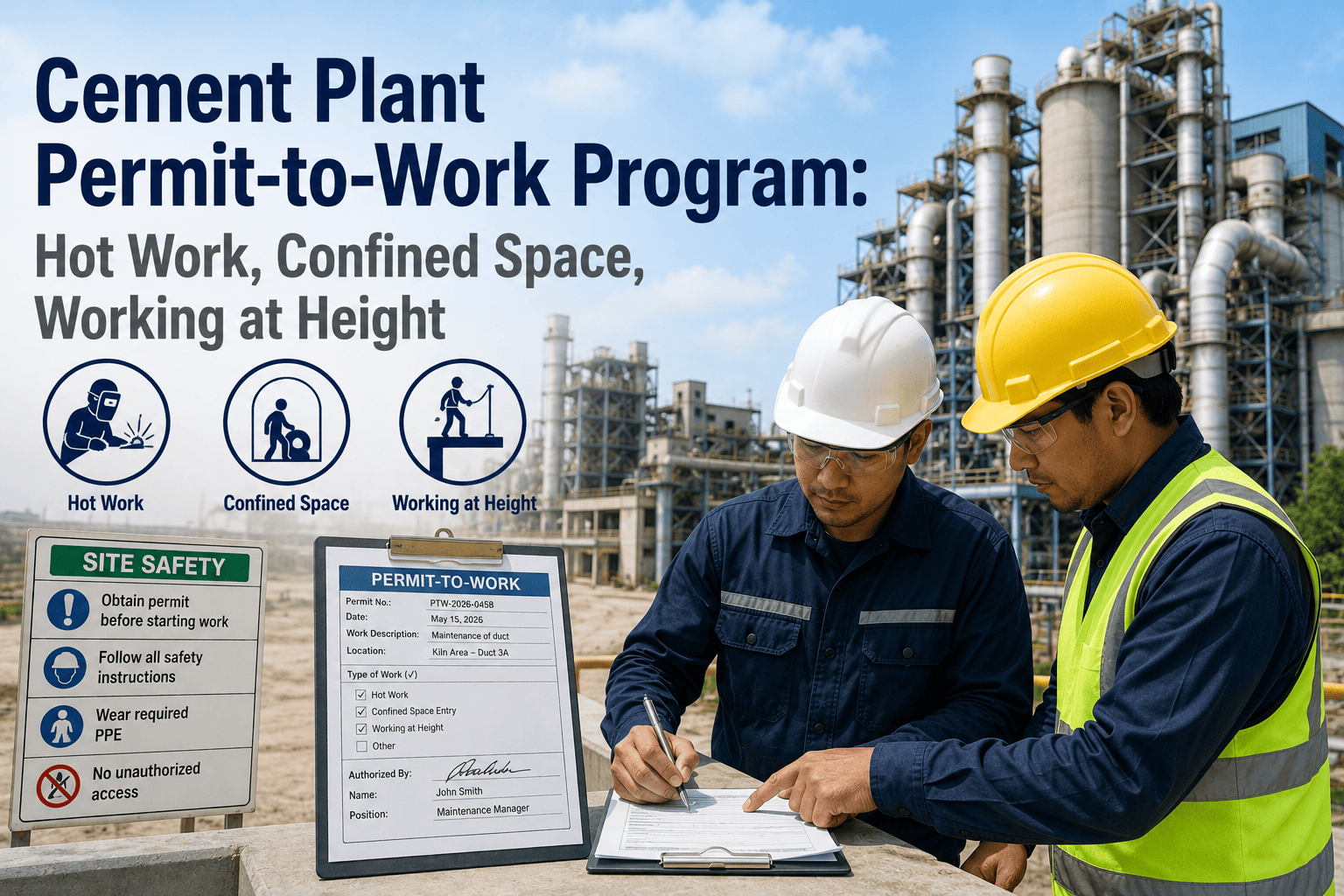
Falls from height account for approximately 25% of all cement plant fatalities, making it the single deadliest hazard category in the industry—exceeding mobile equipment strikes, confined space incidents, and electrical contact combined. Cement manufacturing facilities present uniquely challenging vertical environments where workers routinely access preheater towers reaching 60-120 meters, climb silo structures exceeding 40 meters, traverse elevated conveyor systems spanning kilometers, and perform maintenance on kiln shells at dangerous angles. According to 2024-2025 occupational safety data, 49% of fatal falls occur when no fall protection is being used at all, while insufficient planning reduces the likelihood of using fall protection by 71%. OSHA's January 2025 PPE fit requirements now mandate that harnesses, lanyards, and fall arrest gear properly fit each worker—recognizing that poorly fitting equipment fails during falls. Modern cement plants implementing digital fall protection management systems achieve near-zero fall incidents through systematic permit controls, equipment tracking, and competency verification. Sign up for Oxmaint to digitize your fall protection program with automated permit workflows, equipment inspection scheduling, and real-time compliance dashboards.
Critical Safety Guide
Cement Plant Fall Protection and Working at Heights Safety
Comprehensive strategies for fall hazard elimination, protection system deployment, rescue planning, and digital compliance management across cement manufacturing environments
25%
Of Cement Plant Fatalities from Falls
120m
Preheater Tower Heights
49%
Falls with No Protection Used
2025
OSHA PPE Fit Rule Effective
High-Risk Elevation Zones in Cement Plants
Cement manufacturing facilities contain multiple distinct vertical work environments, each presenting unique fall hazards requiring tailored protection strategies. Preheater towers—the tallest structures in most plants at 60-120 meters—require workers to access multiple platform levels for cyclone cleaning, refractory inspection, and blockage removal during both routine operations and shutdown maintenance. These towers combine extreme heights with confined access, hot surfaces, and atmospheric hazards that complicate rescue operations. Understanding the specific characteristics of each elevation zone enables plants to implement appropriate hierarchy of controls: elimination through design, engineering controls like permanent guardrails, and fall arrest systems where elimination isn't feasible.
Extreme Risk
60-120m
Preheater Tower
Multiple platform levels with open edges
Cyclone access hatches and confined entries
Hot surfaces exceeding 350°C
CO/CO2 accumulation in enclosed areas
Vibration and structural movement
Required: Full-body harness, dual lanyard, rescue plan, atmospheric monitoring
High Risk
30-50m
Silos and Storage
Silo roof access and hatch entries
Engulfment hazards from stored materials
External ladder and platform access
Dust accumulation reducing visibility
Wind exposure on external surfaces
Required: Guardrails, harness tie-off, confined space permit, engulfment protection
Elevated Risk
10-30m
Conveyor Systems
Extended walkway structures
Transfer point access platforms
Moving equipment proximity
Material spillage creating slip hazards
Limited egress during emergencies
Required: Guardrails, toe boards, harness at open edges, LOTO for maintenance
Standard Risk
2-10m
Equipment Platforms
Mill and crusher access platforms
Motor and gearbox maintenance areas
Electrical substation roofs
Temporary scaffold and ladder work
Roof access for inspections
Required: Guardrails or harness above 1.8m, ladder safety, scaffold inspection
The hierarchy of fall protection controls prioritizes elimination and engineering solutions over personal protective equipment. Permanent guardrails, fixed access platforms, and properly designed walkways prevent falls without requiring worker action or equipment inspection. Where elimination isn't feasible, restraint systems prevent workers from reaching fall hazards, while fall arrest systems stop falls that do occur. Book a demo to see how digital work permits enforce zone-specific fall protection requirements automatically.
OSHA 2025 Fall Protection Updates
The January 2025 OSHA PPE fit rule fundamentally changes fall protection compliance by requiring that all personal protective equipment—including harnesses, lanyards, hard hats, and fall arrest gear—must properly fit each individual worker. This amendment to 29 CFR 1926.95 aligns construction standards with general industry requirements that have existed for years, recognizing that poorly fitting equipment can fail during a fall or restrict safe movement. Plants must now maintain multiple harness sizes, document fit verification for each worker, and ensure equipment selection matches individual body dimensions.
PPE Fit Requirements (Effective January 13, 2025)
+Full-body harnesses must properly fit each worker's body dimensions
+Multiple harness sizes required to accommodate workforce variation
+Workers can request properly fitting equipment without retaliation
+Fit verification documentation required during inspections
Existing 1926.502 Requirements (Unchanged)
+Fall protection required at 6 feet (1.8m) above lower level
+Guardrail top rails at 42 inches, withstand 200 lb force
+Safety nets with 6x6 inch max mesh, 5,000 lb border ropes
+Personal fall arrest systems meeting ANSI Z359 standards
Rescue Planning Requirements (Emphasized)
+Prompt rescue capability required before work at height begins
+Designated trained rescue team or self-rescue equipment
+Site-specific rescue plans for each elevated work location
+Regular rescue drills and competency verification
Fall Protection Equipment Systems
Personal fall arrest systems in cement plant environments must address the specific challenges of extreme heights, confined spaces, hot surfaces, and dust exposure that differentiate industrial applications from standard construction. Equipment selection requires consideration of rescue scenarios—a worker suspended after a fall at the 90-meter level of a preheater tower faces different rescue challenges than one who falls from a 3-meter platform. The 2025 ANSI Z359 standards establish performance requirements for harnesses, lanyards, connectors, and anchor systems that cement plants should reference when specifying fall protection equipment. Sign up now to implement comprehensive equipment tracking and inspection management.
H
Full-Body Harnesses
Distribute fall arrest forces across shoulders, chest, and thighs. Must include dorsal D-ring for fall arrest, front D-ring for positioning, and side D-rings for restraint applications. Heat-resistant webbing required near kiln and preheater areas.
Standard: ANSI Z359.11 | Inspection: Before each use + annual
L
Shock-Absorbing Lanyards
Reduce fall arrest forces to under 1,800 lbf (8 kN) through controlled deformation. Single and twin-leg configurations available. Twin-leg (Y-lanyard) enables 100% tie-off during transitions between anchor points.
Standard: ANSI Z359.13 | Max free fall: 6 feet (1.8m)
S
Self-Retracting Lifelines
Allow freedom of movement while limiting free fall distance to inches. Automatically lock when sudden force is applied. Essential for preheater tower work where vertical movement spans multiple levels.
Standard: ANSI Z359.14 | Annual inspection + functional test
A
Anchor Systems
Fixed anchors, horizontal lifelines, and temporary anchor devices must withstand 5,000 lbf per worker attached. Permanent anchor points require engineering certification and periodic load testing.
Standard: ANSI Z359.18 | Capacity: 5,000 lbf minimum
R
Rescue Equipment
Descent devices, rescue winches, and evacuation systems enable prompt rescue of suspended workers. Suspension trauma can cause death within 30 minutes—rescue capability must exist before work begins.
Standard: ANSI Z359.4 | Pre-work rescue plan required
G
Guardrail Systems
Permanent and temporary guardrails eliminate fall hazards without requiring worker action. Top rail at 42 inches, mid-rail at 21 inches, toe boards at platform edges. Preferred over personal fall arrest where feasible.
Standard: OSHA 1926.502(b) | Load: 200 lbf top rail
Equipment inspection and maintenance directly impacts fall protection effectiveness. Harnesses exposed to cement dust, heat, and UV radiation degrade faster than equipment in standard construction environments. Schedule a demo to see how automated equipment inspection scheduling ensures no harness exceeds manufacturer service life without documented inspection.
Digitize Your Fall Protection Program
Automate work permits, track equipment inspections, verify worker competencies, and maintain audit-ready documentation with a unified CMMS platform designed for high-risk industrial environments.
Digital Work Permit and Compliance Management
Paper-based work permit systems consistently fail to enforce fall protection requirements at the point of work. A permit issued in the morning cannot validate that conditions remain safe when work actually begins hours later, cannot verify that the specified fall protection equipment was actually obtained and inspected, and cannot confirm that workers accessing elevated areas hold current competency certifications. Digital permit workflows close these enforcement gaps through automated validation, real-time status tracking, and integration with equipment management and training records. Book a demo to explore how digital permits transform fall protection compliance from administrative paperwork to active safety enforcement.
01
Permit Request
Worker submits digital work-at-height permit specifying location, duration, equipment needed, and rescue plan. System validates training currency and equipment availability before routing for approval.
02
Supervisor Approval
Supervisor reviews permit details, confirms site conditions, verifies rescue capability exists. Digital signature required with timestamp and location verification before work authorization.
03
Equipment Checkout
System confirms harness inspection current, SRL service date valid, anchor points certified. Equipment barcode scan links specific gear to permit with automatic return tracking.
04
Active Monitoring
Real-time dashboard shows all active work-at-height permits across plant. Automatic alerts when permit expiry approaches. Supervisor notification if conditions change.
05
Work Completion
Worker closes permit with completion confirmation. Equipment returned and scanned. Any incidents or near-misses documented with root cause analysis workflow triggered.
Rescue Planning and Emergency Response
OSHA requires employers to provide for prompt rescue of employees in the event of a fall—yet many cement plants lack site-specific rescue capabilities for their most dangerous elevated work locations. A worker suspended after a fall can experience suspension trauma within 15-30 minutes as blood pools in the legs, potentially causing unconsciousness and death. Preheater tower rescue scenarios are particularly complex: responders must access heights exceeding 100 meters, potentially in confined spaces with atmospheric hazards, to reach and lower an incapacitated worker. Rescue planning must happen before work begins, not after an incident occurs.
Preheater Tower (60m+)
Under 20 minutes
Rope rescue team, confined space entry, atmospheric monitoring
Descent devices, rescue winch, SCBA, stretcher
Silo Roof/Top (40m)
Under 15 minutes
Rope rescue, edge protection, engulfment awareness
Rescue tripod, winch, retrieval line
Conveyor Structure (20m)
Under 10 minutes
Ladder rescue, aerial lift positioning
Rescue ladder, descent device, first aid
Equipment Platform (10m)
Under 8 minutes
Self-rescue or assisted rescue
Self-rescue device, trauma straps
Training and Competency Requirements
Fall protection training requirements under OSHA 1926.503 mandate that workers understand fall hazard recognition, proper equipment use, and rescue procedures before working at heights. Training must address the specific hazards of each work environment—preheater tower work presents different challenges than conveyor maintenance or silo access. Annual refresher training maintains competency currency, while practical skill verification confirms workers can actually don equipment, identify anchor points, and execute rescue procedures rather than simply reciting regulatory requirements.
Fall hazard recognition and avoidance
Hierarchy of fall protection controls
Harness inspection, donning, and adjustment
Anchor point identification and selection
Lanyard and SRL connection procedures
Guardrail and warning line systems
Emergency response and rescue basics
Equipment inspection demonstration
Proper harness fit and adjustment
100% tie-off during transitions
Rescue equipment operation
Suspended worker relief techniques
Emergency communication procedures
Site-specific hazard identification
Competent person designation (OSHA)
Rescue team certification
Scaffold erector/inspector
Rope access technician (SPRAT/IRATA)
Confined space rescue integration
Aerial lift operator certification
Fall protection equipment inspector
Transform Fall Protection Compliance
Join cement plants worldwide using Oxmaint to automate work permits, track equipment certifications, and maintain continuous audit readiness for fall protection programs.
Frequently Asked Questions
What are the primary fall hazard areas in cement manufacturing plants?
Cement plants contain multiple high-risk elevation zones including preheater towers (60-120 meters) where cyclone cleaning and refractory work occurs, silos and storage structures (30-50 meters) with roof access and confined space entries, conveyor systems (10-30 meters) spanning production areas, and equipment platforms (2-10 meters) for mill and crusher maintenance. Falls from preheater platforms account for approximately 25% of cement plant fatalities, making them the deadliest single hazard category in the industry.
What changed in OSHA fall protection requirements for 2025?
The January 2025 OSHA final rule amends 29 CFR 1926.95 to require that all construction PPE—including harnesses, lanyards, and fall arrest gear—must properly fit each individual worker. This aligns construction with general industry standards. Plants must now maintain multiple harness sizes, document fit verification, and allow workers to request properly fitting equipment. The 6-foot fall protection trigger height and other 1926.502 requirements remain unchanged, but rescue planning continues to be emphasized.
What fall protection equipment is required for preheater tower work?
Preheater tower work requires full-body harnesses with dorsal D-ring, twin-leg shock-absorbing lanyards for 100% tie-off during transitions, self-retracting lifelines for vertical movement, and certified anchor points meeting 5,000 lbf capacity. Heat-resistant webbing is required near hot surfaces. Given the extreme heights and confined space considerations, rescue planning must include rope rescue capability, descent devices, and potentially SCBA for atmospheric hazards in enclosed cyclone areas.
What is suspension trauma and why does rescue planning matter?
Suspension trauma occurs when a worker hangs motionless in a harness after a fall, causing blood to pool in the legs. Without leg movement to pump blood back to the heart, unconsciousness can occur within 15-30 minutes, potentially leading to death. OSHA requires employers to provide for prompt rescue before work at height begins. Rescue plans must specify who responds, what equipment they use, and how quickly they can reach a suspended worker at each elevated work location.
How can CMMS software improve fall protection program management?
CMMS platforms transform fall protection management through digital work-at-height permits that validate training currency and equipment availability before approval, automated equipment inspection scheduling with barcode tracking, competency management with expiration alerts for certifications, real-time dashboards showing all active elevated work permits, incident documentation with root cause analysis workflows, and audit-ready compliance reports. Digital enforcement closes gaps that paper systems cannot address.
What training is required for workers performing elevated work in cement plants?
OSHA 1926.503 requires training on fall hazard recognition, proper equipment use, and rescue procedures. Workers must understand the hierarchy of controls, demonstrate harness inspection and donning, identify appropriate anchor points, and execute emergency procedures. Competent person designation requires additional training to supervise fall protection programs. Rescue team members need specialized certification. Annual refresher training and practical skill verification maintain competency currency.
What are the hierarchy of controls for fall protection in industrial settings?
The hierarchy prioritizes elimination through design (removing the need to work at height), engineering controls (permanent guardrails, fixed platforms, safety nets), administrative controls (work permits, procedures, training), and finally personal protective equipment (harnesses, lanyards, fall arrest systems). PPE is the last line of defense because it depends on worker compliance and equipment effectiveness. Guardrails and engineered access eliminate fall hazards without requiring worker action.