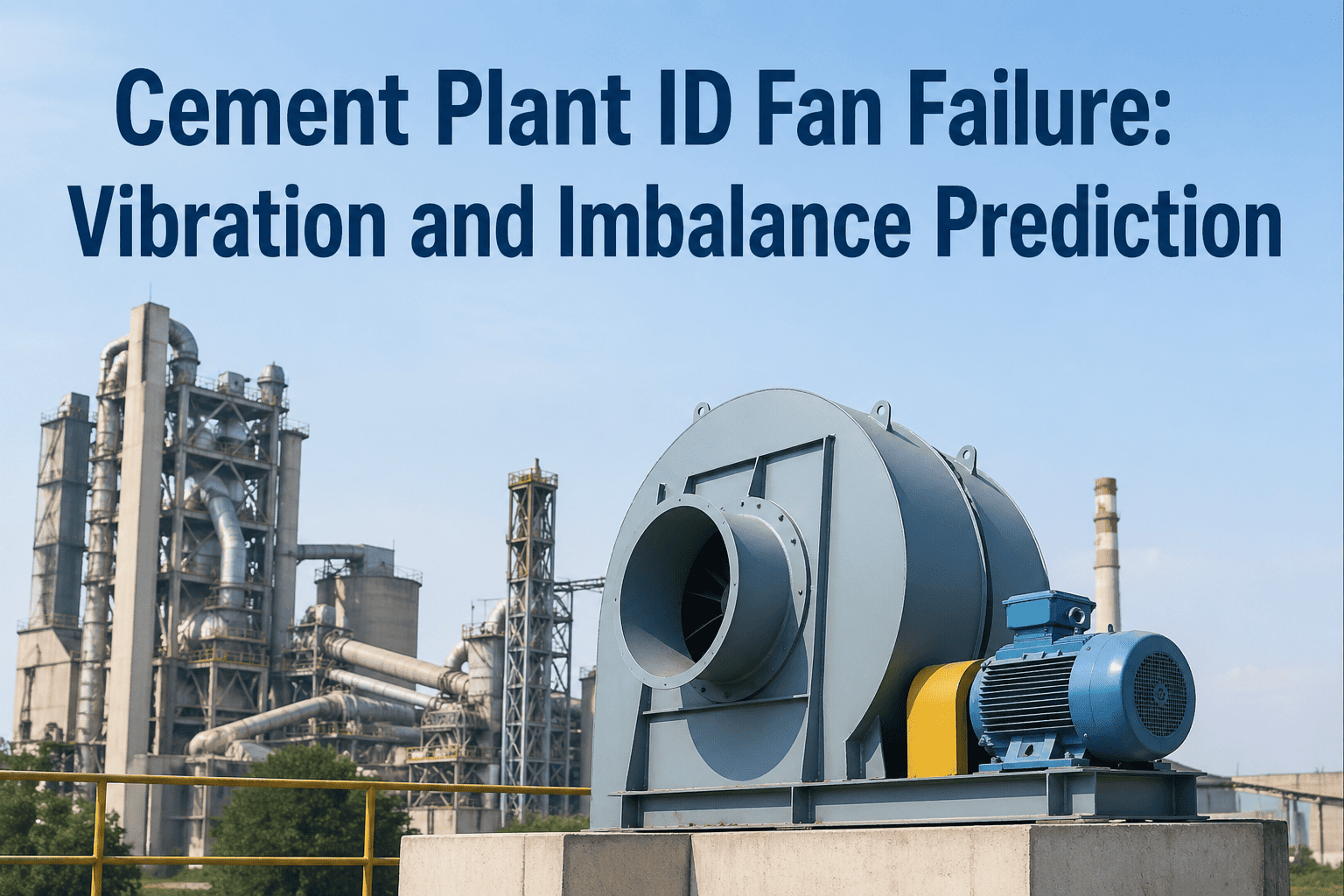
At 2:14 AM on a Thursday, the induced draft fan at a 4,500 TPD cement plant seized without warning. The kiln went cold within 40 minutes. By the time the emergency maintenance crew sourced replacement bearings, aligned the shaft, and restarted the fan, the plant had lost 52 hours of production — roughly $165,000 in revenue and $38,000 in emergency repair costs. The post-incident investigation found the cause: a lubrication schedule that existed on a whiteboard nobody checked. In a typical cement plant, fan and blower systems consume 30% to 50% of total electrical energy, making them the single largest power draw on the production line. Yet industry data shows 38% of all fan breakdowns trace to bearing failures from improper lubrication — a completely preventable problem. This guide gives cement maintenance teams a field-tested framework for every critical fan type, covering failure modes, PM scheduling, vibration diagnostics, and energy optimization. Start tracking fan maintenance with Oxmaint and eliminate the spreadsheet chaos that lets failures slip through.
Facilities running structured preventive maintenance on their fan fleet reduce unplanned downtime by up to 72% and extend equipment life well beyond industry averages. The key is understanding which fans are most critical, what failures look like before they happen, and building a digital system that never lets a task fall through the cracks. Book a demo with Oxmaint to see automated fan maintenance scheduling in action.
The Six Critical Fan Systems in Every Cement Plant
Cement plants depend on six primary fan types — each operating under a unique combination of extreme heat, abrasive dust, and corrosive gases. Understanding each fan's function and failure profile is the foundation of any effective maintenance program. Here's what every maintenance engineer needs to know about each system.
Induced Draft (ID) Fan
CRITICALThe "lung" of the clinker burning system — provides draft for kiln fuel combustion and gas flow through the preheater tower. If this fan stops, the entire kiln shuts down.
Raw Mill Fan
HIGH PRIORITYTransports gas and ground raw meal through the vertical roller mill under extremely high pressure drop. One of the single largest power consumers in any cement facility.
Clinker Cooler Fans
HIGH PRIORITYBanks of 5 to 15 fans blow cold ambient air to cool clinker from 1,500°C to ~100°C. Failure affects clinker quality and damages downstream conveying equipment.
Coal Mill Fan
CRITICALSupplies air for coal grinding and pulverized fuel transport to the kiln burner. Operates in ATEX-classified explosive atmosphere — safety-critical maintenance protocols are mandatory.
Preheater / Precalciner Fan
HIGH PRIORITYCirculates gases through preheater tower stages and calciner vessel. Handles high-alkali compositions that deposit aggressively on blade surfaces.
Cooler Exhaust / ESP Fan
MONITORHandles exhaust gas de-dusting — approximately 2.2 tons of gas per 1 ton of clinker. Exposed to heavy particulate loading and SOx/NOx chemical corrosion.
Top 5 Fan Failure Modes and Root Causes
Understanding why fans fail is more valuable than simply knowing when they fail. These five failure modes account for virtually all cement plant fan breakdowns — and every one of them gives measurable early warnings that a digital monitoring system catches.
Fan Failure Troubleshooting Reference
When a fan shows early warning signs, quick diagnosis saves tens of thousands. This troubleshooting matrix covers the most common symptoms, what to check first, and the corrective action for each scenario.
| Symptom | Check First | Corrective Action |
|---|---|---|
| Vibration spike > 4mm/s | Bearing condition, impeller balance, foundation bolts | Vibration spectrum analysis; plan bearing or balance correction |
| Bearing temp rise > 15°C | Lubrication condition, seal integrity, alignment | Immediate re-lubrication or bearing replacement within 7 days |
| Power draw increase 5–10% | Impeller buildup, belt slip, duct obstruction | Clean impeller; check belt tension; inspect ductwork for blockage |
| Airflow reduction at constant RPM | Internal fouling, damper malposition, duct leaks | Shutdown for cleaning; recalibrate damper position; seal duct leaks |
| Unusual noise / harmonics | Housing cracks, loose components, coupling wear | Visual + thermographic inspection; tighten or replace worn parts |
| 2x RPM vibration signature | Shaft misalignment (angular or parallel) | Laser alignment correction; inspect coupling elements |
Stop Losing $80K+ Per Fan Failure
Oxmaint automates preventive schedules for every fan in your cement plant — from ID fans to clinker coolers. Get real-time condition alerts, automated work orders, and full failure history tracking.
Preventive Maintenance Schedule: Daily to Annual
This frequency-based PM framework covers every inspection, test, and overhaul task for cement plant fans. Each section is designed to be loaded directly into your Oxmaint CMMS as automated recurring work orders.
Daily Checks
Weekly Inspections
Monthly Tasks
Quarterly Overhauls
Annual Shutdown
Vibration Severity Standards for Cement Plant Fans
Vibration analysis is the single most effective predictive technique for rotating equipment in cement plants. It catches over 90% of developing fan faults before they cause unplanned shutdowns. The table below follows ISO 10816 severity classifications for large industrial fan installations.
| Vibration (mm/s RMS) | Severity | Required Action | Response Window |
|---|---|---|---|
| 0 – 2.8 | GOOD | Normal operation — continue routine monitoring | Next scheduled check |
| 2.8 – 7.1 | SATISFACTORY | Investigate source, increase monitoring frequency to 2x | Within 30 days |
| 7.1 – 18.0 | UNSATISFACTORY | Plan corrective maintenance, stage spare parts, assign crew | Within 7 days |
| > 18.0 | UNACCEPTABLE | Immediate controlled shutdown and emergency repair | Immediately |
Energy Optimization: Cut Fan Power Costs 20–40%
When fans consume up to half of your electricity bill, efficiency improvements deliver the highest ROI of any capital expenditure in a cement plant. These three strategies are ranked by payback speed with real-world industry benchmarks.
Replaces damper-based flow control with speed modulation. Cubic affinity law means a 20% speed reduction cuts power by nearly 50%. Also reduces mechanical wear by 30% through softer start/stop cycles.
CFD-optimized backward-curved impellers improve aerodynamic efficiency from 60–70% to above 85%. Wear-resistant alloy coatings extend replacement intervals by 3x.
Thermographic and pressure testing reveals 10–25% false air infiltration in typical cement plants. Sealing leaks directly cuts power consumption with minimal investment and zero production interruption.
How CMMS Transforms Fan Maintenance
Spreadsheets and whiteboards cannot manage 15+ fans generating daily condition data across bearings, motors, impellers, and ductwork. A purpose-built CMMS like Oxmaint replaces guesswork with automated, data-driven maintenance.
Asset Registry & Hierarchy
Every fan, motor, bearing, coupling, and impeller registered with serial numbers, OEM specs, and criticality ratings. Parent-child relationships auto-attach correct spare parts and safety procedures to every work order.
Automated PM Scheduling
Calendar and runtime-meter triggers generate work orders automatically. Daily, weekly, monthly, quarterly, annual tasks dispatched to the right technician at the right time — zero manual intervention.
IoT Condition-Based Triggers
Vibration, temperature, and current sensors feed data directly into Oxmaint. When any reading crosses its alarm, an emergency work order auto-generates with failure codes, assigned crew, and staged spare parts.
Root Cause Failure Analysis
Standardized failure codes across your fan fleet enable pattern recognition at scale — identifying systemic issues like a lubrication procedure that consistently leads to bearing failures on specific fan types.
Spare Parts Automation
Critical spares linked to each asset. When inventory drops below reorder points, purchase requisitions generate automatically. No more week-long shutdowns waiting for bearings to arrive from overseas.
Measurable Results from CMMS-Driven Fan Maintenance
72% Less Downtime
Unplanned fan shutdowns reduced through predictive alerts
45% Cost Reduction
Per-fan maintenance costs lowered vs reactive approach
95% PM Compliance
Automated scheduling ensures no inspection is missed
60% Longer Life
Fan lifespan extended versus reactive-only plants
Take Control of Your Cement Plant Fan Fleet
Join maintenance teams already using Oxmaint to automate fan PM schedules, track condition data, and eliminate unplanned shutdowns across their entire fan fleet.
Frequently Asked Questions
How often should cement plant fans be inspected?
A complete program runs on five frequencies: daily temperature and vibration spot checks, weekly lubrication and belt inspections, monthly vibration spectrum analysis with thermography, quarterly laser shaft alignment and oil analysis, and annual full overhauls during kiln shutdown. A CMMS automates all five layers to ensure 100% task completion regardless of shift changes or staff turnover.
What is the leading cause of fan failure in cement plants?
Bearing failure accounts for approximately 38% of all cement plant fan breakdowns. The top three root causes are incorrect lubrication intervals (over-greasing is as damaging as under-greasing), cement dust contamination entering bearing housings through degraded seals, and shaft misalignment introduced during post-maintenance reassembly.
How much electricity do fans consume in a cement plant?
Fan and blower systems consume between 30% and 50% of a cement plant's total electrical energy — making them the largest single electrical load. In a plant using 100 kWh per ton of cement, fan systems alone account for 30–50 kWh per ton. This makes fan efficiency optimization the highest-ROI energy measure available to cement manufacturers.
Can VFDs be retrofitted to existing cement plant fans?
Yes. Most existing fan motors are VFD-compatible. The retrofit requires motor verification, electrical infrastructure upgrades for the drive cabinet, and DCS integration. Payback periods range from 12 to 18 months with verified energy savings of 20–40%, depending on the fan's part-load operating profile.
At what vibration level should a cement plant fan be shut down?
Per ISO 10816, vibration exceeding 18 mm/s RMS is classified as unacceptable and requires immediate controlled shutdown. Levels between 7.1 and 18 mm/s require corrective maintenance within 7 days. Online monitoring through CMMS-integrated sensors triggers automated responses the moment thresholds are exceeded.
What is the expected lifespan of a well-maintained cement plant fan?
A properly maintained cement plant fan operates reliably for 10 to 15 years. Plants with condition-based maintenance through a CMMS consistently achieve lifespans at the upper end, while reactive-only plants typically experience failures at 5–7 years — less than half the achievable lifespan.
How does Oxmaint CMMS improve fan maintenance specifically?
Oxmaint provides automated PM scheduling with calendar and meter-based triggers, IoT sensor integration for real-time vibration and temperature alerts, standardized failure code tracking for fleet-wide root cause analysis, automatic spare parts reorder triggers, and trend dashboards showing MTBF, energy efficiency, and cost-per-fan metrics. Plants using Oxmaint report 72% less unplanned downtime and 45% lower per-fan maintenance costs.