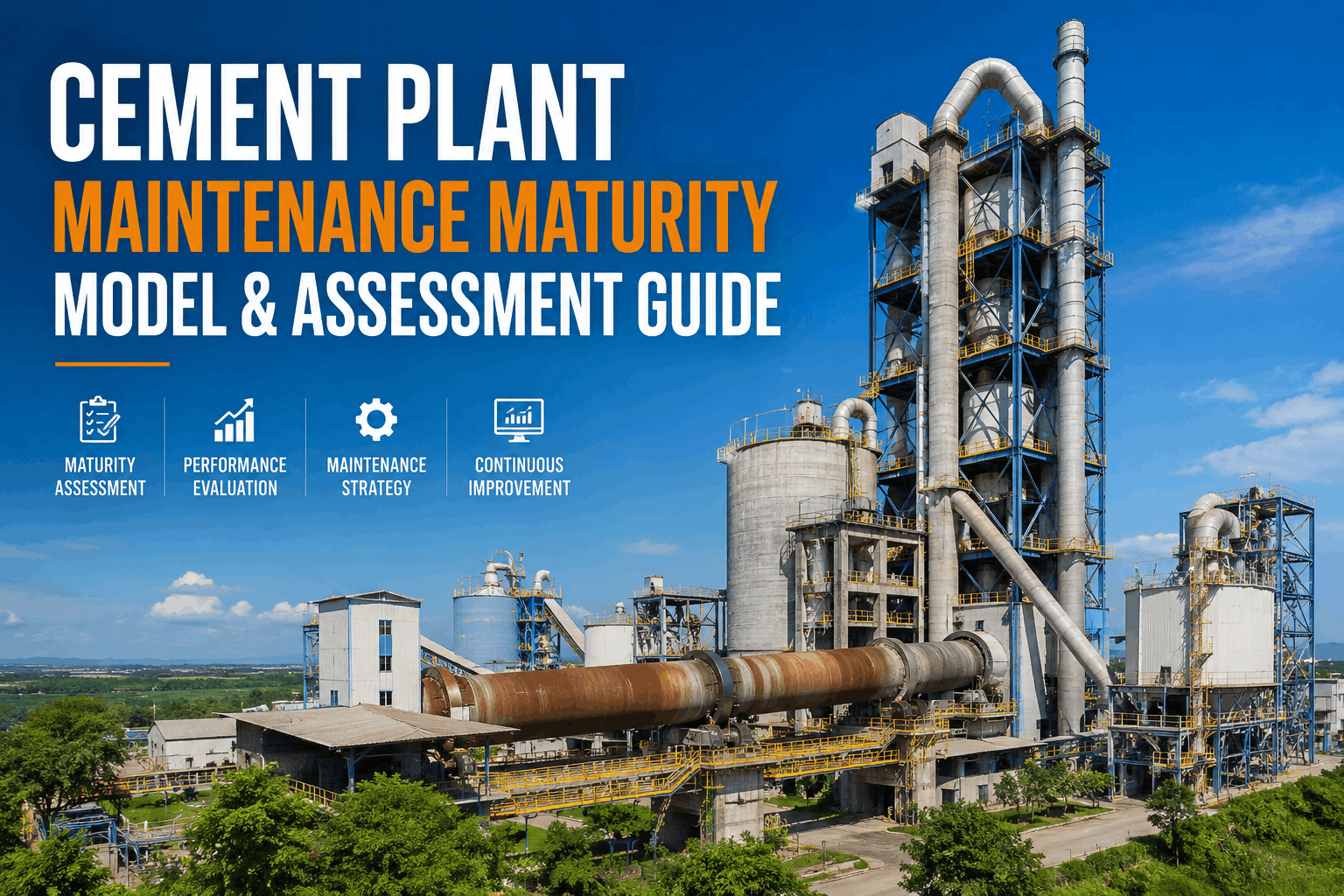
Every cement plant has a maintenance organization—but the difference between a plant that consistently achieves 90%+ kiln availability and one that lurches from one unplanned outage to the next is not budget, not headcount, and not the age of the equipment. It is maintenance maturity. A cement plant maintenance maturity assessment reveals where your organization actually operates on the spectrum from reactive chaos to predictive precision—and, more importantly, identifies the specific capability gaps that must be closed to reach the next level. Most cement plants overestimate their maturity. They confuse having a CMMS with using it effectively, mistake PM completion percentage for PM quality, and believe that vibration monitoring on the kiln drive equals a condition-based maintenance program. An honest assessment against a structured maturity model surfaces the uncomfortable truths: PMs that haven't been reviewed since commissioning, work orders closed without failure codes, condition monitoring data that nobody trends, and a maintenance budget that is allocated based on last year's spend rather than asset condition forecasts. Sign Up Free to see how OxMaint provides the CMMS foundation, structured data capture, and reliability analytics that enable cement plants to advance through the maturity levels with documented evidence of improvement at each stage.
Know Exactly Where Your Cement Plant Stands—and What to Fix Next
OxMaint gives cement maintenance leaders the structured data, PM compliance tracking, and reliability analytics to assess current maturity, close capability gaps, and advance through the maturity levels with measurable evidence.
Why Cement Plant Maintenance Maturity Determines Operational Performance
Maintenance maturity is not an abstract consulting framework—it directly determines kiln availability, production cost per ton, and the plant's ability to meet delivery commitments in a just-in-time construction materials market. A Level 1 (Reactive) plant operates with no effective PM program, repairs equipment when it breaks, and experiences kiln stops measured in events per week rather than per year. A Level 3 (Planned) plant has structured PMs, a functioning CMMS with work order history, and scheduled shutdowns—but still makes decisions based on calendar intervals rather than equipment condition. A Level 5 (Optimized) plant uses predictive analytics, reliability-centered maintenance, and continuous improvement loops where every failure triggers a root cause analysis that feeds back into PM program refinement. The financial difference between levels is measured in millions: each maturity level advancement typically reduces unplanned downtime by 30–50% and maintenance cost per ton by 10–20%. Facilities that Book a Demo with OxMaint see how the CMMS platform provides the data foundation—structured work orders, failure coding, PM compliance tracking, and condition monitoring integration—that makes each maturity level advancement possible and measurable.
OxMaint provides the data to score your plant across the five maturity dimensions—PM program, CMMS utilization, condition monitoring, planning/scheduling, and reliability engineering—with objective evidence rather than opinion.
Beyond simple completion percentage, OxMaint tracks whether PMs are completed on time, whether findings are captured, and whether corrective work orders are generated—measuring PM quality, not just PM quantity.
The gap between Level 2 and Level 3 is structured failure data. OxMaint enforces failure code capture on work order closure and provides the trend analysis that identifies chronic failure patterns.
Advancing from Level 3 to Level 4 requires condition-based decision-making. OxMaint integrates vibration, thermography, and oil analysis data with PM scheduling to trigger work orders based on equipment condition.
Level 4–5 maturity requires that every significant failure drives PM program refinement. OxMaint links RCA findings to PM revisions and tracks whether the revised PM actually reduced repeat failures.
OxMaint dashboards provide the before-and-after metrics that demonstrate maturity advancement—MTBF improvement, PM compliance trend, and maintenance cost per ton reduction—to plant and corporate leadership.
The 5 Levels of Cement Plant Maintenance Maturity
At Level 1, the maintenance organization has no structured preventive maintenance program. Work is exclusively reactive—equipment runs until failure, then maintenance responds. There is no CMMS or the CMMS exists in name only with incomplete asset data and no work order history. Planning consists of the morning meeting where the maintenance manager allocates crews to the day's emergencies. PMs, if they exist at all, are informal—a weekly greasing route that may or may not be completed. There are no failure codes, no root cause analysis, and no reliability metrics beyond "how many times did the kiln stop this month." The kiln operates with availability below 85%, annual unplanned stops exceed 20 events, and maintenance cost per ton is unpredictable and typically 30–50% higher than a Level 3 plant producing the same clinker volume. The path to Level 2 begins with a single discipline: building a complete asset register and implementing basic time-based PMs on the most critical equipment—kiln drive, main baghouse fans, and finish mill drives. OxMaint provides the structured platform to build that asset register and schedule those first PMs. Facilities that Sign Up Free can begin the Level 1-to-Level 2 journey immediately by loading the kiln area asset hierarchy and scheduling the foundational PMs.
At Level 2, the plant has implemented basic time-based PMs on critical equipment and is using a CMMS to schedule and track work orders. The asset register exists and covers the main process equipment—kiln, raw mill, finish mill, and major fans. PMs are scheduled by calendar or runtime and generate work orders automatically. However, the maturity gaps are significant: PM completion rates hover around 60–70% (the overdue backlog builds up), work orders are closed without failure codes or meaningful completion notes, PM checklists are generic and rarely reviewed or updated, and condition monitoring exists only as spot checks on critical bearings—there is no trending program. The plant still experiences 10–15 unplanned kiln stops per year, but most are shorter duration because crews respond faster to known failure patterns. The critical advancement from Level 2 to Level 3 requires three things: PM compliance discipline (sustaining above 85% completion), structured failure data capture (enforcing failure codes on every corrective work order), and planning/scheduling discipline (moving from daily reactive crew allocation to weekly planned work schedules). Teams that Book a Demo can see how OxMaint enforces failure code capture, tracks PM compliance trending, and provides the planning board for weekly work scheduling.
Level 3 represents the industry standard for a professionally managed cement plant maintenance organization—and the level that most plants aspire to reach and sustain. At this level, PM compliance is consistently above 85% on-time completion, all corrective work orders are coded with failure mode and cause codes at closure, weekly maintenance schedules are planned in advance with resource leveling, and the annual kiln shutdown is planned 3–6 months ahead with a defined scope, task list, and contractor management process. The CMMS contains 2–3 years of work order history that enables basic failure trend analysis. Condition monitoring is established as a program: vibration routes on critical rotating equipment are executed monthly, oil analysis samples are taken on schedule, and thermography of electrical equipment and kiln shell is performed quarterly. The plant has a reliability engineer (or shared corporate resource) who reviews failure trends and recommends PM changes. Kiln availability sustains above 90% with 5–8 unplanned stops annually. The gap to Level 4 is that PM intervals are still primarily calendar or runtime-based rather than condition-based, and the plant lacks the integration between condition monitoring data and the CMMS that would enable predictive work order generation. The advancement requires connecting vibration, oil analysis, and thermography data to OxMaint so that condition thresholds automatically trigger work orders—and using the accumulated failure history to conduct formal RCM studies on the kiln and finish mill systems.
At Level 4, the cement plant has shifted from calendar-based PM to condition-based maintenance for all critical assets. Vibration, oil analysis, thermography, and (for the kiln) shell temperature scanning and tire slip monitoring are integrated with the CMMS—when a condition indicator crosses its alarm threshold, a work order is automatically generated for inspection or intervention. PM intervals are dynamically adjusted based on condition data: a mill gearbox with stable vibration and clean oil may have its PM interval extended; a kiln support roller with rising bearing temperature gets increased inspection frequency. The plant has completed formal Reliability-Centered Maintenance (RCM) studies on the kiln system, raw mill, and finish mill, and PM tasks are traceable to specific failure modes identified in the RCM analysis. Root cause analysis is mandatory for any failure causing more than 4 hours of kiln downtime, and RCA corrective actions are tracked to completion with verification that the failure has not recurred. Kiln availability exceeds 95% with 2–4 unplanned stops annually—and those stops are typically short because the predictive program catches most failures before they propagate. The gap to Level 5 is that the plant still operates with some degree of human decision-making lag between condition indication and maintenance action, and reliability data is not yet integrated with production planning and inventory management in a closed-loop optimization system.
Level 5 represents the frontier of cement plant maintenance—where machine learning algorithms analyze years of condition monitoring data, process parameters, and failure history to predict remaining useful life of critical components with sufficient accuracy to schedule replacements during planned shutdowns with zero unplanned intervention. At this level, the maintenance strategy is not just condition-based but predictive-optimized: the CMMS platform uses AI to recommend the optimal maintenance intervention timing that balances component life utilization against the production cost of a shutdown. Digital twin models of the kiln, mills, and critical fan systems simulate degradation patterns and evaluate "what-if" maintenance scenarios. The maintenance budget is generated from asset condition forecasts rather than historical spend. Spare parts inventory is optimized to have the right part available at the predicted replacement date—no sooner (tying up working capital) and no later (causing downtime). The plant achieves kiln availability above 97% with 0–1 unplanned stops annually, and maintenance cost per ton is 30–40% below the Level 3 industry baseline. This level is aspirational for most plants, but the journey from Level 4 to Level 5 begins with the structured data foundation built at Levels 2–4—without years of clean failure data, condition monitoring trends, and PM completion records, the AI models have nothing to learn from. Facilities can Sign Up Free and begin building the data foundation at whatever maturity level they currently occupy.
Cement Plant Maintenance Maturity Assessment: Scoring Dimensions
| Maturity Dimension | Level 1 (Reactive) | Level 3 (Planned) | Level 5 (Optimized) | OxMaint Enabler |
|---|---|---|---|---|
| PM Program | No structured PMs; informal greasing only | 85%+ PM compliance; annual PM review | Condition-based PM; AI-optimized intervals | PM scheduling, compliance tracking, condition trigger integration |
| CMMS Utilization | No CMMS or unused; no WO history | All WOs in CMMS; 2–3 years history; failure codes captured | AI-driven work generation; digital twin integration | Full CMMS with structured data capture and analytics |
| Condition Monitoring | None; bearing failures detected by noise or temperature | Monthly vibration routes; quarterly oil analysis and thermography | Online monitoring on all critical assets; automated alerts | Condition data integration; threshold-based WO generation |
| Planning & Scheduling | Daily reactive crew allocation | Weekly planned schedules; 3–6 month shutdown planning | Optimized scheduling; shutdown scope from condition forecast | Planning board; resource leveling; shutdown management module |
| Reliability Engineering | No reliability function; no RCA | RCA for major failures; annual failure trend review | RCM on all critical systems; continuous PM refinement loop | Failure trend analysis; RCA tracking; PM revision history |
How to Conduct a Cement Plant Maintenance Maturity Assessment with OxMaint
A credible maturity assessment requires evidence, not opinion. The maintenance manager who claims "we're Level 3" but cannot produce PM compliance data, failure code trends, or condition monitoring records from the CMMS is describing an aspiration, not a reality. OxMaint provides the structured data that makes assessment objective: pull the PM compliance report for the last 12 months and you have your PM program score; pull the percentage of corrective work orders with failure codes and you have your CMMS utilization score; review whether condition monitoring data is stored against assets and linked to work order generation and you have your condition monitoring score. The assessment becomes a data extraction exercise rather than a subjective survey. The resulting gap analysis identifies precisely which capabilities must be developed to reach the next level—and OxMaint provides the platform to close those gaps, whether it's enforcing failure code capture, integrating vibration data, or building the RCA tracking workflow. Facilities can Sign Up Free and begin extracting the assessment data from their first month of structured OxMaint usage—establishing the current-state baseline against which all future improvement will be measured.
18-Month Cement Plant Maintenance Maturity Advancement Roadmap
Month 1–3: Establish the Data Foundation (Level 1 → 2)
Complete the asset register for kiln, raw mill, and finish mill areas. Implement basic time-based PMs on all critical equipment. Begin capturing all work in OxMaint with mandatory failure codes on corrective WOs. Target: 70% PM compliance by month 3.
Month 4–6: Build Planning Discipline (Level 2 Foundation)
Establish weekly maintenance scheduling with resource leveling in OxMaint. Implement the planning board for crew allocation. Begin condition monitoring routes (vibration and oil analysis) on kiln drive and critical fans. Target: 80% PM compliance; 100% failure code capture.
Month 7–9: Enforce PM Quality (Level 2 → 3)
Review and update all PM checklists based on 6 months of failure data. Enforce findings capture on PMs—every inspection that identifies an issue must generate a corrective WO. Target: 85% PM compliance; PM findings generating corrective WOs.
Month 10–12: Integrate Condition Monitoring (Level 3 → 4)
Connect vibration, oil analysis, and thermography data to OxMaint. Configure alarm thresholds that automatically generate work orders. Begin trending condition data against failure history. Target: condition-based WOs generating for all critical assets.
Month 13–15: Implement RCM & RCA Discipline (Level 4)
Conduct formal RCM studies on kiln system and finish mill. Mandate RCA for any failure causing >4 hours downtime. Link RCA corrective actions to PM revisions and track repeat failure reduction. Target: 2–4 unplanned kiln stops annually.
Month 16–18: Sustain & Optimize (Level 4 → 5 Path)
Use 18 months of OxMaint data to train predictive models. Implement digital twin for kiln system. Generate maintenance budget from asset condition forecasts. Target: 97%+ kiln availability; maintenance cost per ton 20%+ below baseline. Book a Demo to see the complete maturity advancement workflow in OxMaint.
Frequently Asked Questions
What is a cement plant maintenance maturity model?
A maintenance maturity model is a structured framework for assessing where a cement plant's maintenance organization operates on a spectrum from reactive (Level 1) to optimized/AI-driven (Level 5). It evaluates multiple dimensions—PM program quality, CMMS utilization, condition monitoring integration, planning and scheduling discipline, and reliability engineering capability—against defined criteria for each level. The output is not just a score but a gap analysis that identifies the specific capabilities that must be developed to reach the next maturity level.
What maturity level do most cement plants operate at?
The majority of cement plants globally operate between Level 2 (Developing) and Level 3 (Planned). They have a functioning CMMS, structured PMs, and some condition monitoring, but PM compliance may be inconsistent, failure data capture is incomplete, and condition monitoring is not integrated with work order generation. Plants that believe they are Level 4 often discover during a data-driven assessment that they are actually a strong Level 3—condition monitoring exists but does not drive maintenance decisions systematically.
How long does it take to advance one maturity level?
Advancing from Level 1 to Level 2 can be achieved in 3–6 months with disciplined implementation of an asset register and basic PMs in OxMaint. Advancing from Level 2 to Level 3 typically requires 6–12 months because it involves behavioral change—enforcing failure code capture, achieving sustained PM compliance, and building planning discipline. Advancing from Level 3 to Level 4 requires 12–18 months because it requires condition monitoring integration, RCM studies, and the accumulation of sufficient failure data to validate condition-based decision-making. Level 5 is a multi-year journey built on the data foundation established at earlier levels.
How does OxMaint support maturity assessment and advancement?
OxMaint provides the structured data that makes maturity assessment objective rather than subjective—PM compliance rates, failure code coverage percentages, condition monitoring data stored against assets, and reliability trend metrics are all available directly from the platform. For advancement, OxMaint provides the CMMS foundation (asset register, PM scheduling, work order management), enforces the data discipline (mandatory failure codes, PM findings capture), integrates condition monitoring data, and tracks the reliability metrics that demonstrate improvement at each maturity level.
What is the ROI of advancing maintenance maturity in a cement plant?
Each maturity level advancement typically reduces unplanned downtime by 30–50% and maintenance cost per ton by 10–20%. For a 1 million ton per year cement plant, advancing from Level 2 to Level 3—with a corresponding kiln availability improvement from 88% to 92%—can represent 40,000 additional tons of clinker production annually with no additional capital investment, plus a maintenance cost reduction of $0.50–$1.00 per ton. The CMMS investment required to enable this advancement typically pays back within the first year of sustained PM compliance improvement alone.
Know Your Current Level. Map Your Path to the Next. Measure Every Step.
OxMaint gives cement maintenance leaders the structured data, PM compliance tracking, and reliability analytics to assess maturity objectively, close capability gaps systematically, and prove improvement with metrics that matter to the board.