Cement plants that run maintenance programmes built on calendar-based intervals rather than failure mode analysis spend an estimated 22% to 35% more on preventive maintenance than necessary — while simultaneously leaving the failure modes most likely to cause unplanned kiln stops either unaddressed or addressed at the wrong frequency. Reliability Centered Maintenance applies a structured analytical process to every critical asset: identify the functions, define the failure modes, classify the consequences, and select the maintenance task that addresses each failure mode at the lowest total cost. The result is not more maintenance — it is the right maintenance, at the right interval, on the right assets. Book a demo to see how Oxmaint supports FMEA analysis and RCM-derived PM schedules across your cement plant asset hierarchy.
RCM vs Time-Based vs Reactive Maintenance: Full Comparison
It is worth noting that RCM does not eliminate time-based or reactive maintenance — it places each approach where it is most appropriate. A mature RCM programme typically retains time-based tasks for consumables and low-criticality ancillaries, accepts run-to-failure for assets with genuinely non-operational failure consequences, and applies condition-based and failure-mode-driven tasks to the critical 20% of assets generating 80% of unplanned downtime. The table below scores each strategy honestly across all dimensions, including where time-based and reactive approaches are the correct choice.
| Dimension | RCM (Reliability Centered) | Time-Based (Calendar PM) | Reactive (Run-to-Failure) |
|---|---|---|---|
| PM Interval Logic | Interval derived from failure mode P-F curve analysis. Each task addresses a specific failure mechanism at the optimal point in its degradation curve. | Interval set by OEM recommendation or historical convention. Often 2–4x more frequent than failure modes require, generating over-maintenance cost. | No scheduled interval. Maintenance occurs only after failure. Lowest labour input until a failure event occurs. |
| Failure Mode Coverage | All failure modes systematically identified through FMEA. Each mode assigned a specific maintenance task or run-to-failure decision with documented rationale. | Covers visible, time-dependent failures. Random failures and condition-dependent modes are typically unaddressed by calendar tasks. | No failure modes addressed proactively. Only failures with visible consequence trigger action. |
| Kiln Availability Impact | +18% to +28% availability improvement recorded in cement plants after RCM implementation — from addressing previously undetected failure modes and eliminating unnecessary planned downtime. | Baseline availability maintained. Planned downtime from unnecessary PM tasks reduces available hours. Unaddressed failure modes produce unpredictable unplanned stops. | Lowest planned downtime — but highest unplanned downtime. Mean availability typically 12–22% below RCM-managed plants. |
| Maintenance Cost Structure | Higher initial analysis investment. Lower ongoing labour and parts cost from eliminating unnecessary tasks. Emergency repair premium near zero for analysed assets. | Predictable recurring cost. Typically 22–35% over-spend on tasks that address failure modes that have not and would not have occurred. | Lowest routine cost. Highest emergency repair premium (3.4x planned rate). Unpredictable capital expenditure from catastrophic failures. |
| Spare Parts Demand | Predictable parts demand aligned to condition-triggered or optimised-interval tasks. Inventory holding cost reduced by eliminating calendar-driven part replacements. | Predictable but often over-specified. Parts replaced before end-of-life as a byproduct of calendar-driven tasks. | Unpredictable emergency demand. Parts sourced at premium. High safety stock required to cover unforeseeable failure events. |
| Technician Time Allocation | Labour directed to tasks with documented failure mode consequence. Planned-to-reactive ratio typically above 85% in mature RCM programmes. | Labour allocated to calendar tasks regardless of actual equipment condition. Significant time spent on tasks that yield no condition benefit. | Labour reactive and demand-driven. High proportion of overtime and emergency mobilisation. Planning horizon near zero. |
| CMMS Integration | RCM outputs directly populate Oxmaint FMEA templates, PM task libraries, and condition monitoring thresholds. Failure mode data links to work order records for ongoing analysis. | Calendar tasks mapped to CMMS work order scheduler. No failure mode context in task records. Difficult to evaluate which tasks add value. | Work orders created reactively. No scheduled task library. CMMS used primarily for corrective work order management. |
| Regulatory Evidence | FMEA documentation and maintenance decision records provide auditable evidence of systematic risk assessment — meeting OSHA PSM, PUWER, and BetrSichV structured maintenance requirements. | Completion records provide basic compliance evidence. No risk assessment documentation. Difficult to demonstrate maintenance strategy is optimised for consequence. | Minimal compliance evidence. Reactive-only records may not meet statutory inspection frequency requirements for critical equipment. |
| Initial Implementation Effort | High. Full RCM analysis for a 2 MTPA cement plant requires 6–12 months. Oxmaint FMEA templates reduce analysis time by 40% versus blank-sheet methodology. | Low. OEM recommendations and existing schedules provide immediate starting point. No analytical process required. | Minimal. No implementation process — plant operates without structured maintenance strategy. |
| Suitable For | All safety-critical and high-consequence assets: kiln, ball mill, VRM, preheater ID fan, clinker cooler. Assets where failure cost justifies analysis investment. | Low-criticality, high-volume assets where analysis cost exceeds potential saving. Consumables and non-critical ancillary equipment. | Non-critical assets where failure consequence is low and cost of failure is predictable and acceptable. |
Build Your RCM Programme in Oxmaint
Oxmaint provides cement plant FMEA templates, failure mode libraries, and PM task builders pre-configured for kiln, mill, and preheater asset classes — reducing RCM analysis time by 40% and connecting every maintenance decision directly to work order execution. Book a demo to see the RCM and FMEA tools configured for your plant's asset register.
FMEA Template: Critical Cement Plant Asset Classes
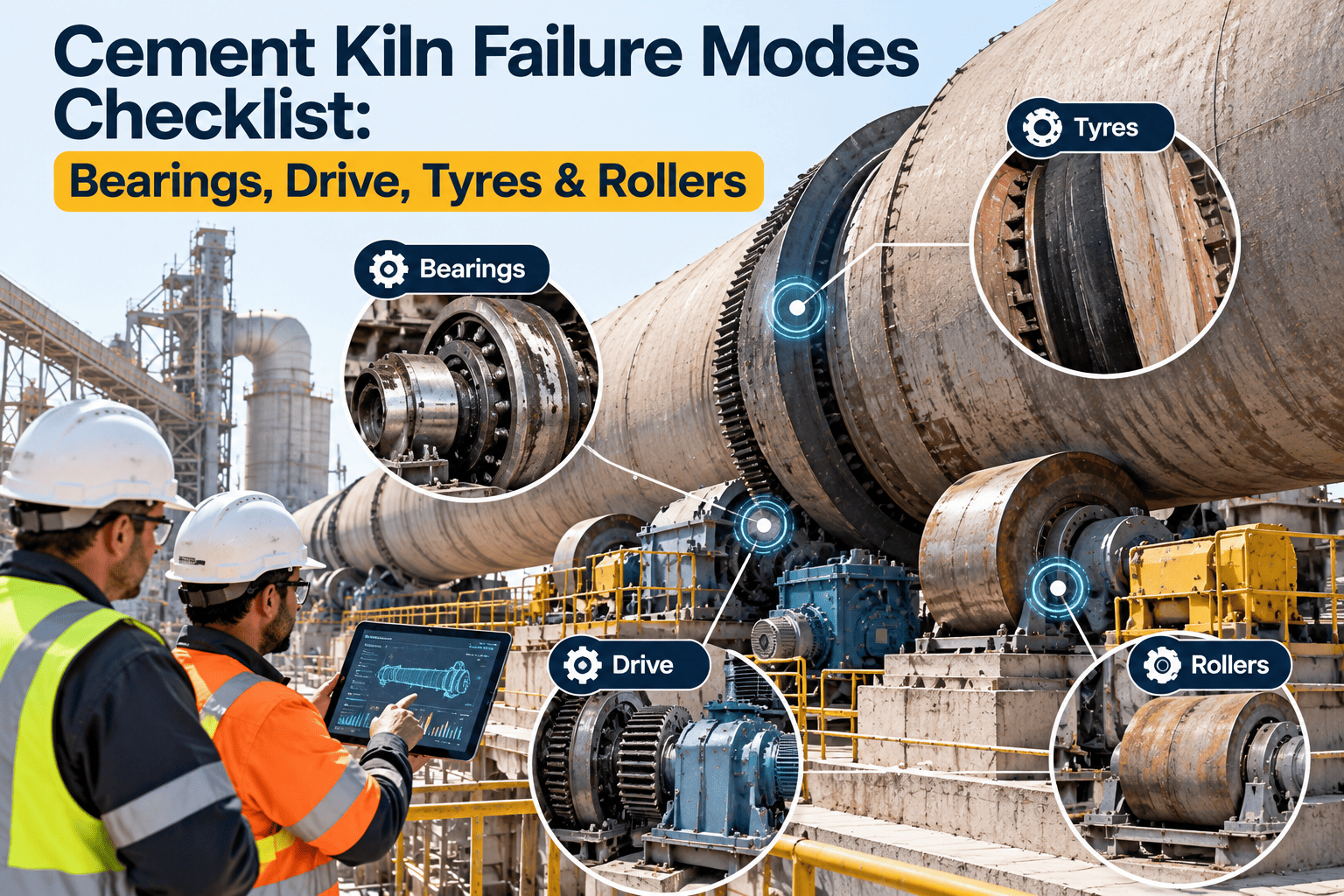
FMEA in a cement plant context goes beyond generic equipment analysis. The operating environment — high dust loading, sustained thermal cycling, long run hours between planned shutdowns — creates failure mode patterns that differ from the same equipment class in lighter-duty applications. Kiln trunnion bearings operate under continuous load at very low rotational speed with process temperature variation driving lubricant viscosity changes across shifts. The failure mode signature and detection lead time for these assets requires plant-specific baseline data, not OEM generic limits. Oxmaint's FMEA templates are pre-populated with cement-industry failure mode libraries, giving reliability engineers a validated starting point they refine to their specific equipment rather than building from a blank sheet.
| Asset | Function | Failure Mode | Failure Effect | Severity | Maintenance Task | Interval / Trigger |
|---|---|---|---|---|---|---|
| Kiln Trunnion Bearing | Support kiln shell rotation without excess friction | Bearing inner race fatigue spall | Unplanned kiln stop. 8–14 hr repair. $180K+ production loss. | Critical | Continuous vibration monitoring + oil analysis | Continuous / Monthly oil |
| Kiln Drive Gearbox | Transmit motor torque to kiln girth gear | Gear tooth surface fatigue | Gearbox seizure. Extended kiln outage. High replacement cost. | Critical | Vibration spectrum analysis + oil particle count | Monthly vibration / Quarterly oil |
| Kiln Girth Gear | Transfer drive torque around kiln shell circumference | Tooth flank wear — abrasive | Accelerating wear to failure. $500K+ replacement cost. | Critical | Backlash measurement + visual inspection | Monthly measurement |
| Preheater ID Fan | Maintain draft through preheater tower | Impeller blade erosion — abrasive dust | Reduced draft. Kiln process instability. Unplanned stop. | High | Vibration monitoring for imbalance onset | Weekly vibration check |
| Ball Mill Trunnion | Support mill shell rotation on bearing journal | Journal surface scoring | Bearing failure. Mill stop. 12–20 hr repair. | High | Oil analysis for metal particles + viscosity | Quarterly oil analysis |
| Clinker Cooler Grate | Cool clinker through controlled air flow | Grate segment thermal fatigue crack | Hot clinker bypass. Cooler efficiency loss. Kiln process impact. | High | Thermal imaging during shutdown inspection | Monthly thermal survey |
| VRM Main Gearbox | Reduce motor speed and multiply torque to grinding table | Planetary gear bearing seizure | Mill trip. Cement production stop. 48–72 hr repair. | High | Oil analysis + vibration on output shaft | Monthly vibration / Quarterly oil |
| Preheater Cyclone | Separate raw meal from process gas | Inlet blockage — material buildup | Process disruption. Emergency clearance. Kiln instability. | Medium | Thermal imaging of cyclone body and riser | Weekly thermal scan |
RCM Failure Mode Classification: Maintenance Task Selection Logic
RCM uses failure mode consequence classification to determine whether a proactive task is warranted and, if so, which type. The decision logic below maps consequence categories to task types for cement plant application.
The most important — and most frequently misapplied — distinction in cement plant RCM is between hidden and evident failures. A hidden failure is not apparent during normal operation and only becomes visible when a second failure occurs or during a specific inspection. The emergency lubrication pump on a kiln trunnion bearing circuit is a classic example: if that pump fails undetected, the plant discovers it has two failed systems simultaneously when the primary lubrication system fails and the backup is needed. Failure-finding tasks at defined intervals are the correct RCM response to hidden failures — and they are often absent from calendar-based PM schedules that focus on degradation management rather than functional verification. Getting this distinction right is one of the highest-value outputs of a structured cement plant RCM programme.
| Consequence Category | Definition in Cement Plant Context | Maintenance Task Type | Example Assets |
|---|---|---|---|
| Safety / Environmental | Failure creates risk of injury, fatality, or environmental breach regardless of operating context | Scheduled restoration or discard task mandatory. No run-to-failure permitted. | Kiln burner fuel valve, high-pressure hydraulic lines, emissions monitoring sensors |
| Operational — Hidden | Failure is not evident during normal operation. Only revealed when another failure occurs or during inspection | Failure-finding task at defined interval to verify protective function is operational | Kiln shell thermal alarm, emergency lubrication pump, fire suppression triggers |
| Operational — Evident | Failure directly and immediately impacts production output, quality, or equipment capability | Condition monitoring task or scheduled restoration if P-F interval permits. Run-to-failure only if cost acceptable. | Kiln trunnion bearings, girth gear, ID fan, clinker cooler grates, VRM gearbox |
| Non-Operational | Failure has no direct production or safety consequence. Only maintenance cost is affected. | Run-to-failure is default unless scheduled task cost is lower than reactive cost at expected failure frequency | Non-critical conveyor drives, secondary instrumentation, low-duty pumps |
Implementing RCM in a Cement Plant: Four Phases
A cement plant RCM programme does not need to cover every asset before it delivers value. The most effective implementations start with a focused analysis of the 15 to 25 assets responsible for the majority of unplanned downtime — typically the rotary kiln system, the primary grinding circuit, and the preheater fan — and expand outward as the reliability team builds analytical capability and the CMMS accumulates failure history data that makes subsequent FMEA work faster and more accurate.
Plants that treat RCM as a one-time project rather than a living maintenance strategy typically see initial availability improvements plateau within 18 months as equipment condition, operating patterns, and production demands shift away from the assumptions the original analysis was built on. The review cycle in Phase 4 is what separates a sustained RCM programme from a documentation exercise.
Frequently Asked Questions
QHow long does a full RCM implementation take for a cement plant?
QWhat is the difference between RCM and a standard FMEA?
QCan RCM be applied to an existing time-based PM schedule or does it require starting from scratch?
QHow does Oxmaint connect FMEA records to live maintenance execution?
Continue Reading
RCM intersects with CMMS platform capability, condition monitoring data quality, workforce knowledge retention, and the maintenance strategy benchmarks that peer plants are achieving. The resources below address each of these topics in the context of cement plant operations. The TPM article is particularly relevant for plants deciding between RCM and TPM — the two methodologies address different dimensions of maintenance performance and are most powerful when deployed together rather than as alternatives.
Deploy RCM-Driven Maintenance Across Your Cement Plant
Oxmaint provides FMEA templates, failure mode analytics, and PM schedule builders pre-configured for cement plant asset classes — connecting every RCM maintenance decision to live work order execution and failure mode tracking. Book a 30-minute demo to see the RCM tools configured for your plant's critical assets.