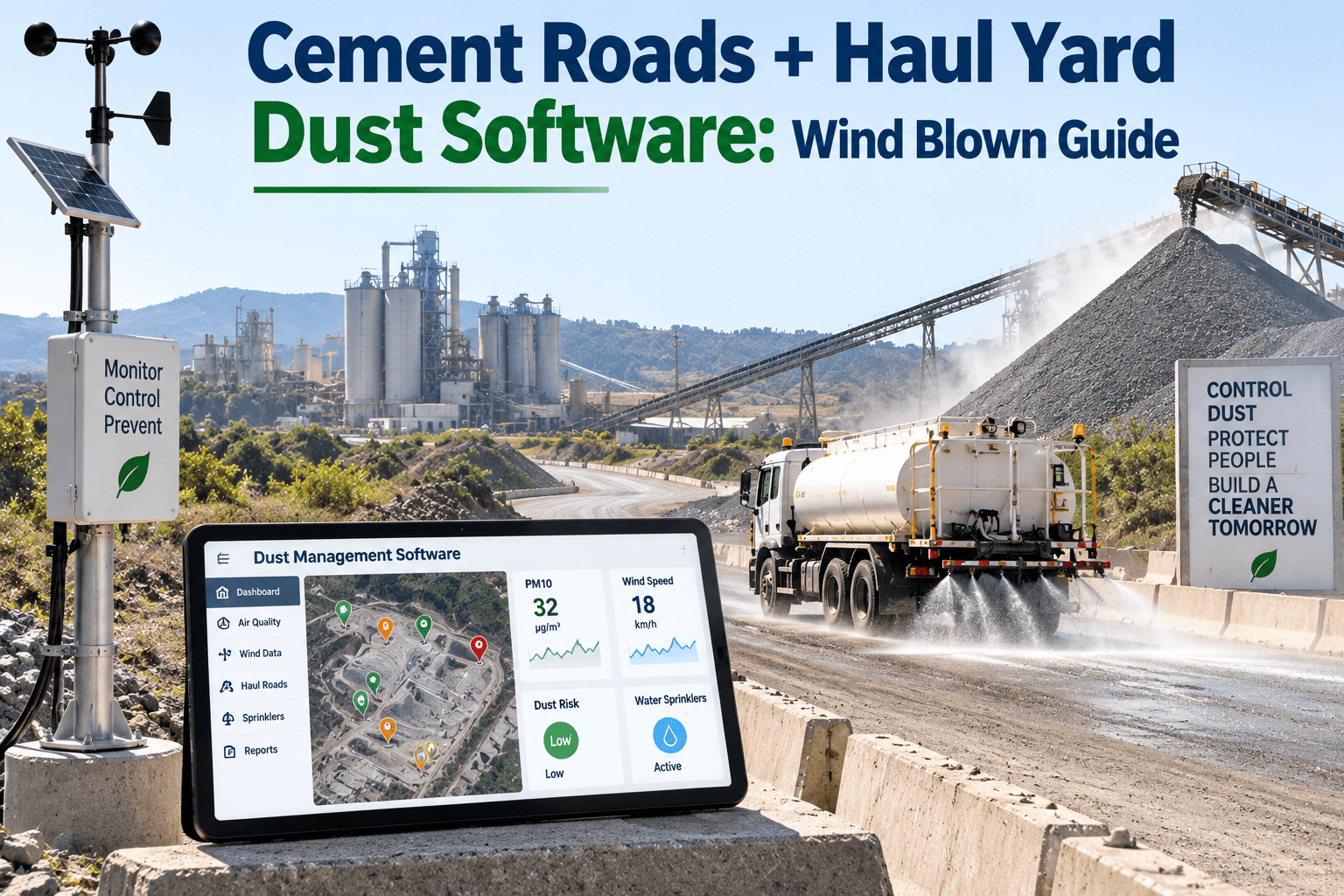
Cement Roads + Haul Yard Dust Software: Wind Blown Guide

By Corin Hale on September 4, 2026

cement-roads-plus-haul-yard-dust-software-wind-blown-guide

At most cement plants, the tallest smokestack is not the biggest dust problem. The haul roads are. Every loaded truck rolling across an unpaved quarry road grinds fines into the air, and on a dry, windy afternoon that fugitive dust drifts over the fenceline, coats equipment, and pushes silica exposure past legal limits. Haul roads are consistently among the largest sources of fugitive dust at industrial sites, yet most plants still manage watering and sweeping on memory and radio calls. This guide covers where the dust comes from, what the rules actually require, and how a CMMS turns scattered dust control into a scheduled, defensible program. Start managing your dust control program with OxMaint free and put every water truck route and sweep on a trackable schedule.

Cement Plants  ·  Fugitive Dust  ·  Haul Road Control 2026
Cement Roads and Haul Yard Dust Software
Track water truck routes, sweeping frequency, and chemical suppressant use across every unpaved plant road — so wind-blown dust stops before it becomes a violation, a health hazard, or a neighbor complaint.
150 µg/m³
PM10 24-hour ambient air limit under NAAQS
50 µg/m³
OSHA respirable silica limit, 8-hour average
$25K–$50K
Per-day penalty range for permit violations
Start Here

Why Haul Road Dust Is the Hardest to Control

Stack emissions leave through one point and are filtered by baghouses and precipitators. Fugitive dust does the opposite: it escapes from dozens of open surfaces at once — haul roads, service roads, the yard, stockpiles, and transfer points — and regulators still expect all of it to be controlled. Unlike a chimney, a haul road has no filter. The only thing standing between a loaded truck and a dust cloud is how recently that road was watered, swept, or treated.

That makes dust control a timing problem, not an equipment problem. A road watered at 7 a.m. can be bone dry by noon in summer heat. A suppressant applied last month may have worn off in the heavily trafficked sections while still holding on the quiet ones. When the schedule lives in someone's head, gaps open silently — and the first sign of a gap is often a visible plume, a complaint, or an inspector with a stopwatch running a Method 9 opacity read.

Where Fugitive Dust Escapes on a Cement Plant Site
Unpaved Haul Roads
Highest volume — heavy trucks, continuous traffic
Quarry Service Roads
Mixed traffic, long exposed runs
Storage Piles
Wind erosion from exposed stockpile faces
Yard and Loadout
Spillage, tracking, intermittent bursts
Transfer Points
Material drop during handling
Paved Roads
Track-out fines, controllable by sweeping
The Wind Factor

Why Wind Turns a Minor Problem Into a Major One

Traffic lifts dust off the road, but wind decides where it goes and how far. A haul road that looks controlled on a still morning can generate a visible plume that crosses the fenceline the moment the afternoon breeze picks up. Wind-blown dust is what turns an internal operational issue into a neighbor complaint, a regulatory event, and a community air-quality concern all at once — because the dust no longer stays on your property.

This is why the best dust programs are weather-aware rather than calendar-only. On a calm, humid day a single watering pass may hold a road all shift. On a hot, dry, windy day the same road may need several passes plus a suppressant top-up, and exposed stockpiles may need sealant or windbreak checks that a still day would never require. A program that waters every road identically regardless of conditions wastes water on the days it is not needed and falls short on the days it matters most.

Wind also interacts with the finest, most dangerous particles. The respirable fraction — the PM2.5 and PM10 particles small enough to reach deep into the lungs — is exactly the material wind carries furthest. So the days with the highest drift are also the days with the highest exposure risk for drivers, grader operators, and anyone downwind. Tying watering intensity and suppressant reapplication to weather conditions is not just good housekeeping; it is the difference between a road that dusts and one that does not on the days that count.

The practical rule: control effort should rise with heat, dryness, wind, and traffic — the four variables that multiply dust. A program that cannot flex with those conditions is really just hoping the weather cooperates.
The Toolkit

The Three Levers of Road Dust Control

Effective dust control on unpaved plant roads comes down to three levers, each with a different cost, service life, and reapplication rhythm. The art is not choosing one — it is applying the right mix to the right road at the right frequency, then proving you did it. These are the levers a control program schedules and tracks.

Water Application
The fastest, cheapest lever. Water trucks with spray nozzles bind fines and settle dust on contact. The catch is longevity — water evaporates fast in heat and needs frequent reapplication, sometimes multiple passes per shift on the busiest sections.
Service lifeHours
Best forActive, high-traffic runs
Chemical Suppressants
Chloride-based, polymer, and organic suppressants bind particles far longer than water and cut watering frequency. They pay off on high-traffic haul routes but carry corrosion and runoff considerations that demand tracking of what was applied, where, and when.
Service lifeWeeks to months
Best forHeavy haul routes
Sweeping and Speed
On paved surfaces, scheduled sweeping removes track-out fines before wheels lift them. Pairing pre-wetting with sweeping is far more effective than dry sweeping alone. Speed limits — 5 mph unpaved, 10 mph paved — cut dispersion at almost no cost.
Service lifePer cycle
Best forPaved roads and yard
Put Every Pass on the Calendar
Schedule Water Trucks, Sweeps, and Suppressant Runs in One Place
OxMaint turns dust control into recurring, auditable work orders. Assign water truck routes by road and shift, set sweeping frequencies, log every suppressant application with product and location, and generate the records an inspector asks for — all from a mobile app that works on the quarry deck.
What the Rules Require

The Compliance Picture Behind Every Dust Cloud

Dust is not only an operational nuisance — it is a regulated emission with real teeth. A mid-size cement plant running two kilns typically faces well over a dozen formal inspections a year across federal, state, and internal frameworks, and haul roads sit squarely inside several of them. Missing documentation for any one regime can turn a routine visit into a citation. Here is how the layers stack up.

EPA NAAQS
Ambient PM10 may not exceed 150 µg/m³ over 24 hours; PM2.5 limits are tighter still. Plants in nonattainment areas face stricter permitting and must show ongoing progress.
OSHA Silica
Respirable crystalline silica carries a permissible exposure limit of 50 µg/m³ over an 8-hour shift, with a written control plan required. Road dust at cement sites is silica-bearing.
MSHA Part 56
Integrated plants with captive quarries must meet mine-safety rules covering haul road standards, mobile equipment inspections, and respirable dust for the mining fleet.
Dust Management Plans
Title V air permits and site dust plans require documented control of fugitive emissions from stockpiles and roads, with visual emissions checks like EPA Method 9 or 22.

The stakes go beyond fines. Cement dust is silica-bearing, and the respirable fraction that road traffic kicks up drives long-term health risk for the people who work around it. Truck drivers and road grader operators at surface operations have historically shown some of the highest silica overexposure rates on site, because they spend their entire shift inside the dust cloud their own vehicles create. Ambient monitoring near cement plants has recorded PM10 concentrations many times above guideline levels. Controlling road dust is therefore a worker-protection measure as much as a compliance one — every pass that keeps a road damp is a pass that keeps respirable silica out of a driver's lungs.

Inspectors do not accept verbal assurances. They ask for records: when each road was watered, how often it was swept, what suppressant was applied, and the exposure data behind it. A control program that cannot produce those records is one plume away from a penalty.
The Real Problem

Why Spreadsheets and Radio Calls Fail

Most plants already know what to do. What breaks down is the follow-through and the proof. Dust control is rarely one person's dedicated job — it is squeezed in around a dozen other priorities, handed off between shifts, and tracked in whatever tool is closest to hand. When it lives in a paper log or a supervisor's memory, three failures repeat themselves across the industry, and each one shows up at the worst possible moment: on the hot windy afternoon when a plume forms, or the morning an inspector arrives asking for records.

01
Missed Passes
A water truck driver calls in sick, a route gets skipped, and no system flags the gap. The road dries out and dusts over before anyone notices the pass never happened.
02
No Proof
The watering happened, but there is no timestamped record. When an inspector asks for the last 30 days of road treatment, the answer is a shrug — and a shrug reads as non-compliance.
03
Blind Reaction
Without dust readings tied to action, teams water everything the same way — over-treating quiet roads while a busy haul route dusts up. Effort goes where it is easy, not where it is needed.
The OxMaint Approach

How a CMMS Runs Dust Control as a Program

OxMaint treats dust control the way it treats any critical maintenance task: as scheduled, assignable, trackable work with a permanent record behind it. Instead of hoping the watering happened, the plant knows it did — and can prove it in minutes. The platform connects the field crew, the schedule, and the compliance file into one loop.

Route Scheduling
Assign water truck routes and sweeping cycles by road and shift as recurring work orders. Skipped passes surface immediately instead of hiding until the road dusts over.
Suppressant Logging
Record every chemical application with product, location, and date, so reapplication timing is driven by service life — not guesswork — and runoff records stay audit-ready.
Sensor Triggers
IoT PM10, PM2.5, and silica readings feed thresholds that auto-generate a corrective work order the moment dust crosses the line, with the sensor data logged for compliance.
Mobile and Offline
Crews close out routes from the quarry deck with QR asset tags, even without signal. The record syncs the moment they are back in range.
Digital Inspections
Run visual emissions checks and mobile equipment pre-shift inspections as structured digital forms, building the paper trail MSHA and OSHA expect.

The result is a shift in posture from reactive to proactive. Instead of scrambling when a plume appears or an inspector arrives, the plant runs dust control as a quiet, continuous background process — routes assigned, passes confirmed, applications logged, and the whole record one export away. That reliability is what protects the air permit, the worker exposure numbers, and the relationship with the community around the fenceline, all at the same time. Dust control stops being the thing that gets forgotten on a busy day and becomes the thing that simply runs.

Quick Reference

Dust Control Playbook by Surface

Surface Primary Lever Typical Frequency Speed Limit
Unpaved haul road Water + suppressant Multiple passes per shift 5 mph
Quarry service road Water + suppressant Daily, weather-driven 5 mph
Paved plant road Sweep + pre-wet Weekly or as needed 10 mph
Yard and loadout Water + cleanup Per shift 10 mph
Storage piles Sealant + windbreak Periodic + wind events N/A
Frequently Asked Questions

Haul Road Dust Control — Common Questions

How often should cement plant haul roads be watered?
It depends on traffic, heat, and wind — busy summer routes may need multiple passes per shift, while treated roads hold longer. The key is a schedule driven by conditions, not habit. Start a free trial to set condition-based watering routes.
Is water or chemical suppressant better for haul roads?
Water is cheap and instant but evaporates in hours; suppressants bind fines for weeks and cut watering frequency on heavy routes. Most plants use both, matched to each road. Book a demo to see suppressant tracking in action.
What records do inspectors want for road dust control?
They want timestamped proof of watering, sweeping, suppressant applications, and any exposure readings. Verbal assurances are not enough. Start a free trial to generate audit-ready dust control records in minutes.
Can OxMaint tie dust sensors to work orders?
Yes. IoT PM10, PM2.5, and silica readings feed thresholds that automatically open a corrective work order when dust crosses the limit, logging the data for compliance. Book a demo to see the sensor-to-action loop live.
Does it work in the quarry without internet?
Yes. The mobile app runs offline with QR asset tags, so crews close out routes on the quarry deck and records sync once back in range. Start a free trial to test the offline field workflow.
Control the Dust Before It Controls Your Inspection
Cement Plants Using OxMaint Prove Every Water Truck Pass and Every Sweep
Water truck routes. Sweeping cycles. Suppressant logs. Sensor-triggered work orders. All in one CMMS that keeps unpaved roads under control and turns audit day into a printout — not a panic.

Share This Story, Choose Your Platform!