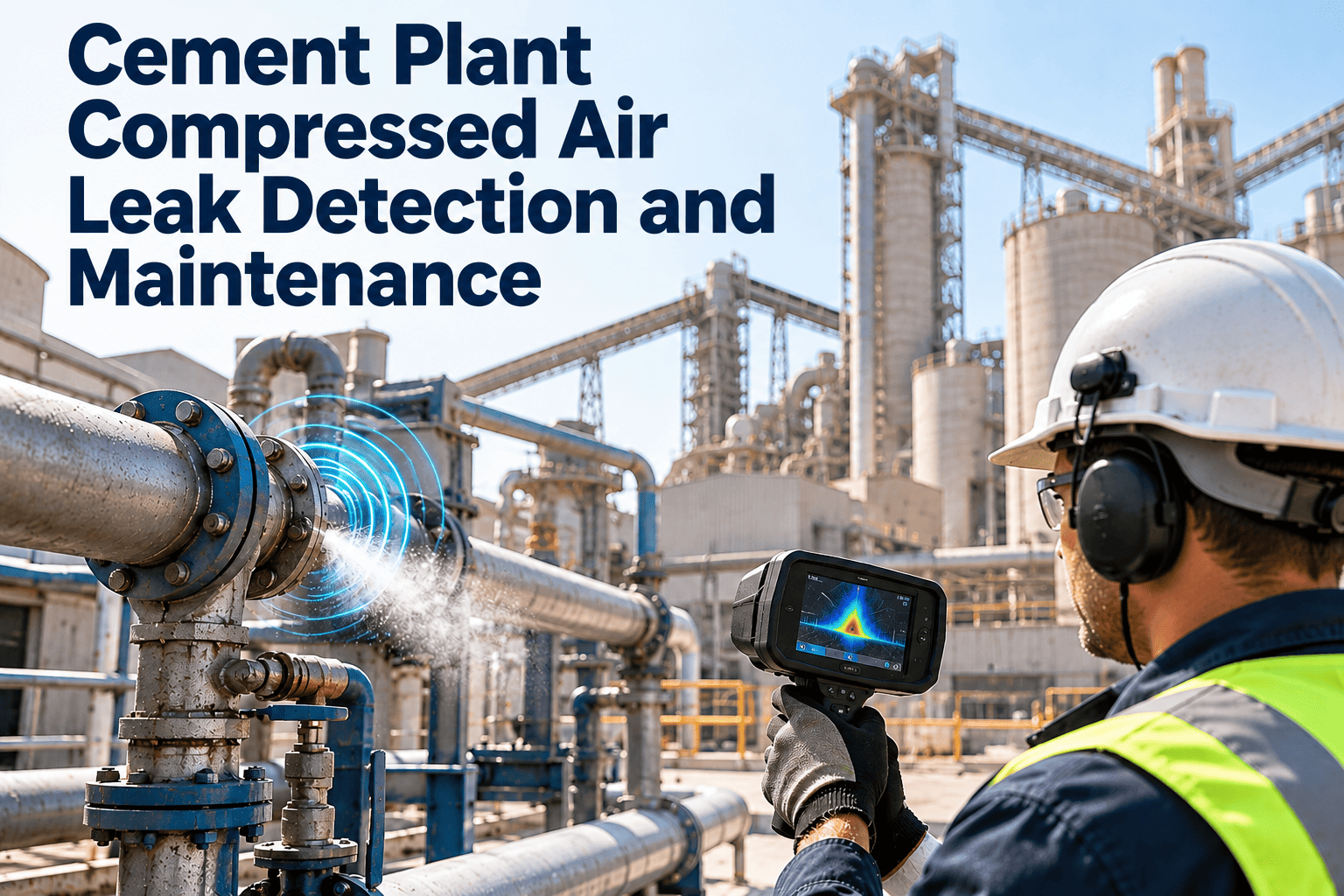
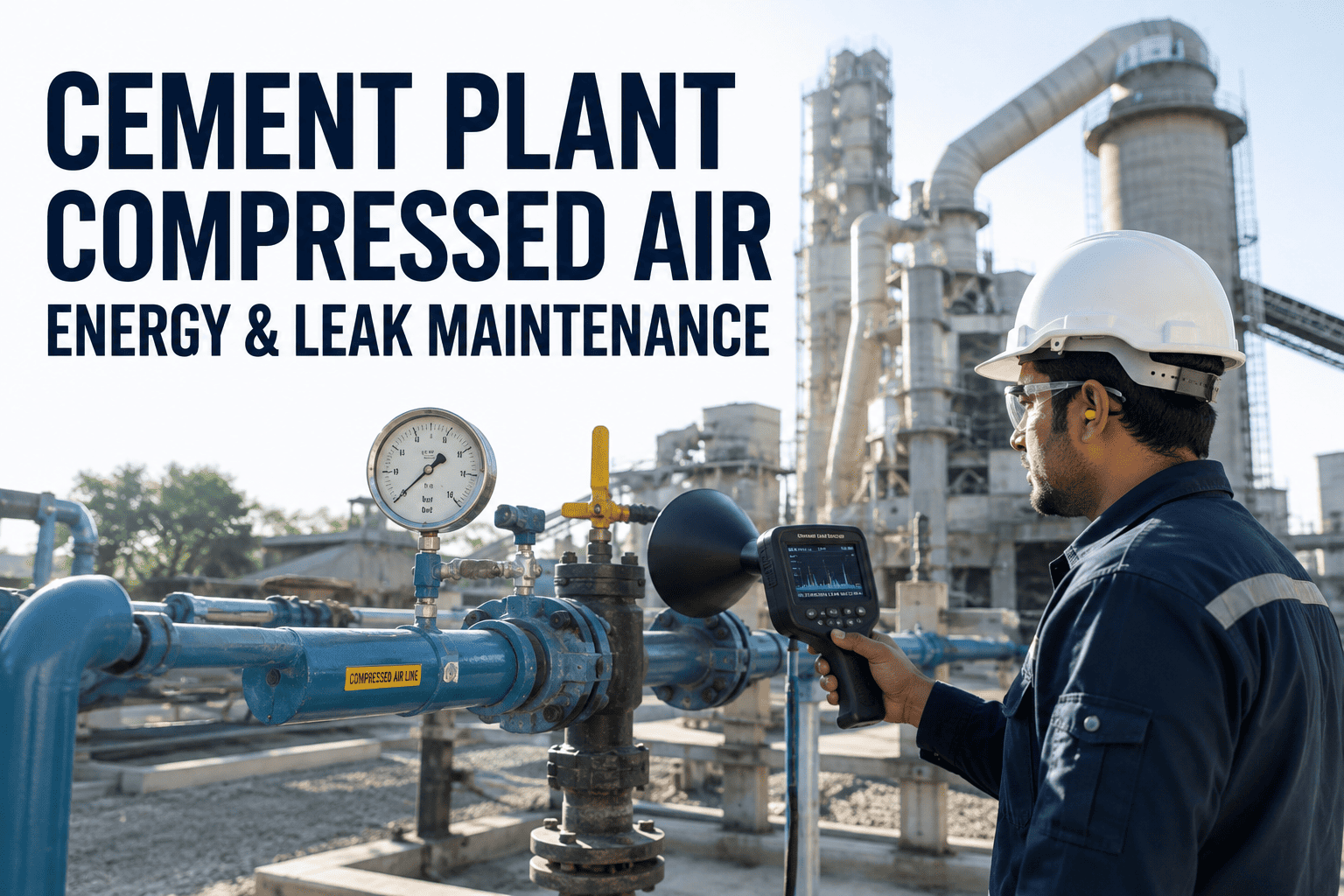
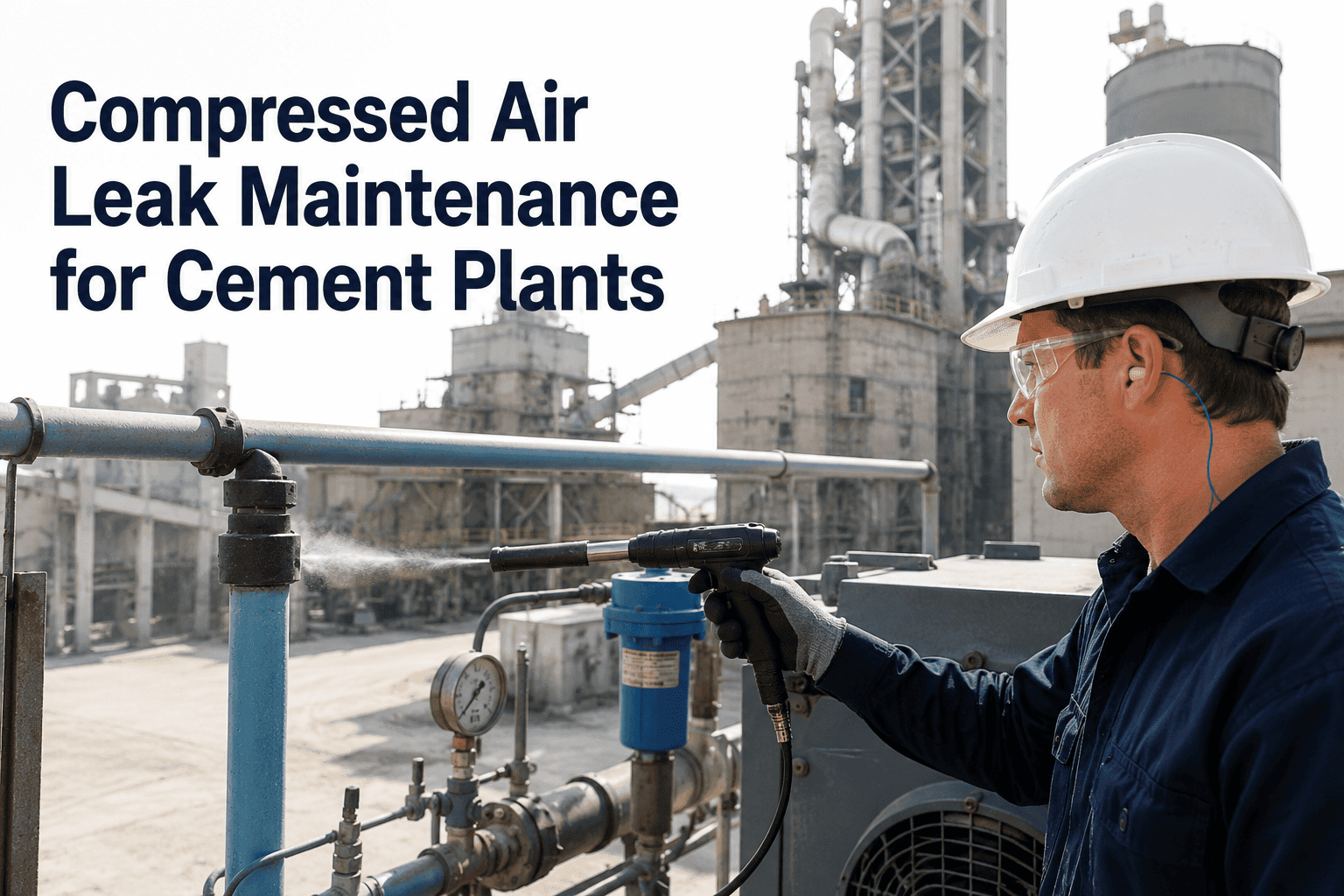
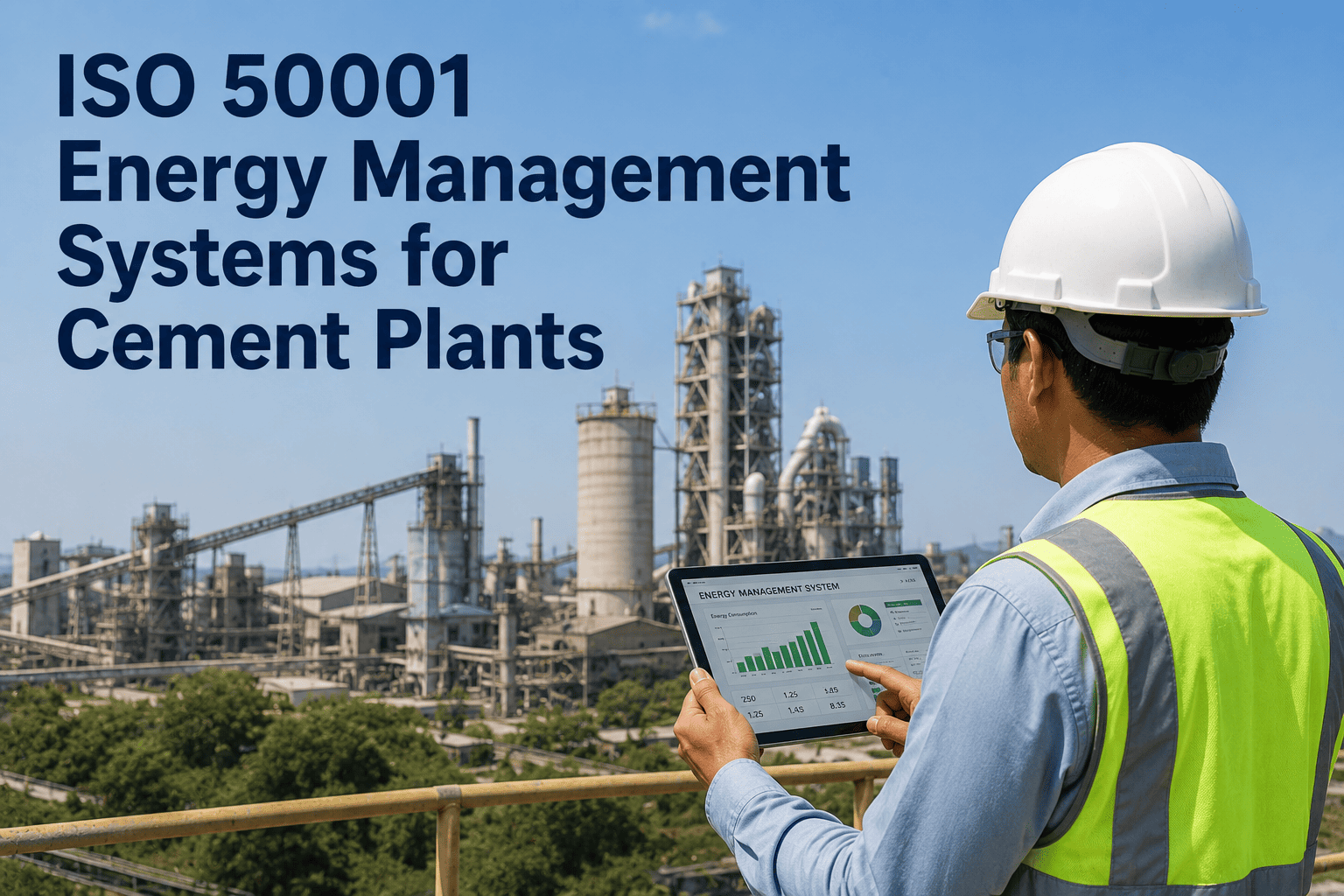
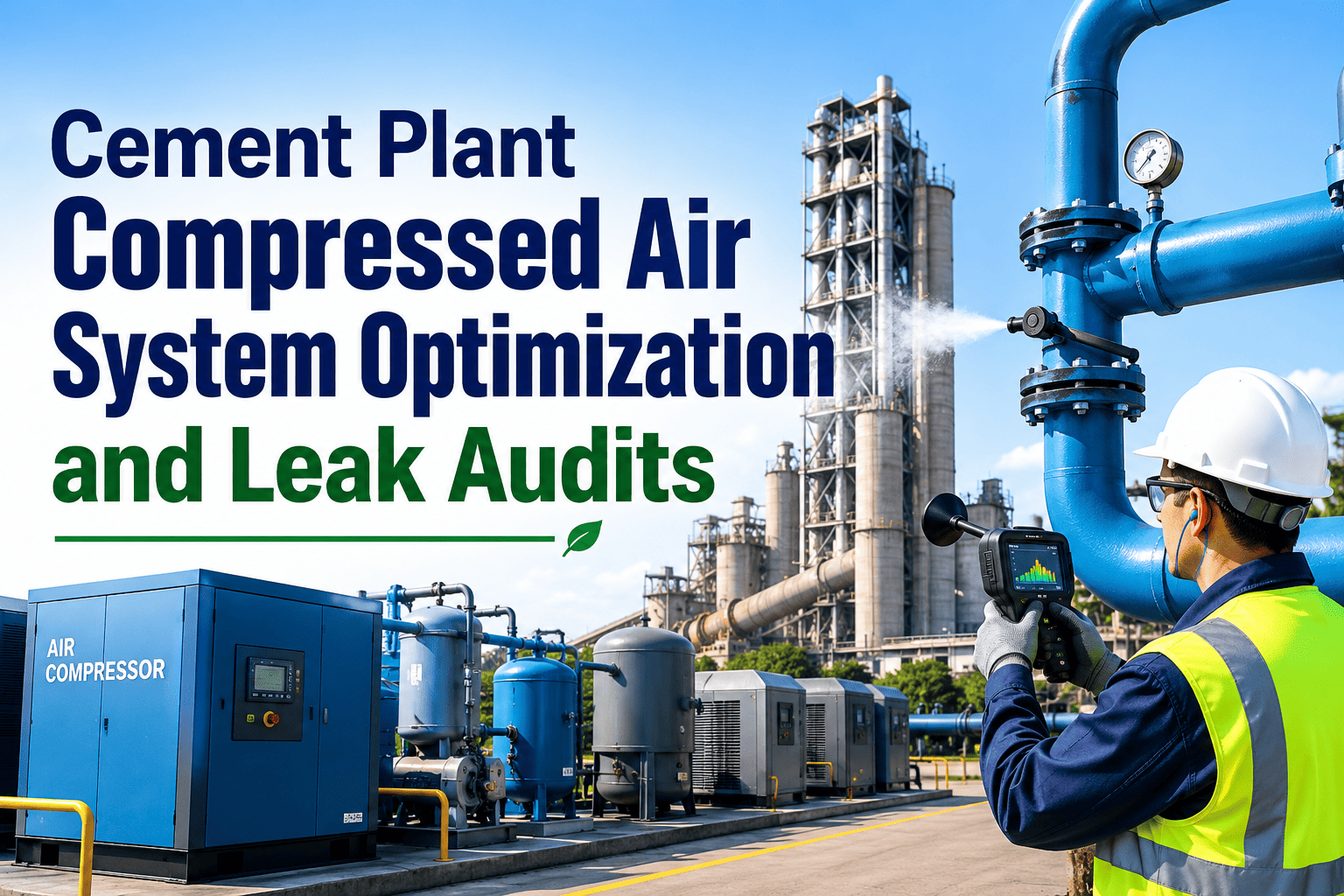
Compressed air is the invisible utility consuming 8–12% of total electrical energy in every cement plant — yet most plants have no real-time visibility into how much of that energy is escaping through leaks, over-pressurised headers, and mismatched end-use demand. Industry surveys consistently find that 25–40% of all compressed air generated in cement plants is lost to undetected leaks before it reaches a single pneumatic actuator, bag filter solenoid, or air slide. On a 3,500 TPD plant running a 1.5 MW compressor fleet, that leakage alone represents ₹80–120 lakh in wasted electricity annually. A structured compressed air optimisation programme — built on regular audits, automated monitoring, and preventive maintenance scheduling — eliminates that waste systematically, delivering measurable cost reductions within 90 days of implementation. Book a demo to see how OxMaint structures compressed air PM and energy monitoring across your plant.
The Energy Cost of Unmanaged Compressed Air in Cement Plants
8–12%
Of total plant electricity consumed by compressed air systems in cement manufacturing
25–40%
Typical compressed air leakage in unaudited cement plants — energy generated but never used
30%
Average energy cost reduction achievable with a structured compressed air optimisation programme
7% / bar
Compressor energy saving for every 1 bar reduction in system operating pressure
Compliance Standards by Region: Compressed Air and Energy Management
Compressed air system management intersects with energy efficiency mandates, equipment safety regulations, and environmental reporting requirements that vary by region. OxMaint automates inspection scheduling, energy monitoring documentation, and compliance audit trails — eliminating manual tracking and missed statutory obligations.
| Region |
Key Frameworks |
OxMaint Coverage |
| India |
BEE Energy Audit Requirements, Factories Act 1948, CPCB Norms |
Energy monitoring dashboards, compressor PM scheduling, statutory inspection calendars |
| USA |
DOE Compressed Air Challenge, OSHA 29 CFR 1910.169, EPA Energy Star |
Digital audit trail exports, safety inspection scheduling, LOTO work order controls |
| Germany |
DIN ISO 11011, BetrSichV, EnMS ISO 50001 |
Energy management record archiving, mandatory test documentation, certification tracking |
| UAE |
Civil Defence codes, DEWA efficiency standards, Estidama |
Real-time energy monitoring, multi-site compliance dashboards, digital inspection records |
| UK |
ESOS Energy Savings Opportunity Scheme, PSSR 2000, HSE regulations |
Pressure system inspection scheduling, ESOS audit documentation, compliance exports |
| Canada |
NRCan Energy Efficiency Act, CSA B51, Provincial OH&S |
Multi-site energy compliance dashboards, centralised inspection record management |
OxMaint automates compressor inspection scheduling, energy monitoring records, and compliance audit trails across every region listed above — giving your team accurate documentation without manual calendar management.
What Is Compressed Air System Optimisation in Cement Plants?
Compressed air system optimisation is the structured approach to reducing the total energy cost of generating, distributing, and consuming compressed air across a cement plant — while maintaining the pressure and flow reliability that pneumatic equipment demands. It moves plants from a "generate more" response to demand shortfalls, toward a "eliminate waste first" strategy where leaks are detected and repaired, pressure is set to the minimum viable level, compressors are staged efficiently, and end-use equipment is audited for genuine demand. Book a demo to see OxMaint's compressed air monitoring and PM framework running on live plant data.
PM
Preventive Maintenance
Systematic, schedule-driven maintenance for compressors, dryers, filters, and distribution hardware — replacing reactive breakdowns with planned interventions. Service intervals, oil changes, separator replacements, and valve inspections driven by running hours and condition data — not failure events.
LM
Leak Detection & Management
Ultrasonic leak surveys conducted quarterly across the full distribution network. Every leak tagged, quantified in L/min, and logged against a repair work order in OxMaint. Leakage rate tracked as a KPI — with target below 10% of total generation vs. the industry average of 25–40%.
PO
Pressure Optimisation
System pressure set to the minimum required by the highest-demand end-use point — not to the maximum compressor rating. Every 1 bar reduction saves 7% compressor energy. Pressure profiling across the distribution network identifies dead-end headers, undersized pipes, and excessive drops consuming unnecessary generation capacity.
EM
Energy Monitoring
Real-time kWh metering at compressor room level and sub-metering at key branch headers. Specific energy (kWh per Nm³ of air delivered) tracked against benchmarks. Trend deviations trigger automated alerts — catching compressor efficiency degradation weeks before it manifests as pressure shortfall or failure.
See OxMaint Managing Compressed Air Systems Live
Our team will walk you through a live demo with actual cement plant compressor PM schedules, leak management workflows, and energy monitoring dashboards — in under 30 minutes.
Four Compressed Air Problems Costing Cement Plants Millions Annually
The same failure patterns repeat across cement plant compressed air systems — regardless of plant capacity, geography, or equipment brand. These four problems account for the majority of avoidable energy waste and unplanned compressor downtime in the industry.
01
Undetected Leakage Across the Distribution Network
Joints, valves, flexible hoses, and pneumatic actuator seals develop leaks gradually — each individually small, collectively catastrophic. A 3mm leak at 7 bar wastes 33 L/min continuously. Plants typically run 50–150 active leaks simultaneously, consuming 25–40% of all compressed air generated. Without ultrasonic surveys on a structured schedule, leaks compound unnoticed for years.
02
Over-Pressurised Systems Running at Maximum Rating
Most cement plant compressed air headers run at 7–8 bar because that is the compressor's rated output — not because any end-use equipment demands it. Air slides require 0.5 bar. Bag filter solenoids need 4–5 bar. Pneumatic tools need 6 bar maximum. Running everything at 7.5 bar means the system permanently wastes 10–20% more energy than the process requires.
03
Reactive Compressor Maintenance and Unplanned Stops
Compressor maintenance is frequently deferred until breakdown — oil separator replacement, air/oil separator element changes, after-cooler cleaning, and valve servicing all skipped until failure forces the issue. A compressor emergency stop during peak kiln operation can cascade into a kiln trip if instrument air pressure falls below the control system's minimum — a single event that costs ₹20–60 lakh in lost production.
04
No Monitoring, No Benchmarks, No Accountability
Without real-time energy metering on the compressor room and sub-metering at branch headers, there is no data to drive decisions. Plant managers cannot identify which shift is running at 35% leakage vs. 12%, cannot measure the impact of a leak repair campaign, and cannot detect a compressor drifting toward inefficiency until the electricity bill confirms what happened last month.
How OxMaint Solves Cement Plant Compressed Air Challenges
OxMaint replaces reactive compressor management with a four-stage framework that structures every decision — from daily maintenance tasks to annual energy audits. Each stage compounds value as your system data accumulates. Book a demo to walk through the full framework with your plant's compressed air asset classes.
1
Register Every Compressed Air Asset in a Digital Hierarchy
Build a complete asset register covering every compressor, dryer, filter station, pressure regulator, distribution header, and end-use zone. OEM specifications, installation dates, service life ratings, and linked spare parts catalogued at each node. QR scanning gives technicians instant mobile access to any asset's full service history, PM schedule, and previous inspection findings — from the compressor room floor.
2
Automate Compressor PM Scheduling by Running Hours
Replace manual service calendars with running-hours-based PM triggers tied directly to each compressor's actual operating data. Work orders for oil changes, separator element replacements, valve inspections, belt checks, and after-cooler cleaning are generated automatically — assigned to named technicians, tracked through completion, and closed with parts consumption logged against the asset record. PM compliance tracked against targets in real time.
3
Run Structured Leak Detection and Repair Campaigns
OxMaint structures quarterly ultrasonic leak surveys as recurring work order packages — covering the full distribution network systematically. Every detected leak is logged with location, estimated flow (L/min), priority classification, and a linked repair work order. Leakage rate is tracked as a plant KPI across surveys — measuring the cumulative impact of each repair campaign and driving accountability for closure rates across maintenance teams.
4
Monitor Energy and Pressure in Real Time — Alert on Deviation
Integrate compressor room kWh meters, flow meters, and pressure transmitters directly to OxMaint's energy monitoring module. Specific energy consumption (kWh/Nm³), system pressure at key distribution points, and inter-stage temperatures are trended against baselines. When measurements drift — a compressor drawing 8% more current at the same delivery pressure, or a header losing 0.5 bar across a previously clear section — automated alerts trigger investigation before the deviation becomes a failure.
Ready to Cut Your Compressed Air Energy Bill by 30%?
OxMaint deploys across a cement plant's compressed air system in under 60 days. Start with the compressor asset register, activate PM scheduling, and begin building the energy data that drives monthly cost reductions. Book a personalised 30-minute demo — no sales pitch, just your system data and our platform.
OxMaint Platform: Purpose-Built for Compressed Air Management in Cement Plants
Each module addresses a specific failure point in cement plant compressed air operations. Together they form a closed-loop system where every PM work order feeds compressor condition data, every energy reading refines the maintenance schedule, and every leak survey result drives accountable repair closure. Book a demo to walk through each module with cement plant compressed air data.
AR
Compressed Air Asset Register
Full digital register from compressor to end-use zone. OEM documentation, running hours, service history, and warranty alerts on every asset. QR scanning enables mobile field access in under 30 seconds.
PM
Hours-Based PM Scheduling
Condition-triggered and running-hours-based PM for compressors, dryers, and filters. Automated work order generation eliminates the manual follow-up that causes deferred maintenance and compressor failures.
LK
Leak Survey Management
Structured quarterly leak detection workflows with per-leak tagging, flow quantification, priority classification, and linked repair work orders. Leakage rate KPI tracked across campaigns.
EM
Energy Monitoring Integration
Real-time kWh, flow, and pressure data from compressor room meters fed directly to OxMaint dashboards. Specific energy consumption trended against benchmarks — alerts triggered on deviation before efficiency loss compounds.
WO
Work Order Management
Full work order lifecycle from PM generation to closure. Labour hours, parts consumed, and repair costs logged against each compressor asset — building the maintenance history that drives accurate service interval optimisation.
MS
Multi-Site Energy Reporting
Portfolio-level dashboards consolidating compressed air energy KPIs, leakage rates, and PM compliance across multiple cement plant sites — giving operations leadership a single performance view without site-by-site reporting cycles.
Reactive vs. Optimised: The Performance Gap in Cement Plant Compressed Air
The performance gap between unmanaged and optimised compressed air systems compounds every operating year. These six factors quantify what structured management delivers — and what reactive programmes cost cement plants.
System Leakage Rate
Reactive Management
25–40% of total generation lost. No survey schedule, leaks accumulate for years undetected and unrepaired.
With OxMaint
Below 10% leakage rate sustained. Quarterly surveys and accountable repair closure keeps the network tight year-round.
Compressor Availability
Reactive Management
78–88% availability. Deferred service causes unplanned compressor trips — some cascading into kiln instrument air failures.
With OxMaint
95–99% availability. Hours-based PM eliminates the deferred service that causes most compressor failures.
System Operating Pressure
Reactive Management
Running at maximum compressor rating (7–8 bar) regardless of actual end-use demand — permanently over-pressurised.
With OxMaint
Pressure set to minimum viable for demand profile. Every 1 bar reduction saves 7% compressor energy — sustained annually.
Energy Cost Visibility
Reactive Management
No sub-metering. Monthly electricity bill is the only indicator — 30-day lag on any deviation, no root cause data.
With OxMaint
Real-time specific energy tracking (kWh/Nm³). Deviations flagged within hours — root cause identified before the bill arrives.
Maintenance Cost Per Compressor
Reactive Management
4–5× emergency repair premium on failed components. Cascading damage when separator, valve, or bearing failures go unaddressed.
With OxMaint
Planned interventions at correct service intervals — eliminating the emergency premium and cascading damage from deferred maintenance.
Audit and Compliance Readiness
Reactive Management
Paper-based records, incomplete service histories, and no energy audit documentation — BEE or ESOS audit failures common.
With OxMaint
Digital audit trail for every inspection, PM, and energy reading. Compliance report generation in minutes — not days of manual assembly.
Compressed Air Optimisation Performance Benchmarks
These performance improvements represent average results from cement plants that transitioned from reactive compressor management to structured OxMaint-driven programmes within 18 months of deployment. Results vary by plant size, system age, and baseline leakage rate.
Reduction in system leakage rate (from 30%+ to below 10%)
72%
Compressed air energy cost reduction within 12 months
30%
PM compliance rate improvement (from ad-hoc to scheduled)
88%
Reduction in unplanned compressor stoppages
65%
Specific energy improvement (kWh per Nm³ delivered)
42%
Reduction in emergency compressor repair expenditure
55%
Your Plant's Compressed Air Baseline Starts Here
OxMaint delivers measurable compressed air energy improvements within 60–90 days of deployment. Book a 30-minute demo to map your current system baseline against these benchmarks and build a business case for your energy team.
ROI From Compressed Air Optimisation in Cement Plants
₹80–120L
Annual energy wasted per 1.5 MW compressor fleet running at 30% leakage
6–14 Mo
Typical payback period on full compressed air optimisation programme investment
4–5×
Cost premium of emergency compressor repair versus planned PM intervention
90 Days
Time to first measurable energy reduction with OxMaint compressed air management
Frequently Asked Questions: Compressed Air Optimisation in Cement Plants
QHow much compressed air leakage is typical in cement plants — and how do I measure it?
Industry benchmarks show 25–40% leakage in unaudited cement plants. The simplest measurement method is the "load/unload" test: run the plant with no production demand, time the compressor load and unload cycles, and calculate the ratio. More precisely, an ultrasonic detector survey quantifies each leak individually in L/min — total plant leakage is the sum of all detected leaks. A well-managed system should sustain leakage below 10% of total generation. OxMaint structures these surveys as recurring work order packages with per-leak logging and repair closure tracking.
QWhat are the most critical preventive maintenance tasks for cement plant compressors?
The highest-impact PM tasks are: air/oil separator element replacement (typically every 4,000–6,000 running hours), after-cooler cleaning (every 2,000 hours in dusty cement environments), inlet filter replacement (every 1,000–2,000 hours depending on ambient dust), oil change with analysis (every 2,000–4,000 hours), minimum pressure valve inspection (annually), and safety relief valve manual lift test (quarterly). In cement plants, the after-cooler cleaning interval is typically 50% shorter than OEM recommendations due to clinker dust ingress. OxMaint tracks running hours per compressor and triggers work orders automatically at each service milestone.
QCan system pressure really be reduced safely in a cement plant with multiple different users?
Yes — and it's one of the highest-return optimisation actions available. The key is a systematic end-use audit: survey every pneumatic application in the plant and document its actual pressure requirement. In most cement plants, bag filter solenoids (4–5 bar), air slides (0.3–0.8 bar), and instrument air systems (5.5–6 bar) are the majority of demand — none requiring more than 6.5 bar. The system is typically running at 7.5 bar because one or two applications were configured high and nobody re-evaluated the rest. Pressure can usually be reduced to 6.5–7 bar safely, saving 3–7% compressor energy permanently. Where specific applications need higher pressure, local boosters are more efficient than running the whole network elevated.
QHow do I calculate the ROI of a compressed air optimisation programme for my plant?
ROI calculation has three components: (1) Energy savings — measure current kWh/month on the compressor fleet, apply expected 20–30% reduction post-optimisation, multiply by electricity tariff. A 1 MW compressor running at 30% leakage wastes ~300 kW continuously; at ₹8/kWh that's ₹2,100/hour or ₹1.8 crore annually in waste energy. (2) Emergency repair avoidance — log current emergency compressor repair costs per year; PM programmes typically reduce this by 50–65%. (3) Production loss avoidance — estimate cost of one compressor-related kiln trip per year; even one event at ₹20 lakh covers most programme costs. OxMaint's energy monitoring module tracks the actual savings achieved against the baseline — giving you real numbers, not estimates.
QWhat causes instrument air pressure failures in cement plant control systems?
The most common causes in order of frequency are: (1) Compressor trip due to deferred maintenance — high temperature shutdown from blocked after-cooler, or separator failure from overdue element replacement; (2) Air dryer failure — desiccant saturation or refrigerant loss causes moisture carryover, freezing control valves in cold climates or causing valve seat corrosion in humid environments; (3) Sudden demand surge — aggressive bag filter pulsing during high dust load simultaneously with a large pneumatic actuator demand spike; (4) Distribution isolation valve left closed after maintenance. Instrument air should be treated as a utility with the same reliability priority as power — segregated supply, dedicated buffer tank, and automatic changeover from duty to standby compressor. OxMaint PM scheduling ensures none of the maintenance-related causes go unaddressed.
QHow does OxMaint integrate with existing compressor controllers and SCADA systems?
OxMaint integrates with compressor room data via OPC-UA (supported by most modern compressor controllers including Atlas Copco, Kaeser, Ingersoll Rand, and Sullair systems), Modbus TCP, and direct PLC outputs. Integration with plant DCS or SCADA is via standard industrial protocols — pulling compressor running hours, discharge pressure, inlet temperature, and power draw in real time. For older compressors without digital outputs, manual data entry via the OxMaint mobile app feeds the same trending and alerting functions — with slightly lower frequency but the same analytical value. Most cement plant integrations are live within 2–4 weeks of deployment start.
Continue Reading: Cement Plant Maintenance Resources
Explore these in-depth guides to build a complete picture of maintenance strategy, energy management, and equipment reliability for cement manufacturing.
Start Optimising Your Compressed Air System Today
OxMaint deploys across your compressed air system in 60 days — no heavy implementation fees, no long onboarding. Start with your compressor asset register, activate PM scheduling, and begin building the energy monitoring data that drives monthly cost reductions. Book a 30-minute demo — your plant's data, our platform, zero obligation.
Leak Survey Management
Hours-Based PM Scheduling
Real-Time Energy Monitoring
Mobile Field Access