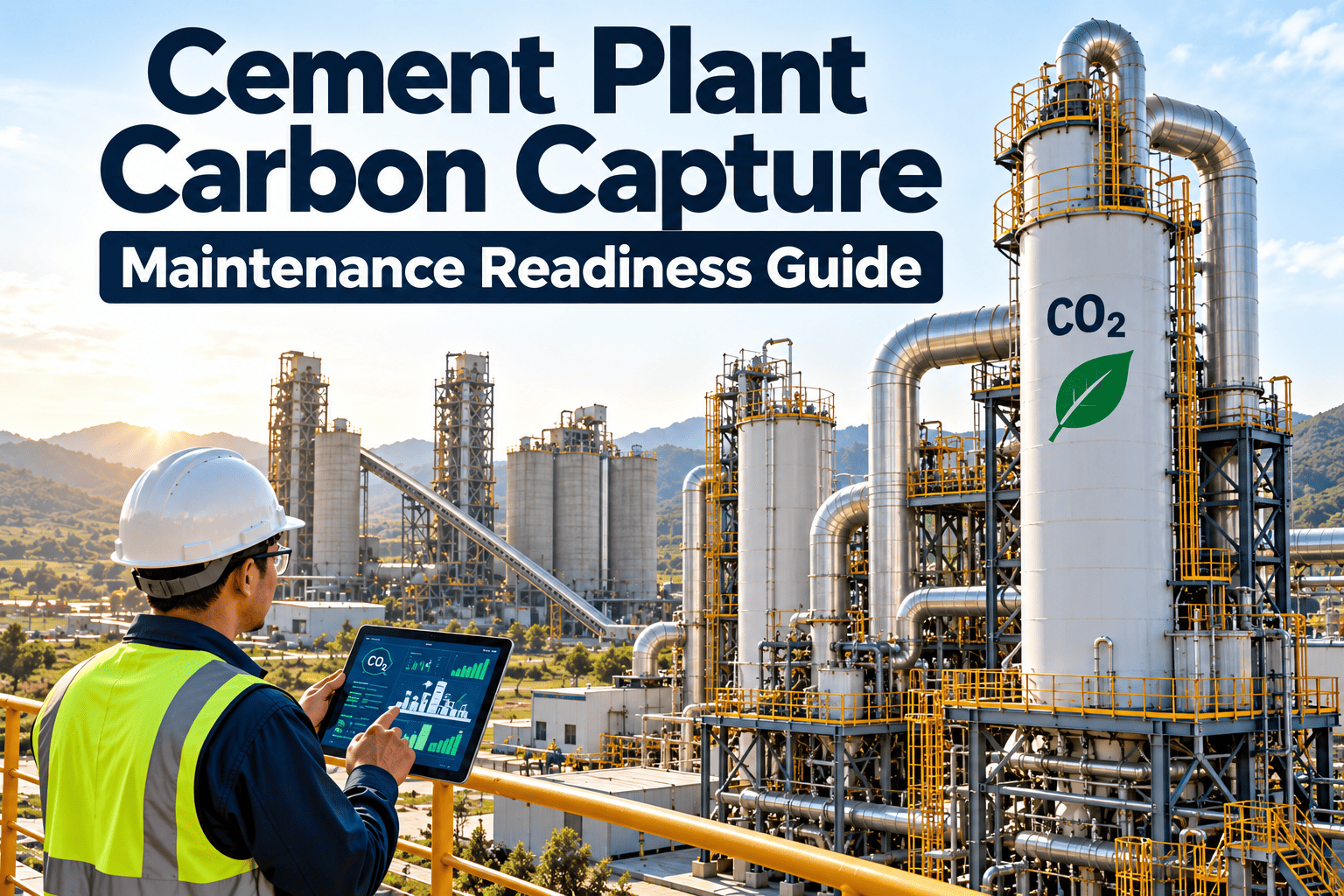
Cement production accounts for 8% of global CO₂ emissions — and the technology pathway to decarbonization runs directly through your maintenance program. Carbon capture systems, LC3 blended cement processing lines, hydrogen co-firing infrastructure, and SCM grinding circuits all require structured PM programs that most cement plants have not yet built. Without disciplined maintenance, CCUS absorption columns foul, LC3 calcination temperatures drift, and alternative binder lines underperform — turning capital-intensive decarbonization investments into reliability liabilities. Oxmaint's CCUS Equipment Tracking and Alt Fuel System PM modules give cement plants the maintenance infrastructure that next-generation green technology demands. Book a demo to see Oxmaint configured for your decarbonization technology portfolio.
Oxmaint's CCUS Equipment Tracking and Alt Fuel System PM modules give cement plants structured maintenance programs for carbon capture systems, LC3 and SCM processing lines, hydrogen co-firing infrastructure, and alternative binder circuits — with the compliance documentation required for EU ETS, ISO 14064, EU CBAM, and regional carbon regulations built into every work order record.
Green Cement Technology Categories Oxmaint Manages
Decarbonization technology in cement spans four distinct equipment families — each with unique wear profiles, process sensitivity requirements, and compliance documentation obligations that standard CMMS platforms are not pre-configured to address.
- Absorption column amine fouling — CO₂ capture efficiency drops 15–25% before visible symptoms
- Compressor seal failure — CO₂ stream contamination invalidates sequestration certificates
- Heat exchanger scaling — thermal efficiency loss triggering 20–30% energy penalty
Amine quality monitoring cycles, compressor seal PM by operating hours, heat exchanger cleaning schedules — all linked to CO₂ capture rate KPIs and EU ETS carbon accounting records.
- Flash calciner temperature drift — uncalcined clay reduces reactivity and clinker substitution ratio
- Classifier wear in LC3 mills — particle size distribution shifts outside specification
- Blend proportioning errors from dosing system wear — clinker factor increases silently
Calciner temperature profiling, classifier inspection by throughput tonnage, and dosing system calibration cycles — with clinker factor tracked per PM completion against sustainability reporting targets.
- Hydrogen embrittlement in burner lances — accelerated cracking vs. conventional fuel systems
- H₂ leak detection sensor drift — safety-critical calibration at 2–3× conventional fuel frequency
- Flame stability control system wear — combustion instability at high H₂ blending ratios
Lance metallurgical inspection by operating hours, H₂ leak detector calibration schedules, and flame stability system PM — all with safety-critical escalation protocols for any inspection failure.
- Shredder rotor and anvil wear — throughput drops, fossil fuel fallback triggered
- Dosing screw calibration drift — thermal substitution rate falls below target
- Emissions monitoring CEMS drift — regulatory exposure during permit exceedances
Throughput-triggered PM for shredders and dosing systems, CEMS calibration scheduling, and environmental permit compliance exports — protecting TSR targets and regulatory standing simultaneously.
Register Your Entire Decarbonization Technology Portfolio in Oxmaint
CCUS columns, LC3 calciners, H₂ infrastructure, and AFR feeding systems — all PM-scheduled, performance-tracked, and compliance-documented from one platform within 3 weeks.
How Oxmaint Delivers Green Cement Maintenance
Every CCUS component registered individually — absorption columns, regeneration reboilers, amine storage, CO₂ compressor stages, and sequestration pipeline interfaces. PM intervals configured per manufacturer specifications and IEA best practice guidelines. Amine quality sampling cycles, compressor seal inspections, and heat exchanger cleaning schedules auto-generated as work orders — with CO₂ capture rate logged per PM completion for EU ETS carbon accounting. Book a demo to see CCUS asset hierarchy configured for your capture technology.
Flash calciner temperature profiles, separator and classifier inspection cycles, and blending dosing system calibrations scheduled against production throughput rather than calendar. Clinker substitution ratio logged per work order completion — when clinker factor drifts above target due to dosing inaccuracy or calcination temperature deviation, Oxmaint generates a process investigation work order linked to the specific equipment record causing the drift.
H₂ leak detection sensors calibrated at 2–3× the frequency of conventional fuel systems — with any sensor failure triggering immediate escalation to the plant safety officer. Burner lance metallurgical inspections scheduled by operating hours to catch hydrogen embrittlement cracking before structural failure. All H₂ safety inspections carry mandatory photo documentation and supervisor sign-off before work order closure. Book a demo to see H₂ safety PM protocol configuration.
Every PM completion, CO₂ capture rate measurement, clinker factor record, and corrective maintenance action exported as timestamped, photo-evidenced compliance packages — formatted for EU ETS annual reports, ISO 14064 verification audits, EU CBAM carbon intensity submissions, and regional carbon regulation requirements across five major markets. No separate carbon management system required.
90-Day Green Cement Maintenance Roadmap
- Register CCUS, LC3, H₂, and AFR assets in Oxmaint hierarchy
- Configure PM intervals per technology type and manufacturer spec
- Set CO₂ capture rate and clinker factor KPI baselines
- Connect to plant historian for process data import
- Build condition-based PM for CCUS compressors and absorption columns
- Configure H₂ safety escalation protocols and mandatory sign-offs
- Mobile app onboarding for maintenance technicians and process engineers
- First green technology performance baseline report generated
- EU ETS and ISO 14064 compliance export templates configured
- Clinker factor tracking linked to LC3 dosing system PM records
- EU CBAM carbon intensity documentation activated per process stream
- Carbon performance KPI dashboards deployed to management team
- Carbon reduction vs. baseline measured against EU ETS targets
- CCUS capture efficiency trend analysis drives PM interval refinement
- Full carbon compliance audit package generated for verifier review
- Multi-plant decarbonisation benchmarking initiated
Regulatory Compliance — Green Cement by Region
Green cement operations face the most complex regulatory landscape in the industry — overlapping carbon markets, environmental permits, and national decarbonisation mandates across every major market. Oxmaint generates compliance exports formatted for all of them.
| Region | Applicable Frameworks | How Oxmaint Covers It |
|---|---|---|
| USA / Canada | EPA 40 CFR Part 98 GHG reporting, DOE Industrial Decarbonization Roadmap, California LCFS for low-carbon cement, Canada Clean Fuel Regulations, OSHA 29 CFR 1910.119 PSM for CCUS sites, EPA CCUS Class VI well permits | GHG facility report maintenance records, LCFS pathway documentation, CCUS equipment PM records for Class VI permit compliance, PSM mechanical integrity documentation |
| Australia | NGER carbon capture and storage provisions, Safeguard Mechanism CCUS crediting, CER carbon credit (ACCU) documentation, ARENA CCUS grant compliance, Clean Energy Finance Corporation requirements | NGER CCUS equipment records, Safeguard CCUS crediting maintenance evidence, ACCU documentation packages, ARENA grant compliance exports |
| United Kingdom | UK ETS CCUS provisions, UK CCS Network Access Code, UK Cement Zero initiative, Industrial Decarbonisation Challenge documentation, BEIS CCUS cluster requirements, Environment Agency CCUS permits | UK ETS carbon capture records, CCS Network maintenance documentation, BEIS cluster compliance exports, Environment Agency permit maintenance records |
| Germany / EU | EU ETS free allocation and CCUS provisions, EU CBAM embedded carbon documentation, EU Industrial Carbon Management Strategy, Innovation Fund CCUS grant compliance, CSRD decarbonisation reporting, ISO 14064 carbon accounting | EU ETS CCUS capture records, CBAM embedded carbon intensity exports, Innovation Fund compliance documentation, CSRD maintenance evidence, ISO 14064 audit trail |
| Saudi Arabia / UAE | Saudi Aramco and SABIC industrial decarbonisation frameworks, UAE Net Zero 2050 industrial strategy, ADNOC CCS requirements, Vision 2030 industrial carbon reduction targets, SASO green building materials standards | Aramco/SABIC supplier decarbonisation documentation, UAE Net Zero compliance records, ADNOC CCS maintenance evidence, Vision 2030 carbon reduction reporting packages |
Oxmaint vs Competitors — Green Cement and CCUS Maintenance
No general-purpose CMMS includes CCUS equipment hierarchies, carbon capture KPI tracking, or the multi-framework compliance exports that green cement technology demands. Oxmaint is purpose-built for the industrial decarbonisation reality cement plants now face.
| Feature | Oxmaint | MaintainX | UpKeep | Fiix (Rockwell) | IBM Maximo | Limble CMMS | Hippo (Eptura) |
|---|---|---|---|---|---|---|---|
| CCUS equipment hierarchy and PM scheduling | ✓ Yes | ✗ No | ✗ No | ~ Partial | ~ Config | ✗ No | ✗ No |
| CO₂ capture rate KPI linked to maintenance records | ✓ Yes | ✗ No | ✗ No | ✗ No | ~ Partial | ✗ No | ✗ No |
| LC3 calciner and classifier throughput-based PM | ✓ Yes | ✗ No | ✗ No | ~ Partial | ~ Config | ✗ No | ✗ No |
| H₂ safety-critical inspection protocols with escalation | ✓ Yes | ✗ No | ✗ No | ~ Partial | ✓ Yes | ✗ No | ✗ No |
| EU ETS and ISO 14064 compliance exports | ✓ Yes | ✗ No | ✗ No | ✗ No | ~ Limited | ✗ No | ✗ No |
| EU CBAM embedded carbon intensity documentation | ✓ Yes | ✗ No | ✗ No | ✗ No | ~ Partial | ✗ No | ✗ No |
| Clinker factor tracked per maintenance completion | ✓ Yes | ✗ No | ✗ No | ✗ No | ~ Config | ✗ No | ✗ No |
| Multi-region carbon compliance exports (5 regions) | ✓ Yes | ✗ No | ✗ No | ✗ No | ~ Limited | ✗ No | ✗ No |
| Cement-specific asset hierarchy (kiln, mill, CCUS) | ✓ Yes | ✗ No | ✗ No | ✗ No | ~ Config | ✗ No | ✗ No |
| Mobile QR scan for field technicians | ✓ Yes | ✓ Yes | ✓ Yes | ✓ Yes | ~ Limited | ✓ Yes | ~ Partial |
| Deployment without IT project or hardware | ✓ 2–3 wks | ~ 4–8 wks | ~ 4–6 wks | ~ 8–16 wks | ✗ 6–18 mo | ~ 4–8 wks | ~ 6–12 wks |
| Transparent SaaS pricing for industrial plants | ✓ Yes | ~ Per user | ~ Per user | ~ Enterprise | ✗ High cost | ~ Per user | ~ Per user |
Why Cement Plants Choose Oxmaint for Decarbonisation Maintenance
A single CCUS absorption column represents $2–4M of capital. Without structured amine quality monitoring and compressor seal PM, fouling and mechanical failures erode capture efficiency — destroying both carbon performance and ROI on your decarbonisation investment.
Oxmaint links clinker substitution ratio directly to equipment maintenance execution — when dosing system wear silently increases clinker factor, the deviation shows up as a maintenance trigger before it impacts carbon reporting or certification targets.
EU ETS, ISO 14064, EU CBAM, and regional carbon reports generated automatically from maintenance records — eliminating the separate carbon management system that most green cement operations run alongside their CMMS at significant additional cost.
Hydrogen co-firing introduces embrittlement and leak detection risks that conventional CMMS platforms have no templates for. Oxmaint includes mandatory supervisor sign-off, automatic escalation on sensor failure, and photo-evidenced completion records for every H₂ safety-critical check.
CCUS, LC3 processing, hydrogen infrastructure, and AFR co-processing managed from the same Oxmaint platform — eliminating the separate maintenance tracking spreadsheets that green technology pilots accumulate before a structured CMMS is deployed.
Unlike IBM Maximo implementations requiring 6–18 months, Oxmaint deploys across a cement plant's full decarbonisation technology portfolio in 3 weeks — with asset registry, PM schedules, carbon KPI tracking, and compliance exports all operational before the next EU ETS reporting period closes.
Your Carbon Targets Are Only as Good as Your Equipment Maintenance
Oxmaint closes the loop between decarbonisation technology PM and carbon performance reporting — protecting TSR targets, clinker factors, and CO₂ capture rates through structured maintenance execution.
Results — What Cement Plants Achieve With Oxmaint
Frequently Asked Questions
Continue Reading
Make Your Decarbonisation Technology Work as Hard as Your Maintenance Team
CCUS tracking, LC3 process PM, H₂ safety protocols, and multi-region carbon compliance — all in one platform. Deployed in your cement plant within 3 weeks, no IT project required.