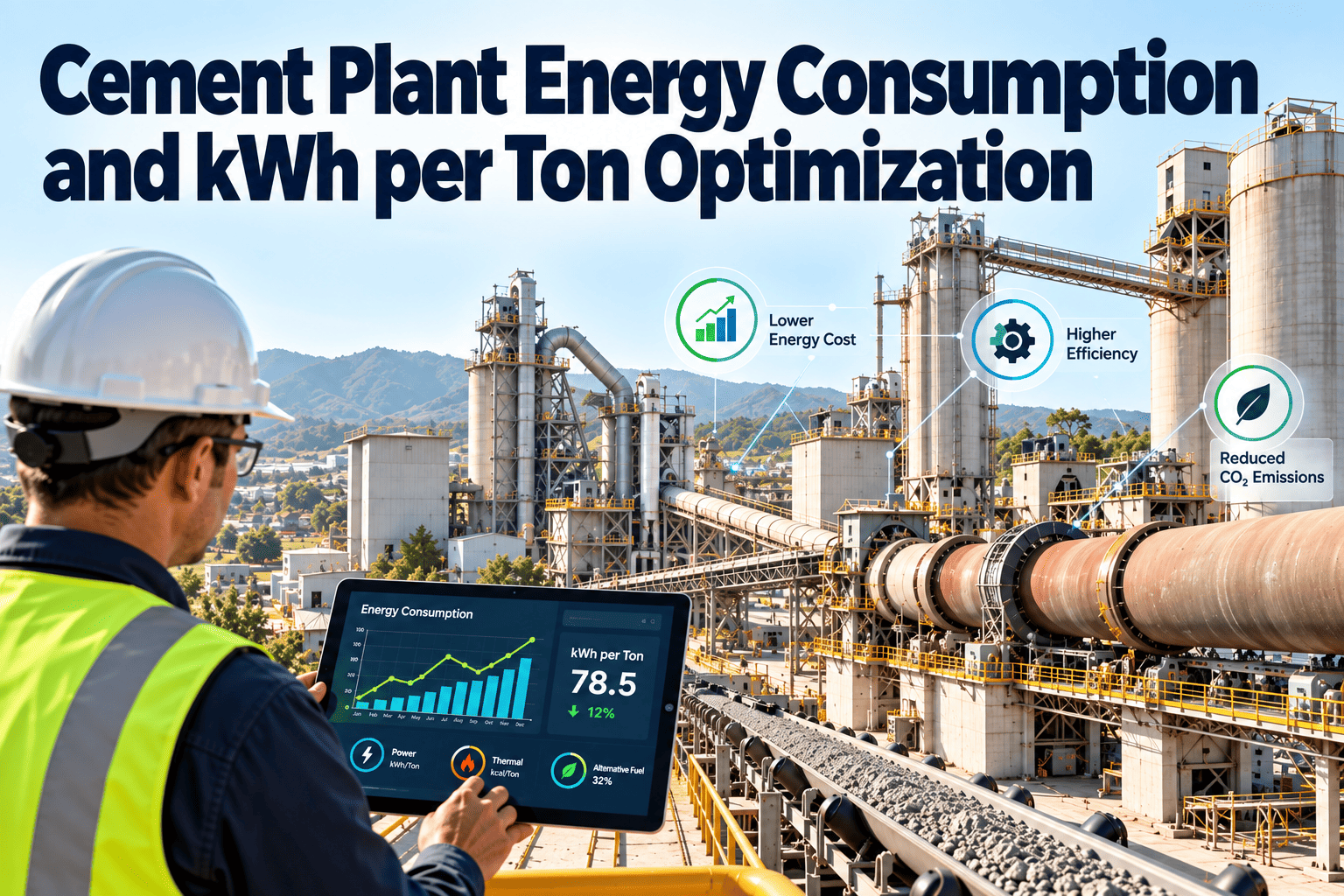
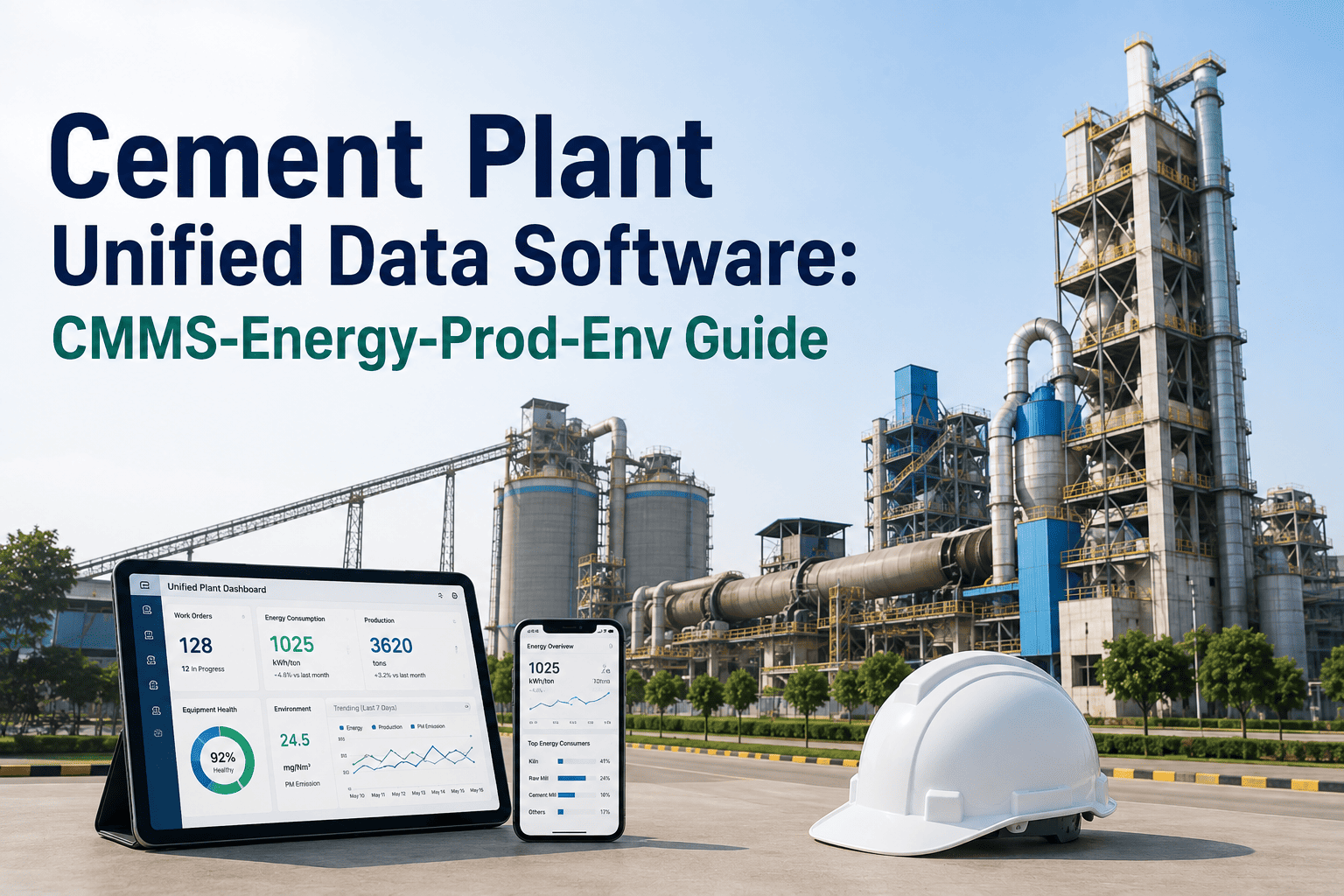
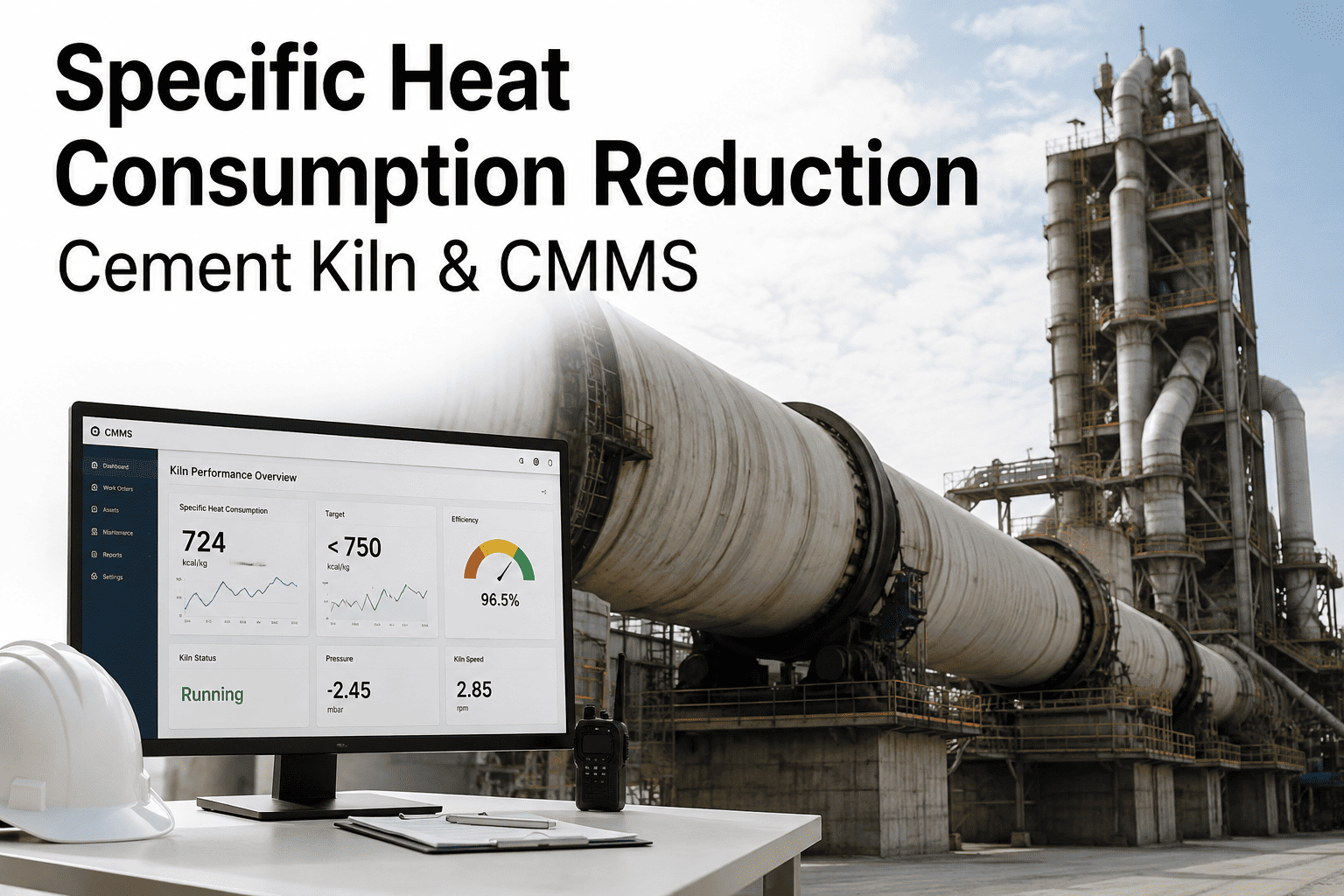
Cement manufacturing consumes 110–150 kWh per tonne of clinker — making energy the single largest variable cost at 30–40% of total production cost. Most cement plants have real-time energy meters but no structured maintenance program connecting equipment condition to energy performance. When a raw mill separator bearing wears, energy consumption climbs 8–12% before the failure is detected. When a kiln shell cooler fan loses efficiency, fuel consumption rises 15–20 kcal/kg. Oxmaint closes the loop between equipment PM and energy performance — tracking kWh/ton per asset, flagging energy anomalies as maintenance triggers, and automating the compliance documentation that EU CBAM, ISO 50001, and regional energy regulations demand. Book a demo to see Oxmaint's energy monitoring dashboard configured for your cement plant.
Oxmaint's Energy Monitoring Dashboard and kWh/ton Tracking connect equipment condition directly to energy performance — automatically flagging energy anomalies as maintenance work orders before they become failures. Plants gain 15–25% energy reduction, real-time kWh/ton visibility per asset, and the compliance documentation required for ISO 50001, EU CBAM, and regional energy regulations — all from one platform without a separate energy management system.
The Maintenance-Energy Connection in Cement Plants
Every major energy consumer in a cement plant degrades with wear — and that degradation shows up as rising kWh/ton before any mechanical failure is detectable. Oxmaint tracks the energy signature of each asset and triggers maintenance work orders when consumption deviates from baseline. This converts energy waste into a maintenance signal rather than a cost write-off.
See Oxmaint's kWh/ton Dashboard for Your Plant
Real-time energy consumption per asset, anomaly alerts as maintenance triggers, and automated ISO 50001 documentation — live in your plant within 3 weeks.
How Oxmaint Delivers Energy Management for Cement Plants
Every major energy consumer registered with rated power, baseline kWh/ton at design load, and energy performance history. Raw mills, cement mills, kilns, cooler fans, compressors, and conveyors each tracked individually. Energy consumption logged per work order completion — building a continuous performance record per asset without requiring a separate energy management system. Book a demo to see the energy asset hierarchy for your plant layout.
Oxmaint compares actual kWh/ton against configurable baselines per asset and operating condition. When consumption deviates beyond threshold — 8% for mills, 5% for kiln drive, 15% for fans — an investigation work order is automatically generated with the anomaly data pre-populated. Energy waste becomes a work order, not a month-end report observation. Peak demand events are flagged in real time with load-shedding recommendations to avoid tariff penalties.
Ball charge audits, separator inspections, blade wear checks, and VFD calibrations scheduled by production hours rather than calendar dates — triggered when energy performance data indicates degradation rather than at fixed intervals that may be too early or too late. Kiln tyre and riding ring alignment checks aligned to kiln drive power trend rather than arbitrary monthly schedule. Book a demo to see condition-based PM scheduling for your equipment.
All energy performance records, maintenance actions, and corrective interventions export as timestamped, photo-evidenced compliance packages — formatted for ISO 50001 energy management system audits, EU CBAM carbon reporting, and national energy efficiency regulatory submissions across six major regulatory regions. No manual reformatting. No separate reporting tool.
Implementation Roadmap — 90 Days to Energy-Optimized Maintenance
- Register all major energy consumers in Oxmaint hierarchy
- Set kWh/ton baselines per asset at design operating conditions
- Configure energy anomaly alert thresholds per equipment class
- Connect to existing metering and SCADA data sources via API
- Build condition-based PM schedules for mills, kiln, cooler, fans
- Configure peak demand alerts and load-shedding work orders
- Mobile app onboarding for maintenance technicians and operators
- First energy performance baseline report generated
- Energy anomaly work orders reviewed and intervention patterns identified
- ISO 50001 compliance export templates configured
- EU CBAM carbon intensity documentation linked to energy records
- Shift-level kWh/ton reporting to operations team activated
- Energy reduction vs. baseline measured and reported to management
- Peak demand penalty reduction quantified against pre-Oxmaint baseline
- Capital planning for highest-energy-impact replacements generated
- Multi-plant rollout planning initiated based on pilot results
Start Your 90-Day Energy Optimization Program
Asset registry, kWh/ton baselines, and anomaly-triggered PM schedules configured in your plant within 2 weeks — no IT project, no hardware, no energy consultant required.
Regulatory Compliance — Energy Management by Region
Oxmaint generates energy maintenance records formatted for every major regulatory framework your cement operations encounter — from EU CBAM to ISO 50001 to national energy efficiency mandates.
| Region | Applicable Frameworks | How Oxmaint Covers It |
|---|---|---|
| USA / Canada | EPA ENERGY STAR Industrial, DOE Superior Energy Performance (SEP), FEMP energy audit requirements, 10 CFR Part 431 industrial equipment efficiency, state energy efficiency mandates | kWh/ton performance records, SEP-formatted energy documentation, DOE audit evidence packages, ISO 50001 alignment exports |
| Australia | National Greenhouse and Energy Reporting (NGER), Safeguard Mechanism baselines, Energy Efficiency Opportunities (EEO) program, NABERS industrial rating, state energy audit obligations | NGER energy consumption records, Safeguard baseline compliance exports, EEO audit documentation, NABERS evidence packages |
| United Kingdom | UK ETS energy intensity reporting, ESOS energy audit compliance, SECR sustainability reporting, Climate Change Agreement (CCA) targets, ISO 50001 certification support | UK ETS consumption records, ESOS audit packages, SECR maintenance evidence, CCA target documentation, ISO 50001 audit trail |
| Germany / EU | EU ETS carbon intensity, EU CBAM (Carbon Border Adjustment Mechanism), EU Energy Efficiency Directive (EED), CSRD energy reporting, ISO 50001, Energieeinspargesetz (EnEG) | EU CBAM carbon intensity documentation, ETS consumption records, EED audit exports, CSRD energy maintenance evidence, ISO 50001 alignment |
| Saudi Arabia / UAE | Saudi Energy Efficiency Program (SEEP), UAE Supreme Council of Energy mandates, Vision 2030 industrial energy targets, SEC metering compliance, Estidama industrial rating | SEEP energy performance records, SEC metering compliance exports, Vision 2030 reporting packages, Estidama energy evidence documentation |
Oxmaint vs Competitors — Cement Energy Management
Most CMMS platforms are general-purpose work order tools. Oxmaint is purpose-configured for industrial energy management — connecting asset condition to energy consumption in a way that no general CMMS delivers.
| Feature | Oxmaint | MaintainX | UpKeep | Fiix (Rockwell) | IBM Maximo | Limble CMMS |
|---|---|---|---|---|---|---|
| kWh/ton tracking per asset | ✓ Yes | ✗ No | ✗ No | ~ Partial | ~ Partial | ✗ No |
| Energy anomaly → auto work order | ✓ Yes | ✗ No | ✗ No | ~ Partial | ✓ Yes | ✗ No |
| Peak demand alert and load-shedding PM | ✓ Yes | ✗ No | ✗ No | ✗ No | ~ Partial | ✗ No |
| ISO 50001 compliance documentation | ✓ Yes | ✗ No | ✗ No | ~ Partial | ✓ Yes | ✗ No |
| EU CBAM carbon intensity exports | ✓ Yes | ✗ No | ✗ No | ✗ No | ~ Partial | ✗ No |
| Condition-based PM from energy data | ✓ Yes | ✗ No | ✗ No | ~ Partial | ✓ Yes | ✗ No |
| Cement-specific asset hierarchy | ✓ Yes | ✗ No | ✗ No | ✗ No | ~ Config | ✗ No |
| Multi-region compliance exports | ✓ Yes | ✗ No | ✗ No | ✗ No | ~ Partial | ✗ No |
| Mobile QR scan in field | ✓ Yes | ✓ Yes | ✓ Yes | ✓ Yes | ~ Limited | ✓ Yes |
| Deployment without IT project | ✓ 2–3 weeks | ~ 4–8 wks | ~ 4–6 wks | ~ 8–16 wks | ✗ 6–18 mo | ~ 4–8 wks |
| Pricing model (industrial plants) | ✓ Transparent SaaS | ~ Per user | ~ Per user | ~ Enterprise quote | ✗ High-cost enterprise | ~ Per user |
Value Propositions — Why Cement Plants Choose Oxmaint
Oxmaint integrates energy monitoring directly into the CMMS — eliminating the cost and complexity of running a separate SCADA-adjacent energy platform alongside your maintenance system.
When kWh/ton rises above threshold, Oxmaint creates a maintenance work order immediately — not a report that someone reads next month. The energy deviation becomes an intervention, not a cost accepted.
ISO 50001, EU CBAM, and regional energy audit documentation generated automatically from maintenance records — no separate data entry, no manual report compilation before every audit cycle.
Unlike IBM Maximo or Fiix enterprise implementations, Oxmaint deploys in 2–3 weeks across a cement plant — asset registry, PM schedules, and energy dashboards operational before the next billing cycle closes.
Groups with multiple cement plants see cross-plant kWh/ton benchmarking in one dashboard — identifying which plants are underperforming on energy and which PM practices are driving better efficiency at others.
Cement plants pay significant peak demand tariff penalties. Oxmaint schedules high-load operations and mill start sequences to avoid simultaneous peak loads — reducing monthly demand charges without changing production volume.
Results — What Cement Plants Achieve With Oxmaint
Cut kWh/ton. Cut Costs. Stay Compliant.
Oxmaint's Energy Monitoring Dashboard and condition-based PM give cement plants a 15–25% energy reduction with zero additional headcount — and the compliance documentation your next ISO 50001 or EU CBAM audit requires.