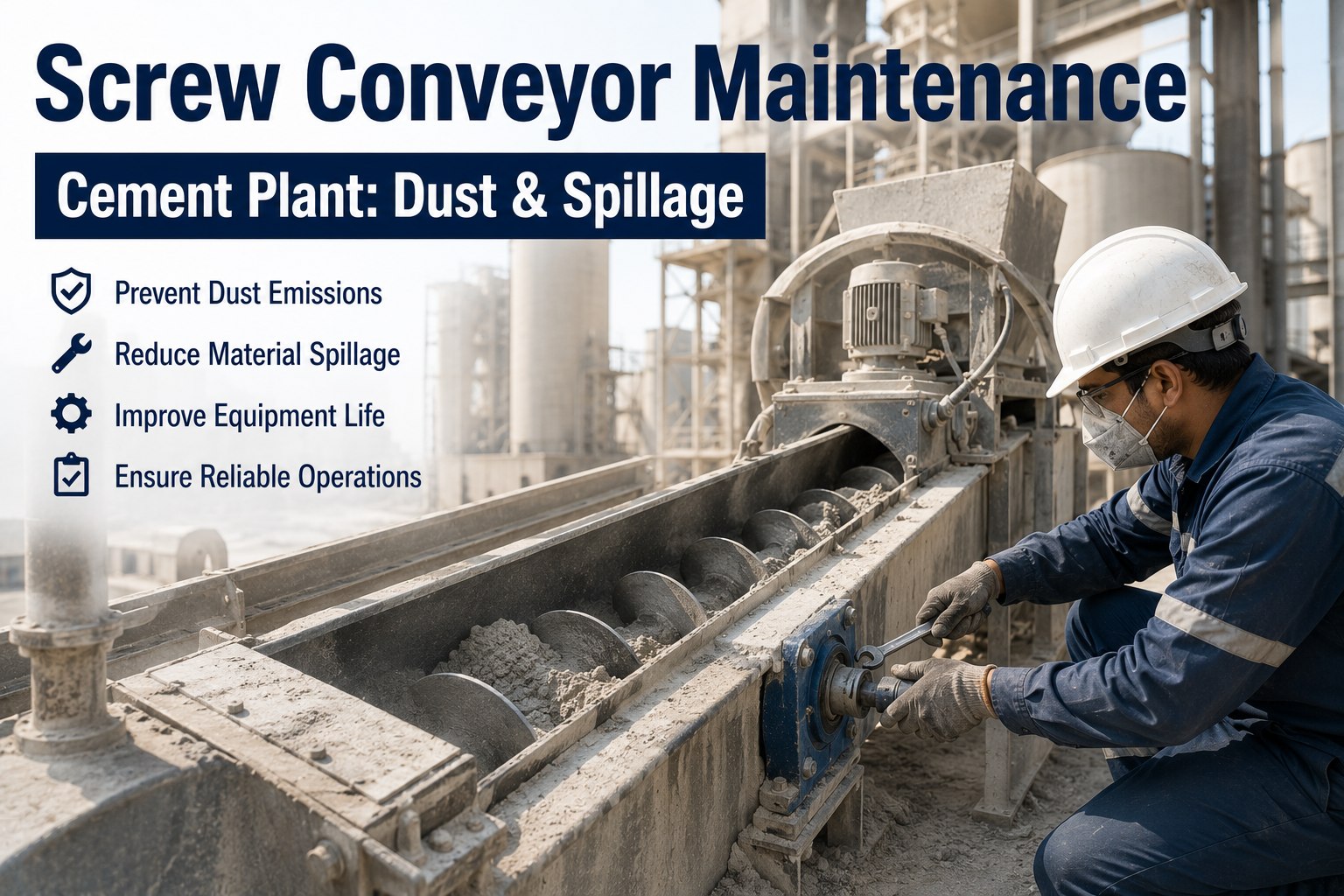
Screw conveyors in cement plants handle some of the harshest material in any industry — fine dust, hot clinker, abrasive grit — and the wear shows up fast on flights, shafts, and seals. A single leaking trough can scatter tons of material per week, foul walkways, and trigger the kind of housekeeping backlog that shuts down inspection routes. The maintenance strategy that works is structured: timed flight-wear monitoring, trough and seal service, blockage prevention, and a CMMS that schedules every PM before failure. Set up your screw conveyor reliability program in OxMaint — Start Free Trial — and keep dust, spillage, and unplanned downtime out of your daily routine.
Stop the dust, the spillage, and the 3 a.m. blockage call.
A CMMS-driven screw conveyor maintenance plan cuts flight wear failures, seals trough leaks, and prevents the cement buildup that turns a 20-minute PM into a 6-hour shutdown.
What a leaking screw conveyor actually costs a cement plant
Screw conveyors move 60–80% of all material flows in a typical cement operation — clinker dust, raw meal, kiln feed, and finished cement. When maintenance slips, the costs compound fast.
A 180-asset plant in the US Southeast was spending roughly $42,000 per year on emergency screw conveyor repairs — replacement flights, expedited shafts, and contract labor for packed-trough clear-outs. After implementing meter-based PM triggers in a CMMS (flight inspection every 500 hours, seal service every 90 days, trough alignment check every 180 days), unplanned screw failures dropped 61% in the first year and the emergency-repair spend fell to under $16,000. The payback on the CMMS deployment was under four months.
The four-tier screw conveyor PM checklist for cement plants
Structured by frequency. Each tier feeds the next — every check logged in the CMMS becomes the baseline for the next inspection cycle.
- Walk the full trough length — note any dust plumes, material piles under flanges, or bearing noise
- Check hanger bearing temperature by touch or IR — flag anything above 70°C
- Listen for metallic scraping indicating flight-to-trough contact
- Verify discharge chute flow — no bridging, no slow drain
- Confirm drive motor amperage is within nameplate range
- Inspect end-bearing seals for grease leakage and cement buildup
- Grease hanger bearings per OEM spec — purge old grease, do not over-lubricate
- Check trough cover bolts for looseness — cement vibration backs them out
- Examine flight edges with a flashlight — look for curling, pitting, or thickness loss
- Inspect gland packing at the drive shaft — tighten or replace if dust is escaping
- Measure flight thickness at 3 points per pitch — log trend in CMMS
- Check shaft runout at drive end — flag if over 0.15 mm TIR
- Inspect trough liner wear plates — replace before trough wall is exposed
- Torque all flange bolts to spec — re-torque in a cross pattern
- Verify dust collection pickup at trough covers is clear and drawing
- Remove trough covers — full internal inspection of flights, shaft, and hangers
- Pull and measure the screw — replace if flight wear exceeds 30% of original thickness
- Repack or replace end bearings — check housing for cement ingress
- Inspect and re-align drive coupling — correct angular and parallel misalignment
- Replace gland packing and lip seals as a set — never reuse old packing
Screw conveyor failure modes, inspection points, and action thresholds
Print this table and attach it to the screw conveyor PM task in your CMMS — the thresholds are the trigger for a work order, not a discussion.
| Failure Mode | Inspection Point | Action Threshold | CMMS Trigger |
|---|---|---|---|
| Flight edge erosion | Measure thickness at 3 points per pitch | Below 70% of original thickness | Auto-generate replacement work order |
| Shaft wear at hanger bearing | Micrometer at bearing journal | Wear exceeds 0.25 mm on diameter | Schedule shaft refurbishment |
| End seal dust leak | Visual + white-glove wipe test | Any visible dust trail at seal | Generate seal service work order |
| Trough wall thinning | Ultrasonic thickness at wear zones | Below 60% of nominal wall | Plan liner replacement at next shutdown |
| Hanger bearing failure | Temperature + audible check | Above 80°C or grinding noise | Immediate stop and bearing swap |
| Drive coupling wear | Visual + dial indicator | Misalignment over 0.1 mm | Re-alignment task within 7 days |
| Trough cover seal failure | Dust accumulation on walkway below | Any new dust accumulation | Re-gasket and re-torque covers |
Seven field-tested steps to keep cement dust inside the trough
Each step is a CMMS-scheduled task — not a one-time fix. Cement dust is not just a housekeeping issue; it is a combustible-dust risk and an OSHA exposure point under 29 CFR 1910.1000.
Re-gasket every trough cover flange annually
Cement fines settle into gasket interfaces and wick moisture, hardening into a rigid layer that no longer seals. Replace full-length gasket material during the quarterly shutdown and log the material spec in the CMMS for reorder consistency.
Maintain negative pressure at all dust pickup points
Each trough cover pickup should draw 200–400 CFM depending on screw diameter. Verify with a velometer monthly — a clogged pickup is the number-one cause of dust escape and the easiest to catch early.
Replace gland packing before it fails — not after
Packing that has been tightened more than three times is spent. Schedule a packing-and-lantern-ring replacement every 6 months on hot-clinker screws and every 12 months on cool cement screws. The part costs $40; the dust it prevents costs thousands.
Install spillage trays under every flange joint
A 6-inch-wide spillage tray beneath each trough flange catches the fine leak before it reaches the floor. It turns a 2-hour cleanup into a 5-minute scrape and gives maintenance a visible early-warning signal that a gasket is failing.
Prevent blockages with feed-rate interlocks
Hard-block a screw conveyor from starting unless the downstream conveyor is confirmed running. A packed screw that starts against a dead discharge is the most common cause of flight damage and shaft twisting in cement service.
Flush cool-down cycles for hot-clinker screws
Hot clinker screws should run a 5-minute empty flush before shutdown to prevent material from baking onto flights and hardening into a solid mass that bends the screw on the next start. Build this into the PLC stop sequence and log it.
Log every dust observation as a CMMS event
Even a small dust trail is a data point. When operators log "dust at cover 4" in the CMMS, the system can correlate it across shifts and trigger a targeted inspection before the leak becomes a spillage event.
Reactive screw maintenance vs. CMMS-driven PM
The same crew, the same screw conveyors, the same cement dust — the only change is whether work is scheduled or surprise.
| Dimension | Reactive (No CMMS) | CMMS-Driven PM |
|---|---|---|
| Flight replacement trigger | When screw fails to convey | At 70% thickness, scheduled in advance |
| Seal service | When dust is visible on walkways | Every 90 days, automatic work order |
| Blockage frequency | 4–8 per year per conveyor | 1–2 per year, mostly external causes |
| Mean time to repair | 6–11 hours (find parts + cool down) | 2–4 hours (parts staged, scheduled) |
| Annual repair spend per conveyor | $8,000–$14,000 | $2,500–$5,000 |
| Spillage cleanup labor | ~3 hrs/week per leaking unit | Under 30 min/week per unit |
| Inspection data history | Clipboards, lost or illegible | Full trend per asset, exportable |
Build your screw conveyor PM schedule in under a day.
Import your asset list, set the PM triggers from the table above, and let the CMMS push work orders to your techs' phones.
Screw conveyor maintenance in cement — answers technicians actually need
Five questions we hear most from cement plant maintenance managers setting up their first screw conveyor PM program in a CMMS.
How often should I inspect screw flights in a cement plant?
For abrasive clinker-dust service, measure flight thickness monthly at three points per pitch and log the trend in your CMMS. For finished-cement conveyors, every 60 days is usually sufficient. The action threshold is 70% of original thickness — below that, schedule a replacement at the next planned shutdown rather than waiting for the flight to fail mid-cycle.
What is the most common cause of screw conveyor dust leaks?
Worn or over-tightened gland packing at the drive shaft, followed by hardened cover gaskets. Packing that has been adjusted more than three times is spent and should be replaced as a set with the lantern ring. Schedule this every 6 months on hot-clinker screws. You can set this as a recurring work order in OxMaint — Start Free Trial and configure it in minutes.
How do I prevent screw conveyor blockages in cement service?
Three controls cover 90% of blockages: interlock the screw start to downstream conveyor running status, flush-run hot screws for 5 minutes before shutdown, and never let the feed rate exceed 85% of the screw's rated capacity. Log every blockage in the CMMS with location and material — patterns emerge within a quarter that point to the root cause.
Should I use hardfacing or replace worn screw flights?
Hardface weld overlay is cost-effective when flight thickness is above 60% of nominal and wear is on the pushing edge only. Below that, or when the flight face is pitted across the full diameter, replacement is more reliable. In either case, the decision should be driven by CMMS trend data, not by what is found during a breakdown tear-down.
Can a CMMS really reduce screw conveyor downtime by 40% or more?
Yes — but only if the PM triggers are meter-based or condition-based, not calendar-only. Plants that move from "inspect every quarter" to "inspect every 500 run-hours plus thickness trend" typically cut unplanned screw failures 40–60% in the first year. See it in action — Book a Demo and we'll walk through your screw conveyor fleet live.
Put screw conveyor reliability on autopilot.
Set up flight-wear tracking, seal-service PMs, and blockage-prevention work orders in one afternoon. Your walkways stay clean, your screws stay running.
Free 14-day trial · No credit card