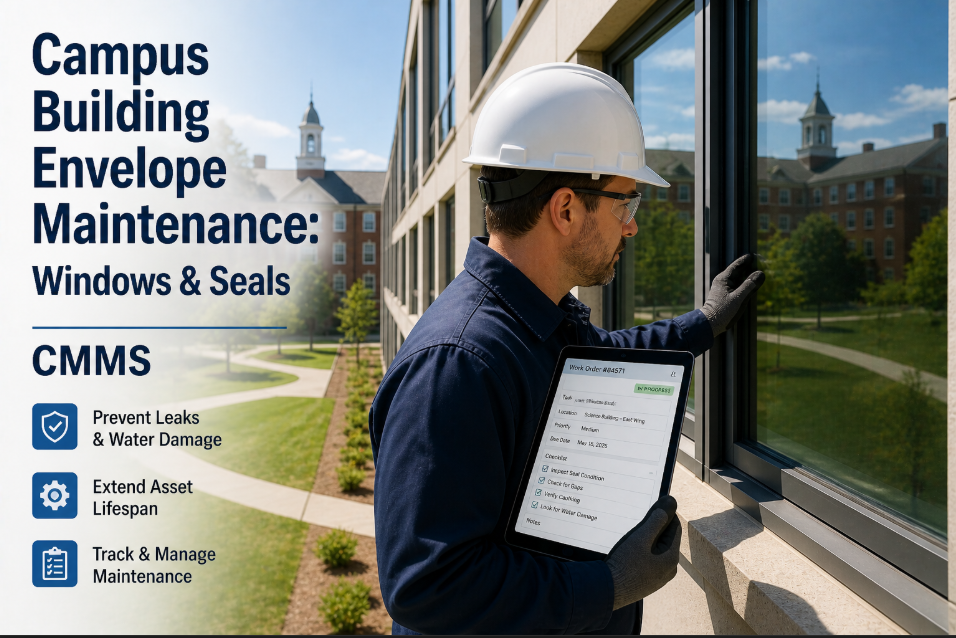
An energy audit at a mid-Atlantic university revealed that eight campus buildings were collectively losing $180,000 in conditioned air annually through failed perimeter window seals, deteriorating caulk joints, and compromised expansion joints — all of it invisible from the inside. The first sign most building occupants had noticed was condensation streaking between panes, a few drafty window seats in winter, and one persistent ceiling stain in a third-floor corner office that facilities had repaired twice with new ceiling tiles. Nobody had connected the ceiling stain to an exterior wall failure eighteen inches above it. The mold remediation that followed the discovery cost $62,000. The window seal replacement across the affected buildings cost $28,000. The ceiling repair had cost $4,200 — twice. Had the building envelope been on a documented inspection schedule with condition scoring, the $62,000 mold job and the repeat ceiling repairs would not have happened. If your campus manages building envelope inspection on a calendar reminder and a clipboard, start a free trial with Oxmaint or book a demo and see what a structured program looks like.
Building Envelope Failure — What It Actually Costs Campus Facilities
Failed Seals and Envelope Breaches Account for 40% of Campus Energy Loss and Are the Primary Entry Point for the Mold Claims That Follow
40%
Of campus energy loss traced to envelope failures
DOE Building Technologies Office — window and door envelope failures are the single largest non-mechanical energy loss category in educational buildings
$62K
Average mold remediation cost per campus building
IICRC S520 standard remediation for a moderate mold event in a 50,000–80,000 sq ft academic building — triggered by undetected water intrusion
7 years
Silicone joint sealant replacement cycle
Most campus buildings are running 12–20 year-old perimeter caulk — well beyond service life — with no scheduled replacement program
18 mo.
Typical delay from failure to interior damage discovery
Water intrusion at the envelope travels inside wall cavities for months before visible ceiling or wall damage reveals the source
The Building Envelope Components That Fail Most Often on Campus
Campus buildings accumulate decades of differential settlement, thermal cycling, UV degradation, and deferred sealant replacement. The components that fail first are predictable — and preventable with a documented inspection program. Campuses that catch these at the maintenance stage spend 8–12 cents per dollar of what a mold remediation or structural repair costs. See how Oxmaint schedules and tracks envelope inspections — book a demo or start a free trial.
01
Perimeter Window Sealant Joints
The silicone or polyurethane bead between the window frame and the masonry or curtain wall frame has a service life of 7–12 years under normal UV and thermal cycling. Most campus windows were sealed at installation and never re-sealed. Failed sealant allows air and water infiltration at every joint — typically 40–80 linear feet per window unit.
7–12 year replacement cycle
02
Insulated Glass Unit Seal Failure
The hermetic seal between the panes of a double or triple-glazed window fails from thermal stress and solar degradation over 15–25 years, allowing moisture to enter the sealed airspace. The visible sign is fogging between panes — but the R-value loss begins months before fogging appears. Campuses with glazing over 20 years old typically have 8–15% unit failure rates.
15–25 year unit life; 8–15% failure rate at age 20+
03
Expansion Joint Systems
Expansion joints between building sections, at grade transitions, and at roof-to-wall junctions allow the building to move without cracking. The flexible cover materials — neoprene, EPDM, or backer rod plus sealant — have a 10–15 year service life. Failed expansion joints are the most common source of the unexplained ceiling stains that recur after multiple roof membrane repairs.
10–15 year cover life; source of most recurrent leaks
04
Curtain Wall and Storefront Glazing Gaskets
EPDM gaskets that retain glazing in curtain wall and storefront systems harden and shrink over 15–20 years, losing their compression seal. Water infiltration at curtain wall systems is notoriously difficult to trace because it travels inside the aluminum framing before exiting at the sill — often 6–8 feet from the actual breach point.
EPDM hardening begins after 12–15 years
The Envelope Inspection Cycle Every Campus Should Be Running
Spring
Post-Winter Inspection
March–April — inspect all sealant joints for winter freeze-thaw cracking, check expansion joints for ice damage, inspect glazing for frame distortion. Roof-to-wall transitions inspected after snow load season. Most envelope failures initiated by winter cycling are visible in spring before water intrusion begins.
Critical detection window
Summer
Condition Scoring and Planning
June–July — photograph and condition-score all envelope components. Rate sealant condition (0–10 scale), log glazing unit fogging observations, document expansion joint cover wear. Summer inspection data feeds the fall repair program and the CapEx forecast for sealant replacement and re-glazing projects.
Feeds CapEx forecast and fall repair program
Fall
Pre-Winter Repair Program
September–October — complete all sealant repairs and glazing replacements before temperatures drop below 40°F (sealant application minimum). Expansion joint cover replacements completed before freeze-thaw season begins. This window is non-negotiable — sealant applied below 40°F fails within one to two years.
Temperature-critical repair window
Winter
Interior Monitoring and Incident Response
November–February — monitor interior surfaces for condensation, ice dams, staining, and drafts. Any new leak incident logged against the specific building envelope asset and investigated for envelope source before interior repair proceeds. Incident documentation feeds spring inspection prioritization.
Incident data feeds next spring inspection
Built for Campus Envelope Management
Schedule Every Seal Inspection. Score Every Component. Prevent Every Mold Claim.
Oxmaint manages the full annual building envelope inspection cycle — spring damage assessment, summer condition scoring, fall repair scheduling, and winter incident logging — with every component tracked against its condition score and replacement forecast built into the 5-year CapEx model.
How Oxmaint Manages Campus Building Envelope Maintenance
01
Envelope Component Asset Registry
Every envelope component registered as an asset — each window unit, glazing bay, expansion joint section, and sealant run mapped by building face and elevation. Condition score tracked per component, not just per building. When the north face of a 1970s science building scores 4.2 out of 10, you know where to send the crew — not just which building to look at.
Component-level condition visibility across the portfolio
02
Seasonal Inspection Scheduling
Spring post-winter, summer condition scoring, and fall pre-repair inspection work orders auto-scheduled annually for every building in the portfolio. Technicians receive mobile inspection checklists with component-specific condition scoring fields, photo capture, and defect flagging — no clipboards, no lost inspection sheets.
Annual inspection cycle runs without manual scheduling
03
Incident-to-Envelope Source Tracing
When a ceiling stain or interior leak is reported, Oxmaint's work order captures the interior symptom and links it to an envelope investigation work order — prompting a technician to identify the exterior source before any interior repair is authorized. Stops the cycle of repeated interior repairs on unresolved envelope failures.
Recurrent repairs traced to root cause, not masked
04
Sealant Age and Service Life Tracking
Sealant application dates logged at the component level. Oxmaint calculates elapsed service life for every perimeter joint based on material type (silicone vs polyurethane vs EPDM) and exposure conditions. Components approaching end of service life appear in the upcoming maintenance queue automatically — not after the first winter leak.
Sealant replacement triggered by age, not leak reports
05
Energy Loss Correlation Reporting
Oxmaint cross-references envelope condition scores with building energy consumption data — identifying which buildings show the highest energy cost per square foot correlated with declining envelope condition scores. This correlation report makes the capital case for re-glazing and sealant replacement to finance and senior leadership in language they respond to.
Energy savings quantified per envelope repair project
06
5-Year Envelope CapEx Forecasting
Every envelope component with a condition score below 6 and a remaining service life under 3 years feeds into the rolling CapEx forecast automatically. Window replacement programs, curtain wall re-sealing, and expansion joint replacements projected 5 years out — with cost estimates attached — giving the board real numbers, not guesses.
CapEx board submissions built from real condition data
Building Envelope Maintenance — Reactive vs Planned
| Cost Category |
Reactive (No Inspection Program) |
Planned (Oxmaint Envelope Program) |
| Sealant replacement |
Emergency spot repair after leak — $800–$2,400 per incident |
Scheduled joint replacement — $0.80–$1.20 per linear foot |
| Water intrusion damage |
Interior drywall, insulation, and flooring — $8,000–$40,000 per event |
Avoided — envelope sealed before water enters |
| Mold remediation |
$30,000–$120,000 for moderate mold event per building |
Avoided — no undetected moisture accumulation |
| Energy loss cost |
$12,000–$45,000 annual HVAC overrun per building with failed seals |
Reduced 30–40% after sealant and glazing program |
| Inspection documentation |
None — or paper records nobody can find |
Complete digital trail with photos and condition scores |
| CapEx forecast accuracy |
Guesswork — no condition data |
Component-level data generates ±12% accurate 5-year forecast |
Frequently Asked Questions
How does Oxmaint handle envelope inspections across buildings of different ages and construction types?+
Each building in the Oxmaint registry is configured with its construction type (masonry, curtain wall, metal panel, precast), approximate age, and envelope material profile. Inspection templates and service life calculations are calibrated to match the construction type — a 1960s brick masonry building gets a different inspection checklist and replacement lifecycle than a 1990s curtain wall building. Multi-building campuses configure each building separately; portfolio-level reporting aggregates all of them.
Book a demo to see the building configuration workflow.
Can facility technicians conduct envelope inspections with a mobile device, or do they need specialized equipment?+
Mobile-first is the design intent. Technicians use the Oxmaint mobile app on any iOS or Android device to complete inspection checklists, capture photos of defective sealant or fogged glazing, enter condition scores by component, and flag defects for work order generation — all from the jobsite. No specialized equipment required for the documentation phase. For the inspection itself, binoculars, a flashlight, and a moisture meter cover 90% of envelope inspection work at the technician level. Specialized facade inspections requiring rope access or lift equipment are scheduled as contractor work orders within the same platform.
How does Oxmaint connect envelope inspection data to energy management systems?+
Oxmaint's open API connects to building energy management systems and utility metering platforms. When an envelope condition score drops below a configured threshold, a report is generated showing that building's energy consumption trend alongside its envelope condition deterioration — giving the facilities and sustainability teams correlated data rather than two separate reports that nobody connects. Campus energy managers particularly value this cross-system correlation for justifying window replacement CapEx to finance committees.
How are exterior facade inspection contractors managed inside Oxmaint?+
Specialized facade contractors — rope-access teams, sealant applicators, glazing contractors — are assigned work orders through Oxmaint exactly like internal technicians. They receive mobile work order access, submit completion documentation and photos, and their work is logged against the specific building envelope component. The university maintains full visibility of contractor work without requiring the contractor to use a separate reporting system. Contractor performance history is tracked at the work order level for re-bid decisions.
Building Envelope Maintenance — Oxmaint
No More Recurrent Ceiling Stains From Unresolved Envelope Failures.
Every window seal tracked against its service life. Every expansion joint scored and scheduled for replacement. Every interior leak traced to its exterior source before a drywall crew touches anything. The $62,000 mold remediation that follows an undetected envelope failure becomes the $28,000 proactive repair program — on a scheduled timeline, with a CapEx forecast your board can read.
40%
Of campus energy loss traced to envelope failures
8x
Cost differential: reactive repair vs proactive sealing
7 yrs
Sealant replacement cycle tracked per component
5 yr
CapEx forecast from real condition scores