A public university with a $14.2 million annual facilities maintenance budget discovered in October that it had already spent 91% of its annual HVAC budget — with five months remaining in the fiscal year. The overspend had been accumulating since May, driven by a cascade of chiller failures in three aging residence halls that generated $380,000 in emergency repairs nobody flagged as anomalous until the associate VP of finance asked for a mid-year budget review. By the time the overspend was visible, the damage was done: the remaining HVAC budget had to be raided from deferred maintenance reserves, which pushed $620,000 in planned roof replacements into the next fiscal year — where they competed with new budget requests and lost. The roofs leaked through another winter. The total downstream cost of detecting the budget variance five months late: $1.4 million in compounded deferred maintenance. The HVAC overspend itself was $380,000. Detecting it in May instead of October would have triggered a $380,000 conversation. Detecting it in October triggered a $1.4 million problem. If your campus maintenance budget variance is only visible during quarterly reviews or year-end reconciliation, start a free trial with Oxmaint or book a demo to see real-time AI budget variance alerts.
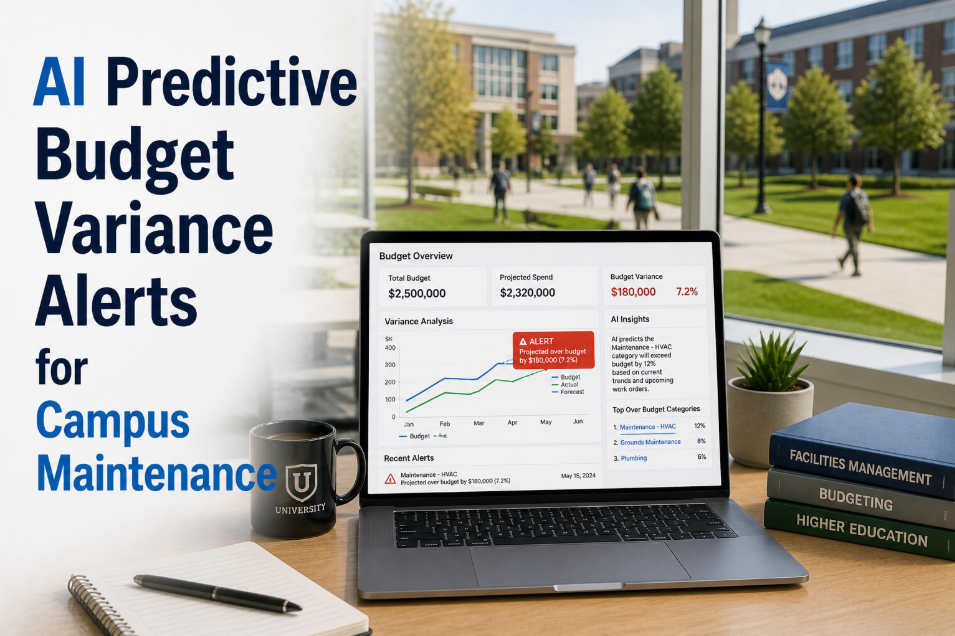
AI Predictive Budget Variance Alerts —
Overspending Detected in Days, Not Months. AI Flags Budget Anomalies by Building, System, and Category Before They Compound.
67%
Campuses discover overruns late
NACUBO survey — two-thirds of institutions detect maintenance budget variances only at quarterly or annual review
3.7x
Cost multiplier from late detection
Downstream impact of deferred projects displaced by unplanned overspends — APPA facilities benchmark
$220K
Average undetected annual variance
Per campus — budget leakage across buildings and systems invisible without automated monitoring
48 hrs
AI alert lead time
Anomalous spending pattern detected and flagged within 48 hours of the triggering work order
Know About the Overspend the Week It Starts — Not the Quarter It Ends
Oxmaint's AI budget monitoring watches every work order, every part purchase, every labor hour across every building and system — and alerts you the moment spending deviates from the predicted pattern.
What AI Budget Variance Detection Actually Does
Traditional budget tracking compares actual spend to budgeted amount at a point in time — typically monthly or quarterly. If the HVAC line item is budgeted at $1.2 million annually and the June report shows $680,000 spent, a human reviewer might notice that is slightly ahead of the 50% midpoint — or might not, because the report shows 30 other line items and the 6.7% variance does not look alarming in a table. AI budget variance detection works fundamentally differently. It does not wait for a human to review a report. It monitors every work order as it closes, every part as it is consumed, every labor hour as it is logged — and compares the running spend against a predictive model built from historical patterns, seasonal curves, asset age profiles, and PM schedule cadence. When spending in any category, building, or system deviates from the predicted trajectory by more than the configured threshold — typically 15–20% above predicted for that point in the year — the alert fires immediately. Not at the next quarterly review. Not when the director happens to open the spreadsheet. Within 48 hours of the anomaly. The difference between a $380,000 problem and a $1.4 million problem is detection speed. Want to see how AI budget monitoring would have flagged your last overspend? Start a free trial and load last year's data, or book a demo to walk through a variance alert scenario.
Four Budget Variance Patterns AI Catches Before Humans Do
01
Cascading Equipment Failures
Three chillers in aging buildings fail within six weeks. Each repair is coded as a separate emergency work order. No single repair looks alarming. But the AI sees the HVAC-mechanical subcategory spending at 2.3x the predicted rate for that month and alerts the director before the fourth failure hits — enabling a proactive decision to rent temporary cooling instead of another $95,000 emergency repair.
Detected: Week 3 of cascade | Manual detection: Month 5
02
Slow Parts Cost Inflation
A plumbing supplier increases prices 12% mid-year. Each individual work order looks normal — a flush valve costs $34 instead of $30. But across 400 plumbing work orders per year, the annual parts budget overruns by $18,000. AI detects the per-unit cost drift after the first 30 orders and alerts procurement to renegotiate or re-source before the variance compounds further.
Detected: After 30 orders | Manual detection: Year-end reconciliation
03
Single-Building Cost Anomaly
One residence hall built in 1968 consumes $142,000 in maintenance — 3.8x the campus average per-building cost. But when the budget is tracked at the department level, the anomaly disappears into the aggregate. AI monitors per-building spending against building-specific baselines and flags the outlier — providing the data needed to justify a capital renovation request instead of perpetual reactive spending.
Detected: Monthly building-level analysis | Manual detection: Never
04
Seasonal Spend Misalignment
Heating costs spike every November — that is expected. But this November the spike is 28% above the November average of the last four years. Is it weather? Is it a boiler running inefficiently? Is it a steam trap failure dumping energy? AI separates weather-normalized baseline from actual spending and identifies the excess as equipment-driven, not weather-driven — triggering an inspection that finds 14 failed steam traps costing $340/day in wasted energy.
Detected: Day 9 of anomaly | Manual detection: Next heating season comparison
Manual Budget Tracking vs. AI Variance Monitoring
| Budget Dimension |
Manual / Spreadsheet Tracking |
Oxmaint AI Variance Monitoring |
| Detection speed |
Quarterly review — 60–90 day lag from anomaly to awareness |
48-hour alert from the work order that triggers the variance |
| Granularity |
Department-level totals — building and system detail unavailable |
Building, floor, system, asset class, vendor, and technician level |
| Seasonal adjustment |
Flat monthly budget divided by 12 — seasonal patterns ignored |
AI model trained on 3+ years of seasonal spend curves per category |
| Root cause identification |
Variance identified — root cause requires manual investigation |
Alert includes contributing work orders, assets, and cost drivers |
| Predictive capability |
None — variance only visible after money is spent |
AI projects end-of-year spend based on current trajectory — alerts on projected overrun |
| Reporting effort |
8–12 hours per quarter to compile, reconcile, and present |
Real-time dashboard — exportable report generated in 30 seconds |
How Oxmaint AI Budget Variance Alerts Work
01
Historical Spend Model Training
Oxmaint ingests 2–4 years of historical maintenance spending — by building, by system, by category, by month. The AI builds a predicted spend curve for each budget dimension that accounts for seasonal patterns, PM schedule timing, and asset age profiles. The model improves continuously as new data flows in.
Spend predictions calibrated to your campus patterns
02
Real-Time Spend Tracking
Every closed work order adds its labor cost, parts cost, and contractor cost to the running total for its building, system, and category. The running total is compared against the predicted curve continuously — not at month-end, not at quarter-end. Every work order completion triggers a variance check across all relevant budget dimensions.
Variance calculated on every work order closure
03
Threshold-Based Alert Engine
Configurable alert thresholds per budget category: 15% above predicted for HVAC, 20% for plumbing, 10% for electrical — whatever matches your institutional risk tolerance. When cumulative spend in any dimension crosses its threshold, the alert fires to the maintenance director and the budget officer simultaneously with the contributing work orders attached.
Alerts tuned to your risk tolerance — zero noise
04
Root Cause Drill-Down
The alert does not just say "HVAC is over budget." It shows which buildings are driving the variance, which assets generated the highest-cost work orders, which vendors charged above-average rates, and whether the overspend is labor-driven, parts-driven, or contractor-driven. The director opens one screen and sees the full story — no manual investigation required.
Root cause visible in the alert — not buried in spreadsheets
05
End-of-Year Spend Projection
AI projects the end-of-year total for each budget category based on current spending trajectory, remaining PM schedule costs, known seasonal patterns, and open work order estimates. The projection updates daily. A director in July can see the projected December 31 total and make mid-year adjustments before the overspend materializes — not after.
See December's budget position in July
06
Budget Reallocation Recommendations
When one category is trending over budget, the AI identifies categories trending under budget and suggests reallocation options. Electrical is 12% under projected spend — reallocate $28,000 to HVAC to cover the chiller repair surge without tapping deferred maintenance reserves. The recommendation includes the specific transfer amount and the projected end-of-year impact on both categories.
Data-driven reallocation instead of emergency reserve raids
The Cost of Late vs. Early Budget Variance Detection
$1.4M
Cost of 5-month detection delay
Compounded deferred maintenance from projects displaced by undetected overspend
48 hrs
AI detection speed
Anomalous pattern flagged within two business days of the triggering work order
$220K
Average recovered annual leakage
Budget variances caught and corrected before compounding across fiscal year
87%
Reduction in reserve fund raids
Early detection enables mid-year reallocation instead of emergency reserve withdrawals
Every dollar of maintenance overspend that goes undetected for a quarter does not cost one dollar — it costs 3.7 dollars when the downstream impact of displaced projects, deferred maintenance compounding, and emergency reserve depletion is calculated. AI variance monitoring does not prevent equipment from failing — it prevents the financial cascade that follows when failures accumulate undetected in the budget data. The maintenance director who sees the variance in week three makes a $380,000 decision. The director who sees it in month five makes a $1.4 million decision. Same equipment failures. Radically different financial outcomes. See how AI budget monitoring works with your actual spend data — start a free trial and load your current-year budget, or book a demo to walk through a live variance alert scenario.
Frequently Asked Questions
How much historical data does the AI need to produce accurate predictions?+
The minimum for meaningful seasonal modeling is 24 months of work order data with cost attribution. Three to four years produces significantly better accuracy because the model can distinguish recurring patterns from one-time anomalies. If your campus is transitioning from paper or spreadsheet tracking, Oxmaint can ingest historical data from CSV exports during setup. For campuses with less than 24 months of digital data, the AI starts with industry benchmark curves and calibrates to your actual patterns within the first 6 months of operation.
Book a demo to discuss your data readiness.
Can alerts be configured differently for different budget categories?+
Yes — and they should be. High-volatility categories like HVAC and plumbing typically need wider thresholds (18–25%) to avoid false alerts from normal seasonal variation. Stable categories like elevator maintenance or grounds can use tighter thresholds (10–15%) because their spend patterns are highly predictable. Oxmaint allows threshold configuration per category, per building, and per cost type (labor vs. parts vs. contractor). Alert recipients are also configurable — the electrical supervisor gets electrical alerts, the plumbing supervisor gets plumbing alerts, and the director gets everything above a dollar threshold.
Does this replace our existing budget tracking in the ERP or finance system?+
No — Oxmaint AI budget monitoring operates at the operational level, tracking maintenance-specific costs at granularity the ERP cannot achieve (building, system, asset, technician). The ERP remains the financial system of record. Oxmaint feeds summarized cost data to the ERP through standard export or API integration. The value is that the maintenance director sees the variance in real time at the operational level — months before the variance becomes visible in the ERP's quarterly financial reports. The ERP confirms the number. Oxmaint finds the problem.
How does the system handle one-time capital expenditures vs. recurring maintenance?+
Work orders in Oxmaint are categorized as operating maintenance or capital expenditure. The AI variance model runs only on operating maintenance costs — capital projects are excluded from the predictive baseline. This prevents a $200,000 chiller replacement from triggering a false variance alert on the HVAC operating budget. Capital expenditures are tracked separately in the CapEx forecasting module with their own approval workflows and budget tracking.
Start a free trial to see how operating and capital budgets are separated in the dashboard.
AI Budget Variance Alerts — Oxmaint CMMS
Detect the Overspend in Week Three. Not Month Five. Not Year-End.
AI monitors every work order, every part, every labor hour — and alerts you the moment spending deviates from the pattern. Root cause attached. Reallocation options included. End-of-year projection updated daily. The $1.4 million surprise that never has to happen again.
48 hrs
Variance detection speed
$220K
Average annual leakage recovered
3.7x
Cost avoided per early detection
87%
Fewer emergency reserve raids