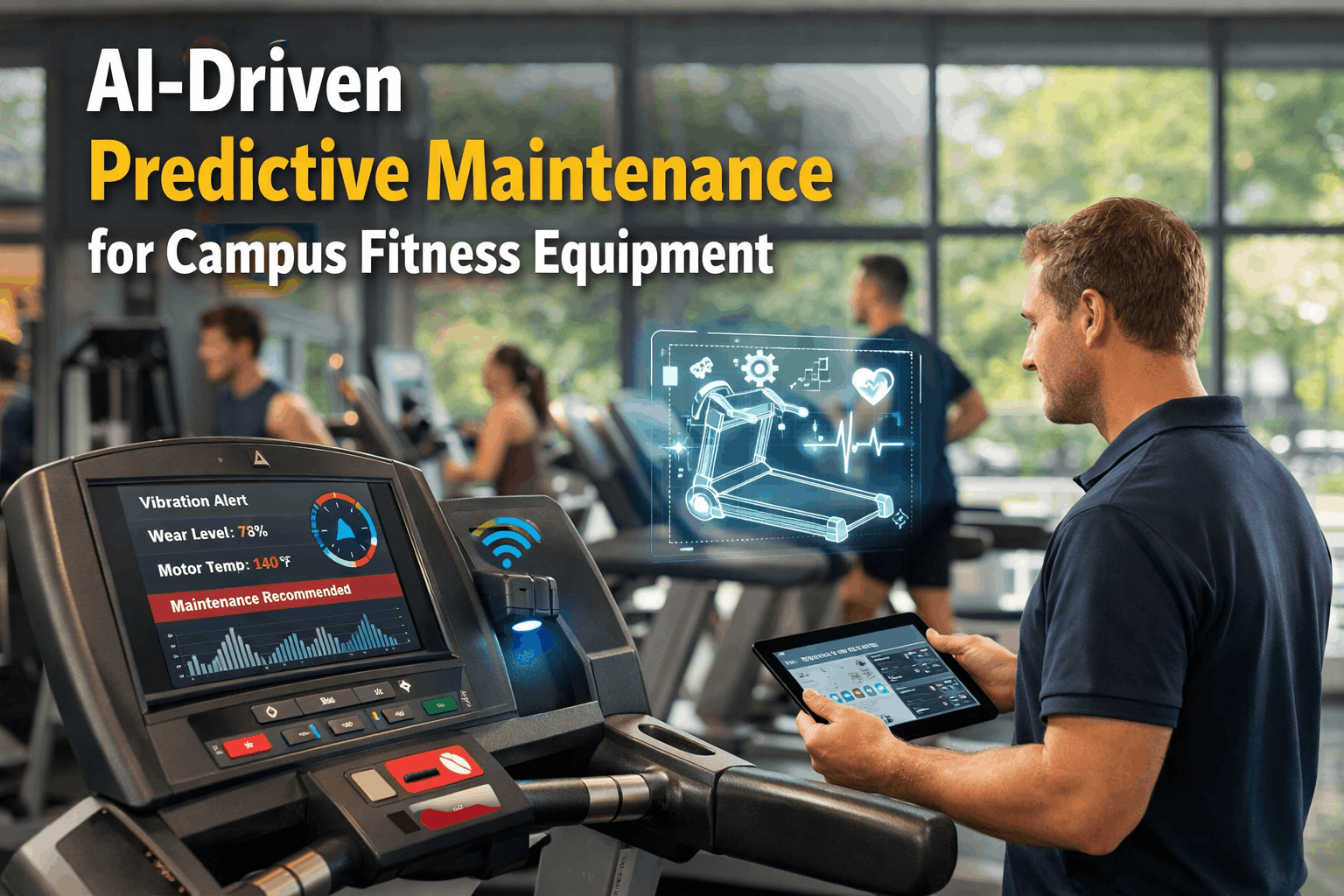
Your campus recreation center's treadmill doesn't fail without warning—it whispers first. A slight vibration increase. A motor running 3°F hotter than last month. A belt that's stretching imperceptibly. The difference between a scheduled repair and an emergency shutdown during finals week is whether you're listening to those whispers. AI-driven predictive maintenance transforms how campus facilities manage fitness equipment, moving from reactive firefighting to proactive intervention that prevents injuries, reduces costs, and maximizes equipment availability. Start listening to your equipment today—try Oxmaint free.
What This Guide Covers
This guide explains how predictive maintenance applies specifically to campus fitness environments—the sensors that matter, the data patterns that predict failures, and the practical steps to implement condition monitoring on gym equipment. You'll learn which equipment benefits most from IoT monitoring, what alert thresholds actually work, and how to build a predictive program that fits university budget and staffing realities.
Why Predictive Maintenance Matters for Campus Gyms
Traditional maintenance approaches—running equipment until it fails (reactive) or servicing on fixed schedules regardless of condition (preventive)—both leave money and safety on the table. Predictive maintenance uses real-time data to intervene at the optimal moment: after degradation begins but before failure occurs.
For campus recreation facilities, the stakes extend beyond equipment costs. A treadmill belt that fails mid-sprint causes injuries. A cable machine that snaps during use creates liability exposure. A weight room closure during January resolution season or finals stress relief period frustrates thousands of students. Predictive maintenance addresses all three concerns simultaneously. Schedule a demo to see how predictive alerts work.
73% of Equipment Failures
Show detectable warning signs days or weeks before catastrophic breakdown. Vibration changes, temperature increases, and current draw anomalies all provide advance notice—if you're monitoring for them.
Opportunity: Catch problems while they're still minor repairs, not major replacements
40-60% Cost Reduction
Facilities implementing predictive maintenance typically reduce overall maintenance costs by 40-60% compared to reactive approaches, while simultaneously improving equipment availability and extending asset life.
Opportunity: Stretch recreation center budgets further while improving service
Student Safety First
Campus fitness centers serve users ranging from first-time gym visitors to varsity athletes. Many don't recognize equipment warning signs. Predictive monitoring protects users who can't protect themselves.
Opportunity: Prevent injuries before they occur, reduce liability exposure
Scheduled Interventions
Predictive data lets you schedule repairs during low-usage periods—summer sessions, holiday breaks, early mornings—rather than emergency closures during peak demand.
Opportunity: Maximize equipment availability when students need it most
How Predictive Maintenance Works for Gym Equipment
Predictive maintenance relies on sensors that continuously monitor equipment condition, software that analyzes the data to detect anomalies, and alert systems that notify maintenance teams when intervention is needed. Here's how the system works in practice for campus fitness equipment. Get started with condition monitoring—sign up free.
Step 1: Sensor Deployment
Install appropriate sensors on critical equipment—vibration sensors on motors, temperature sensors on bearings and motors, current monitors on electrical systems. Modern IoT sensors are wireless, battery-powered, and easy to retrofit on existing equipment.
Step 2: Baseline Establishment
When equipment is known to be in good condition, the system records baseline readings. Normal vibration amplitude, typical motor temperature, standard current draw—these become the reference points for detecting change.
Step 3: Continuous Monitoring
Sensors transmit data continuously or at regular intervals. Cloud-based software stores the data, displays trends, and applies AI algorithms to detect patterns that indicate developing problems.
Step 4: Anomaly Detection
When readings deviate from baseline beyond defined thresholds, the system generates alerts. AI learns what patterns precede specific failure modes, improving prediction accuracy over time.
Key Monitoring Points for Campus Fitness Equipment
Not all gym equipment benefits equally from predictive monitoring. Focus resources on equipment where failures are expensive, dangerous, or highly disruptive. The following table identifies the most valuable monitoring points for typical campus fitness centers. Book a consultation to prioritize your monitoring strategy.
| Equipment | Parameter | Monitoring Method | Alert Threshold |
|---|---|---|---|
| Treadmill Motor | Temperature | Thermal sensor | >15°F above baseline |
| Treadmill Motor | Vibration | Accelerometer | >2x baseline amplitude |
| Treadmill Belt | Tension/Slip | Current draw monitoring | >20% deviation from baseline |
| Elliptical Drive | Vibration | Accelerometer | Frequency shift indicating bearing wear |
| Cable Machine | Cable tension | Load cell or visual AI | Stretch >5% from baseline |
| Stationary Bike | Pedal bearing | Vibration sensor | Harmonic patterns indicating wear |
| Weight Stack | Guide rod alignment | Position sensor | >2mm deviation from center |
Swipe to see more →
Equipment-Specific Predictive Strategies
Different equipment types exhibit different failure patterns and benefit from different monitoring approaches. Here's how to apply predictive maintenance to the major categories of campus fitness equipment.
Treadmills: The Highest-Priority Target
Treadmills account for more gym injuries than any other equipment category and typically represent the largest maintenance expense in campus fitness centers. They're also ideal candidates for predictive monitoring because their failure modes produce clear early warning signals. Start monitoring your treadmills today—try free.
Motor Degradation
What Sensors Detect:
- Temperature increase as bearings wear or windings degrade
- Vibration amplitude increase from bearing roughness
- Current draw increase as motor works harder
- Speed inconsistency from controller issues
Predictive Value: Motor failures typically show symptoms 2-4 weeks before complete failure, allowing scheduled replacement during low-usage periods
Belt Wear and Tension
What Sensors Detect:
- Motor current spikes when belt slips under load
- Speed variation as belt stretches unevenly
- Temperature increase from friction on dry deck
- Vibration patterns from belt tracking issues
Predictive Value: Belt problems develop over days to weeks—early detection prevents the sudden slip that causes falls
Deck Lubrication
What Sensors Detect:
- Motor temperature increase from friction
- Current draw increase as resistance rises
- Belt temperature increase at deck interface
- Speed variations as friction changes
Predictive Value: Lubrication issues show gradual degradation patterns—easy to schedule maintenance before damage occurs
Incline Mechanism
What Sensors Detect:
- Motor current during elevation changes
- Position sensor accuracy drift
- Cycle time changes for elevation adjustment
- Unusual sounds (acoustic monitoring)
Predictive Value: Incline motor failures often strand treadmills at awkward angles—prediction prevents mid-workout failures
Strength Equipment: Preventing Catastrophic Failures
Cable machines and selectorized equipment present high-consequence failure modes. A snapped cable or failed pulley drops weight stacks suddenly—creating serious injury risk. Predictive monitoring focuses on the components most likely to fail catastrophically. See how cable monitoring prevents injuries—schedule a demo.
Critical Monitoring Points
Cable Integrity
Visual AI systems can detect cable fraying before it's visible to human inspection. Tension sensors identify cable stretch that indicates fatigue. Load monitoring reveals cables that are weakening under normal use.
Alert Trigger: Any visible fraying, >5% stretch from baseline, or load anomalies during normal operation
Pulley Bearings
Vibration sensors on pulleys detect bearing wear through characteristic frequency patterns. Temperature sensors identify bearings running hot from friction. Acoustic monitoring catches the grinding sounds of imminent failure.
Alert Trigger: Vibration frequency shift, temperature >10°F above baseline, or acoustic anomaly detection
Weight Stack Alignment
Position sensors verify weight stacks are tracking correctly on guide rods. Misalignment causes premature wear and can lead to stack binding. Current monitoring on motorized adjusters reveals mechanical resistance.
Alert Trigger: Position deviation >2mm, current draw >15% above baseline, or cycle time increase
Cardio Equipment: Ellipticals and Bikes
Ellipticals and stationary bikes share common failure modes centered on bearings, drive systems, and resistance mechanisms. While generally less dangerous than treadmills, failures still create downtime and user frustration.
Monitoring Priorities
Pedal and Crank Bearings
The high-cycle pedaling motion wears bearings predictably. Vibration sensors detect the characteristic signatures of bearing degradation—increasing amplitude and frequency shifts that indicate ball or race wear.
Predictive Lead Time: 2-6 weeks from first detectable symptoms to failure
Resistance Systems
Magnetic resistance systems are generally reliable, but the servo motors that position magnets can fail. Current monitoring and position verification reveal developing problems before resistance becomes inconsistent.
Predictive Lead Time: 1-3 weeks for servo motor issues
Drive Belts and Chains
Belt-driven ellipticals and chain-driven bikes show wear through vibration patterns and current draw changes. Stretched belts and worn chains create distinctive signatures detectable well before slip or breakage.
Predictive Lead Time: 3-8 weeks from detectable wear to replacement need
Ready to Predict Before Problems Occur?
Oxmaint integrates with IoT sensors to bring predictive maintenance capabilities to campus fitness facilities—automatic alerts, trend visualization, and AI-powered failure prediction.
AI and Machine Learning in Predictive Maintenance
The "AI" in AI-driven predictive maintenance refers to machine learning algorithms that improve prediction accuracy over time. Unlike simple threshold alerts, AI systems learn the specific patterns that precede failures in your equipment, under your usage conditions. Experience AI-powered predictions—start your free trial.
Pattern Recognition
Machine learning algorithms identify subtle patterns in sensor data that humans would miss. The combination of slight vibration increase, minor temperature rise, and small current draw change might individually seem normal but together predict bearing failure.
Benefit: Catches failures that simple threshold monitoring would miss
Continuous Learning
Every confirmed failure teaches the AI system. When a motor fails after showing specific patterns, the system updates its models. Over time, predictions become more accurate and lead times extend.
Benefit: System improves automatically with use
Equipment-Specific Models
AI can learn that your Life Fitness treadmills show different pre-failure patterns than your Precor units. It adapts predictions to specific equipment brands, models, and even individual machines with unique characteristics.
Benefit: More accurate than generic maintenance schedules
Remaining Useful Life
Advanced AI doesn't just predict "failure imminent"—it estimates remaining useful life. "Motor bearing has approximately 340 operating hours remaining" allows precise scheduling and parts ordering.
Benefit: Optimize intervention timing and parts inventory
Implementing Predictive Maintenance: A Practical Roadmap
Moving from reactive or basic preventive maintenance to predictive capabilities is a journey. The following roadmap provides a realistic timeline for campus recreation facilities with typical budget and staffing constraints. Get a customized implementation plan—book a consultation.
Foundation Building
- Implement CMMS to establish asset registry and work order tracking
- Document current failure history and maintenance costs
- Identify highest-priority equipment for predictive monitoring
- Train staff on new systems and predictive concepts
Expected Outcome: Baseline data established, staff prepared for new approach
Pilot Deployment
- Install sensors on 5-10 highest-priority assets (typically treadmills)
- Establish baselines during known-good operation
- Configure initial alert thresholds based on industry standards
- Integrate sensor data with CMMS for automatic work order generation
Expected Outcome: First predictive alerts received, validation of approach
Expansion and Refinement
- Expand monitoring to additional equipment categories
- Refine alert thresholds based on actual failure correlation
- Train AI models on your specific equipment and usage patterns
- Develop response protocols for different alert types
Expected Outcome: Predictive accuracy improving, emergency repairs declining
Optimization
- Full coverage of critical equipment achieved
- AI models providing reliable remaining useful life estimates
- Parts ordering integrated with predictions for just-in-time inventory
- Maintenance scheduling fully optimized around predictions
Expected Outcome: 40-60% reduction in unplanned downtime, measurable cost savings
Sensor Technology for Gym Environments
Selecting appropriate sensors for campus fitness environments requires consideration of the physical conditions, data requirements, and practical installation constraints. Integrate your sensors with Oxmaint—sign up free.
Vibration Sensors (Accelerometers)
Measure mechanical vibration to detect bearing wear, imbalance, and looseness. Modern MEMS accelerometers are small, inexpensive, and battery-powered. Mount on motor housings, bearing locations, and drive components.
Temperature Sensors
Track thermal conditions of motors, bearings, and electrical components. Rising temperature often indicates increased friction, electrical problems, or overload conditions. Wireless sensors simplify retrofit installation.
Current Monitors
Measure electrical current draw to detect motor degradation, mechanical binding, and belt slip. Non-invasive clamp-on sensors install without electrical work. Current patterns reveal problems before they cause failures.
Acoustic Sensors
Detect unusual sounds that indicate mechanical problems. AI-powered acoustic monitoring learns normal equipment sounds and alerts on anomalies. Particularly valuable for detecting bearing and gear problems.
Pro Tip: Start Simple
Don't over-engineer your initial deployment. Start with temperature and vibration monitoring on your highest-risk equipment. As you gain experience and prove ROI, expand to more sophisticated monitoring. A simple system that's actually used beats a complex system that overwhelms your team.
Integration with Campus Systems
Predictive maintenance delivers maximum value when integrated with your broader campus operations. Sensor data should flow into systems that enable action, not just accumulate in isolated dashboards. See seamless integration in action—schedule a demo.
CMMS Integration
When sensors detect anomalies, work orders should generate automatically with relevant data attached. Technicians see exactly what triggered the alert and what data supports intervention.
Inventory Management
Remaining useful life predictions enable just-in-time parts ordering. When the system predicts a bearing has 30 days remaining, automatic reorder ensures the part arrives before it's needed.
Scheduling Systems
Integration with facility scheduling enables maintenance during optimal windows. Schedule repairs during summer sessions, early mornings, or semester breaks rather than prime usage hours.
Budget Planning
Predictive data informs budget forecasts. When you know which equipment will need major service in the coming year, budget requests become data-driven rather than guesswork.
Measuring Success: KPIs for Predictive Maintenance
Track these key performance indicators to measure the effectiveness of your predictive maintenance program and demonstrate value to administrators. Start tracking your maintenance KPIs—try free today.
Common Implementation Challenges
Understanding potential obstacles helps you plan for successful implementation. Here are the most common challenges campus facilities encounter and how to address them. Discuss your challenges with a specialist—book a call.
Budget Constraints
The Challenge:
- Sensors and monitoring systems require upfront investment
- University procurement processes can be slow
- Competing priorities for limited facilities budgets
Solution: Start with pilot on highest-cost equipment, document savings, use data to justify expansion. ROI typically achieved within 6-12 months.
Staff Capacity
The Challenge:
- Small maintenance teams already stretched thin
- New systems require learning curve
- Alert fatigue if thresholds poorly calibrated
Solution: Choose user-friendly platforms, start simple, refine thresholds to minimize false alerts. System should reduce workload, not add to it.
Data Quality
The Challenge:
- Sensors require proper installation for accurate data
- Baseline establishment needs equipment in known-good condition
- Environmental factors can affect readings
Solution: Follow sensor installation best practices, validate baselines with manual inspection, account for environmental variables in analysis.
Change Management
The Challenge:
- Staff accustomed to reactive approaches
- Trust in predictions takes time to develop
- Organizational inertia resists new methods
Solution: Celebrate early wins, share success stories, involve technicians in system refinement. Trust builds as predictions prove accurate.
Start Your Predictive Journey Today
Oxmaint provides the foundation for predictive maintenance—asset tracking, work order management, and sensor integration—all designed for facilities teams managing fitness equipment.
Expert Perspective
Industry Insight
"The campus recreation facilities that achieve the best equipment reliability all share one characteristic: they shifted from asking 'what broke?' to asking 'what's about to break?' That mindset change—supported by the right data and tools—transforms maintenance from a cost center to a value driver."
"In my experience, the biggest barrier isn't technology or budget—it's the belief that predictive maintenance is only for large industrial operations. A campus fitness center with 50 pieces of equipment can implement predictive monitoring just as effectively as a factory with 500 machines. The principles scale."
Frequently Asked Questions
What's the minimum equipment count for predictive maintenance to be worthwhile?
There's no minimum—even a single high-value or safety-critical asset can justify monitoring. However, most campus fitness centers see the best ROI starting with 10-20 pieces of equipment, typically focusing on treadmills and cable machines where failures are most costly or dangerous.
How much do sensors cost for typical gym equipment?
Basic vibration and temperature sensors range from $50-200 per unit. A comprehensive monitoring setup for a treadmill (motor temp, motor vibration, current monitoring) typically costs $200-400 in hardware. Costs continue to decline as IoT technology matures.
Can we retrofit sensors on existing equipment?
Yes—modern IoT sensors are designed for retrofit installation. Wireless, battery-powered sensors mount externally without modifying equipment. Non-invasive current monitors clamp around power cables. No equipment modification required for most monitoring applications.
How long until we see results from predictive maintenance?
Initial results—catching developing problems before failure—often appear within the first 1-2 months of monitoring. Measurable improvements in downtime and costs typically emerge by month 6. Full optimization with trained AI models takes 12-18 months.
Do we need dedicated staff to manage predictive systems?
No—modern platforms are designed for small teams. Alerts come via email or mobile notification. The CMMS integration means work orders generate automatically. Your existing maintenance staff manages the response; the system handles the monitoring and analysis.
Transform Your Equipment Maintenance
Predictive maintenance isn't just for factories—campus fitness facilities can achieve the same benefits: reduced downtime, lower costs, and improved safety. Oxmaint provides the foundation you need to move from reactive to predictive.
No credit card required. See results in your first 30 days.