School Playground Safety Inspection Checklist: CPSC and ASTM Standards

By jamie lanister on March 23, 2026

school-playground-safety-inspection-checklist-cpsc-astm

Playground injuries send more than 200,000 children to emergency rooms in the United States every year — and the majority are preventable with structured inspection. The CPSC Handbook for Public Playground Safety and ASTM F1487 establish the inspection framework that schools, districts, and facility managers need to protect children and document compliance. This checklist covers every inspection item required under those standards: fall zones, surfacing depth, equipment hardware, entrapment hazards, age-appropriate design, and ADA accessibility — structured for both the monthly operator inspection and the annual CPSI-certified inspection, and built for direct import into Oxmaint's compliance tracking module.

2026 Edition · CPSC / ASTM F1487 · K-12 Schools
School Playground Safety Inspection Checklist: CPSC and ASTM Standards
Fall zones, surfacing depth, hardware condition, entrapment hazards, age-appropriate design, and ADA accessibility — monthly and annual inspection protocols per CPSC and ASTM F1487.
7
Inspection categories

80+
Inspection tasks

CPSC
ASTM F1487

Free
CMMS import
Inspection Frequencies and Who Should Inspect
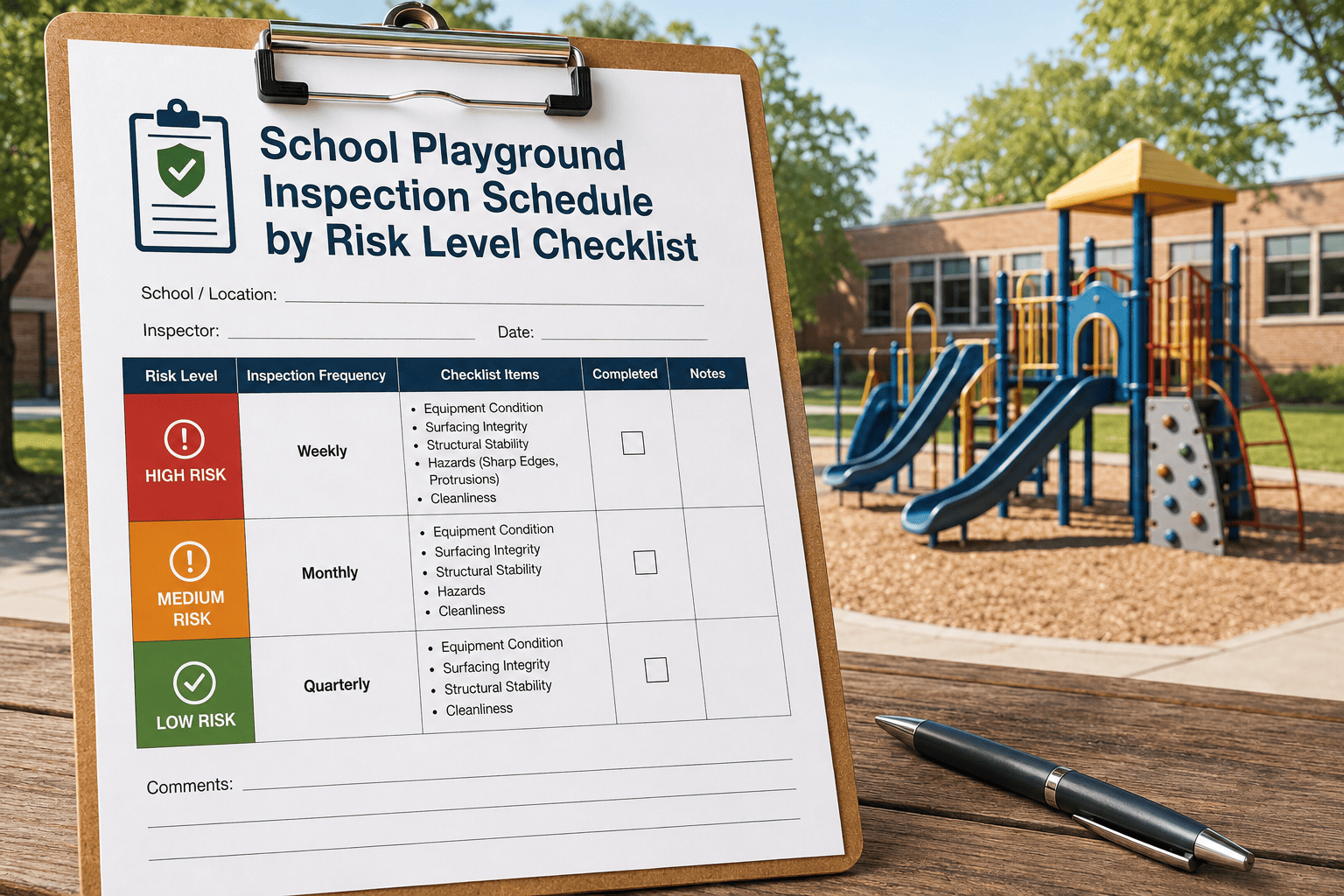
Tasks are marked by frequency: Daily Monthly Annual. Daily checks are performed by trained school staff before use. Monthly checks are performed by the designated facilities or maintenance team. Annual inspections must be performed by a Certified Playground Safety Inspector (CPSI). All findings must be documented — an undocumented inspection provides no legal protection. Import this checklist into Oxmaint to generate timestamped records automatically.

1. Surfacing and Fall Zones

Surfacing failures cause more playground injuries than any other factor — 79% of playground injuries involve falls, and inadequate surfacing depth is the leading contributing cause. ASTM F1292 specifies the required fall height protection for each surfacing material. CPSC guidelines require loose-fill materials to maintain the minimum depth at all points within the fall zone, not just at the center of the playground.

DailySurfacing Visual Check
MonthlySurfacing Depth Measurement
Annual (CPSI)ASTM F1292 Surfacing Compliance

2. Hardware, Fasteners, and Moving Parts

Hardware failures cause lacerations, punctures, and entanglement injuries. Protruding bolt ends — those extending more than one thread beyond a nut — are a documented CPSC hazard. Exposed fastener heads with sharp edges, deteriorated bushings, and worn pivot bearings all appear on CPSC recall lists and injury reports. Hardware inspection must document condition, not just presence.

MonthlyFastener and Hardware Inspection
MonthlyMoving Components
Annual (CPSI)Hardware Compliance Review
Every Inspection Automatically Creates a Legal Protection Record in Oxmaint
When a playground injury occurs, the first question from parents, attorneys, and insurance investigators is "when was this last inspected and what did the record show?" Oxmaint timestamps every inspection, records the inspector name, and flags any overdue tasks — giving your school district a documented, defensible inspection programme.

3. Entrapment Hazards

Head entrapment is responsible for the majority of playground fatalities. ASTM F1487 defines two critical openings: those between 3.5 inches and 9 inches are head entrapment hazards; those less than 3.5 inches are head and neck entrapment hazards. Both must be eliminated from all play structures. The Go/No-Go probe is the only reliable measurement tool — visual estimation is not sufficient.

MonthlyOpening and Gap Inspection
MonthlyStrangulation and Entanglement Hazards
Annual (CPSI)Full Entrapment Assessment

4. Structural Integrity

Structural failures — post corrosion, footing movement, cracked plastic components — are less common than surfacing and hardware issues but produce more severe injuries when they occur. Wood posts absorb moisture at the ground line and rot from the inside; the exterior can look sound while the core has failed. Plastic components fatigue and crack from UV exposure. Neither failure announces itself before it happens.

MonthlyStructural Visual Inspection
Annual (CPSI)Structural Integrity Assessment

5. Age Appropriateness and Use Zone Separation

ASTM F1487 establishes distinct design criteria for equipment intended for children aged 2–5 and 5–12. Mixing age-group equipment in the same use zone — or without adequate separation — creates injury risk when older children's play patterns conflict with younger children's capabilities. Age-appropriate design also determines maximum platform heights, riser heights on climbing components, and guardrail requirements.

MonthlyAge Zone Inspection
Annual (CPSI)ASTM F1487 Age Compliance
Track Inspection Due Dates Across Every School Playground — Oxmaint Alerts Before Deadlines
Oxmaint schedules daily, monthly, and annual inspection work orders for every playground asset — sends alerts to the responsible staff member before the inspection window closes, and records every completion with the inspector's identity and timestamp.

6. ADA Accessibility

ADA requirements for playgrounds are governed by the 2010 ADA Standards for Accessible Design, specifically the Play Areas guidelines under Section 240. Schools and districts that receive federal funding have additional obligations under Section 504 of the Rehabilitation Act. At minimum, each accessible play area must have an accessible route to the play components and a minimum number of ground-level and elevated accessible components based on the total number of components.

MonthlyAccessible Route Inspection
Annual (CPSI)ADA Compliance Audit

7. General Site Safety

General site safety covers the hazards that exist around the playground rather than on the equipment — the conditions that fall outside the CPSC and ASTM equipment standards but create injury risk: tree branch hazards, inadequate perimeter barriers, drainage failures, and inadequate sight lines for supervision. These conditions are not covered by CPSI certification requirements but are a routine source of premises liability.

DailyPre-Use Site Safety Check
MonthlySite Conditions Inspection
Annual (CPSI)Site Safety and Documentation Review

Frequently Asked Questions

Three levels are required. Daily pre-use checks by trained staff before children arrive — focusing on hazardous objects, vandalism, and obvious damage. Monthly inspections by the facilities or maintenance team covering surfacing depth, hardware condition, and entrapment hazards. Annual inspections by a Certified Playground Safety Inspector (CPSI) covering full CPSC and ASTM F1487 compliance. All three levels must be documented.
Minimum depth depends on the equipment's critical fall height and the surfacing material. For engineered wood fibre (EWF), CPSC guidelines require 12 inches for equipment with a fall height up to 8 feet. For sand or pea gravel, 12 inches is required for fall heights up to 5 feet. Depth must be measured at the point of greatest displacement — under swings and at slide exits — not at the centre of the playground. Rubber tiles and poured-in-place surfacing are rated by the manufacturer per ASTM F1292 testing.
Two critical ranges: openings between 3.5 and 9 inches are head entrapment hazards — a child's head can enter but cannot exit. Openings less than 3.5 inches are head and neck entrapment hazards for young children. Both must be eliminated from play structures. A Go/No-Go probe is required for measurement — visual estimation is not sufficient. V-shaped angle openings of less than 55 degrees are also entrapment hazards regardless of dimension.
CPSC guidelines strongly recommend CPSI-certified inspectors for annual inspections, and many school district insurance policies and state regulations require it. A CPSI provides legally defensible documentation of compliance — evidence that the inspection was conducted by a qualified person using the correct methodology. The CPSI designation is issued by the National Recreation and Park Association (NRPA). Book a demo to see how Oxmaint manages CPSI inspection records alongside routine maintenance.
Oxmaint creates an asset record for each playground — scheduling daily, monthly, and annual inspection work orders automatically. Each completed inspection is timestamped with the inspector's name and any findings recorded. Overdue inspections trigger alerts before the compliance window closes. All records are exportable for insurance, legal review, or district audit. Start your free trial to import this checklist and go live within 48 hours.
Compliance & Audit Trail — Oxmaint
Document Every Playground Inspection — Before the Incident, Not After.
80+
inspection tasks

CPSC
ASTM F1487

48 hrs
to go live

Free
to start
Auto-scheduled daily, monthly, and CPSI annual work orders per playground
Timestamped inspection records — legally defensible documentation automatically
Overdue alerts — notified before the inspection window closes, not after
Multi-playground dashboard — all sites, all compliance status, one view

Share This Story, Choose Your Platform!