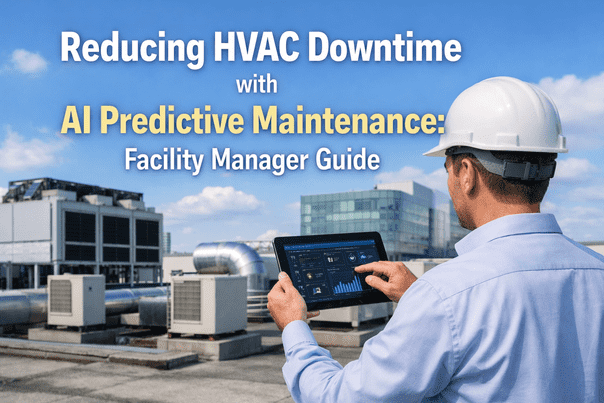
HVAC systems account for 40 to 60% of a commercial building's total energy spend and represent the single highest-cost emergency repair category in facility management, with average unplanned HVAC events costing $8,400 to $22,000 per occurrence including emergency contractor premiums, tenant disruption costs, and temporary cooling or heating provision. Yet 71% of HVAC failures that result in full system shutdown show measurable precursor conditions in sensor data 7 to 21 days before failure, conditions that AI predictive maintenance systems detect and act on before occupants or facility managers are even aware a problem exists. This guide covers how AI predictive maintenance works specifically for HVAC systems, the failure modes it catches, the implementation steps for a commercial building portfolio, and the verified cost savings data from facilities that have deployed it. Sign up free on Oxmaint to see HVAC predictive maintenance configured for your portfolio, or book a demo to review the implementation path for your building systems.
Cut HVAC Emergency Repair Costs by Up to 60% With Oxmaint Predictive Maintenance
IoT sensor integration, ML failure prediction, and automatic work order generation for every HVAC system in your portfolio. Live in 14 days with pre-built models for chillers, AHUs, fan coils, and cooling towers.
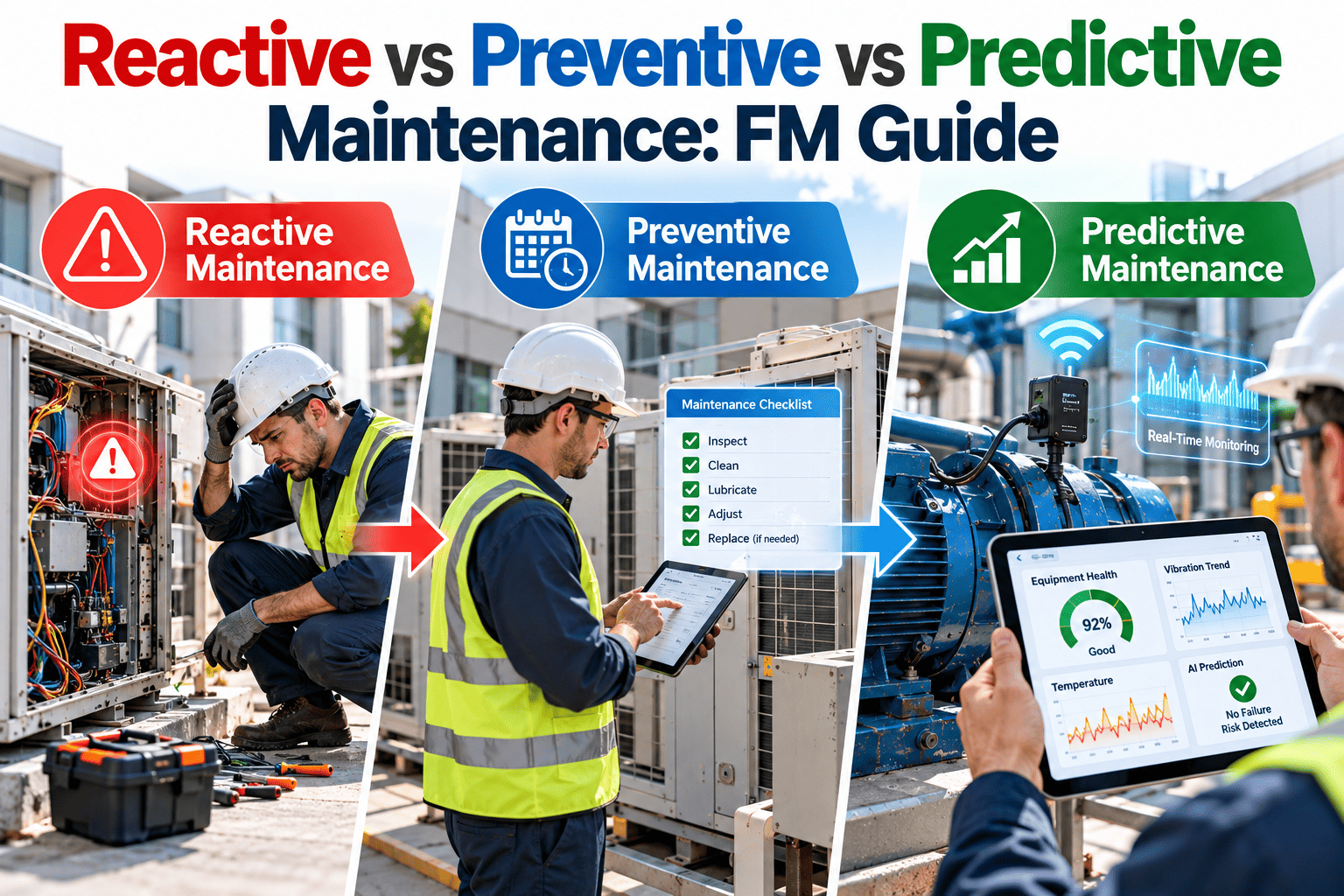
HVAC predictive maintenance uses IoT sensors on motors, bearings, compressors, and coils to continuously monitor vibration, temperature, current draw, and pressure. Machine learning models trained on HVAC failure patterns analyse the sensor streams, identifying deterioration signatures 7 to 21 days before systems fail. The result: planned intervention replaces emergency breakdown, emergency contractor premiums are eliminated, and technician time is spent on assets that genuinely need attention rather than calendar-driven visits to healthy systems.
HVAC Failure Modes That AI Predictive Maintenance Catches Before Shutdown
Not all HVAC failures are equal in their detectability or cost impact. The failure modes below account for 78% of unplanned HVAC downtime events in commercial facilities and all produce measurable sensor anomalies 7 to 21 days before the failure event, anomalies that AI monitoring systems detect and escalate before the system goes down.
Vibration sensor anomaly detectable 14 to 28 days before bearing failure. Undetected bearing failure results in compressor seizure costing $18,000 to $65,000 in parts and labour versus a $400 to $800 planned bearing replacement at the detected stage.
Detection lead: 14 to 28 days · High ROISuction and discharge pressure trends deviate from baseline 7 to 14 days before compressor damage occurs. Early detection saves $2,400 to $8,000 in refrigerant recovery and compressor repair versus late-stage failure at full event cost.
Detection lead: 7 to 14 days · High ROIVibration and current draw deviations detectable 14 to 21 days before motor seizure. Planned bearing replacement at $350 to $700 versus emergency motor replacement at $4,800 to $12,000 plus chiller downtime during the event.
Detection lead: 14 to 21 days · High ROIVibration signature changes detectably 7 to 14 days before belt snap. Belt replacement on a scheduled visit costs $80 to $240. Emergency after-hours response to a failed AHU costs $1,400 to $3,800 plus zone disruption for occupied space.
Detection lead: 7 to 14 days · Medium ROIMotor casing temperature trends upward 10 to 18 days before thermal protection trips and shuts down the air handling unit. Monitoring prevents the 6 to 18 hour recovery window and $2,200 to $7,400 after-hours restoration cost.
Detection lead: 10 to 18 days · High ROIInternal temperature sensor data shows thermal rise 14 to 21 days before protection shutdown. VFD replacement costs $3,400 to $18,000. Early intervention addresses root cause at $200 to $600, avoiding the full replacement event entirely.
Detection lead: 14 to 21 days · High ROIVibration, temperature, and current deviations are detectable 7 to 14 days before pump bearing seizure. Planned bearing replacement at $350 to $800 versus emergency pump replacement at $1,800 to $12,000 depending on pump size and application.
Detection lead: 7 to 14 days · High ROISupply air temperature trends lower while return air delta-T decreases 7 to 10 days before coil ice-over shuts down the unit. Intervention at this point prevents a 24 to 48 hour recovery cycle and the costs associated with it.
Detection lead: 7 to 10 days · Medium ROIDetect Every One of These HVAC Failure Modes Before Shutdown With Oxmaint
Pre-trained ML models for chillers, AHUs, cooling towers, and fan coils detect all these failure modes automatically. Work orders generated at the optimal intervention point, 14 to 28 days before failure. Book a demo to see HVAC monitoring configured for your systems.
How AI Predictive Maintenance Monitors HVAC Systems
AI predictive maintenance for HVAC works through a four-layer technology stack: sensor deployment, data pipeline, ML analysis, and CMMS work order integration. The value of the system depends on all four operating together correctly.
Four-Step HVAC Predictive Maintenance Implementation
| Implementation Step | Timeline | Key Activities | Outcome |
|---|---|---|---|
| Step 1: HVAC Asset Registry and Prioritisation | Days 1 to 3 | All HVAC equipment registered in CMMS with specs, age, and replacement value. Critical assets prioritised for sensor deployment based on replacement cost and downtime impact. | Asset hierarchy live. Priority sensor list confirmed. |
| Step 2: Sensor Deployment and Commissioning | Days 3 to 8 | Wireless vibration, temperature, and current sensors installed on priority assets. IoT gateway commissioned at each building. Data flow verified from sensor to cloud pipeline. | All priority assets transmitting live sensor data. |
| Step 3: Baseline and Model Activation | Days 8 to 14 | Pre-trained HVAC ML models activated per equipment class. Operational baselines established from first 5 to 7 days of live data. Anomaly thresholds calibrated to site-specific conditions. | Models live at 74% baseline prediction accuracy. |
| Step 4: Work Order Integration and Go-Live | Days 14 to 21 | Prediction-to-work-order automation enabled. Technician mobile training completed. First auto-generated predictive work orders reviewed by FM manager before full autonomous operation is activated. | Full predictive programme live. First ROI measurable at 6 months. |
Verified HVAC Predictive Maintenance Cost Savings Data
The ROI data below reflects benchmark results from commercial building portfolios that deployed AI predictive maintenance for HVAC systems and tracked outcomes over 12 and 24 month periods. Portfolio sizes ranged from 3 to 22 buildings with HVAC asset counts of 40 to 280 monitored units.
HVAC System Coverage in Oxmaint Predictive Maintenance Console
| HVAC System | Sensors Required | Failure Modes Detected | Detection Lead Time | Avg Repair Cost Avoided |
|---|---|---|---|---|
| Water-Cooled Chiller | Vibration, temperature, current, pressure | Compressor bearing, tube fouling, refrigerant leak, water treatment | 14 to 28 days | $18K to $65K |
| Air-Cooled Chiller | Vibration, temperature, current, pressure | Compressor bearing, condenser fouling, fan motor, refrigerant | 10 to 21 days | $12K to $45K |
| Air Handling Unit (AHU) | Vibration, temperature, differential pressure, current | Fan bearing, belt, motor overheating, coil fouling, VFD | 7 to 18 days | $2.2K to $18K |
| Cooling Tower | Vibration, temperature, flow | Fan motor, gearbox, basin conditions, biological growth | 10 to 21 days | $4.8K to $22K |
| Centrifugal Pump | Vibration, temperature, current, pressure | Bearing failure, impeller cavitation, seal failure, motor overload | 7 to 14 days | $1.8K to $12K |
| Fan Coil Unit (FCU) | Temperature, current (via BAS) | Motor failure, coil fouling, valve failure via BAS integration | 5 to 14 days | $400 to $2.4K |
Frequently Asked Questions: HVAC Predictive Maintenance
Reduce HVAC Downtime by 60% With AI Predictive Maintenance Across Your Full Portfolio
Pre-trained HVAC ML models, IoT sensor integration, and automatic work order generation deployed across your chiller plant, AHUs, cooling towers, and pumps in 14 to 21 days. No infrastructure replacement, no IT project, full ROI visibility from month one.