Building Automation Systems (BAS) are the central nervous system of smart buildings — controlling HVAC, lighting, access control, and energy management. Yet most facility managers treat BAS as a black box, discovering faults only when occupants complain or energy bills spike. A single failed outdoor air temperature sensor can reduce chiller efficiency by 15–20% for an entire cooling season. An uncalibrated CO₂ sensor can drive over-ventilation, wasting $5,000–$15,000 annually in a mid-sized office building. Without structured maintenance, BAS controllers drift, actuators stick, and network communication failures create blind spots across your facility. OxMaint's preventive maintenance platform schedules BAS inspections, logs sensor calibration dates, and auto-generates work orders for out-of-range readings — integrating directly with your building automation network. Book a demo to see how BAS maintenance connects to your CMMS.
Smart Buildings · BAS Preventive Maintenance · CMMS Integration
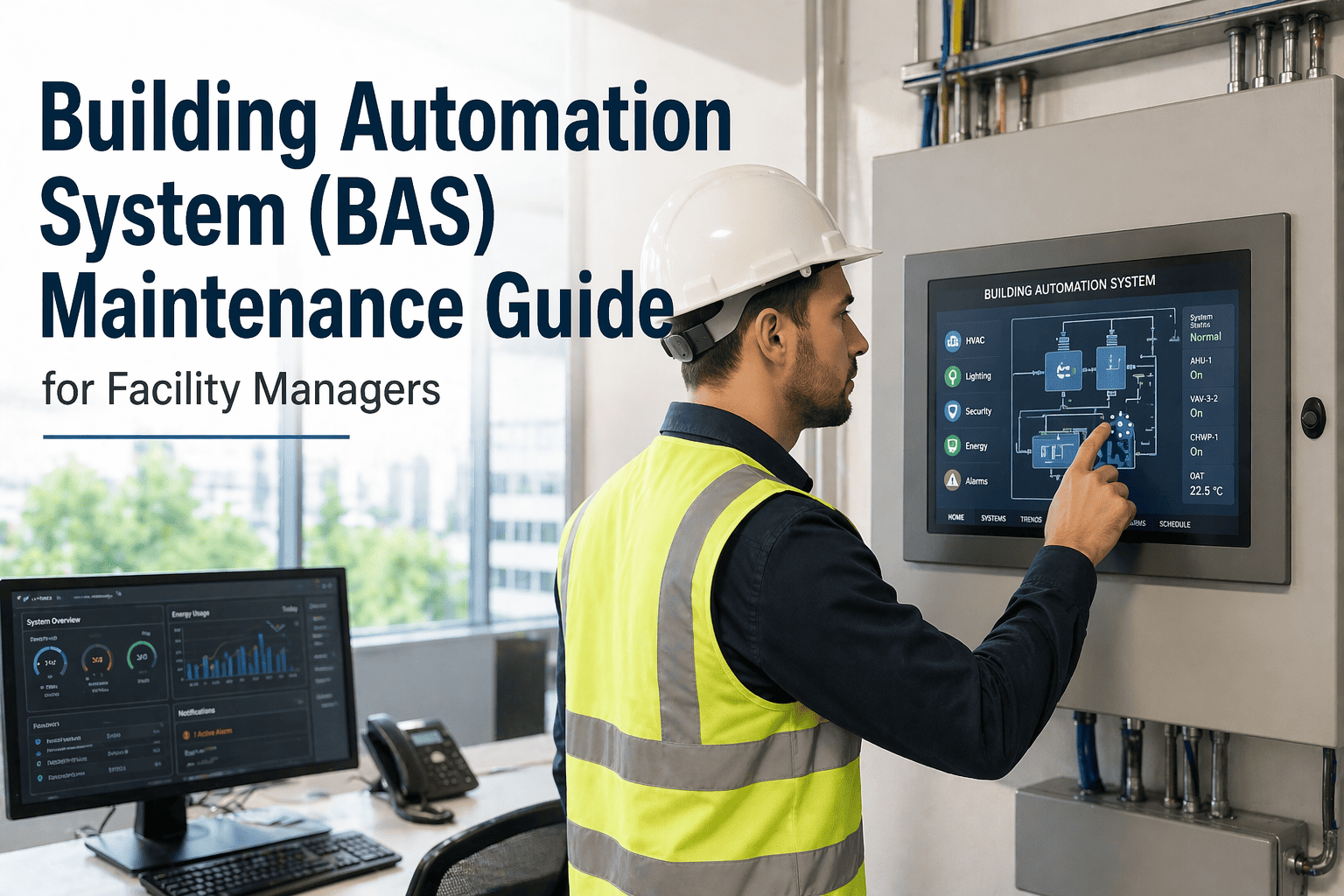
Building Automation System (BAS) Maintenance Guide for Facility Managers
Sensor calibration, controller inspection, network verification, and CMMS integration — the complete framework for maintaining your building automation system.
15-20%Efficiency loss from a single failed outdoor air sensor
$5K-15KAnnual waste from uncalibrated CO₂ sensors
60%Fewer BAS faults with quarterly controller inspections
Stop discovering BAS faults through occupant complaints. OxMaint schedules sensor calibrations, controller inspections, and network checks — auto‑generating work orders when values drift outside acceptable ranges.
BAS Components
Building Automation System — Key Components That Require Maintenance
BAS maintenance is not optional — it is the difference between a building that optimizes itself and one that operates 15–20% below efficiency potential. The components below are the most failure-prone and highest-impact elements in any building automation system.
01
Temperature Sensors
Space, duct, outdoor air, and water temperature sensors drift over time. A 2°F offset in outdoor air temperature can disable economizer free cooling entirely.
02
Pressure Sensors
Duct static pressure, filter differential pressure, and water pressure sensors. Drift in filter pressure sensors leads to late filter changes and airflow reduction.
03
CO₂ / IAQ Sensors
Demand control ventilation relies on accurate CO₂ readings. Uncalibrated sensors cause over-ventilation (energy waste) or under-ventilation (IAQ complaints).
04
Actuators & Dampers
Sticking economizer dampers, failed VAV box actuators, and drifting control valves. A stuck economizer can waste $8,000–$15,000 annually in a single AHU.
05
Controllers & PLCs
DDC controllers, field controllers, and communication processors. Battery failure in controllers reschedules setpoints to defaults — often discovered months later.
06
Network Infrastructure
BACnet routers, MSTP trunk wiring, IP switches, and gateways. Communication failures create building-wide control gaps that defeat system redundancy.
Maintenance Schedule
BAS Preventive Maintenance — Frequency and Tasks
| Component |
Maintenance Task |
Frequency |
Acceptable Range |
Action Trigger |
| Temperature Sensors | Calibrate against NIST-traceable reference | Annually | ±0.5°F of reference | >±1.0°F deviation |
| Pressure Sensors | Compare to calibrated manometer | Semi-annual | ±2% of reading | >±5% deviation |
| CO₂ Sensors | Calibrate with known gas mixture | Annually | ±30 ppm at 1000 ppm | >±50 ppm deviation |
| Actuators / Dampers | Full stroke test, torque check | Quarterly | 100% stroke in <120 sec | Sticking or incomplete travel |
| DDC Controllers | Battery test, firmware version, I/O check | Quarterly | Battery >3.0V, no fault LEDs | Battery <2.8V or comm fault |
| BACnet Network | Device discovery, ping test, error log | Monthly | All devices responding | Device offline or high error rate |
BAS Performance KPIs
Key Performance Indicators for Building Automation Health
Sensor Calibration Compliance
100%
All critical sensors calibrated annually — documented in CMMS
Controller Uptime
99.9%
Target for all BAS controllers and network devices
Actuator Stroke Success
>98%
Quarterly full-stroke test pass rate
Network Communication Health
>99%
BACnet device discovery success rate
BAS Preventive Maintenance Completion
95%
Quarterly inspections completed on schedule
"The most expensive maintenance mistake in smart buildings is treating the BAS as a set-and-forget system. Sensor drift is not a matter of if — it is a matter of when. A building that operated at 18% below energy baseline in year one may be at 5% below by year five, not because equipment degraded, but because sensors drifted and controls lost calibration. The facilities that maintain their BAS with the same discipline they apply to HVAC mechanical systems are the ones that sustain energy savings decade after decade."
Dr. Linda Huang, PE, CEM
Building Performance Specialist · 20 years BAS commissioning and optimization · Author of ASHRAE research on sensor drift and energy impact
Frequently Asked Questions
How does OxMaint integrate with existing BAS systems?
OxMaint connects to leading BAS platforms including Siemens Desigo, Johnson Controls Metasys, Honeywell Niagara, Schneider Electric, and Distech via BACnet/IP, BACnet MSTP, Modbus TCP, and REST APIs. The integration is read-only from the BAS perspective — OxMaint consumes point data (temperatures, pressures, status, alarms) without writing to BAS controllers, ensuring no disruption to building control logic. When sensor values drift outside configured ranges, OxMaint creates work orders for repair technicians.
Book a demo to see BAS integration configuration.How often should BAS controllers be inspected?
Quarterly controller inspections are the industry standard for commercial buildings. Each inspection should include: checking controller status LEDs for fault indicators, verifying battery backup (replace every 3-5 years), reviewing control logic setpoints against current schedules, testing input/output points for correct response, and checking enclosure for dust, moisture, and loose wiring. Annual controller firmware updates are recommended for cybersecurity and feature improvements.
Start a free trial to schedule BAS controller inspections.What is the most common BAS failure point in commercial buildings?
Sensor drift — specifically outdoor air temperature sensors and space CO₂ sensors — is the most common and most costly BAS failure point. A 2–3°F drift in outdoor air temperature disables economizer sequences, costing $5,000–$15,000 annually in unnecessary mechanical cooling. Uncalibrated CO₂ sensors cause demand control ventilation to fail, either wasting energy or causing IAQ complaints. Annual sensor calibration against NIST-traceable references is non-negotiable for building automation reliability.
Book a demo to set up BAS sensor calibration schedules.How does OxMaint generate BAS maintenance work orders automatically?
OxMaint pulls BAS point data at configurable intervals (typically 15 minutes). For each sensor, the platform maintains acceptable ranges based on design values, seasonal baselines, or trend analysis. When a value falls outside its configured range and persists beyond a settable duration (e.g., 30 minutes), OxMaint creates a work order assigned to the appropriate technician. The work order includes the point name, current value, acceptable range, and asset hierarchy (e.g., AHU-03 → Zone 4 → Temperature Sensor). This turns BAS data into maintenance action without operator intervention.
Book a demo to see auto-work-order triggers.
Maintain Your BAS Like Any Critical Asset
OxMaint's preventive maintenance platform schedules BAS sensor calibrations, controller inspections, network checks, and alarm response — integrating directly with your building automation system to turn data drift into maintenance action.