The fire marshal stands in the lobby of the 42-story mixed-use tower, clipboard in hand, requesting documentation for the quarterly sprinkler system inspection completed six weeks ago. The facility manager scrolls frantically through email attachments, text messages from contractors, and a filing cabinet stuffed with paper inspection forms—somewhere in this chaos exists proof that 847 sprinkler heads, 156 fire extinguishers, and 23 emergency exit lighting systems passed inspection. Thirty minutes later, the marshal issues a citation not for failed equipment, but for inadequate documentation. The $15,000 fine pales compared to the insurance premium increase and the building owner's demand for an explanation at tomorrow's board meeting.
This documentation nightmare unfolds daily across mixed-use towers where residential units, commercial offices, retail spaces, and parking structures create compliance complexity that paper-based systems simply cannot manage. The average mixed-use tower maintains 2,500-8,000 fire safety assets requiring inspections at intervals ranging from daily emergency lighting checks to annual suppression system certifications—yet 67% of facility teams still rely on spreadsheets, paper logs and contractor invoices that disappear into filing systems never designed for regulatory scrutiny.
Mixed-use towers implementing digital compliance logs with AI analytics and predictive maintenance facility management workflows achieve 99.8% inspection completion rates while reducing fire marshal citation risk by 85-95%. The transformation extends beyond documentation to include IoT sensor integration detecting system anomalies, mobile inspections facility management apps enabling real-time verification, and work order automation that converts inspection findings into corrective actions before violations occur. Facility teams ready to eliminate compliance anxiety can explore how digital fire safety logs transform inspection management.
What if your next fire marshal inspection became a 15-minute walkthrough instead of a documentation scramble?
While other facility managers explain missing inspection records and face preventable citations, forward-thinking towers use AI-powered CMMS platforms to maintain perpetual audit readiness. Discover why leading mixed-use properties trust Oxmaint to protect their fire safety compliance.
Transform Facility Management Safety Using AI + IoT Data
Effective fire safety compliance for mixed-use towers requires understanding how digital logs, AI analytics, and IoT sensors create an interconnected ecosystem that transforms reactive documentation into proactive risk management. Modern facility management CMMS best practices extend beyond simple inspection tracking to include real-time equipment health monitoring, automated compliance calendars, and predictive algorithms identifying system degradation before it compromises life safety.
Traditional fire safety management relies on calendar reminders, contractor scheduling, and manual log entries that create documentation gaps exploited during regulatory inspections. Digital compliance logs equipped with barcode/QR scanning, photo verification, and GPS-stamped task completion ensure every inspection generates tamper-proof records that satisfy even the most demanding fire marshals. Organizations managing complex fire safety portfolios can see how AI-powered inspection scheduling eliminates compliance gaps.
IoT pressure sensors and flow monitors detecting leaks, valve malfunctions, and system degradation 30-60 days before inspection failures. Automated alerts trigger work orders before compliance deadlines.
AI pattern recognition distinguishing genuine emergencies from environmental triggers, cooking smoke, and equipment malfunctions. Reduces tenant disruption while maintaining life safety vigilance.
Automated battery health monitoring and illumination verification ensuring exit pathways remain visible during power failures. Mobile inspections capture photographic proof of functional signage.
Barcode/QR tracking of inspection dates, hydrostatic testing schedules, and replacement timelines. Automated alerts 30-60 days before expiration prevent compliance gaps.
Mixed-Use Tower Fire Safety Compliance Requirements
Mixed-use towers face uniquely complex facility management compliance requirements where residential fire codes intersect with commercial occupancy standards, retail assembly requirements, and parking structure ventilation mandates. Each occupancy classification demands specific inspection frequencies, documentation formats, and corrective action timelines that overwhelm paper-based tracking systems while creating liability exposure when records prove incomplete during litigation discovery.
Strategic CMMS implementation creates unified compliance dashboards consolidating requirements across all occupancy types while automatically generating inspection schedules aligned with NFPA standards, local fire codes, and insurance mandates. AI analytics identify approaching deadlines, flag overdue inspections, and prioritize corrective actions based on violation severity and tenant impact. Facility directors navigating multi-occupancy compliance can discuss unified compliance strategies with implementation specialists.
Life safety systems protecting dwelling units including smoke detectors, sprinkler coverage, emergency egress lighting, and stairwell pressurization verification.
- Monthly smoke detector testing per unit
- Quarterly sprinkler visual inspections
- Annual fire door integrity testing
- Semi-annual stairwell pressurization verification
Business occupancy fire protection including suppression systems, alarm monitoring, emergency communication, and evacuation plan documentation.
- Weekly fire pump inspection and testing
- Monthly emergency generator load testing
- Quarterly fire alarm sensitivity testing
- Annual suppression system certification
High-occupancy areas requiring enhanced suppression coverage, occupancy monitoring, emergency lighting density, and accelerated inspection frequencies.
- Daily emergency exit verification
- Weekly hood suppression inspections (kitchens)
- Monthly occupancy load verification
- Quarterly assembly area evacuation drills
Ventilation systems, CO detection, standpipe connections, and mechanical room fire separation maintaining safe conditions in support spaces.
- Monthly CO detector calibration
- Quarterly standpipe flow testing
- Semi-annual ventilation system verification
- Annual fire damper inspection
Digital Compliance Log Benefits
Predictive Maintenance for Fire Safety Systems
Predictive maintenance facility management transforms fire safety from reactive repair to proactive stewardship, where AI analytics identify equipment degradation patterns weeks or months before failures compromise life safety or trigger compliance violations. Traditional calendar-based maintenance misses 60-70% of developing problems while wasting 25-35% of maintenance budgets on unnecessary interventions that don't address actual equipment condition.
IoT sensors monitoring sprinkler system pressure, fire pump vibration signatures, emergency generator performance, and alarm panel health enable condition-based maintenance that intervenes precisely when data indicates developing problems. The distinction between calendar maintenance and predictive maintenance often determines whether a building passes or fails its annual fire marshal inspection. Teams transitioning to predictive fire safety maintenance can access condition monitoring tools that prevent compliance failures.
| Fire Safety System | Traditional Maintenance Approach | Predictive AI Approach | Failure Prevention | Cost Impact |
|---|---|---|---|---|
| Fire Pumps | Weekly manual inspection | Continuous vibration + flow monitoring | 45-60 days advance warning | 65% repair cost reduction |
| Sprinkler Systems | Quarterly visual inspection | IoT pressure + leak detection | 30-45 days advance warning | 55% maintenance optimization |
| Fire Alarm Panels | Annual sensitivity testing | Continuous circuit monitoring | 14-30 days advance warning | 70% false alarm reduction |
| Emergency Generators | Monthly load bank testing | Runtime analytics + fuel quality | 21-45 days advance warning | 50% maintenance efficiency |
| Smoke Control Systems | Semi-annual testing | Damper position + airflow monitoring | 30-60 days advance warning | 60% downtime prevention |
Mobile Inspections & Work Order Automation
Mobile inspections facility management workflows revolutionize fire safety compliance by converting smartphone and tablet devices into verification tools that capture inspection evidence, route findings to appropriate technicians, and generate audit-ready documentation without paper forms or manual data entry. The transformation eliminates transcription errors, ensures consistent inspection protocols, and creates timestamped proof that inspections occurred when and where claimed.
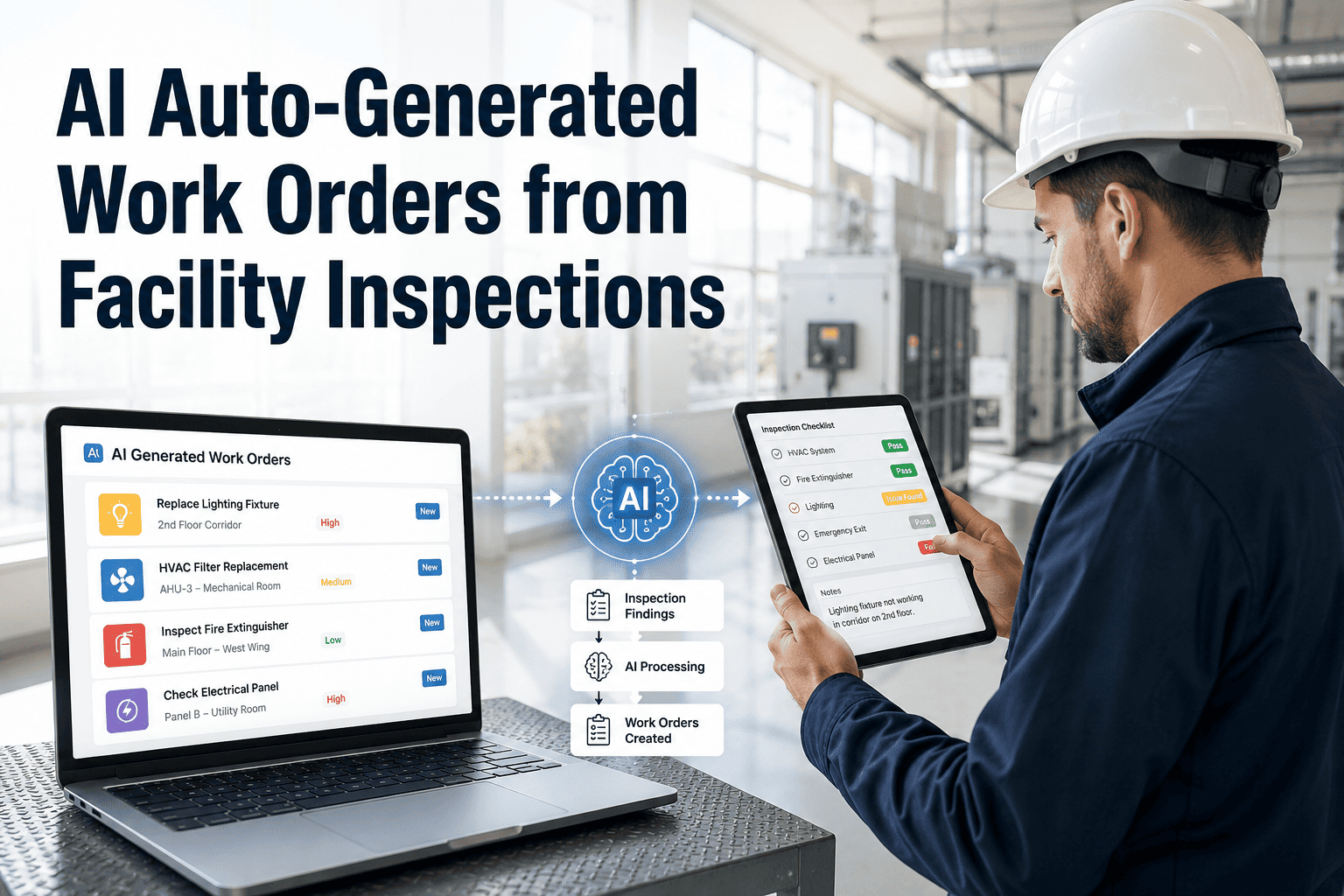
Work order automation connects inspection findings directly to corrective action workflows, automatically generating repair tickets when technicians identify deficiencies, routing urgent life safety issues for immediate response, and tracking resolution through completion with full documentation. The integration eliminates the gap between identifying problems and fixing them—the gap where compliance violations and liability exposure accumulate. Organizations streamlining inspection-to-repair workflows can implement automated work order generation immediately.
Digital Inspection Workflow Architecture
Technician scans asset tag confirming correct equipment identification and location verification via GPS.
Mobile app presents code-compliant inspection checklist with required photo capture points and measurement fields.
Issues identified during inspection automatically trigger work order creation with severity classification.
Technician signs completion with timestamp, creating tamper-proof audit trail for regulatory review.
Percentage of scheduled fire safety inspections completed within required timeframes. Primary compliance metric demonstrating systematic execution.
Average duration from deficiency identification to corrective action completion. Measures responsiveness to life safety concerns.
Percentage of inspections with required photographic evidence, measurements, and technician signatures. Audit readiness indicator.
Count of fire safety work orders exceeding resolution deadlines. Risk exposure metric requiring immediate management attention.
Percentage of time fire safety systems operate without failure. Direct measure of life safety protection and predictive maintenance effectiveness.
Count of fire marshal citations issued for documentation or equipment deficiencies. Ultimate compliance success metric.
Building a Resilient Backbone — A Facility Management Operating Model with Integrations
Successful fire safety compliance requires seamless integration between CMMS platforms, building automation systems, fire alarm monitoring services, and contractor management workflows creating a unified operational backbone. Fragmented implementations with disconnected data silos achieve only 40-50% of potential compliance benefits while creating documentation gaps that surface during regulatory inspections and insurance audits.
Integration architecture design determines long-term scalability—towers selecting open-protocol platforms maintain flexibility for future system additions while avoiding vendor lock-in that inflates lifecycle costs and limits innovation adoption. The goal is creating a single source of truth where every fire safety asset, inspection record, and corrective action exists in one searchable, auditable system. Teams evaluating integration requirements can discuss compatibility with existing building systems and fire monitoring services.
Multi-Site Rollouts & Portfolio Standardization
Property portfolios managing multiple mixed-use towers face exponential compliance complexity where inconsistent inspection protocols, varying contractor relationships, and disconnected documentation systems create risk exposure that compounds across properties. Multi-site rollouts implementing standardized CMMS workflows achieve portfolio-wide visibility while enabling best practice sharing and centralized compliance oversight.
Standardization delivers economies of scale in contractor negotiations, training efficiency, and technology licensing while ensuring every property maintains identical compliance standards regardless of local management variations. The portfolio approach transforms fire safety from individual property burden to enterprise capability with centralized analytics identifying systemic risks and optimization opportunities. Portfolio managers implementing standardized compliance can explore enterprise deployment strategies with multi-site experience.
Portfolio Fire Safety Compliance ROI Framework
Implementation Playbook for Digital Fire Safety Compliance
Transforming fire safety compliance from paper chaos to digital excellence requires systematic implementation following proven facility management CMMS best practices. Organizations rushing technology deployment without workflow redesign achieve only 30-40% of potential benefits, while structured implementations following phased playbooks consistently deliver 85-95% of projected compliance improvements.
The implementation sequence matters significantly—asset inventory must precede inspection scheduling, baseline data collection must precede AI analytics activation, and staff training must precede mobile deployment. Towers inverting these sequences experience extended implementation timelines and user frustration that undermines adoption. Teams planning implementation can discuss phased rollout strategies with deployment specialists.
Fire Safety Digital Transformation Playbook
Deploy barcode/QR tags on every fire safety asset—extinguishers, sprinkler zones, alarm devices, emergency lighting—with specifications, installation dates, and inspection history imported into CMMS.
Configure automated inspection schedules aligned with NFPA requirements, local fire codes, and insurance mandates. System generates work orders at appropriate intervals with escalation for approaching deadlines.
Equip technicians and contractors with mobile inspection apps featuring guided checklists, photo capture requirements, and digital signature completion creating audit-ready documentation.
Connect fire pump monitors, sprinkler pressure sensors, and alarm panel diagnostics to CMMS platform for continuous condition monitoring and predictive maintenance alerts.
Configure automated work order generation triggered by inspection deficiencies, sensor alerts, and compliance deadlines with intelligent routing to appropriate technicians or contractors.
Enable real-time dashboards tracking inspection completion, deficiency aging, system uptime, and compliance status with automated reporting for management and regulatory review.
Conclusion
Fire safety compliance with digital logs represents the evolution from documentation chaos to audit-ready excellence, where AI analytics and predictive maintenance facility management capabilities directly translate into reduced citation risk, lower insurance premiums, and eliminated compliance anxiety. Mixed-use towers implementing comprehensive digital compliance systems achieve 99.8% inspection completion rates while generating the tamper-proof documentation that transforms fire marshal visits from adversarial audits to collaborative walkthroughs.
Understanding the interconnected architecture of barcode/QR asset tracking, mobile inspections facility management workflows, and IoT sensor integration reveals that successful implementations require systematic transformation extending far beyond simple software deployment. Facility management CMMS best practices demonstrate that compliance excellence becomes reality when technology investments combine with workflow redesign, staff training, and performance measurement establishing accountability at every level.
The 2025 regulatory environment rewards facility teams demonstrating systematic fire safety stewardship while penalizing those maintaining paper-based approaches that cannot withstand regulatory scrutiny or litigation discovery. Success requires balancing proven compliance workflows delivering immediate risk reduction with emerging AI analytics innovations positioning properties for continuous optimization and stakeholder confidence.
Imagine your next fire marshal inspection lasting 15 minutes because every record is instantly accessible, every inspection is documented with photos, and every deficiency shows timestamped resolution—how would that change your relationship with regulators?
Every month without digital fire safety logs is another month accumulating documentation risk and compliance exposure. Join the forward-thinking mixed-use towers that transformed fire safety from liability burden to competitive advantage with Oxmaint's AI-powered CMMS platform—the same technology protecting high-rise portfolios nationwide.