integrations-workflow-for-elevator-teams

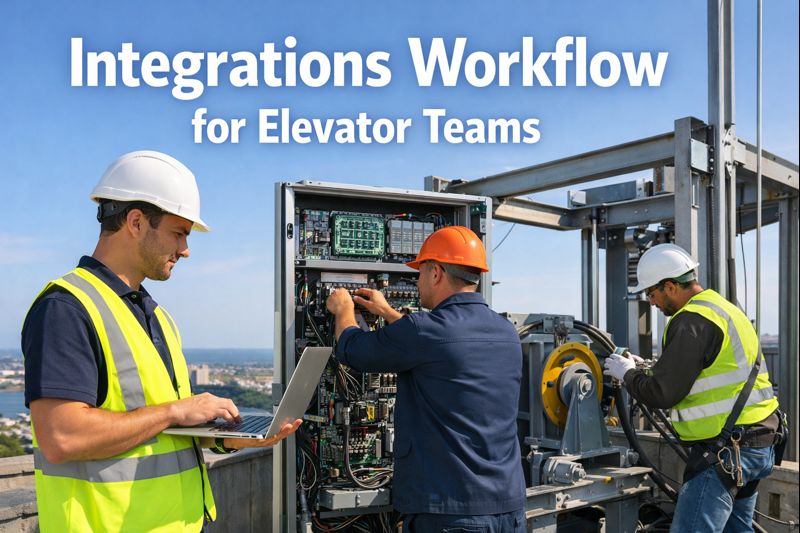
Integrations Workflow for Elevator Teams


Elevator service teams operate in a high-stakes environment where every minute of downtime impacts building operations, tenant satisfaction, and regulatory compliance. Managing maintenance schedules across dozens of elevators, coordinating field technicians, tracking compliance documentation, and syncing with accounting systems traditionally requires juggling multiple disconnected tools. Integrated workflow solutions eliminate these silos by connecting every aspect of elevator operations—from service dispatch to invoice generation—into a unified platform that keeps your entire team aligned. Schedule a consultation to explore how integrated workflows can transform your elevator maintenance operations.

Why Integrated Workflows Matter for Elevator Teams

The elevator maintenance industry faces unique operational challenges that manual processes simply cannot address efficiently. With technicians dispersed across multiple sites, compliance requirements growing more complex, and customers demanding faster response times, disconnected systems create costly delays and missed opportunities.

The Case for Workflow Integration
$33B+
Global elevator maintenance market size in 2024, projected to reach $61 billion by 2032 with 8% annual growth
67%
Faster hiring and onboarding processes when using integrated workflow automation tools
50%
Of work activities can be automated according to McKinsey, freeing teams for higher-value tasks
20.6B
Passenger trips made annually on US elevators—driving demand for reliable maintenance operations
Ready to streamline your elevator service operations? Join leading maintenance teams using integrated workflows to reduce downtime and improve technician productivity.
Sign Up Free

How Integrated Workflows Transform Elevator Operations

Modern elevator maintenance demands seamless coordination between office staff, field technicians, building managers, and accounting departments. An integrated workflow platform connects these stakeholders through automated processes that eliminate manual handoffs and ensure nothing falls through the cracks.

Elevator Workflow Integration Components From service request to payment collection
01
Service Request Automation
Incoming service calls, email requests, and IoT alerts automatically generate work orders with complete building history, equipment details, and priority classification. No manual data entry required.
02
Smart Dispatch and Scheduling
AI-powered scheduling assigns the right technician based on location, certifications, equipment expertise, and current workload. Route optimization reduces drive time between service calls.
03
Mobile Field Execution
Technicians access digital checklists, equipment history, parts inventory, and safety protocols on mobile devices. Completed inspections sync instantly with office systems.
04
Compliance Documentation
Inspection reports, safety certifications, and regulatory documentation generate automatically from completed work orders. Audit trails maintain complete compliance history for each elevator.
05
Financial Integration
Completed work orders flow directly to invoicing and accounting systems. Integration with QuickBooks, Xero, and other platforms eliminates double entry and accelerates payment collection. Sign up for Oxmaint to connect your financial workflows seamlessly.

Key Integration Categories for Elevator Teams

Successful workflow integration requires connecting multiple system categories that touch different aspects of elevator service operations. Each integration point eliminates manual processes and reduces the risk of data silos.

Essential Integration Points
Accounting Systems
Connect with QuickBooks, Xero, or enterprise accounting platforms for automated invoicing, expense tracking, and financial reporting without manual data transfer.
Calendar and Scheduling
Sync with Google Workspace, Microsoft 365, and other calendar systems to coordinate technician schedules, customer appointments, and preventive maintenance windows.
GPS and Fleet Tracking
Real-time technician location tracking enables smarter dispatching, accurate ETAs for customers, and optimized routing between service calls across multiple buildings.
Communication Tools
Integrate SMS, email notifications, and team messaging to keep technicians, dispatchers, and customers informed about service status and schedule changes.
Payment Processing
Accept payments in the field through integrated payment APIs. Generate invoices from completed work orders and collect payment faster with digital processing.
IoT and Monitoring
Connect elevator monitoring systems and IoT sensors to automatically generate service tickets when equipment performance degrades or maintenance thresholds are reached.
See integrated workflows in action. Book a demo and we'll show you how Oxmaint connects your elevator operations end-to-end.
Book a Demo

Workflow Automation for Common Elevator Tasks

Different elevator service scenarios require tailored workflow approaches. Understanding which tasks benefit most from automation helps teams prioritize their integration efforts for maximum operational impact.

Elevator Workflow Automation Opportunities
Service Type Manual Process Pain Points Automated Workflow Benefits
Preventive Maintenance Missed schedules, inconsistent checklists, compliance gaps Auto-generated PM schedules, digital checklists, automated compliance documentation
Emergency Callbacks Slow dispatch, poor technician-job matching, customer communication delays Instant work order creation, smart technician assignment, automated customer updates
Annual Inspections Paper-based forms, manual report generation, filing errors Digital inspection forms, automated report generation, cloud-based document storage
Parts and Inventory Stockouts, over-ordering, manual reorder tracking Automatic reorder triggers, parts usage tracking by equipment, vendor integration
Contract Management Missed renewals, manual billing, service level tracking Contract expiration alerts, automated recurring billing, SLA performance dashboards
Technician Timesheets Manual time entry, payroll delays, labor cost inaccuracies GPS-verified clock-in/out, automatic payroll integration, real-time labor tracking
Automation impact varies by company size and existing process maturity. Start with highest-friction workflows for fastest ROI.

Manual vs. Integrated Workflow Management

Understanding the capability gap between traditional manual processes and integrated workflow platforms reveals why leading elevator service companies are prioritizing digital transformation.

Workflow Management Approach Comparison
Manual Processes
X
  • Paper work orders and spreadsheet scheduling
  • Phone-based dispatch and status updates
  • Manual data entry between systems
  • Delayed invoicing after job completion
  • Limited visibility into field operations
20+ hrs weekly on manual admin tasks
Integrated Workflows
Y
  • Digital work orders with automated routing
  • Real-time mobile dispatch and tracking
  • Seamless data flow between platforms
  • Same-day invoicing from completed jobs
  • Complete field visibility and reporting
80% reduction in admin overhead
Connect Your Elevator Operations End-to-End
Oxmaint integrates with the tools your elevator team already uses—accounting software, calendars, GPS tracking, and communication platforms—creating a unified workflow that eliminates manual handoffs and keeps everyone synchronized.

Integration Benefits by Team Role

Different team members experience workflow integration benefits in unique ways. Understanding these role-specific advantages helps build organizational buy-in for digital transformation initiatives.

Workflow Integration Impact by Role
Team Role Key Integration Benefits Time Savings
Field Technicians Mobile access to equipment history, digital checklists, instant parts availability, GPS navigation to job sites 2-3 hours daily
Dispatchers Real-time technician locations, automated job assignment, drag-and-drop scheduling, instant customer notifications 4-5 hours daily
Service Managers Complete operational visibility, performance dashboards, SLA tracking, automated reporting 8-10 hours weekly
Accounting Staff Automatic invoice generation, direct accounting system sync, labor cost tracking, contract billing automation 10-15 hours weekly
Business Owners Real-time profitability insights, cash flow visibility, customer satisfaction metrics, growth opportunity identification Strategic focus shift

ROI of Workflow Integration

Integrated workflows deliver measurable returns through direct time savings, reduced errors, faster payment collection, and improved customer satisfaction. The financial impact compounds across multiple operational areas.

Documented Integration Benefits Based on field service automation research and industry data
80%
Higher lead conversion with CRM workflow automation
67%
Faster onboarding with automated workflows
51%
Of employees spend 2+ hrs daily on automatable tasks
25%
Of managers spend 20+ hrs weekly on repetitive admin
Calculate your potential time savings. Create a free Oxmaint account and see how workflow integration can transform your elevator service operations.
Sign Up Free

Implementation Best Practices

Successful workflow integration requires thoughtful planning across technology selection, team adoption, and change management. A phased approach delivers quick wins while building toward comprehensive operational transformation.

Recommended Integration Roadmap
Week 1-2
Process Assessment
Map current workflows and pain points Identify integration priorities Document system requirements
Week 3-4
Platform Setup
Configure core CMMS platform Connect accounting integration Set up mobile applications
Week 5-6
Team Training
Train dispatchers on new workflows Onboard field technicians to mobile Configure user roles and permissions
Week 7+
Optimization
Add additional integrations Refine automated workflows Monitor and improve KPIs
The biggest transformation happens when teams stop thinking about individual tools and start thinking about connected workflows. When your service call automatically becomes a work order, which becomes a completed inspection, which becomes an invoice—that's when efficiency gains compound exponentially.
— Field Service Operations Expert

Common Integration Challenges and Solutions

Elevator service companies face predictable challenges when implementing workflow integrations. Understanding these obstacles and proven solutions accelerates successful adoption.

Integration Challenge Resolution Guide
Challenge Impact Solution
Legacy system compatibility Data silos, manual workarounds required Choose platforms with open APIs and pre-built integrations for common accounting and scheduling tools
Technician adoption resistance Incomplete data, workflow breaks Involve field staff in selection, demonstrate time savings, provide comprehensive mobile training
Data quality issues Inaccurate reporting, failed automation Clean historical data before migration, establish data entry standards, validate inputs automatically
Process variability Workflows don't fit all scenarios Select flexible platforms that support custom workflows, start with core processes then expand
Integration maintenance Broken connections, sync failures Choose vendors with dedicated integration support, monitor sync status, set up failure alerts
Transform Your Elevator Service Workflows
Your spreadsheets and disconnected tools cannot match the efficiency of integrated workflows that automatically route service requests, dispatch the right technician, sync with accounting, and keep customers informed at every step. Oxmaint helps elevator teams connect their entire operation—from the first service call to the final invoice.

Frequently Asked Questions

Which accounting systems does Oxmaint integrate with for elevator businesses?
Oxmaint integrates with popular accounting platforms including QuickBooks and Xero, enabling seamless invoice generation, expense tracking, and financial reporting without manual data entry. Completed work orders automatically flow to your accounting system for faster billing cycles. Schedule a consultation to discuss your specific accounting integration needs.
How long does it take to implement integrated workflows for an elevator service team?
Most elevator service companies can implement core workflow integrations within 4-6 weeks, including platform setup, team training, and initial process refinement. Simple integrations like calendar sync can be configured in hours, while more complex accounting integrations may require a few days of setup and testing.
Can field technicians use the system offline when working in elevator shafts?
Yes, Oxmaint's mobile application supports offline functionality, allowing technicians to complete inspections, update work orders, and access equipment history even without cellular connectivity. Data automatically syncs when the device reconnects, ensuring no information is lost during service calls in areas with limited signal.
How do integrated workflows help with elevator compliance documentation?
Integrated workflows automatically generate inspection reports, safety certifications, and regulatory documentation from completed work orders. Digital forms ensure consistent data capture, and cloud storage provides instant access to compliance history for audits. Sign up for a free account to see how automated documentation works.
What if our current tools don't have native integrations available?
Oxmaint provides open APIs that enable custom integrations with specialized systems. For legacy tools without API capabilities, we can often connect through intermediate platforms or develop custom solutions. Book a demo to review your specific technology stack and integration options.


Share This Story, Choose Your Platform!