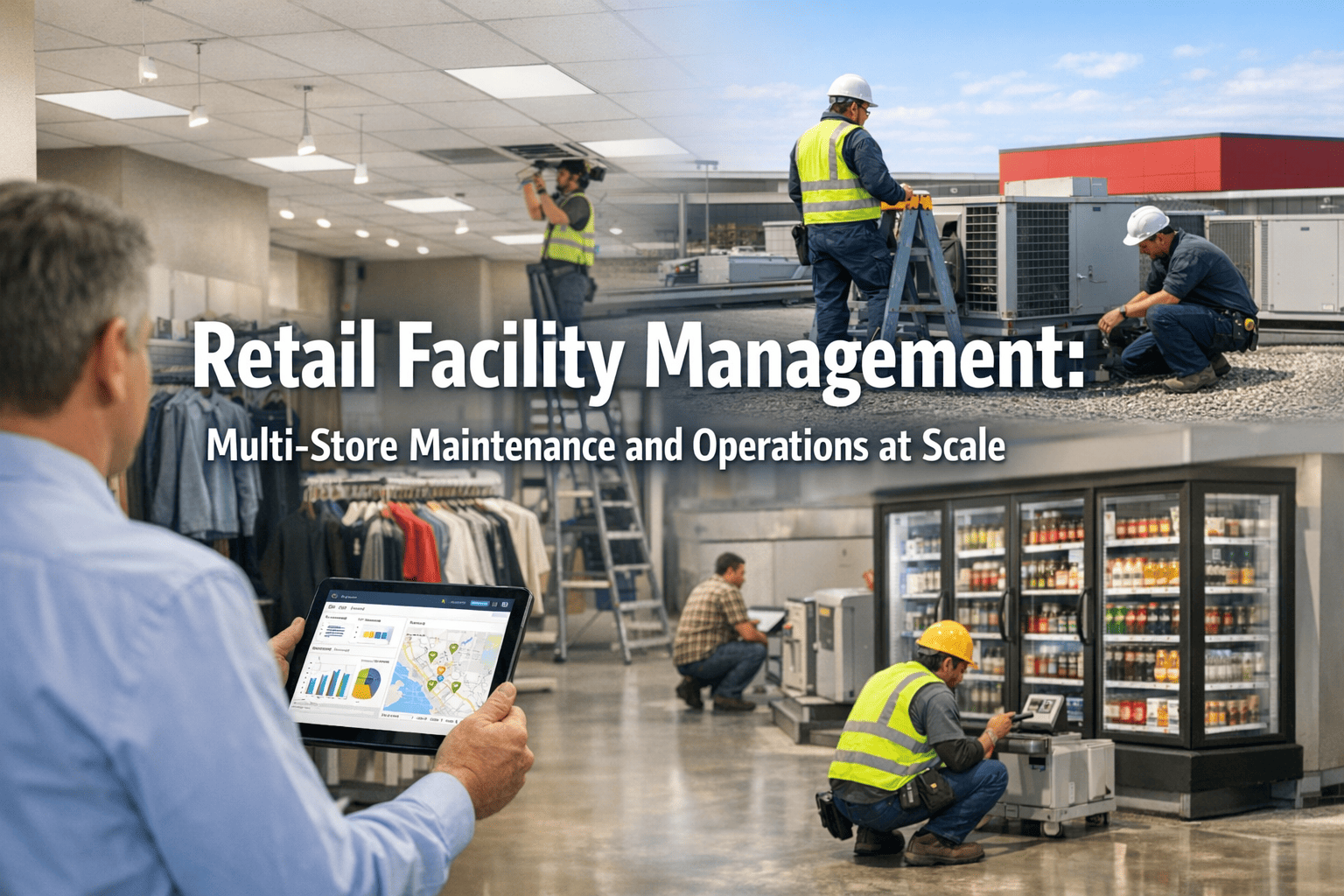
Retail Chain Facility Management: Multi-Location Maintenance at Scale
By John Polus on March 25, 2026
Airport and transportation facility management carries a compliance and safety burden that no other built environment imposes. A runway lighting fault during low-visibility operations is not a maintenance issue. It is a safety-of-life issue reportable to the FAA, EASA, or CASA within hours. A baggage handling system failure during peak operations does not create an inconvenienced passenger. It creates a missed connection cascade that generates claim liability, airline penalty exposure, and IATA performance data that affects gate allocation in the next scheduling cycle. FM teams managing airport and transit infrastructure without structured PM programmes, asset condition tracking, and compliance documentation systems are operating at risk that is both regulatory and reputational simultaneously. Book a demo to see how Oxmaint manages airport and transportation facility maintenance for safety-critical operations.
ArticleAirport and Transportation Facility Management: Safety-Critical OperationsIndustry-Specific FM · P2 · 9 min read
$74K
average cost per hour of unplanned baggage handling system downtime at a major hub airport including airline claims and rebooking costs
72 hrs
FAA-mandated maximum response time for non-critical airfield lighting faults before mandatory NOTAM issuance and potential capacity restriction
4.8x
higher cost per repair event for reactive emergency maintenance versus planned maintenance at equivalent airport infrastructure asset
68%
of airport facility compliance deficiencies cited in FAA and EASA audits relate to documentation gaps, not system failures
Safety-Critical Asset Management, Compliance Documentation, and PM Scheduling for Airport FM
Oxmaint gives airport and transportation FM teams an asset register with criticality ratings, PM schedules per regulatory standard, work order management with safety flag escalation, and compliance documentation exportable for FAA, EASA, CAA, and ICAO audit cycles. Go live in under 14 days with no implementation project required. Book a demo to see Oxmaint configured for your facility type and regulatory environment.
Four Transportation Facility Types and Their FM Requirements
Airport and transportation FM covers four structurally different facility types, each with distinct regulatory authorities, asset criticality profiles, and maintenance documentation obligations. Oxmaint's critical infrastructure templates address each directly.
Airports
Commercial, Regional, GA
FAA AC 150 · EASA · CAA · ICAO Annex 14
Airfield lighting, baggage systems, HVAC in terminals, and security screening infrastructure all carry mandatory PM documentation requirements. FAA Advisory Circulars define maintenance intervals that must be demonstrable at inspection.
72 hrs
Maximum response time for airfield lighting faults before NOTAM required
Rail and Metro
Urban transit, commuter, intercity
FRA · TSA · Network Rail · Transport for London standards
Station platform edge systems, escalators, emergency ventilation, and track-adjacent equipment require scheduled PM with documentation producible at any safety inspection. Deferred PM on platform edge doors is an operational safety liability.
PSD
Platform screen door PM intervals defined by transport authority per network standard
Terminal crane systems, vehicle screening equipment, gangway and terminal HVAC, and fire suppression systems across large facilities require asset-level PM tracking. ISPS security equipment maintenance records are mandatory for port facility security compliance.
ISPS
Security equipment maintenance records mandatory per port facility security plan
Bus and Coach Terminals
Intercity, transit, fleet depots
FMCSA · ADA compliance · Fire code · Local transport authority standards
Bus terminal FM covers fuelling systems, vehicle wash equipment, charging infrastructure for electric fleets, and accessible facility compliance. ADA compliance audits require documented maintenance records for lifts, ramps, and accessible wayfinding systems at every terminal.
ADA
Documented maintenance records for accessibility systems required at every terminal
Critical Airport and Transportation Assets with Maintenance Requirements
Standard commercial building PM intervals are not sufficient for transportation infrastructure. The assets below carry regulatory-specified maintenance frequencies and documentation requirements that must be demonstrable at any unannounced inspection.
Airfield Lighting Systems
FAA AC 150ICAO Annex 14
Runway edge lights, threshold lights, taxiway centreline, and precision approach path indicators require inspection at FAA AC 150/5340-26 frequencies. Each lamp replacement, circuit test, and intensity check must be documented with date, technician, and result per fixture per inspection cycle.
Regulatory requirement: Documented per fixture per cycle
Baggage Handling Systems
IATA AHMAirport SLA
Conveyor drives, transfer units, tilt-tray sorters, and baggage claim carousels carry airline SLA obligations that define maximum downtime per hour and per day. PM completion records per asset are required for SLA compliance evidence and insurance underwriting at major hub airports.
SLA exposure: $74K per hour of BHS downtime at hub airports
Escalators and Passenger Lifts
ASME A17.1EN 115
Airport escalators in high-density passenger flow areas require monthly safety inspections under ASME A17.1 or EN 115 depending on jurisdiction. Each inspection must produce a formal record with inspector credentials. Escalator failure during peak departure creates crowd management exposure and ADA compliance risk simultaneously.
Inspection frequency: Monthly under ASME A17.1 and EN 115
Fire Suppression and Emergency Systems
NFPA 409NFPA 130
Airport hangars require NFPA 409 foam suppression system testing at defined intervals. Transit stations require NFPA 130 emergency ventilation and fire suppression documentation per zone. All test results must be retained and producible for fire marshal and aviation authority inspection with no preparation lag.
Standard: NFPA 409 for hangars, NFPA 130 for transit stations
Terminal HVAC and Ventilation
ASHRAE 62.1FAA Terminal
High-occupancy terminal HVAC requires filter changes, coil cleaning, and ventilation rate verification at intervals defined by ASHRAE 62.1 and local building codes. Terminal HVAC failure during peak season creates both passenger safety exposure and airline ground delay attribution. Energy optimisation through PM compliance reduces terminal HVAC cost 22 to 28% at airports that achieve 90%+ PM compliance.
Energy saving: 22 to 28% on structured HVAC PM at 90%+ compliance
Security Screening Equipment
TSA · DHSECAC standards
X-ray screening units, explosive trace detectors, advanced imaging technology, and access control systems at checkpoints require calibration and PM records at TSA-specified intervals. A checkpoint security lane with an out-of-calibration screening unit is a compliance event, not an operational inconvenience. Documentation gaps in screening equipment maintenance are federal compliance violations.
Compliance risk: Federal violation on undocumented calibration gap
Asset-Level PM for Every Safety-Critical System. Compliance Documentation Ready for Any Audit.
Oxmaint creates individual asset records for every airfield light circuit, BHS conveyor section, escalator, fire suppression zone, and screening lane. PM schedules follow the applicable regulatory standard per asset type. All test and inspection results are stored per asset and export as formatted compliance packages for FAA, EASA, TSA, and fire marshal audits. Book a demo to see Oxmaint's safety-critical FM configuration for your facility.
Airport FM: Reactive vs Compliance-Driven Maintenance
FM Area
Compliance-Driven with Oxmaint
Reactive without CMMS
Airfield lighting PM
Each fixture tracked as an individual asset. Inspection records per lamp per circuit stored with date, technician, and result. FAA AC 150 compliance packages export in under 2 hours per inspection cycle with zero manual assembly.
Inspection records in paper log books or spreadsheets per area not per fixture. FAA inspection preparation requires 3 to 6 weeks of manual record assembly. Documentation gaps produce findings and conditional certification.
BHS maintenance
Each BHS section tracked with separate PM schedule and SLA performance history. Drive motor failures, sensor faults, and belt condition trends visible before stoppage. Airline SLA compliance evidence available per system per day.
BHS maintenance triggered by stoppage or airline complaint. No advance visibility of degrading components. Airline SLA evidence assembled manually from work order logs after each incident. No trend data for pre-failure intervention.
Compliance documentation
All maintenance records for FAA, EASA, TSA, and NFPA-regulated assets exportable by standard, asset class, and date range. Audit preparation completes in under 4 hours from live data. No manual document search.
Compliance records distributed across paper binders, contractor reports, and multiple spreadsheets. FAA and TSA inspection preparation requires 3 to 6 weeks of manual assembly. Documentation gaps result in citations and remediation requirements.
Safety fault escalation
Work orders on safety-critical assets carry automatic escalation flags. Open faults on airfield lighting, fire suppression, and emergency egress trigger supervisor notification within the configured SLA window. No safety fault sits unacknowledged.
Safety faults reported through informal channels. Escalation depends on shift handover communication reliability. Faults discovered at inspection that were known to field technicians for days without formal work order escalation.
ROI: What Compliance-Driven Airport FM Delivers
$74K
BHS downtime cost per hour
Average cost per hour of baggage handling system downtime at a major hub airport including airline claims and rebooking costs
68%
Compliance deficiencies from docs
Airport facility compliance deficiencies cited in FAA and EASA audits that relate to documentation gaps, not actual system failures
4 hrs
Audit prep time
Time to assemble complete FAA, EASA, or TSA compliance documentation package from Oxmaint vs 3 to 6 weeks of manual record assembly
28%
Terminal HVAC energy saving
Average energy cost reduction at airports achieving 90 percent or above PM compliance on terminal HVAC through structured maintenance programmes
QHow does Oxmaint track airfield lighting maintenance to FAA Advisory Circular requirements?
Oxmaint creates individual asset records for each airfield lighting circuit and fixture group. PM schedules follow FAA AC 150/5340-26 frequencies. Each inspection result is stored per fixture with technician attribution, date, and pass/fail status. Compliance packages export per runway per cycle for FAA inspection with no manual assembly. Book a demo to see airfield lighting configuration for your airport.
QCan Oxmaint manage baggage handling system PM with airline SLA tracking at the same time?
Yes. Each BHS conveyor section, transfer unit, and carousel is a separate asset in Oxmaint with its own PM schedule and SLA performance history. Work orders capture fault time, response time, and resolution time against configured SLA thresholds. SLA compliance reports export per system per airline per period. Start free trial to configure BHS asset tracking and SLA monitoring in Oxmaint.
QHow does Oxmaint support TSA and DHS security equipment calibration documentation requirements?
Oxmaint stores calibration records, PM completion certificates, and equipment test results per security screening asset with the required technician credential, date, and interval fields. All records export by checkpoint, lane, and date range for TSA compliance review. Documentation gaps are flagged before they become compliance violations. Book a demo to see security equipment compliance configuration.
QHow quickly can an airport deploy Oxmaint and achieve compliance documentation coverage?
Most airport FM teams go live with Oxmaint in 10 to 14 days with pre-built templates for FAA, EASA, NFPA 409, NFPA 130, ASME A17.1, and TSA-regulated asset classes. PM schedules activate at go-live. Compliance documentation coverage builds automatically from day one with no manual backfill required. Sign up free or book a demo to see the airport implementation timeline.
Safety-Critical PM Tracked. Compliance Documentation Ready for Any Audit. Live in 14 Days.
Oxmaint connects airport and transportation facility asset records, regulatory-standard PM schedules, work order management with safety escalation flags, and FAA, EASA, TSA, and NFPA compliance documentation into one platform. Go live in under 14 days with no implementation project required.