Every fleet manager has lived through the same afternoon: a vehicle is down for a part that costs little, takes days to arrive, and nobody thought to stock. Meanwhile the shelf holds cartons of slow-moving items that never get used. A critical spare parts list fixes that imbalance by deciding, with evidence, which parts must be on hand and which can be ordered on demand. This guide shows how to build one, and how fleet inventory and maintenance software keeps it accurate as your fleet changes.
Parts and Procurement
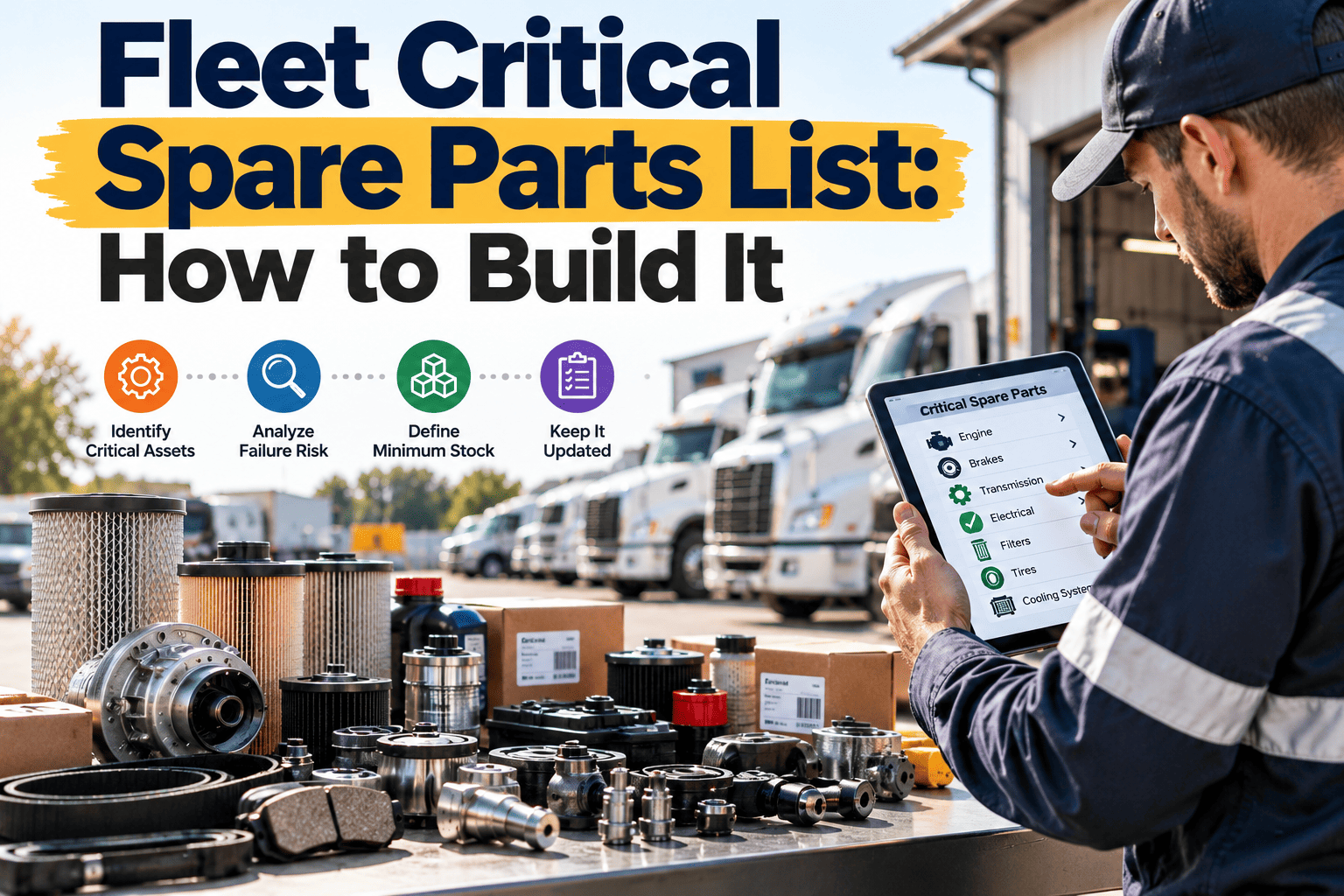
Fleet Critical Spare Parts List: How to Build It
Stock what keeps vehicles moving, not what is easy to buy. Score parts by downtime impact, lead time, and failure history to build a list you can defend and maintain.
Downtime impact
How badly does the vehicle stop?
x
Lead time
How long to get it?
x
Failure frequency
How often does it fail?
=
Criticality
The Two Failure Modes of Fleet Parts Stocking
Understocked
- Vehicles wait days for common wear items
- Emergency freight and premium pricing
- Technicians cannibalize other units
- Preventive work is deferred for lack of parts
Overstocked
- Cash tied up in parts that rarely move
- Obsolete stock after a fleet model change
- Shelf space lost, counts drift from reality
- Expired or degraded items such as seals and fluids
Step 1: Identify Candidate Parts
Failure history
Repeat work orders by component, such as starters, alternators, sensors, belts, hoses, and brake parts.
Preventive maintenance kits
Filters, fluids, wipers, bulbs, and consumables used on every scheduled service.
Safety and compliance items
Parts without which a vehicle cannot legally or safely run, such as lighting, brake components, and mirrors.
Technician input
The shop knows which parts cause the longest waits and which suppliers are unreliable.
Step 2: Score Each Part
| Factor | Low (1) | Medium (2) | High (3) |
|---|---|---|---|
| Downtime impact | Vehicle runs with a workaround | Reduced use or limited routes | Vehicle cannot operate or fails inspection |
| Supplier lead time | Same-day local availability | A few days | Weeks, special order, or single source |
| Failure frequency | Rare, isolated events | Occasional across the fleet | Repeated, predictable failures |
| Fleet exposure | One or two units use it | A model group uses it | Used across much of the fleet |
| Replacement cost | High cost, hard to hold | Moderate | Low, cheap to stock |
Step 3: Place Parts in Stocking Tiers
Tier A: Always on the shelf
High scores across downtime and lead time. Set minimum quantities and reorder points, and count them often.
Tier B: Stock selectively
Moderate scores. Hold one or two where fleet exposure justifies it, or share across sites.
Tier C: Order on demand
Low scores or easy local supply. Use supplier agreements instead of holding stock.
Insurance spares
Expensive, low-frequency, long-lead items. Consider pooling, supplier consignment, or exchange programs.
Example Categories to Review by System
Brakes
Pads, shoes, rotors, drums, slack adjusters, air lines, valves
Electrical
Starters, alternators, relays, fuses, lamps, harness connectors
Engine and cooling
Belts, hoses, thermostats, water pumps, filters, sensors
Emissions
Sensors, DEF system components, filters, depending on engine type
Suspension and steering
Bushings, tie rods, shocks, air springs, wheel seals
Body and safety
Mirrors, wipers, door hardware, reflectors, seat belts
These are review prompts, not a universal list. Your engines, duty cycle, and vehicle mix decide what is actually critical.
Step 4: Set Quantities With Simple Logic
Reorder point
Average usage during the supplier lead time, plus a safety buffer for variation.
Minimum
The quantity that triggers a reorder before the shelf is empty.
Maximum
The ceiling that limits cash tied up and avoids expiry or obsolescence.
Review rhythm
Reassess quarterly or when the fleet mix, routes, or suppliers change.
Keeping the List Alive
1
Issue parts to work orders
2
Measure real usage and stockouts
3
Adjust tiers and quantities
4
Retire obsolete parts as units leave
Metrics for Parts Performance
Stockout rate on critical parts
Wait-for-parts downtime in vehicle days
Inventory turns by tier
Count accuracy from cycle counts
Emergency purchase share of total parts spend
Common Mistakes When Building the List
Building from memory
- Listing parts that were painful once but rarely fail
- Missing parts that quietly cause weeks of waiting
- Letting the loudest technician decide what is critical
- Using purchase price as the only measure of importance
Building from data
- Ranking parts by repeat failures and wait time
- Using supplier lead times as recorded, not assumed
- Involving technicians, planners, and purchasing together
- Reviewing the list as the fleet and routes change
Working With Suppliers to Shorten Lead Times
Confirm real lead times
Record the actual days between order and delivery for each critical part, not the quoted figure. Real history shows which suppliers deserve a safety stock buffer.
Agree stocking arrangements
Ask local distributors about consignment stock, same-day will-call, or dedicated inventory for your fleet parts.
Qualify a second source
For single-source parts, find an approved alternate so one supplier problem does not stop vehicles.
Review performance regularly
Track fill rate, delivery time, and returns by supplier, and use the numbers in annual discussions.
Handling Parts for Mixed and Aging Fleets
Group by commonality
Parts shared across several models justify higher stock than parts used on one unit, so map every part to the vehicles that use it.
Watch the aging units
Older vehicles fail more often and their parts become harder to source. Review them before they become a source of long downtime.
Plan for model changes
When a vehicle type is retired, wind down its unique parts instead of leaving them on the shelf for years.
Standardize where possible
Choosing common components at purchase time reduces the number of critical parts you must hold.
Build a Parts List From Real Work Orders
Let repair history show you what actually stops your vehicles, then stock accordingly.
Storeroom Practices That Keep the List Accurate
Clear part numbers
Use one consistent part number and description so the same item is not stored or ordered under several names.
Defined locations
Assign bins and shelves so technicians find parts quickly and counts are easy to verify.
Issue to work orders
Require every part removed from stock to be charged to a work order, which keeps usage data honest.
Cycle counting
Count Tier A items most often, and investigate every variance rather than adjusting it silently.
Return and core handling
Track returns, cores, and warranty exchanges so credits reach the right account.
Special Cases to Plan For
Obsolete parts
Identify items with no remaining use, then return, sell, or write them off on a schedule instead of letting them accumulate.
Shelf-life items
Seals, hoses, adhesives, and fluids can degrade in storage, so rotate stock and record dates received.
Consignment stock
Agree who owns the stock, how usage is reported, and when it is invoiced.
Shared pool parts
For expensive spares used rarely, share a pool across sites and track where each unit is held.
Rebuilt and exchange units
Track cores and exchange terms for starters, alternators, and similar components.
Safety-critical items
Hold parts that keep vehicles legal on the road and review them first in every list update.
A Scoring Walkthrough With Illustrative Parts
The scores below are examples to show the method. Your own failure history, lead times, and duty cycle will produce different results.
| Part | Downtime impact | Lead time | Failure frequency | Likely tier |
|---|---|---|---|---|
| Air brake chamber | 3, vehicle cannot run | 2, a few days | 2, occasional | Tier A |
| Serpentine belt | 3, engine cannot run | 1, same-day local | 2, occasional | Tier B |
| Specialized engine sensor | 2, reduced operation | 3, special order | 2, occasional | Tier A or insurance spare |
| Cab interior trim | 1, vehicle runs | 1, easy to source | 1, rare | Tier C |
| Transmission control module | 3, vehicle cannot run | 3, long lead time | 1, rare | Insurance spare or exchange |
Budgeting and Justifying the Inventory
Cost of downtime
Estimate what a vehicle day out of service costs in lost revenue, rentals, and delayed work, then compare it with holding cost.
Carrying cost
Include capital tied up, storage space, handling, and obsolescence risk when judging how much stock to hold.
Emergency purchase premium
Track freight and rush charges paid on parts that could have been stocked, and use them to support the list.
Phased investment
Fund Tier A first, measure the reduction in wait time, and use the results to justify the next stage.
Who Should Own the Critical Parts List
Maintenance and shop
- Identify failures and repair time
- Confirm which parts actually stop vehicles
- Report usage accurately on work orders
- Flag parts that are repeatedly missing
Purchasing and finance
- Negotiate supply and lead times
- Approve stock levels and spending limits
- Watch obsolescence and write-offs
- Review emergency purchase trends
Reorder Triggers and Approvals
Automatic triggers
When stock falls to the reorder point, generate a purchase request so reordering does not depend on someone noticing an empty bin.
Approval limits
Set spending thresholds for supervisors and managers, with faster routes for Tier A parts that stop vehicles.
Emergency purchases
Allow urgent buys when a vehicle is down, but record the reason so repeated emergencies point to a stocking gap.
Receiving checks
Check delivered parts against the order and the work order before they enter stock.
Supplier performance
Record late or incorrect deliveries so supplier reviews rest on evidence.
The Quarterly Review Routine
Review stockouts
List every time a critical part was missing and decide whether the tier, minimum, or supplier needs to change.
Review slow movers
Find parts that have not been used for a long period and decide whether to reduce, return, or remove them.
Review new failures
Look for components that have started failing repeatedly and consider adding them to the list.
Review fleet changes
Account for new vehicles, retired units, and route changes that alter which parts matter.
Signs Your Critical Parts List Is Working
Shorter waits
Vehicle days lost waiting for parts fall, especially on the components you identified as critical.
Fewer rush orders
Emergency freight and premium purchases become the exception, not a weekly event.
Accurate counts
Cycle counts match system records, so technicians trust what the storeroom says is on the shelf.
Leaner slow stock
Parts that rarely move are reduced or removed, freeing cash and shelf space for items that matter.
Judge the list by what happens at the vehicle. A shorter list with high availability on the right parts is better than a long list that nobody can keep accurate.
Getting Technicians to Trust the List
Involve them early
Ask technicians which parts cause the longest waits. Their experience finds gaps that reports alone can miss.
Show the evidence
Share the scores and failure history behind each decision so the list is seen as fair, not arbitrary.
Make requests easy
Give the shop a simple way to request additions and record missing parts during a repair.
Close the loop
Tell the team what changed after each review, so they see their feedback produce results.
How Oxmaint Supports the Parts List
Inventory management
Hold parts with minimums, reorder points, locations, and supplier details.
Work order parts usage
Issue parts to each job so real consumption feeds your stocking decisions.
Asset history
See repeat failures by component and unit to find genuinely critical parts.
Preventive maintenance
Link PM schedules to parts kits so upcoming work is not blocked by missing stock.
Reporting
Review usage, stock levels, and spend to adjust the list each quarter.
Frequently Asked Questions
What makes a fleet spare part critical?
A part is critical when its absence stops or restricts a vehicle, takes long to source, or fails often. Cost alone does not define it.
How many parts should be on the list?
There is no fixed number. Start with Tier A items from failure history and expand only when data shows repeated waits.
How often should the list be reviewed?
Review quarterly and whenever you add or retire vehicle models, change routes, or switch suppliers.
Can software set reorder points for me?
It can track usage and minimums so you set them from data. You can start with your current parts list and refine it.
What about multi-site fleets?
Decide which items to hold centrally and which locally. Book a demo to review a multi-location setup.
Keep Vehicles Moving, Not Waiting
Build a scored, tiered critical parts list and keep it current with real usage from every work order.