Fleet downtime costs U.S. operators an average of $448–$760 per vehicle per day — and most of it is preventable. A structured preventive maintenance checklist, applied consistently across your entire fleet, is the single highest-ROI action a maintenance team can take. This guide covers all 12 critical vehicle systems, recommended PM intervals, and how modern tools like AI-powered CMMS platforms, OBD telematics, digital twin simulation, and SAP/PLC integration are transforming fleet PM from a scheduled obligation into a real-time, data-driven competitive advantage.
How Modern Technology Is Transforming Fleet PM
Traditional fleet PM relied on paper logs, mileage stickers, and technician memory. Today, four technologies are fundamentally changing how maintenance teams work — reducing missed PMs, catching failures earlier, and integrating dispatch-to-workshop workflows seamlessly. Oxmaint integrates all four into a single PM platform your technicians can use on a tablet in the bay.
PM Interval Reference — What Gets Done When
Different systems wear at different rates. The interval reference below shows the correct PM frequency for every major vehicle system — from daily walk-around checks through heavy overhaul milestones. Use this as your scheduling reference before completing the full system-by-system checklist below.
1. Engine System PM Checklist
The engine is the highest-consequence system in any fleet vehicle. Missed engine PM is the leading cause of unplanned breakdowns and the most expensive reactive repair category. Auto-trigger engine PM work orders from OBD oil-life data with Oxmaint.
Engine oil level and condition
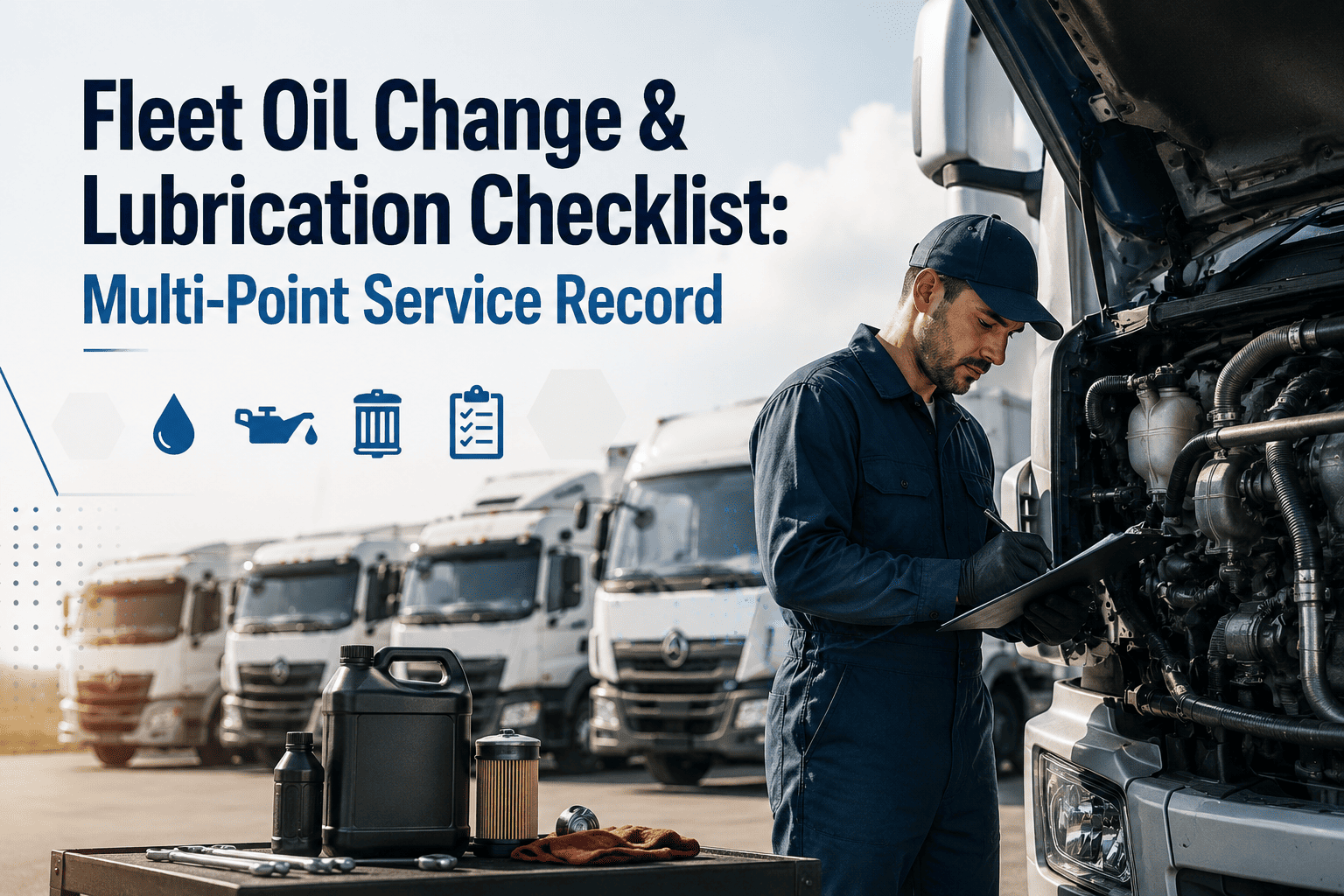
Check dipstick — oil colour, viscosity, and level. Change at 5,000 mi or OBD oil-life alert. Never exceed manufacturer interval — engine oil degradation accelerates exponentially past the change point.
Oil filter replacement
Replace at every oil change — never run a new oil charge through a saturated filter. A clogged filter bypasses the filtration element entirely, sending unfiltered oil through the engine.
Air filter condition
Inspect at 15,000 mi. Replace if restriction indicator is red or filter is visibly clogged. A 25% restricted air filter reduces fuel economy by 10% and increases emissions above DOT thresholds.
Fuel filter replacement
Replace at 15,000 mi for diesel; 30,000 for petrol. Clogged filters reduce fuel pressure to injectors — causing hard starts, power loss, and eventual injector damage costing $800–$3,000 per injector.
Spark plugs / glow plugs
Inspect at 30,000 mi. Worn plugs increase fuel consumption by up to 30%, cause misfires that damage catalytic converters, and generate P030X misfire fault codes in OBD data before failure is noticed by drivers.
Drive belts and tensioners
Inspect at 30,000 mi. Check for cracking, fraying, glazing, and tensioner bearing play. Belt failure strands the vehicle and can cause secondary engine damage if the belt drives the water pump or alternator.
OBD Integration tip: PID monitoring of oil temp, MAF sensor readings, and fuel trim values can trigger Oxmaint engine PM work orders automatically — before a fault code fires. See how it works.
2. Transmission System PM Checklist
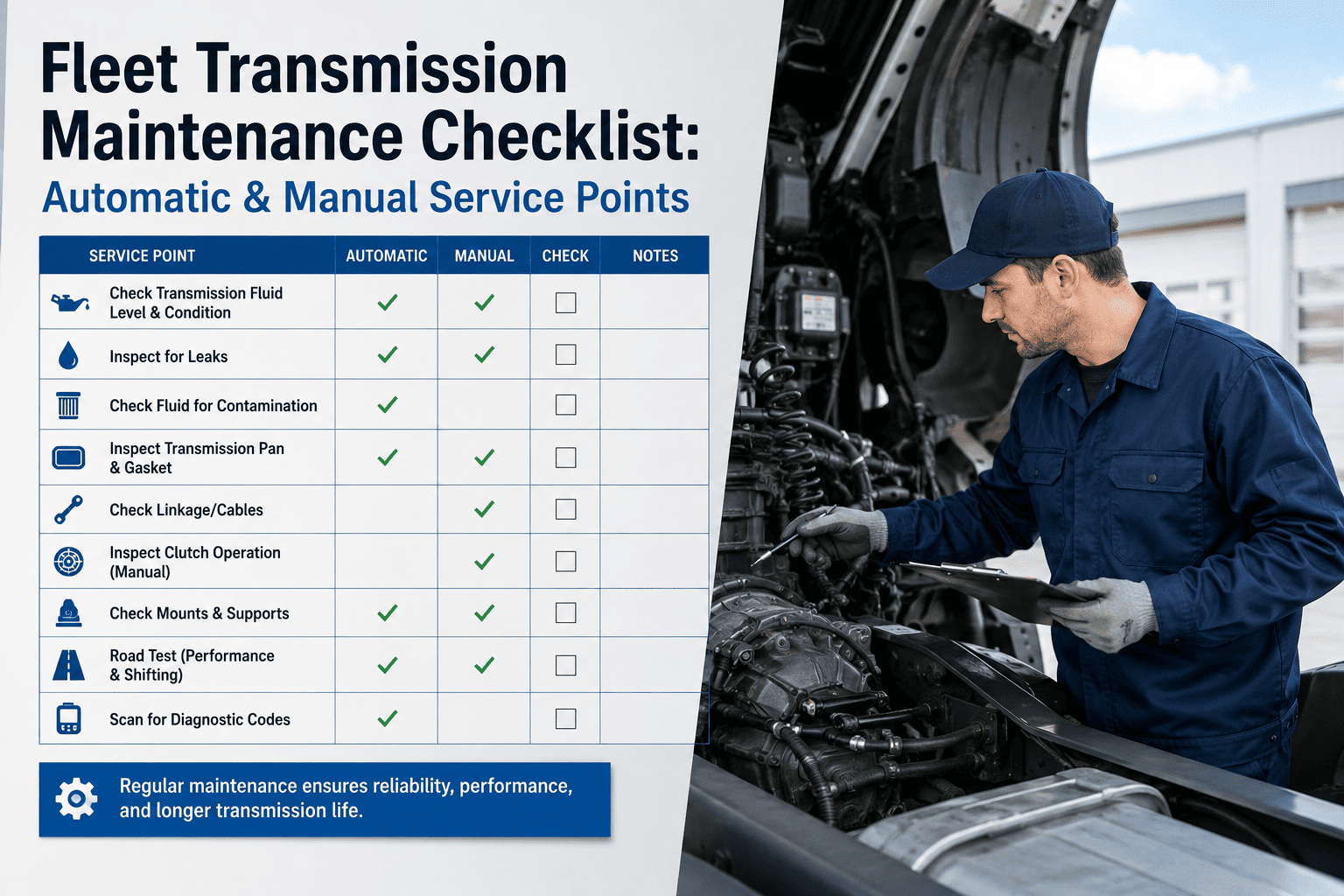
Transmission failures are among the most expensive reactive repairs in any fleet — averaging $3,500–$8,000 for automatics and $6,000–$14,000 for heavy-duty units. Structured PM at the correct intervals prevents the majority of these failures.
Transmission fluid level and colour
Pink/red = good. Brown or burnt smell = immediate change required. Check at 15,000 mi. Milky appearance indicates water contamination — drain immediately and investigate source before damage to clutch packs occurs.
Transmission fluid flush
Full flush at 30,000 mi for automatics or per manufacturer spec. Remove pan, clean screen, replace filter. Contaminated transmission fluid is the primary cause of solenoid failure and shift quality degradation in high-mileage fleet vehicles.
Clutch wear inspection (manual)
Measure clutch engagement point. Slipping, hard engagement, or vibration indicates wear — check at 30,000 mi or on driver complaint. Early clutch intervention costs $600–$900; replacement after full failure averages $2,400+.
Driveshaft and U-joints
Grease U-joint zerks at 15,000 mi. Check for vibration, clicking, or visible wear on cups. A failed U-joint at highway speed can cause catastrophic driveline separation and secondary chassis damage.
Differential fluid
Front and rear differential fluid check at 30,000 mi. Change at 60,000 mi or if water contamination is detected via the magnetic drain plug. Neglected differential fluid causes ring and pinion wear that costs $1,800–$4,500 to repair.
Digital Twin tip: Transmission temp and shift-point data fed into an AI digital twin model can predict clutch pack wear 8–12 weeks before failure — eliminating the unplanned breakdown entirely. Learn how Oxmaint supports predictive PM.
3. Brake System PM Checklist
Brake system PM is the single most safety-critical maintenance task in any fleet. Brake failures are the top cause of commercial vehicle crash fatalities and the most common DOT out-of-service violation. There is no acceptable tolerance for deferred brake PM. Track brake PM records and inspection history with Oxmaint.
Brake pad / shoe thickness measurement
Measure at 15,000 mi. Replace below 3mm (disc) or 2mm (drum). Never estimate brake pad thickness visually — measure with a gauge. Worn pads that fail during DOT inspection generate out-of-service orders and halt vehicle operations immediately.
Rotor / drum thickness and scoring
Measure rotor thickness and inspect for heat cracks, deep scoring, or warping. A rotor below minimum thickness specification is an immediate replacement requirement — machining a rotor below spec creates a brake fade risk under hard braking.
Brake fluid level and moisture content
Check level weekly. Test moisture content at 30,000 mi — fluid above 3% moisture must be flushed. Moisture-saturated brake fluid lowers boiling point by up to 50°F, increasing brake fade risk on long descents with loaded vehicles.
Brake caliper slide and piston condition
Check for seized caliper slides causing uneven pad wear. Inspect piston dust boots for cracking and corrosion. A seized caliper drags the pad against the rotor continuously — destroying the pad in 2,000–4,000 mi and generating heat that warps the rotor.
Brake lines, hoses, and ABS system
Inspect for corrosion on steel lines, swelling on rubber hoses, and bulging at connection points. Confirm ABS warning light extinguishes after ignition-on self-test. Any ABS fault code stored in OBD data requires immediate investigation and corrective action before next dispatch.
AI Camera Vision tip: Drive-through tyre and brake pad wear cameras at depot entry flag brake wear without lifting the vehicle — saving 40+ minutes per inspection cycle and catching wear trends across the full fleet automatically.
4. Steering and Suspension PM Checklist
Steering and suspension failures account for 22% of vehicle handling-related crashes in commercial fleets. Worn suspension components also accelerate tyre wear by up to 40%, generating compounding costs that far exceed the PM investment required to prevent them.
Power steering fluid level and condition
Check reservoir level monthly. Dark or contaminated fluid indicates oxidation — flush and refill at 30,000 mi. Metal particles visible on the magnetic dipstick indicate pump wear — inspect pump before component failure.
Steering rack / box for leaks and play
Check for fluid leaks at boots and seals. Any free play exceeding 1/8" at the steering wheel requires adjustment or replacement. Excessive play delays vehicle response in emergency manoeuvres — unacceptable in any commercial vehicle.
Tie rod ends and ball joints
Check for looseness, boot damage, and grease nipple condition. Worn tie rods cause tyre feathering wear and imprecise steering — missed during PM, they progress to a sudden separation failure that causes loss of directional control.
Shock absorbers, struts, and springs
Bounce test each corner — more than 1.5 oscillations indicates a worn damper. Leaking shocks need immediate replacement. Check leaf springs for cracks and coil springs for sag. Heavy-duty trucks should inspect at every 15,000 mi under maximum load conditions.
Wheel alignment check
Check at 15,000 mi or after any kerb or pothole impact. Misalignment costs up to $1,200/year per vehicle in premature tyre wear — the alignment check pays for itself on the first set of tyres it prevents from wearing out prematurely.
5. Electrical System PM Checklist
Electrical failures cause 32% of roadside breakdowns in commercial fleets — more than any other single system. Most are preventable with structured battery testing, charging system monitoring, and OBD fault code management at regular PM intervals.
Battery load test and terminal inspection
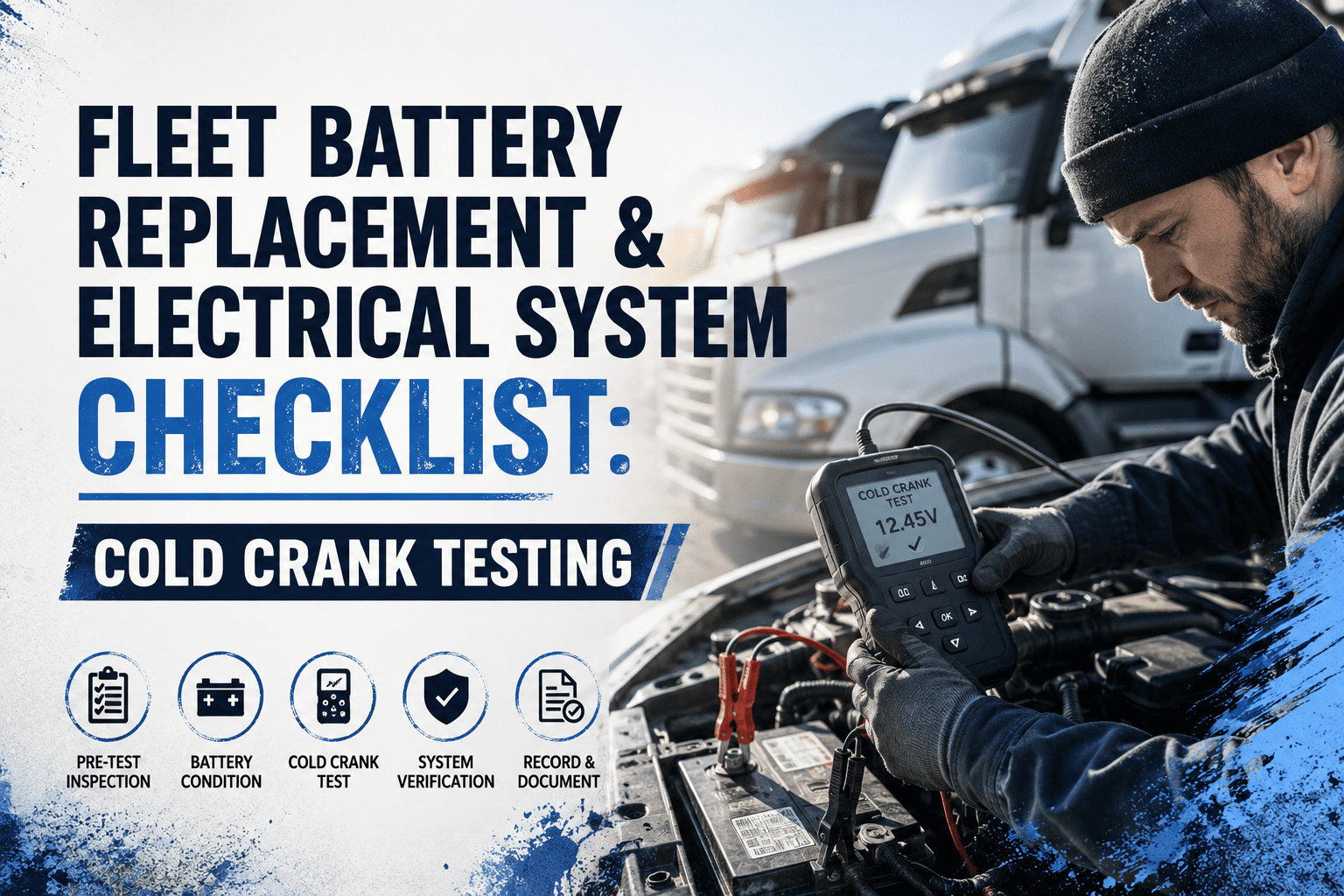
Load test battery at 15,000 mi or annually. Check terminals for corrosion and tight connection. Cold cranking amps below 80% of rated capacity signal an imminent failure — replace before it strands the vehicle rather than after.
Alternator output and charging voltage
Measure charging voltage at idle — should be 13.5–14.8V. Voltage outside this range requires immediate alternator inspection. An undercharging alternator drains the battery gradually; an overcharging alternator destroys batteries and can damage ECU components.
All lights, indicators, and hazards
Full lamp circuit check — headlights, taillights, brake lights, reverse, and indicators. FMCSA Part 393 requires all lighting systems to be functional. A single inoperable brake light is a DOT out-of-service violation that grounds the vehicle immediately on inspection.
OBD fault code scan — all modules
Scan all electronic modules — not just the engine — including transmission, ABS, SRS, and body control modules. Document and action every stored DTC before dispatch. Fault codes stored in non-engine modules are frequently missed when only engine codes are checked.
Wiring harness and ground strap inspection
Inspect for chafing, heat damage from exhaust proximity, and loose ground straps. A single failed ground strap creates intermittent faults across multiple systems simultaneously — one of the most time-consuming diagnostic problems in fleet maintenance.
OBD + CMMS Integration: Auto-push DTC codes from your OBD adapter directly into Oxmaint work orders — eliminate manual transcription errors and reduce DTC-to-workshop time by up to 60%. Book a demo to see the integration.
6. Tyre System PM Checklist
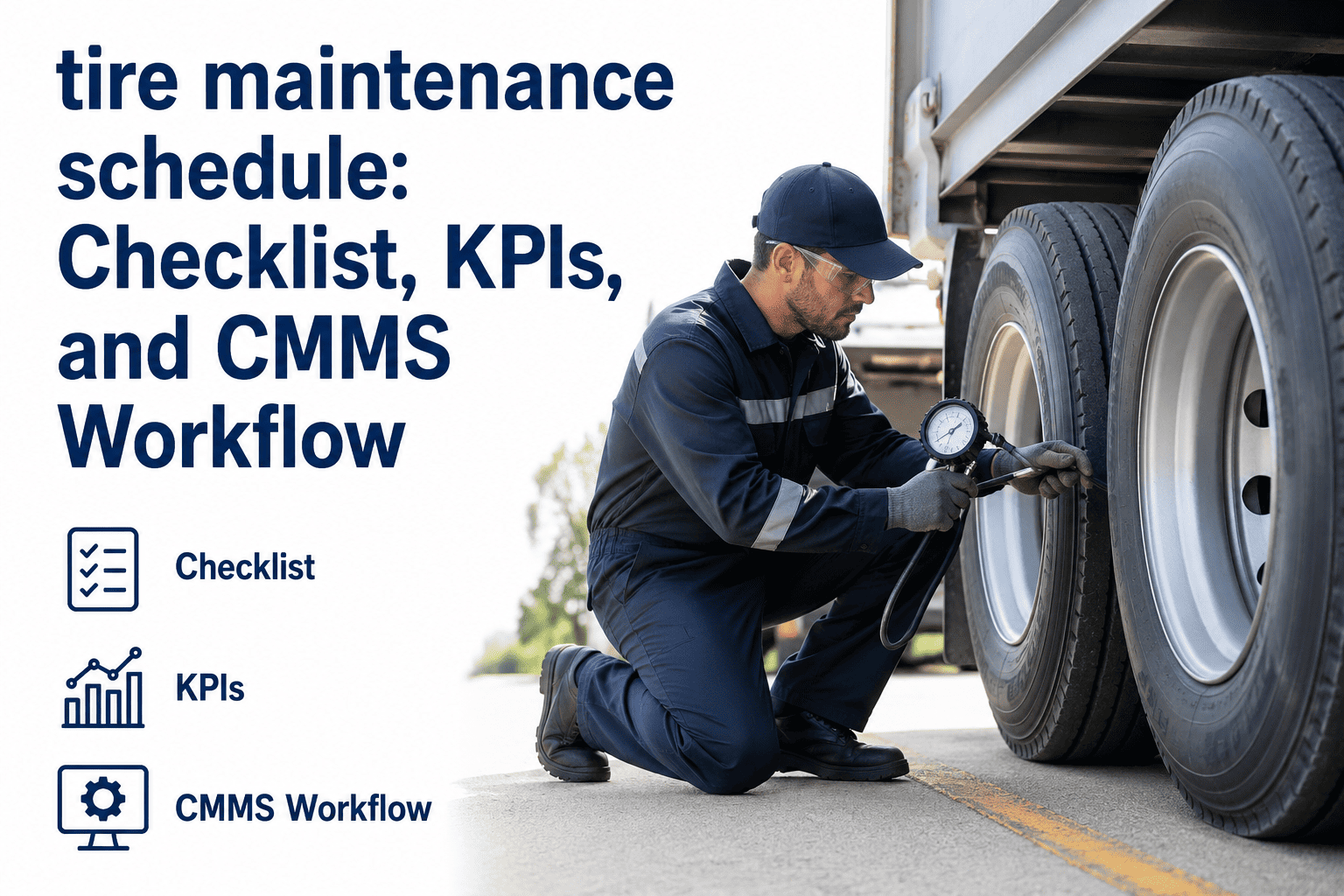
Tyre failures are the most common cause of commercial vehicle breakdowns and one of the leading causes of fatal truck crashes. Structured tyre PM — pressure, tread depth, rotation, and balance at the correct intervals — eliminates the majority of tyre-related incidents entirely.
Tyre pressure — all positions including spare
Check cold inflation pressure daily. TPMS alerts confirm low pressure but do not replace physical checks — TPMS sensors fail silently and can read normal while the tyre is dangerously underinflated. A tyre running at 20% under-inflation generates 30°F more heat and reduces tread life by 25%.
Tread depth measurement — all positions
Minimum legal limit is 2/32". Fleet standard should be a 4/32" trigger for replacement — tyres between 2/32" and 4/32" have significantly degraded wet stopping performance. Measure with a gauge, not a visual estimate. Log tread depth at each PM to identify wear rate acceleration that indicates alignment or inflation problems.
Tyre rotation at every 5,000 mi oil change
Cross-rotate non-directional tyres at every oil change service. Consistent rotation extends tyre life by 20–25%, generating direct cost savings that typically offset the labour cost of rotation within the first rotation cycle.
Sidewall condition and bulge inspection
Any sidewall bulge is an immediate removal requirement — a bulged sidewall indicates internal structure failure and can blow out without warning at highway speed. Check for cuts, embedded objects, and weather cracking on stored or low-utilization fleet vehicles.
Wheel balance and nut torque
Balance at every tyre rotation. Check wheel nut torque with a calibrated torque wrench at 100 mi after any wheel removal. Loose wheel nuts create vibration that generates fatigue cracks in the wheel studs — a failure that results in wheel separation at speed.
7. Cooling System PM Checklist
Coolant level and freeze point test
Check expansion tank level weekly. Test freeze protection with a refractometer at 30,000 mi — should protect to at least -35°F for cold-region fleets. Coolant that tests outside specification is an engine at risk regardless of how recently it was serviced.
Coolant flush and pH test
Full system flush at 30,000 mi. Test pH before and after — coolant below pH 7 is acidic and actively corroding aluminium components. Degraded coolant causes water pump impeller erosion, heater core failure, and radiator tube blockage that are far more expensive than the flush that would have prevented them.
Radiator hoses and clamps
Squeeze hoses — soft or spongy texture indicates internal degradation and imminent failure. Check all clamps for tightness and look for dried coolant staining at connection points that indicates slow seepage. A burst hose dumps the entire cooling system in minutes.
Water pump, thermostat, and radiator cap
Check water pump bearing play and weep hole at 30,000 mi. Replace thermostat at 60,000 mi — a failed thermostat causes overcooling in cold climates or overheating in hot ones. Test radiator cap release pressure annually — a cap releasing below spec causes coolant loss at operating temperature.
SAP PM Integration tip: Coolant change work orders auto-scheduled in SAP PM module at 30,000-mile triggers — synced with parts inventory and technician availability through Oxmaint's SAP connector. See the integration.
8. Exhaust System PM Checklist
Exhaust manifold and gaskets
Listen for ticking on cold start — indicates a manifold gasket leak. Carbon deposits at gasket faces confirm active leakage. Act before backpressure increases cause valve float and cylinder head damage in turbocharged diesel engines.
Catalytic converter and DPF condition
Check for rattling substrate — a rattling cat indicates broken substrate that will eventually block exhaust flow and cause engine damage. Monitor DPF regeneration cycle frequency via OBD data — increasing frequency signals excessive soot loading. Forced regen at high soot load before active DPF failure.
Muffler, pipes, hangers, and DEF/AdBlue levels
Check for rust-through, loose hangers, and ground clearance issues. Check DEF/AdBlue level at every PM — running low triggers engine derate mode that limits power to 5 mph in some EPA-compliant engines. Clean EGR valve at 30,000 mi on diesel fleets to prevent carbon buildup causing rough running.
9. HVAC System PM Checklist
Cabin air filter replacement
Replace at 15,000 mi or annually. A clogged cabin filter reduces defrost airflow, increasing driver windshield fogging risk and fatigue on long routes. In humid climates, a saturated cabin filter grows mould that degrades air quality in the driver cab.
A/C refrigerant charge and leak test
Check charge pressure pre-summer. Low refrigerant causes compressor damage due to inadequate lubrication — an A/C compressor replacement costs $800–$1,800. UV dye leak test at 30,000 mi or at first sign of reduced cooling before the system is run low and the compressor is damaged.
Heater core flow, blend door, and compressor belt
Test heat output at maximum setting — slow response indicates coolant flow restriction to the heater core. Check blend door actuator operation. Inspect compressor belt tension and clutch engagement. A seized A/C compressor bearing shreds the belt and disables all accessories on the same drive belt circuit.
10. Body, Cab, and Fluid Systems PM Checklist
Door, cab, and cargo body seals
Inspect door seals for compression set and cracking. Failed cab seals allow moisture intrusion that causes corrosion in electrical connectors, accelerating electrical system failures. Failed cargo body seals increase cargo damage claims from moisture ingress.
Chassis frame and fifth wheel / coupling
Annual visual inspection for frame cracks, corrosion, and bent rails. Grease fifth wheel plate at every 5th service. Inspect coupling jaws, release handle, and locking mechanism before every tractor-trailer connection. A failed fifth wheel coupling at speed is a catastrophic safety event.
Safety equipment — fire extinguisher, warning triangles, first aid
Monthly check of expiry dates, charge indicators, and seal condition. DOT and local authority compliance — non-negotiable on commercial vehicles. A fire extinguisher out of date or uncharged during a cab fire directly contributes to property loss and potential fatalities.
All fluid top-up and condition check
Confirm levels and condition: engine oil, transmission fluid, coolant (pH and freeze point), brake fluid (moisture %), power steering fluid, and windshield washer fluid. Documenting fluid condition at each PM creates the trend data needed to detect early system deterioration before it becomes a breakdown.
We went from 14 roadside breakdowns a month to fewer than 3 after deploying Oxmaint's digital PM checklists across our 180-vehicle fleet. The OBD integration alone saved us two engine replacements in the first quarter — fault codes were sitting there for weeks and nobody caught them until the CMMS started auto-creating work orders from the data.
PM Compliance Impact — Key Fleet Metrics
Fleets with structured digital PM checklists report 60–70% fewer roadside breakdowns vs. paper-based programs within 12 months of deployment.
Every $1 invested in preventive maintenance saves $3–$5 in reactive repair. Engine and transmission failures prevented by PM average $8,000–$22,000 each.
Digital PM checklists with auto-populated intervals and OBD prefill reduce PM documentation time per vehicle service significantly vs. paper-based programs.
Fleets using CMMS-based PM checklists pass DOT roadside inspections at 94%+ vs. 71% for paper-based maintenance programs — a direct compliance and liability advantage.
Frequently Asked Questions
The most common questions from fleet maintenance managers and technicians about PM intervals, OBD integration, and compliance documentation requirements.
Every 5,000 miles for oil and basic checks; every 15,000 for brakes, filters, and suspension; every 30,000 for fluids, belts, and cooling. Heavy-duty trucks and vehicles in severe-duty conditions should use shorter intervals. Cross-reference OEM specifications with OBD oil-life monitoring data — condition-based triggers are more accurate than fixed mileage alone.
Preventive maintenance runs on fixed time or mileage intervals regardless of component condition. Predictive maintenance uses real-time data — OBD diagnostics, vibration sensors, oil analysis — to service components only when condition data indicates it is needed. The best fleet PM programs use fixed intervals as a baseline and layer OBD condition-based triggers on top to catch failures between scheduled services.
OBD data streams engine hours, mileage, fault codes, and sensor values directly into the CMMS — triggering work orders automatically, eliminating manual mileage tracking, and surfacing developing faults before they become breakdowns. Leading fleets report 40–60% fewer roadside breakdowns after OBD-to-CMMS integration, primarily from catching developing faults in DTC data before drivers notice symptoms.
An AI digital twin is a virtual replica of a physical vehicle updated in real time from sensor data. It simulates component wear, models failure probability, and recommends PM actions before physical symptoms appear — giving maintenance teams 4–12 weeks of advance warning on critical component failures. Digital twins are most valuable on high-utilization, high-replacement-cost components like transmissions, engines, and brake systems.
Each checklist item maps to FMCSA Part 396 inspection categories. Digital completion records with technician ID, timestamp, and vehicle ID provide the documented maintenance history required during DOT roadside inspections and post-accident reviews — instantly retrievable, tamper-evident, and court-admissible. FMCSA requires driver vehicle inspection reports and maintenance records to be retained for 14 months minimum.
Yes. Oxmaint integrates bi-directionally with SAP Plant Maintenance — syncing PM work orders, parts consumption, technician labour, and vehicle history between systems. Work orders created in Oxmaint appear in SAP PM; completions sync back automatically without double-entry, eliminating the data reconciliation work that consumes significant maintenance management time in SAP-based enterprises.