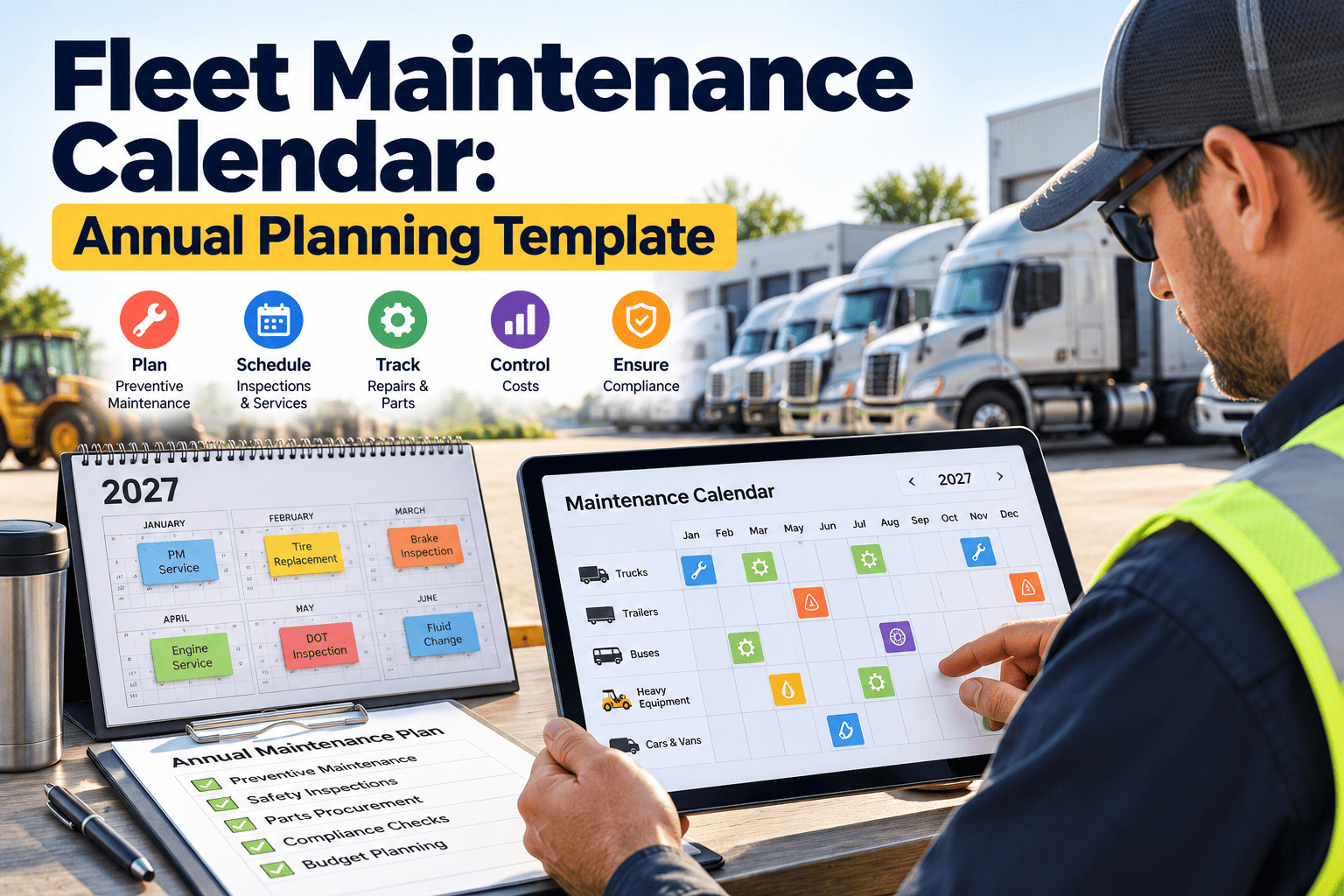
Fleet maintenance rarely fails because nobody knew a service was needed. It fails because twenty services came due in the same week, a parts order was placed too late, or a seasonal check was forgotten until the first cold morning or the first heavy rain. An annual maintenance calendar spreads that work across the year, matches it to shop capacity, and puts seasonal and regulatory dates in front of planners before they become urgent. This page turns the annual plan into a checklist with an owner and a completion test for every task, so you can tick through the year. Use it with a fleet preventive maintenance scheduling system that keeps schedules current as vehicles and usage change.
Fleet maintenance calendar: the annual planning checklist
65 tasks in 10 groups, each with an owner and a completion test. Plan the year once, then tick it off by quarter, month, week and day.
65tasks
10groups
4quarters
3repeat cycles
How to use this checklist
Each task shows an owner and the test that tells you it is truly finished.
1Set up firstFinish Groups A and B before the first working day of the year.
2Assign ownersEach item names a role. Replace it with a real name.
3Tick with proofTick an item only when its Done when test is true.
4Review monthlyUpdate the progress tracker and move or escalate overdue items.
Recurring groupsGroups G, H and I repeat. Create them as recurring work orders so they appear without anyone remembering.
Fixed datesGroup B items do not move. Move other work around them.
Seasonal groupsGroups C to F and J follow your climate. Shift them to match your region.
A. Set up before month 1
8 checks
Do these in the last weeks of the old year. A calendar built on a wrong asset list or wrong meters will be wrong all year.
A1Planner
The asset list matches reality: active, standby and sold units are flagged correctly.Done when: No unit in the schedule has left the fleet, and no active unit is missing.A2Planner
A meter reading from the last 30 days exists for every unit.Done when: Every unit shows a dated, verified reading.A3Maintenance manager
Preventive maintenance intervals are approved for each vehicle class.Done when: The approver has signed off each class.A4Planner
The right meter is chosen for each asset: distance, hours or calendar.Done when: No idle-heavy or stationary asset relies on distance alone.A5Planner
A job plan is attached to each preventive service level.Done when: Each template lists tasks, parts and expected labor.A6Planner
Annual inspection dates are staggered across groups of units.Done when: No month holds more inspections than the shop can complete.A7Shop lead
Shop capacity is set for each month in technician hours.Done when: Leave, training and a reserve for unplanned work are already subtracted.A8Parts lead
Long-lead parts and tire orders are placed.Done when: Orders are confirmed with delivery dates before the months of use.B. Fixed dates and compliance
7 checks
Place these first. They do not move. Requirements vary by country and operation, so confirm what applies to you. US examples refer to 49 CFR Part 396.
B1Compliance lead
A periodic inspection date is set for every unit. In the US, 49 CFR 396.17 requires one at least every 12 months.Done when: Every unit has a date no later than the legal limit, and the report is retained for the required period.B2Compliance lead
Inspector qualification records are current.Done when: Certificates and training records were reviewed this year.B3Compliance lead
Driver vehicle inspection report storage and retrieval work. Three months is the US retention period under 49 CFR 396.11 for covered operations.Done when: A report from about 80 days ago can be found within minutes.B4Compliance lead
Maintenance record retention is checked. 49 CFR 396.3 calls for one year, and six months after a vehicle leaves your control.Done when: Records for a recently sold unit are still available.B5Admin
Registration, permit and certificate renewals are listed with lead time.Done when: Each renewal shows a start-by date, not only an expiry date.B6Shop lead
Calibration dates for gauges, scales and diagnostic tools are listed.Done when: Every tool with a calibration requirement has a due date.B7Parts lead
Warranty expiry and open recall work are listed by unit.Done when: Claims and recall repairs are scheduled before their deadlines.Turn this checklist into a live preventive maintenance schedule
Schedule services by meter or calendar, assign work orders and track completion for every unit in Oxmaint.
C. First quarter: reset and plan
7 checks
Close the old year and make sure the new plan is based on what actually happened.
C1Planner
All last year's work orders are closed or carried forward with a reason.Done when: No work order is open without an owner and a date.C2Maintenance manager
Cost, downtime and repeat failures are reviewed by unit.Done when: A short list of worst-performing units is written down.C3Maintenance manager
Intervals are adjusted from failure history.Done when: Each change has a reason recorded.C4Shop lead
Winter or rainy-season damage is inspected on suspension, undercarriage and body.Done when: Findings are logged as defects with work orders.C5Shop lead
Brakes and alignment are checked on units with uneven tire wear.Done when: Results are recorded on the unit history.C6Planner
Newly purchased vehicles have asset records and schedules.Done when: Each new unit has a first service date.C7Planner
The annual calendar is published to the shop and to operations.Done when: Both teams have confirmed receipt.D. Second quarter: prepare for peak
7 checks
Heat, load and long days hit vehicles hardest. Service what peak season will stress.
D1Shop lead
Cooling systems are serviced, including radiators, belts and hoses.Done when: Coolant condition and hose checks are recorded per unit.D2Shop lead
Air conditioning and refrigeration units are tested before hot weather.Done when: Each unit passes a function test or has a repair order.D3Shop lead
A tire condition and pressure sweep is completed.Done when: Tires below your limits are replaced or scheduled.D4Shop lead
Brake wear is measured on heavy-use units.Done when: Measurements are logged against the unit.D5Maintenance manager
Mid-year preventive maintenance compliance is reviewed.Done when: Overdue services are listed with an owner.D6Planner
Schedules are rebalanced for units whose duty or usage changed.Done when: Projected due dates were recalculated.D7Maintenance manager
Spare vehicle coverage for peak weeks is confirmed.Done when: Spare units are identified for services that take a unit off the road.E. Third quarter: run and sustain
7 checks
Keep pace while demand is high, and prepare for the final season.
E1Shop lead
Fluid analysis samples are taken on high-hour units.Done when: Samples are sent and results linked to the unit.E2Shop lead
Filter changes are completed on the highest-utilization units.Done when: Each change is recorded with a meter reading.E3Shop lead
Wear items are checked, including belts, hoses, bushings and chambers.Done when: Findings create work orders where needed.E4Planner
Overdue inspections are caught up.Done when: The overdue list is empty or has a dated plan.E5Parts lead
Parts stock is audited against the next three months of planned work.Done when: Shortages are ordered.E6Planner
Outside vendors are booked for body, paint and specialty repairs.Done when: Dates are confirmed in writing.E7Planner
Preparation for the next season is planned.Done when: Season checklists are attached to work orders.F. Fourth quarter: prepare for the cold, wet or dark season and close out
7 checks
Match this group to your climate. Move items earlier or later where your seasons differ.
F1Shop lead
Batteries are load tested and terminals cleaned.Done when: Weak batteries are replaced before the season starts.F2Shop lead
Heaters, defrosters, wipers and lighting work.Done when: Each unit passes a function check.F3Shop lead
Fuel systems are serviced and air tanks drained where required.Done when: Service is recorded per unit.F4Shop lead
Tire tread depth is measured.Done when: Units near the limit have replacement orders.F5Compliance lead
Compliance records are reviewed before year end.Done when: A sample of inspection and maintenance records is retrievable.F6Maintenance manager
Cost and downtime reports are finalized.Done when: Reports are signed off by the maintenance manager.F7Maintenance manager
Next year's calendar and budget are drafted.Done when: Drafts are shared with finance and operations.G. Every month
6 checks
A monthly review keeps the plan honest. Without it the calendar drifts.
G1Maintenance manager
Preventive maintenance completion is reviewed.Done when: The percentage completed in its window is written down.G2Planner
Overdue items are assigned or moved with a reason.Done when: No overdue item is left without an owner.G3Planner
A meter reading audit is run.Done when: Units with no recent reading are listed and fixed.G4Shop lead
Capacity for next month is checked against scheduled hours.Done when: Overload is solved by moving flexible work or booking vendors.G5Parts lead
Parts reorder levels are reviewed.Done when: Fast movers have stock for the coming month.G6Planner
New and retired units are updated in the asset list.Done when: Schedules for retired units are closed.H. Every week
5 checks
Weekly checks stop small problems from becoming overdue services.
H1Shop lead
The defect backlog is reviewed.Done when: Each open defect has a priority and an owner.H2Shop lead
Tire pressure is checked on parked units.Done when: Readings are recorded.H3Shop lead
Batteries and lighting are checked on parked units.Done when: Problems create work orders.H4Planner
Next week's schedule is shared with the shop and operations.Done when: Both teams know which units are coming in.H5Parts lead
Parts status is confirmed for next week's jobs.Done when: Any missing part has an order and a date.I. Every day
5 checks
Daily habits feed the whole system with accurate, timely information.
I1Driver
Pre-trip and post-trip inspections are completed and signed.Done when: Each assigned unit has an inspection record for the shift.I2Driver
Defects are reported in the same shift they are found.Done when: No known defect waits for the next day.I3Shop lead
Unsafe vehicles are tagged out of service.Done when: The tag is visible and the status is recorded.I4Driver
The meter reading is entered.Done when: The reading is validated against the last value.I5Shop lead
New defects are reviewed each morning.Done when: Each defect has an owner before the shift starts.J. Seasonal readiness lists
6 checks
Attach each list to a recurring work order and record completion unit by unit.
J1Shop lead
Cold weather: batteries, coolant strength, block heaters, fuel additives and air dryers are checked.Done when: Completion is recorded on every unit before the first freeze.J2Shop lead
Cold weather: heaters, defrosters, wipers, washer fluid and lighting are checked.Done when: Each unit passes a function check.J3Shop lead
Hot weather: radiators, fans, belts, hoses and air conditioning are checked.Done when: Units show no leaks or weak components.J4Shop lead
Hot weather: tire pressure, tread and reefer unit function are checked.Done when: Findings are logged and corrected.J5Shop lead
Wet season: wiper blades, lighting, connectors, wheel-end seals and drainage points are checked.Done when: Corrosion and moisture problems are logged and corrected.J6Planner
Dusty or coastal work: air filters, cooling fins, undercarriage and electrical contacts are checked at a shorter interval.Done when: The shorter interval is set in the schedule.Progress tracker
Print this table or copy it into a spreadsheet. Update it at the monthly review so you can see which groups are slipping.
| Group | Checks | Done | Open | Overdue |
|---|
| A. Set up before month 1 | 8 | | | |
| B. Fixed dates and compliance | 7 | | | |
| C. First quarter: reset and plan | 7 | | | |
| D. Second quarter: prepare for peak | 7 | | | |
| E. Third quarter: run and sustain | 7 | | | |
| F. Fourth quarter: prepare for the cold, wet or dark season and close out | 7 | | | |
| G. Every month | 6 | | | |
| H. Every week | 5 | | | |
| I. Every day | 5 | | | |
| J. Seasonal readiness lists | 6 | | | |
| Total | 65 | | | |
What the numbers mean
On trackGroups for the current period are done, and overdue is zero or has a dated plan.
SlippingOverdue items are growing, or the monthly review was skipped. Rebalance capacity first.
Plan has broken downFixed compliance dates are at risk. Move flexible work, book vendors and escalate today.
Frequently asked questions
How do I use this annual maintenance checklist?
Work through Groups A and B before the year starts, then use the quarter, month, week and day groups as recurring work orders. Update the progress tracker at every monthly review.
Should schedules follow meters or the calendar?
Use both. Meter-based triggers suit wear-driven work, and calendar triggers suit inspections and seasonal tasks. You can book a demo to see both in one schedule.
How do we avoid every inspection falling due at once?
Group units and assign different months, moving dates earlier rather than later. Record the reason for each change so an audit can follow it.
Does the seasonal list fit every region?
No. It is a starting point. Move the tasks to match your cold, hot, wet or dusty seasons, and add the conditions your vehicles face.
Can we run this from a spreadsheet?
Yes, but reminders, meters and completion tracking become hard to maintain. You can get started with a scheduling system that does this automatically.
Plan the year once and keep it on schedule
Automate preventive maintenance triggers, balance shop workload and keep inspection records ready for every vehicle.