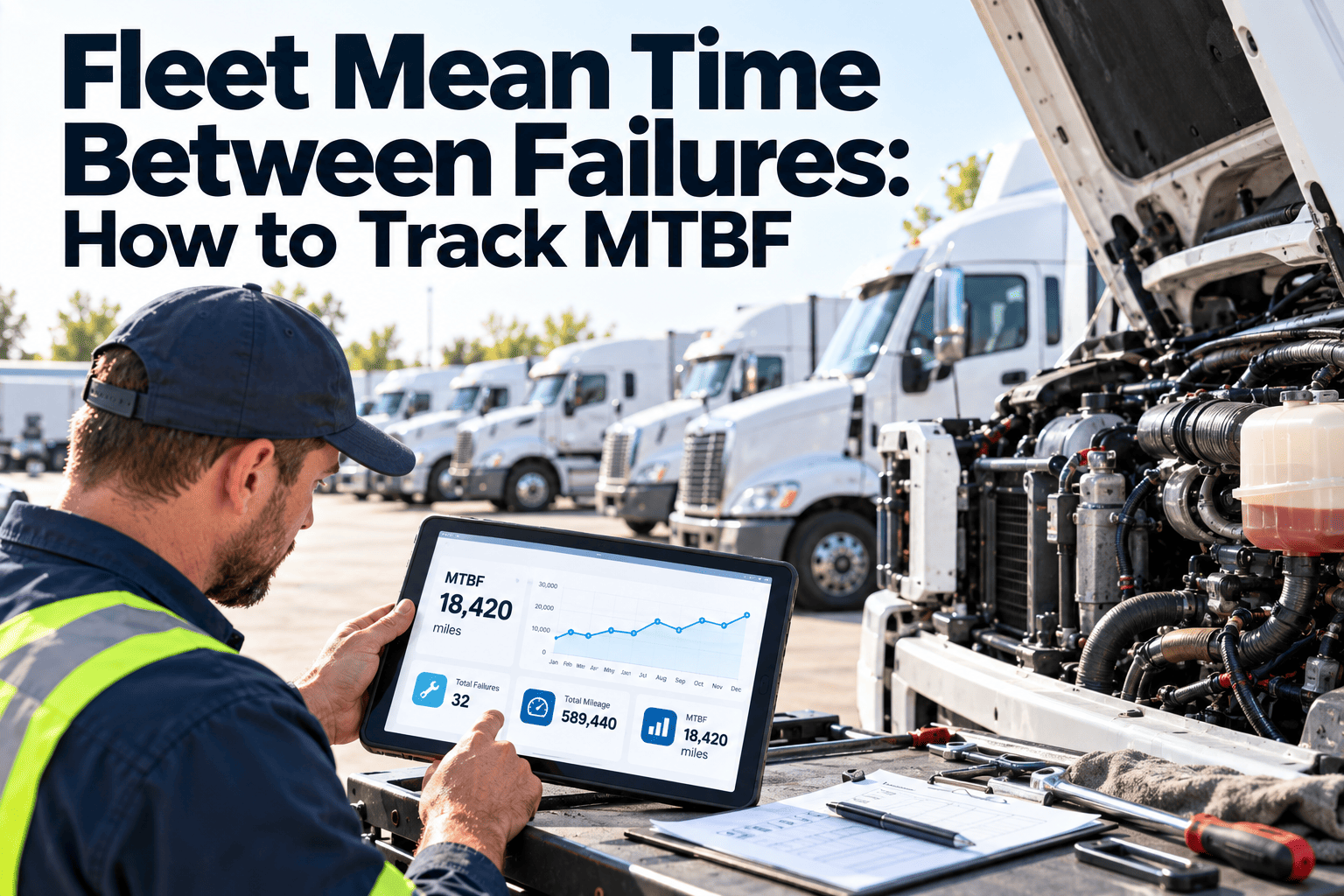
Fleet Mean Time Between Failures, or MTBF, tells you how long a truck, trailer, or component usually runs before a failure takes it out of service. Tracked well, it turns breakdown history into a planning tool for preventive maintenance intervals, parts stocking, and replacement timing. The catch is that MTBF is only as reliable as the failure records behind it, so consistent work orders and asset history matter more than the formula itself. A maintenance-first fleet CMMS keeps that history clean from the very first repair.
Fleet Mean Time Between Failures: How to Track MTBF
Define what counts as a failure, record it the same way every time, and calculate MTBF by unit, class, and system so your fleet can fix the repeat problems that cause downtime.
What MTBF Means for a Fleet
- MTBF is the average operating time between one failure and the next on a repairable asset.
- Fleets usually measure it in miles, engine hours, or operating days, depending on how the asset works.
- A higher MTBF means fewer interruptions, but only when failures are defined consistently.
- Use miles for over-the-road tractors, where distance drives wear.
- Use engine or PTO hours for vocational trucks, generators, and idle-heavy equipment.
- Use days in service for trailers and other assets with no meter.
Why MTBF Matters Beyond the Shop
Failure frequency affects dispatch, cost, safety, and capital planning
Dispatch reliability
Every unplanned failure disrupts a load, a route, or a shift. Falling MTBF often shows up first as missed delivery windows, spare-unit swaps, and frustrated drivers, long before it appears in a monthly report.
Maintenance cost
Frequent failures bring roadside service, towing, expedited parts, and overtime labor. MTBF helps separate normal wear from avoidable repeat cost, so budget conversations rely on evidence instead of anecdotes.
Safety and compliance
Brake, steering, lighting, and tire failures carry safety consequences. A recorded history of defects, repairs, and verification shows that problems were found and corrected in a controlled way.
Capital planning
MTBF by model, engine, and age supports specification and replacement decisions. It shows when keeping an older unit costs more in disruption than the purchase of a newer one.
A Simple Worked Example
Illustrative numbers for a small tractor group
| Item | Value | Note |
|---|---|---|
| Tractors in group | 6 | Same model and duty cycle |
| Combined miles in period | 600,000 | From odometer or telematics |
| Qualifying failures | 8 | Unscheduled repairs that stopped the unit |
| MTBF | 75,000 miles | 600,000 ÷ 8 |
- The number alone is not the insight. Look at which of the 8 failures share a system.
- If four came from the same system, that system becomes the first target for inspection or part changes.
Decide What Counts as a Failure
Write the rule down before you calculate anything
Usually counts
- Road calls and tows caused by a defect
- Unscheduled repairs that remove the unit from service
- Component failures found outside planned service
- Failed roadside or pre-trip findings that stop dispatch
Usually does not count
- Planned preventive maintenance
- Scheduled tire or brake wear replacements
- Accident damage and driver-caused damage
- Cosmetic repairs that do not affect operation
- Gray areas, such as a leak repaired at the next PM, need a clear rule so every shop treats them the same.
- Review the rule yearly. Changing it mid-year breaks trend comparisons.
Systems That Usually Drive Fleet Failures
Tag every repair to a system so patterns become visible
| System | Typical failure signals | Data worth recording |
|---|---|---|
| Brakes and air system | Air leaks, out-of-adjustment brakes, valve faults | Axle position, component, measured values |
| Electrical and lighting | Intermittent lights, charging faults, harness damage | Circuit, connector location, fault code |
| Cooling and engine | Overheating, leaks, belt or hose failures | Engine hours, coolant condition, fault code |
| Aftertreatment | Derates, sensor faults, regeneration problems | Fault codes, duty cycle, regeneration history |
| Tires and wheel-ends | Blowouts, bearing heat, seal leaks | Position, tire brand, tread and pressure |
| Suspension and steering | Worn bushings, broken springs, play in linkage | Axle, side, mileage since last service |
- Keep the system list short enough that technicians can choose quickly at closeout.
- Add a free-text field for detail, but never let it replace the coded cause.
The MTBF Tracking Workflow
Capture the event
Open a work order for every unplanned repair, with the date, meter reading, and reported symptom.
Classify the cause
Tag the system, component, and failure type using a short, fixed list technicians can pick from quickly.
Link to the asset
Attach the repair to the exact unit so history follows the vehicle across drivers, depots, and shops.
Calculate and compare
Divide operating time by failures for each unit, class, and system, then compare against your own baseline.
Act on the pattern
Change inspection items, PM intervals, parts choices, or replacement plans where the data shows repeat failure.
Where MTBF Data Breaks Down
- Repairs described as "fixed it" with no cause
- Meter readings left blank or estimated
- Same fault logged under different names
- Repeat repairs treated as new, unrelated jobs
- Roadside repairs missing from the record
- Required cause and system fields on closeout
- Meter captured at every work order
- Standard failure codes across all shops
- Repeat repairs linked to the prior job
- Vendor invoices entered against the unit
- Most MTBF problems are data-entry problems, not math problems.
- Simple required fields at closeout fix more than complex reporting later.
Start Capturing Failure Data That Can Be Trusted
Set up assets, work orders, and failure codes in one place so MTBF reflects what actually happened on the road and in the shop.
Segment MTBF to Find Real Causes
A fleet-wide average hides the units and systems that need attention
| Cut | What it shows | Typical action |
|---|---|---|
| By unit | Lemons and problem vehicles | Deep inspection or replacement review |
| By model and year | Design or batch weaknesses | Adjust PM and parts stocking |
| By system | Brakes, electrical, cooling, aftertreatment | Add targeted inspection items |
| By route or duty cycle | Stress from terrain, loads, idle time | Match intervals to real use |
| By depot or shop | Repair quality and process gaps | Share methods and training |
| By part brand or supplier | Quality differences | Change spec or raise warranty claims |
- Keep sample sizes in mind. A group with two failures can swing widely from one repair.
- Track trends over several periods before changing policy.
MTBF Next to Other Fleet KPIs
| Metric | Question it answers | How it pairs with MTBF |
|---|---|---|
| MTBF | How often do we fail? | Frequency of unplanned events |
| MTTR | How long does repair take? | Duration of each event |
| Availability | How much time is the unit usable? | Combined result of both |
| PM compliance | Is service done on time? | Low compliance often lowers MTBF |
| Repeat repair rate | Do fixes hold? | Explains short intervals on one system |
| Cost per mile | What does reliability cost? | Links failures to budget |
- A fleet can have a good MTBF and poor availability if each repair waits on parts.
- Reading MTBF with MTTR gives a more honest picture of uptime.
Reading MTBF Without Fooling Yourself
Six cautions before you change a maintenance policy
- New units distort averages. Early-life failures behave differently from mid-life wear, so compare units of similar age.
- Mixed duty cycles mislead. A regional day cab and a long-haul sleeper should not share a baseline.
- Small samples swing. One repair can move MTBF sharply on a group of three trucks.
- Repeat repairs hide root cause. If the same fault returns, count it and link it to the earlier job.
- Seasons matter. Heat, cold, and peak freight can change failure rates in ways unrelated to maintenance quality.
- Window length matters. Use a consistent period, such as rolling twelve months, when comparing results.
- When in doubt, treat MTBF as a prompt for inspection rather than proof of a cause.
Turning MTBF Into Maintenance Decisions
Preventive maintenance intervals
If a component fails well before its scheduled service, shorten the interval or add an inspection step.
Inspection checklists
Add the early warning signs technicians and drivers could have seen before the failure.
Parts and inventory
Stock the parts tied to frequent failures so repair time is not spent waiting.
Warranty and vendors
Documented failure patterns give you evidence when raising claims or reviewing suppliers.
Replacement planning
Falling MTBF with rising repair cost helps justify retiring a unit before it becomes a service risk.
Where MTBF Data Comes From
Combine sources, and know the weak point of each one
| Source | What it provides | Watch out for |
|---|---|---|
| Work orders | Failure date, cause, system, labor, parts | Vague descriptions and missing meters |
| Odometer or telematics | Miles or engine hours per period | Gaps from device outages or unit swaps |
| Driver inspections | Defects found before or during a trip | Defects reported but never linked to repairs |
| Roadside and vendor invoices | Repairs done outside your shop | Invoices not entered against the unit |
| Parts transactions | Which components were replaced | Parts issued to the wrong asset |
- Outside repairs are the most commonly missed failures. Make vendor invoice entry part of closeout.
- Reconcile operating time monthly so a missing meter does not distort several periods.
A Monthly MTBF Review Agenda
Keep the meeting short and tied to decisions
- Review the worst performers. List the units and systems with the lowest MTBF and the most repeat repairs.
- Check data quality. Look for missing meters, uncoded repairs, and outside invoices not yet entered.
- Find the common cause. Ask whether failures share a part, a supplier, a route, or a missed service.
- Assign one action. Examples include a new inspection item, a changed interval, or a parts review.
- Confirm last month's action. Check whether the earlier change moved the trend before adding another.
- One clear action per meeting is easier to measure than a long list of good intentions.
A Hypothetical Example of Acting on the Data
What the data shows
- One tractor model shows repeated air system failures.
- Most occur between scheduled services.
- Repairs are logged as general leaks with no location.
What the team changes
- Adds an air-system inspection point to the PM checklist.
- Requires leak location at work order closeout.
- Reviews the same model again after a full quarter.
- This is an illustration of the process, not a measured result.
Setting Realistic MTBF Goals
- Start from your own baseline for each vehicle class rather than an outside benchmark.
- Set goals for the systems causing the most failures, not for the fleet average alone.
- Review goals after major changes such as new models, new routes, or a revised PM program.
- Pair each goal with an action, such as a checklist change or a part review.
Who Owns Which MTBF Task
- Technicians: record cause, system, and meter reading at closeout.
- Service writers: enter outside repairs and confirm no unit is missing a record.
- Maintenance managers: review trends monthly and approve interval changes.
- Fleet analysts: reconcile operating time and publish the report.
How Oxmaint Supports MTBF Tracking
Maintenance-first records that feed the calculation
- Asset management keeps every tractor, trailer, and component with its full repair history.
- Work orders capture cause, system, meter reading, labor, and parts at closeout.
- Inspections turn driver and technician findings into trackable defects.
- Preventive maintenance scheduling lets you adjust intervals when MTBF shows a pattern.
- Inventory records link parts use to the units and failures they belong to.
- Reporting and dashboards help compare units, classes, and depots over time.
- Mobile workflows let technicians record work at the vehicle, so details are not lost.
- Predictive and condition-based triggers can be added where you already collect reliable meter or sensor data.
- Start with clean corrective work orders. Add advanced analysis once the basics hold.
Inspections, Records, and Compliance
The same records that satisfy auditors also make MTBF possible
| Record | Why it matters | MTBF benefit |
|---|---|---|
| Driver vehicle inspection reports | Documents defects reported before dispatch | Shows failures caught early |
| Repair and maintenance history | Supports audits and warranty review | Provides the failure count |
| Preventive maintenance records | Shows service was completed on time | Links PM gaps to later failures |
| Annual inspection records | Confirms periodic safety review where required | Adds a formal condition checkpoint |
- In the United States, motor carriers generally keep inspection, repair, and maintenance records for each vehicle under FMCSA rules.
- Requirements differ by country, vehicle type, and operation, so confirm what applies to your fleet.
- Storing records against the asset avoids searching paper files during an audit or a claim.
A 30-Day MTBF Starter Plan
Define
- Write the failure definition
- Choose miles, hours, or days
- Build a short failure code list
Clean the base
- Verify asset list and meters
- Make cause and system required
- Train shop staff
Calculate
- Set a baseline by class
- Rank systems by failure count
- Flag repeat repairs
Act
- Adjust one PM interval
- Add one inspection item
- Review results next month
Fleet MTBF FAQs
What is a good MTBF for a fleet?
There is no universal target. Compare against your own baseline by vehicle class, duty cycle, and age, then look for improvement over time.
Should I measure MTBF in miles or hours?
Use the unit that drives wear. Miles suit highway tractors, hours suit idle-heavy equipment, and days work for unmetered trailers.
Does preventive maintenance count as a failure?
No. Count only unplanned events that stop or restrict the unit, and keep that rule consistent.
How many failures do I need for reliable MTBF?
More is better. With few events, treat results as signals, and you can book a demo to see how history is grouped.
Can I track MTBF without a CMMS?
You can in a spreadsheet, but consistency suffers as the fleet grows. You can try Oxmaint to keep records in one system.
Make MTBF a Number Your Team Can Act On
Give your shop a single system for assets, inspections, work orders, and repair history, and let the failure data guide your next maintenance decision.