
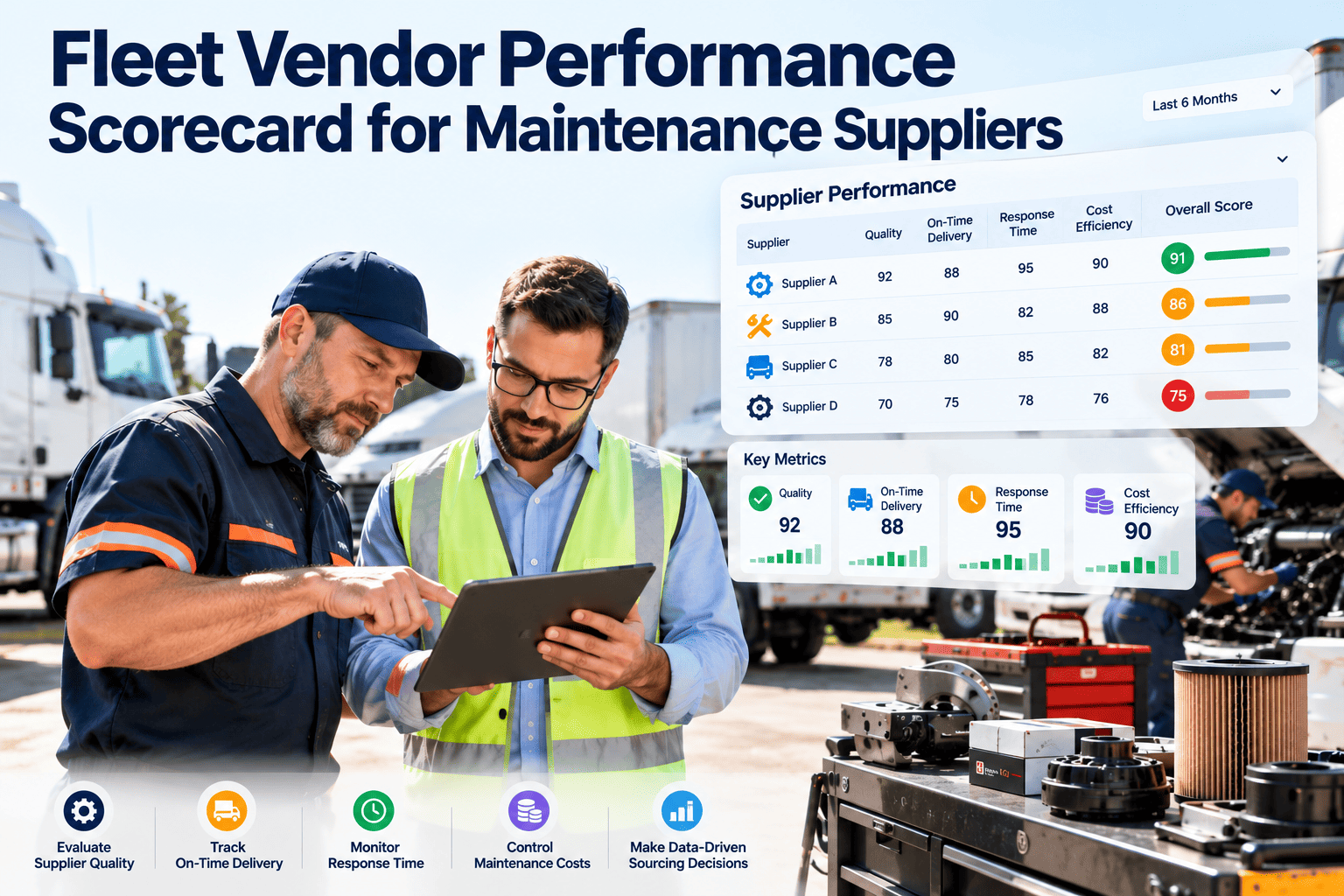
Fleet operations depend on external vendors for parts, service, tires, fuel, telematics, and specialized repairs — and the quality of those vendors directly impacts vehicle uptime, maintenance cost, and compliance. Yet 67% of fleet managers select vendors based primarily on price, without a structured evaluation of quality, lead time, warranty terms, or compliance history. The result is predictable: cheap parts that fail early, slow suppliers that extend vehicle downtime, and vendors who cannot produce the documentation your compliance program requires. A vendor evaluation scorecard transforms procurement from a price-shopping exercise into a strategic selection process that optimizes total value, not just unit cost. This template provides the scoring framework for fleet vendor evaluation — covering pricing, quality, delivery performance, compliance, communication, and warranty terms. Download it to formalize your vendor selection process, or use Oxmaint's vendor management module to track supplier performance continuously from actual work order data — not just RFP promises. The cheapest vendor is rarely the best value. This scorecard proves it with data. Book a demo or start a free trial to see vendor analytics.
Fleet Vendor and Supplier Evaluation Scorecard Template: RFP and Selection
Score fleet vendors on pricing, quality, lead time, compliance, warranty, and communication. Structured evaluation for parts suppliers, service providers, tire vendors, and outsourced maintenance partners.
Choose Vendors Based on Value, Not Just Price
The scorecard template standardizes your vendor evaluation process. Oxmaint tracks vendor performance continuously from actual work order outcomes — parts failure rates, delivery times, and warranty claim success — giving you data that RFP responses never provide.
Scorecard Evaluation Categories
The template evaluates vendors across six weighted categories. Weights are adjustable based on your fleet priorities — a fleet with critical uptime requirements may weight delivery speed higher than one with flexible scheduling.
Unit pricing, volume discounts, price stability guarantees, payment terms, hidden fees, and total cost of ownership. Evaluates not just quoted price but long-term cost predictability and transparency. Includes core return credit terms for parts vendors.
Part failure rates, rework frequency, quality certifications (ISO, OE-equivalent), brand reputation, and defect rates. The highest-weighted category because quality failures create downstream costs that dwarf purchase price differences.
Standard delivery time, emergency delivery capability, order accuracy rate, backorder frequency, and delivery reliability. A vendor who is 10% cheaper but takes 3 days longer to deliver extends vehicle downtime by 3 days — costing far more than the price difference.
Ability to provide SDS sheets, certificates of compliance, product recalls notifications, and audit-ready documentation. For DOT-regulated fleets, vendor compliance documentation is a regulatory requirement, not a preference.
Warranty terms, warranty claim process, return policy, restocking fees, and defective product replacement speed. A vendor with a 24-month warranty and fast claim processing delivers significantly more value than one with a 12-month warranty and difficult claims.
Account manager responsiveness, technical support availability, order status visibility, issue resolution speed, and willingness to adapt to your processes. Vendor relationships require operational alignment, not just transactional pricing.
Scoring Methodology
Each vendor is scored 1-5 across all criteria within each category. The category score is weighted and combined into a total vendor score out of 100. This standardized methodology ensures fair comparison and defensible selection decisions.
| Score | Rating | Definition |
|---|---|---|
| 5 | Exceptional | Exceeds all requirements, best-in-class performance, proactive value delivery |
| 4 | Strong | Meets all requirements with consistent above-average performance |
| 3 | Acceptable | Meets minimum requirements with satisfactory performance |
| 2 | Below Standard | Inconsistent performance, occasional failures to meet requirements |
| 1 | Unacceptable | Fails to meet requirements, significant quality or service issues |
The scorecard evaluates vendors at selection time. Oxmaint evaluates vendors continuously from actual work order outcomes — tracking parts failure rates by supplier, delivery time accuracy, warranty claim success rates, and total cost per vendor. When a vendor's quality declines or a new supplier outperforms, the data tells you before the problems accumulate.
Frequently Asked Questions
How many vendors should I evaluate for each procurement category?
How often should vendor scorecards be updated?
Should I share the scorecard criteria with vendors?
How do I weight categories for my specific fleet needs?
Stop Choosing Vendors on Price Alone
The cheapest vendor costs you the most when parts fail early, deliveries arrive late, and warranty claims are denied. This scorecard template brings structure to vendor selection. Oxmaint brings continuous performance data that keeps your vendor relationships accountable. Download the scorecard to formalize your next vendor evaluation, or go digital for real-time supplier intelligence.



.png)

