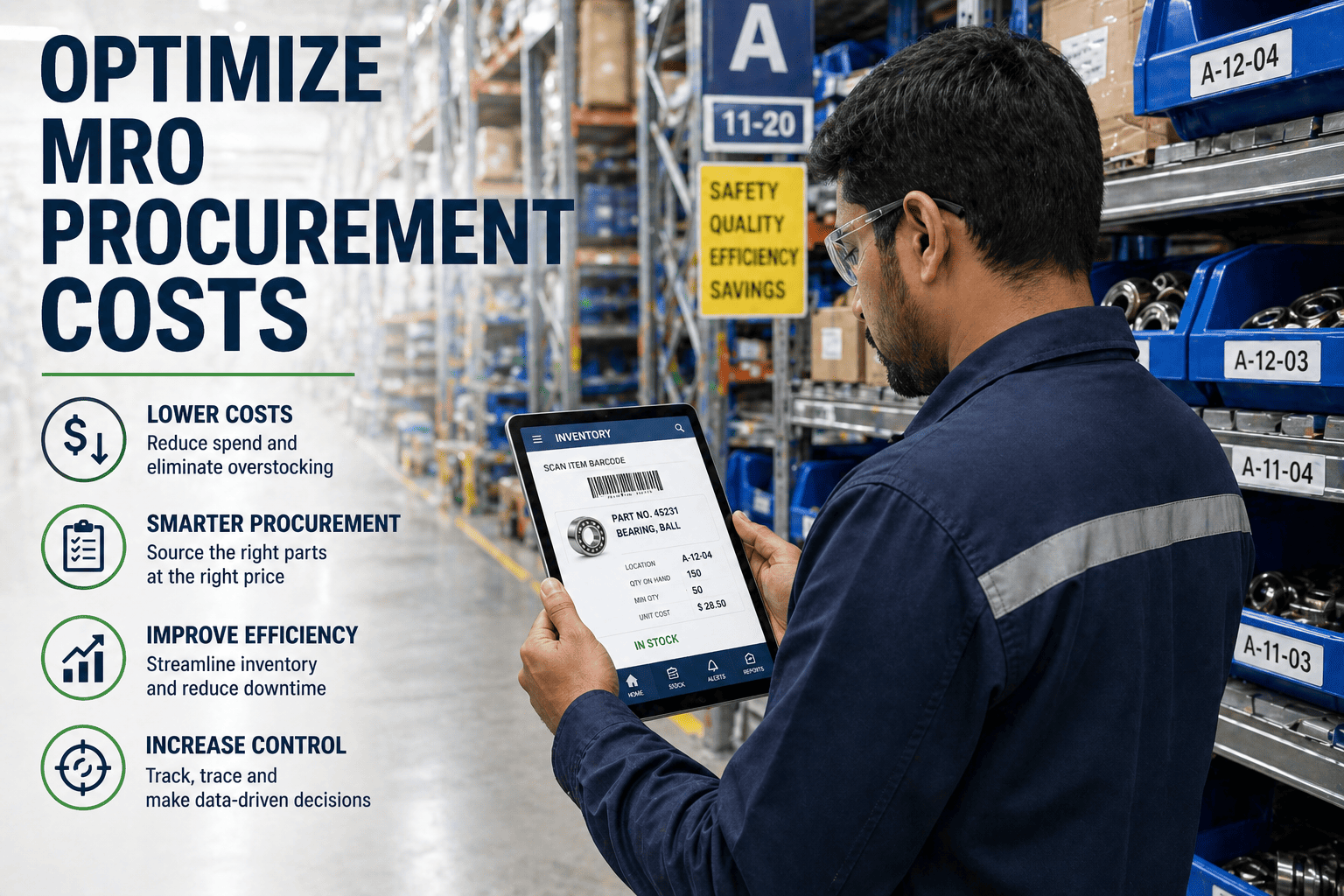
A frozen-foods plant in Pennsylvania bought from 187 MRO suppliers across one fiscal year. Procurement leadership had no idea — there was no consolidated view, no spend analysis, no vendor scorecards, just thousands of one-off purchase orders cut by 14 different requesters across maintenance, sanitation, and operations. When the new VP of Supply Chain finally ran a unified spend report, two findings shocked the leadership team: 41% of parts in the storeroom had not been touched in 24 months, and the same SKU was being purchased from four different vendors at price differentials of up to 38%. The plant was bleeding $1.2M annually in fragmented MRO spend that a structured procurement strategy would have captured automatically. Start a free trial to see how OxMaint exposes hidden MRO spend across every site, vendor, and SKU. APQC benchmarking shows maverick spend averages 7.4% of total procurement, and global studies find 41% of factory parts inventory is never used — both numbers fall fast when CMMS-integrated procurement replaces fragmented purchasing. Book a demo to see the consolidated spend dashboard live.
MRO Procurement Strategy for FMCG — Cut Maintenance Purchasing Costs by 20%
MRO is the most fragmented, least-managed spend category in most FMCG plants. AI-driven CMMS-integrated procurement consolidates vendors, eliminates emergency premiums, right-sizes inventory, and turns purchasing from a cost drain into a structured cost lever — without changing what your technicians do at the bench.
From Reactive Purchasing to a Cost-Reduction Lever
Strategic MRO procurement is the practice of treating Maintenance, Repair, and Operations spend as a single managed category — with consolidated vendor relationships, standardised parts catalogues, consumption-driven reordering, and structured contracts replacing one-off emergency purchases. In FMCG plants, MRO covers spare parts, consumables, lubricants, PPE, sanitation supplies, and contracted services — typically 3-7% of operating cost and one of the highest-leverage cost-reduction opportunities available. Done correctly, strategic MRO unlocks 15-25% reduction in total purchasing cost without changing what your maintenance team actually does at the bench. Curious about the spend patterns in your own plant? Start a free trial and OxMaint will surface your hidden vendor concentration and SKU duplication within hours.
The Six Levers That Drive Every Successful MRO Cost Reduction
Every documented FMCG MRO success story uses some combination of these six levers. World-class procurement teams use all six in sequence — each lever amplifies the next.
Move from 100-150+ MRO suppliers to 25-40 strategic partners. Volume-based pricing unlocks 8-12% reductions on identical SKUs while administrative overhead per vendor drops sharply.
Eliminate duplicate parts where multiple variants serve the same function. Standardisation simplifies inventory, increases volume per SKU, and unlocks better contract pricing.
Min/max levels recalibrated against actual usage from work order data. Stockouts disappear, dead stock liquidates, and emergency purchase premiums of 35-60% are eliminated.
Strategic suppliers manage stock at point-of-use for high-velocity items. Inventory drops 20-30%, working capital is freed, and stockouts on managed SKUs essentially disappear.
Annual blanket agreements lock in pricing below spot rates. Contracted SKUs see 6-10% lower per-unit cost — and procurement processing time per order drops 70%+.
Unified dashboard exposes off-contract purchases, rogue requesters, and price variance. Maverick spend drops from 7.4% benchmark to under 2% within 6 months.
Where MRO Money Leaks in FMCG Plants
Most FMCG plants do not have a procurement problem — they have a visibility problem. The four leaks below explain why "we negotiated good prices" and "the budget looks fine" coexist with millions of dollars of recoverable cost.
Average mid-size FMCG plant uses 100-150+ MRO suppliers — none of whom see enough volume to give meaningful concessions. Procurement loses leverage; vendors win.
When stockouts force emergency orders, plants pay 35-60% above contract pricing. A reactive maintenance culture turns this into a permanent line item disguised as "freight cost".
41% of factory inventory globally is parts that will never be used — bought reactively, kept "just in case", and never written off. Working capital tied up; storeroom space consumed.
7.4% of MRO spend bypasses procurement entirely — credit cards, petty cash, ad-hoc PR/PO outside the system. No leverage, no compliance, no visibility, no audit trail.
Every Vendor, Every SKU, Every Purchase Order — Visible in One Place.
OxMaint connects work order parts consumption, inventory ledgers, vendor scorecards, and purchase order workflows into a single MRO procurement engine — so consolidation, contract leverage, and dead stock cleanup happen as part of normal operations, not as a once-a-year project.
How OxMaint Runs Strategic MRO Procurement End-to-End
OxMaint connects every part consumed at the work order level to every purchase order, vendor relationship, and inventory ledger entry — making MRO procurement a managed loop instead of a fragmented chain.
Every work order that uses a part automatically debits the inventory ledger in real time. Procurement sees live consumption velocity per SKU — no end-of-month reconciliation, no surprise stockouts.
When inventory hits min threshold, the system creates a digital PR routed through configurable approval workflows — pre-populated with preferred vendor, contract pricing, and expected delivery date.
Fill rates, on-time delivery, defect rates, and price variance flow automatically from receiving records into vendor performance scorecards. Negotiations are armed with data, not anecdote.
Cross-vendor SKU duplication, off-contract maverick purchases, and volume concentration opportunities are surfaced automatically — turning a spend report into a 30-day consolidation roadmap.
Upcoming PM schedules show exactly which parts will be needed and when — enabling pre-staging instead of reactive ordering, and giving vendors visibility for better fill performance.
Portfolio-wide rollup combines MRO demand across plants for category-level negotiation. The aggregated volume unlocks pricing tiers no single plant could reach independently. Book a demo to see the multi-site procurement console.
Fragmented Procurement vs. Strategic OxMaint Procurement
The contrast below maps the operating reality of an unmanaged MRO function against a CMMS-integrated procurement model — measured across the metrics that matter to maintenance, finance, and operations leadership.
What Strategic MRO Procurement Delivers in Year One
Outcomes from FMCG plants implementing OxMaint-integrated MRO procurement — measured 12 months from go-live against pre-implementation baselines.
Frequently Asked Questions
How does OxMaint deliver 20% MRO cost reduction without compromising part quality?
Can OxMaint integrate with our existing ERP procurement modules?
How quickly do we see measurable savings after implementation?
Do technicians need to change their part-request workflow?
Every Unmanaged Purchase Order Is Money Left on the Table.
OxMaint connects work order consumption, inventory levels, vendor scorecards, and purchase orders into a strategic MRO procurement engine — exposing dead stock, eliminating emergency premiums, consolidating vendor leverage, and delivering 20%+ MRO cost reduction within 14 weeks.