Confectionery Brand Reduces Quality Rejects by 38% with AI-Powered Inspection
By Jason Manga on March 24, 2026
A UK confectionery manufacturer producing premium chocolate and sugar-coated products was running first-pass yield at 94% across its three moulding and enrobing lines — acceptable on paper, but costing $2.1M annually in rework, scrap, and customer complaints. Visual defect inspection was manual, fatigue-sensitive, and inconsistent between shifts. OxMaint's AI Vision Inspection Integration was deployed across all three lines. Ten months later: first-pass yield at 98.7%, quality reject rate down 38%, and customer complaints down 61%.
Case Study · AI & Vision · United Kingdom
Confectionery Brand Reduces Quality Rejects by 38% with AI-Powered Inspection
How a UK premium confectionery manufacturer replaced inconsistent manual visual inspection with OxMaint AI vision integration — cutting reject rates, recovering first-pass yield, and eliminating customer complaints in under 10 months.
IndustryConfectionery — premium chocolate moulding, enrobing, and sugar-coated products
LocationWest Midlands, United Kingdom
FacilitySingle production facility, 180,000 sq ft, BRC Grade A certified
Lines3 production lines — 2 chocolate moulding lines and 1 enrobing line
Production28 million units annually across 60+ SKUs in premium and retail gift categories
Workforce340 employees · 14 QA staff · 3 production shifts per day
The Challenge: Manual Inspection at Scale Was Failing
Premium confectionery is an unforgiving category for visual defects. A cracked chocolate shell, a cosmetic sugar coat with a colour streak, or an enrobed product with an exposed centre is not a rework opportunity in a retail gift context — it is a return, a complaint, and a brand event. The manufacturer's quality team knew this. They also knew their manual inspection process was inconsistent in ways that were difficult to quantify but impossible to ignore.
6%
First-pass reject rate — 3× the category benchmark for comparable confectionery lines
Manual visual inspection at line speed was identifying some defects and missing others. The 6% first-pass reject rate masked a wider problem: an unknown proportion of defective units were passing inspection and reaching customers.
$2.1M
Annual rework, downgrade, and scrap cost — all attributable to quality failures caught too late
$1.2M in direct rework and scrap material, $620K in downgrade (premium product sold at standard price), and $280K in customer complaint processing, returns, and retailer penalties. All traceable to visual defect categories that AI vision systems detect reliably.
Shift
Variability — inspection outcomes differed significantly by shift and by inspector
End-of-shift data consistently showed higher pass rates in the last two hours of each shift than in the first two — a clear fatigue signature. Night shift reject rates were 22% lower than day shift, not because night shift product was better, but because the detection threshold was lower.
61%
Customer complaints attributable to visual defects — the only defect category reaching consumers
Micro-cracks in chocolate shells, colour variation in sugar coatings, and surface bloom from temperature excursions were all passing manual inspection and reaching retail. 61% of the year's customer complaints described defects that should have been detected at line inspection.
"
We had experienced, motivated QA staff working hard to catch defects. The problem wasn't effort — it was that the human visual system cannot maintain consistent sensitivity at 400 units per minute for an eight-hour shift. We were asking people to do something they were physically incapable of doing consistently. AI vision doesn't fatigue.
Head of Quality, Premium Confectionery Manufacturer — West Midlands, UK
Why OxMaint AI Vision: The Selection Decision
The quality team evaluated three AI vision platforms over 12 weeks. The evaluation was structured around confectionery-specific performance requirements that standard industrial vision systems consistently fail to meet.
✓
Confectionery-Specific Defect Classification — Not Generic Industrial Vision
Chocolate confectionery defects — shell cracks, bloom, enrobing voids, sugar coat colour deviation, and mould fill irregularities — require model training on confectionery-specific image libraries, not generalised industrial object detection. OxMaint's AI vision module arrived pre-trained on confectionery product classes and was configurable to the manufacturer's specific product and defect taxonomy within the pilot period. Two competing platforms required 6+ months of custom training before they reached useful sensitivity on confectionery-specific defect classes.
✓
Integration with OxMaint PM and Quality Records — Closed-Loop Defect Response
The manufacturer's quality team required that AI vision findings feed directly into OxMaint's corrective action and PM scheduling workflows. When the vision system identifies a repeating defect pattern — enrobing voids at a specific belt position, shell cracks from a specific mould — it must automatically raise a maintenance work order and a quality investigation. No other evaluated platform offered native integration between vision findings and CMMS work order generation without custom API development.
✓
BRC Issue 9 Quality Management System Compatibility
BRC Issue 9 requires documented inspection procedures, acceptance criteria, and defect records with traceability to production batch and shift. OxMaint's vision module records every inspection event — product type, defect class, reject count, timestamp, and operator — and links it to the production batch record automatically. The inspection record satisfies BRC QMS requirements without any additional documentation step.
Deployment was sequenced by product risk — the premium boxed chocolate line first (highest customer visibility, highest complaint cost), then the moulding line, then the enrobing line. Each line required a separate AI model training period and integration commissioning before production release.
Phase 1
Months 1–3
Premium Moulding Line — Highest Customer Risk First
Line 1: 180 units/min, 14 SKUs — the highest-value, highest-complaint line deployed first
01
Camera Installation
4-camera array installed at mould demould station and post-packaging inspection point. Line speed maintained at full production rate during installation — zero downtime for camera fit-out.
02
Model Training
AI model trained on 12,000 labelled images across 8 defect classes: shell cracks, bloom, mould fill voids, surface contamination, weight deviation, shape irregularity, colour deviation, and wrapper seal failure.
03
Shadow Mode Validation
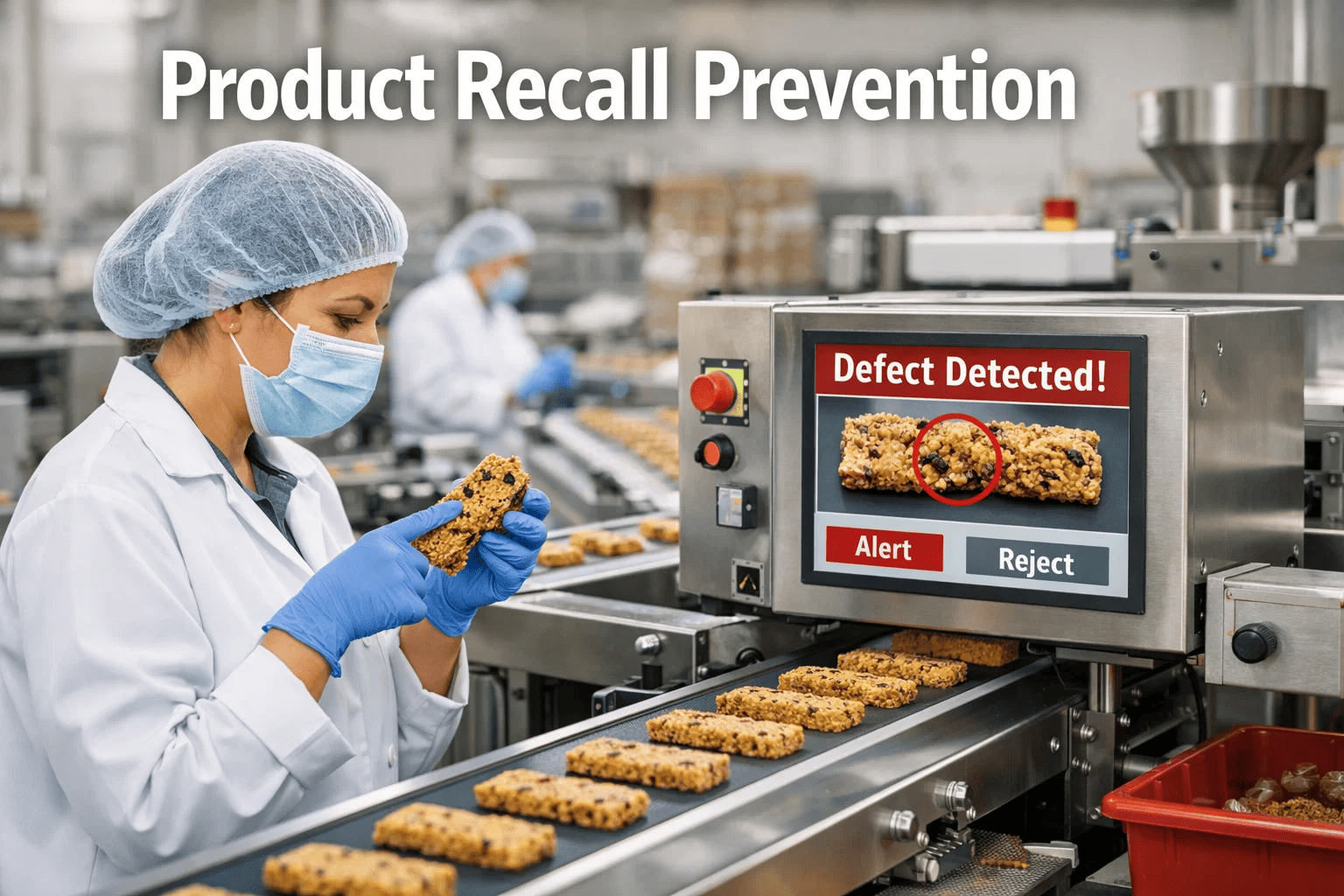
AI vision ran in shadow mode alongside manual inspection for 4 weeks. AI detection rate compared to manual — AI identified 34% more defects per shift. False positive rate calibrated below 0.8%.
04
Live Deployment
AI vision replaced manual line inspection at month 3. Manual QA resource reallocated to end-of-line audit and root cause investigation rather than 100% visual screening.
✓Phase 1 outcome: Reject rate on Line 1 dropped from 6.8% to 1.9% within 6 weeks of live deployment. Customer complaints from Line 1 products fell 71% in the following quarter.
Phase 2
Months 4–7
Second Moulding Line — Closed-Loop PM Integration
Line 2: 220 units/min, 22 SKUs — higher speed, more SKU variability
01
Extended Model Library
Phase 1 model extended with Line 2 product images — 22 additional SKUs with different mould profiles and chocolate formulations required incremental retraining over 3 weeks.
02
PM Integration Activated
OxMaint PM integration configured — when the AI detects mould fill voids at a specific mould position in more than 3 consecutive cycles, it raises a maintenance work order on the temper or mould cleaning schedule automatically.
03
Root Cause Identification
First closed-loop event at month 5: AI flagged 12% void rate at mould position 7 on a specific mould plate. Work order raised. Maintenance found a blocked chocolate feed nozzle. Repair completed. Void rate at that position: zero by next shift.
04
QA Team Redeployment
With two lines on AI inspection, 4 of 14 QA staff redeployed from line inspection to quality engineering roles — root cause analysis, supplier quality management, and new product qualification.
✓Phase 2 outcome: Line 2 reject rate from 5.9% to 1.6%. First closed-loop PM event identified a maintenance root cause that had been producing intermittent void defects for months without attribution.
Phase 3
Months 8–10
Enrobing Line — Continuous Coat Inspection
Line 3: continuous enrobing — different defect profile requiring specific model configuration
01
Enrobing-Specific Model
Separate AI model trained for enrobing defects — tail drips, void coverage, exposed centres, surface crack patterns, and coat thickness variation. Different defect taxonomy from moulding lines required standalone model development.
02
Continuous Inspection
Camera system positioned at enrober exit — AI inspects every unit at belt speed, classifying each against 6 enrobing-specific defect classes with a single reject/pass decision per unit within 200ms of inspection.
03
Full Portfolio Live
At month 10, all three production lines running AI vision inspection. 28 million units per year inspected by AI. Manual QA reduced to audit sampling — 2% of units rather than 100% visual screening.
04
BRC Audit Ready
All AI inspection records integrated into OxMaint quality management records — every reject, defect class, timestamp, and batch number retained and exportable for BRC audit in under 3 minutes.
✓Phase 3 outcome: Enrobing line reject rate from 5.2% to 0.9%. Full portfolio first-pass yield: 94.0% → 98.7%. Total reject reduction across all 3 lines: 38%.
The Results: 10-Month Performance Summary
38%
Top Result
Quality Reject Rate Reduction — All 3 Lines
From 6.0% portfolio reject rate to 1.3% — verified against pre-deployment production data. Consistent across all three shifts, all product types, and all SKUs in the portfolio.
98.7%
Achieved
First-Pass Yield at Month 10
From 94.0% to 98.7% first-pass yield — a 4.7-point improvement that placed the plant above the premium confectionery industry benchmark of 97.5% for comparable production types.
61%
Reduction in Customer Complaints
Customer complaints attributable to visual defects fell 61% in the 12 months following full deployment. Retailer-reported defects fell 74% for the same period.
$780K
Annual Rework and Scrap Cost Avoided
From $2.1M to $1.32M annual rework/scrap — $780K in direct cost avoidance documented against production cost records, before accounting for complaint cost reduction and downgrade elimination.
0%
Shift Variability in Detection
The 22% detection rate gap between day and night shift was eliminated entirely. AI vision produces identical sensitivity across all three shifts — the fatigue variable was removed from the quality system.
7.4×
12-Month ROI
$780K rework avoidance plus $290K complaint cost reduction against a full OxMaint AI vision implementation cost of $146K including cameras, integration, and annual licence — 7.4× return in year one.
"
The 38% reject reduction is the headline number, but the closed-loop PM integration is what changed how we work. Before OxMaint, a mould filling defect would run for a shift before someone connected it to a maintenance issue. Now the AI raises a work order before the shift supervisor has noticed the pattern. We're fixing equipment problems before they become quality events.
Head of Quality, Premium Confectionery Manufacturer — West Midlands, UK
Financial Summary
12-Month Financial Performance — AI Vision Deployment
All figures verified against pre-deployment production cost records and complaint management data
Returns processing, retailer penalties, and investigation cost — 61% reduction on $475K baseline
+$290,000
QA Labour Reallocation Value
4 QA staff redeployed from line screening to quality engineering — estimated productivity gain
+$140,000
Downgrade Revenue Recovery
Premium product sold at standard price due to cosmetic defects — partially recovered as defect rate fell
+$80,000
OxMaint AI Vision Implementation Cost
Camera hardware, AI model training, integration, and annual platform licence — 3 lines
−$146,000
Net 12-Month Financial Return
$1,144,000 · 7.4× ROI
Calculation excludes brand value protection from reduced market defect rate and long-term retailer relationship improvement. Both represent additional Year 2+ value not quantified in this report.
Frequently Asked Questions
OxMaint AI vision detects both dimensional and cosmetic defect classes. For chocolate moulding: shell cracks, bloom, mould fill voids, surface contamination, shape irregularity, colour deviation, and weight band deviation. For enrobing: tail drips, void coverage, exposed centres, surface crack patterns, and coat thickness variation. The model is trained on product-specific image libraries and is configurable to the defect taxonomy relevant to each manufacturer's product range and customer acceptance criteria. Book a demo to discuss AI vision configuration for your confectionery lines.
When the AI vision system detects a repeating defect pattern that is attributable to equipment condition — mould fill voids at a specific mould position, enrobing coat defects at a belt position, or surface defects correlating with temperature data — it automatically raises a maintenance work order in OxMaint's PM system. The work order includes the defect pattern data, the affected product and batch, and the suspected equipment cause. Maintenance is alerted before the pattern becomes a production hold event. This closed-loop integration is unique to OxMaint — no other vision platform offers native CMMS integration without custom API development.
For products that are similar to existing trained product classes (same chocolate type, similar mould profile), model extension takes 2–3 weeks with approximately 500–800 labelled images. For entirely new product types or novel defect categories, standalone model development takes 4–6 weeks. OxMaint pre-trains models on confectionery-specific image libraries before site deployment — the majority of the training effort happens before the cameras are installed, not after.
Yes. Every AI inspection event is recorded in OxMaint with product type, defect class, reject count, timestamp, batch number, and the production parameters at time of inspection. The inspection record satisfies BRC Issue 9 requirements for documented inspection procedures, defined acceptance criteria, and defect records with production batch traceability. The complete inspection history for any batch is exportable in under 3 minutes for any BRC auditor request. Start your free trial to explore AI vision quality management.
In this deployment, 4 of 14 QA staff were redeployed from 100% visual line screening to quality engineering roles — root cause analysis, supplier quality management, and new product qualification. AI vision handles the high-volume, repetitive detection task more reliably than people can. It frees QA professionals for analytical and investigative work that requires human judgment. None of the QA staff in this deployment were made redundant — all were redeployed to higher-value roles that had previously been under-resourced.
AI Vision Inspection — OxMaint
Detect Every Defect. On Every Shift. Without Fatigue.
38%
reject reduction
98.7%
first-pass yield
7.4×
12-month ROI
61%
fewer complaints
✓Confectionery-specific defect models — pre-trained, configurable to your product taxonomy